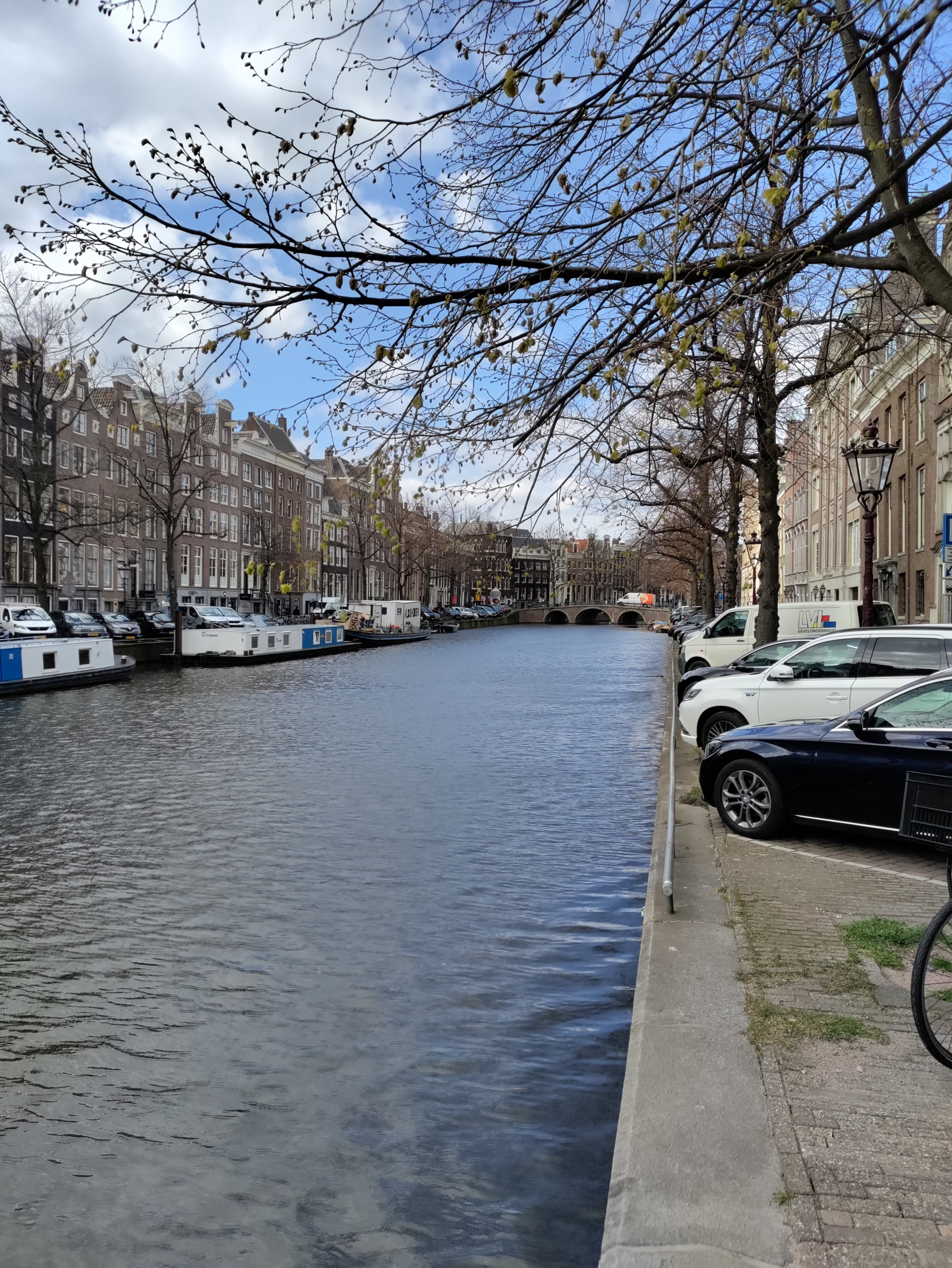
The Emperor’s Canal: Amsterdam’s Broadest Ring, Its Museums of Light and Enlightenment, and the Thirteen Bridges That Cross It
The Keizersgracht is the middle canal of the three great rings, and the widest of them. It is named for Maximilian I, Holy Roman Emperor, whose imperial crown Amsterdam was granted the right to display in 1489 and which still sits atop the Westerkerk tower, a piece of borrowed prestige that the city has never quite let go of.
If the Herengracht was where Amsterdam’s richest citizens lived and the Prinsengracht was where the city worked, the Keizersgracht is where it thought. It carries an unusual concentration of institutions devoted to looking at things: two photography museums, a house museum preserved as a family left it, and the building that Amsterdam built for the Enlightenment itself.
Felix Meritis: The Temple of Enlightenment
The most historically remarkable building on the canal is Felix Meritis, “Happy through Merit”, which opened its doors in 1788.
It was built to a winning competition design by the architect Jacob Otten Husly for a society founded in 1776 devoted to Music, Drawing, Physics, Commerce and Literature. That list of five departments is the Enlightenment in miniature: art and science and trade treated as a single field of enquiry, pursued by citizens rather than courts or universities, in a purpose-built house on a canal.
The building included a concert hall, an observatory and a physics laboratory. It has been called the Temple of Enlightenment, and it remains a symbol of the intellectual freedom and tolerance that Amsterdam has traded on ever since, sometimes accurately. Its later history took in use as the headquarters of the Dutch Communist Party and a spell as a cultural centre, which is its own commentary on how ideas move through a city.
Museum Van Loon: A House Left As It Was
At Keizersgracht 672 stands Museum Van Loon, and it is the closest thing Amsterdam offers to walking into an intact patrician household.
The house was built in 1672 and its first occupant was the painter Ferdinand Bol, Rembrandt’s pupil and one of the most successful portraitists of the age. The Van Loon family, whose fortunes went back to a founding of the Dutch East India Company, lived here from 1884 to 1945, and the house is now presented as they kept it: family portraits, period rooms, a formal garden behind and a coach house at its far end.
The garden matters as much as the interior. The deep plots of the canal ring meant that a canal house was never just a frontage, it ran back a long way, with a garden and often a coach house facing the parallel street behind. Van Loon lets you see the full depth of that arrangement, which most canal houses no longer allow.
Two Museums of Photography
The Keizersgracht has become, improbably, the centre of photography in the Netherlands, with two significant museums a few hundred metres apart.
Huis Marseille, at Keizersgracht 401, occupies two monumental seventeenth-century canal houses dating from 1665. Established in 1999, it was the first museum in the Netherlands devoted exclusively to photography as an art form.
Foam, Fotografiemuseum Amsterdam, opened at Keizersgracht 609 on 13 December 2001, and runs four exhibitions at any one time across documentary, art and fashion photography, deliberately mixing established names with photographers at the start of their careers.
There is a neat logic to photography ending up here. A seventeenth-century canal house is a difficult building to convert into a gallery, narrow, deep, structurally awkward, listed to the rafters, but its rooms are exactly the right scale for looking at prints on a wall.
Het Huis met de Hoofden: Six Heads and Four Centuries of Tenants
At Keizersgracht 123 stands one of the most photographed façades in the city. The Huis met de Hoofden, the House with the Heads, takes its name from six sculpted heads set into its frontage, and was built in 1622 for Nicolaas Sohier, a wealthy stock trader and art collector.
The heads have attracted folklore for centuries, the popular story has a maid decapitating six burglars, but they are conventional classical figures, and the building’s real interest is its extraordinary sequence of afterlives. Restored by the municipality in 1907, it housed the Conservatorium van Amsterdam from 1909 to 1931, then a fur trading business, then the city’s bureau for monuments and archaeology. In 2006 it was sold to the businessman and art collector Joost Ritman, and it now holds the Embassy of the Free Mind, a museum built around Ritman’s library of hermetic and esoteric texts.
Stock trader, music conservatory, fur merchant, council department, library of hermetic philosophy. Few buildings anywhere have been put to such unrelated uses without being demolished in between, and it is a reminder that the canal ring’s survival owes as much to adaptability as to preservation.

The Geelvinck House and the Anatomy of a Canal Plot
The Geelvinck Hinlopen house explains something about the canal ring that a frontage alone never can. It was built for Albert Geelvinck (1647–1693) and Sara Hinlopen (1660–1749), who moved into the double-wide house in 1687.
The address is the point. The house itself faces the Herengracht at 518; its storage ran through the cellar and the attic and out to a warehouse on the Keizersgracht at 633, which is now the museum entrance. A single household occupied a plot running clean through the block from one canal to the next, grand rooms facing the prestigious canal, working storage facing the one behind.
That arrangement is the physical expression of the ring’s hierarchy. The Herengracht got the front door; the Keizersgracht got the goods.
The Homomonument, Partly Over the Water
At the Westermarkt, in the shadow of the Westerkerk, stands the Homomonument, the world’s first major monument commemorating gay men and lesbians persecuted for their sexuality, and specifically those killed under Nazi occupation.
It belongs in an article about this canal because one of its three granite triangles takes the form of a jetty stepping down into the Keizersgracht itself. The monument does not sit beside the water; it enters it. People leave flowers on the step, and on some days they float away down the canal.
It is worth pausing on the geography. Within a hundred metres you have De Keyser’s Westerkerk of 1631, the Anne Frank Huis around the corner on the Prinsengracht, and a monument to people the same occupation murdered. This small patch of Amsterdam carries more of the twentieth century than any museum on the canals.
The Bridges of the Keizersgracht
Thirteen numbered bridges cross the Keizersgracht in our coverage, and as a group they are the most architecturally interesting run on any of the three rings, taking in a Piet Kramer masterpiece, a bridge that collapsed overnight, and one that waited thirty years for a name.
- Bridge 36: De Lucas Jansz. Sinckbrug
- Bridge 37: The crossing that was once Amsterdam’s water gauge
- Bridge 38: The unnamed arch at the most photographed canal junction
- Bridge 41: Johanna Borskibrug
- Bridge 43: Piet Kramer’s Leidsestraat masterpiece
- Bridge 46: The bridge that collapsed in the night
- Bridge 47: The unnamed crossing at the theatre’s edge
- Bridge 48: Marten Toonderbrug
- Bridge 49: Kees Fensbrug
- Bridge 51: Amsterdam’s Lily Bridge
- Bridge 52: The bridge at the foot of the Lily Lock
- Bridge 54: Noordsche Compagniebrug
- Bridge 55: Pastoorsbrug
Bridge 37 belongs to the same vanished system as Bridge 34 on the Herengracht and Bridge 75 on the Prinsengracht: three inner sluices staged along the Utrechtsestraat, built to hold back the Amstel and made obsolete by the Amstelsluizen of 1673.