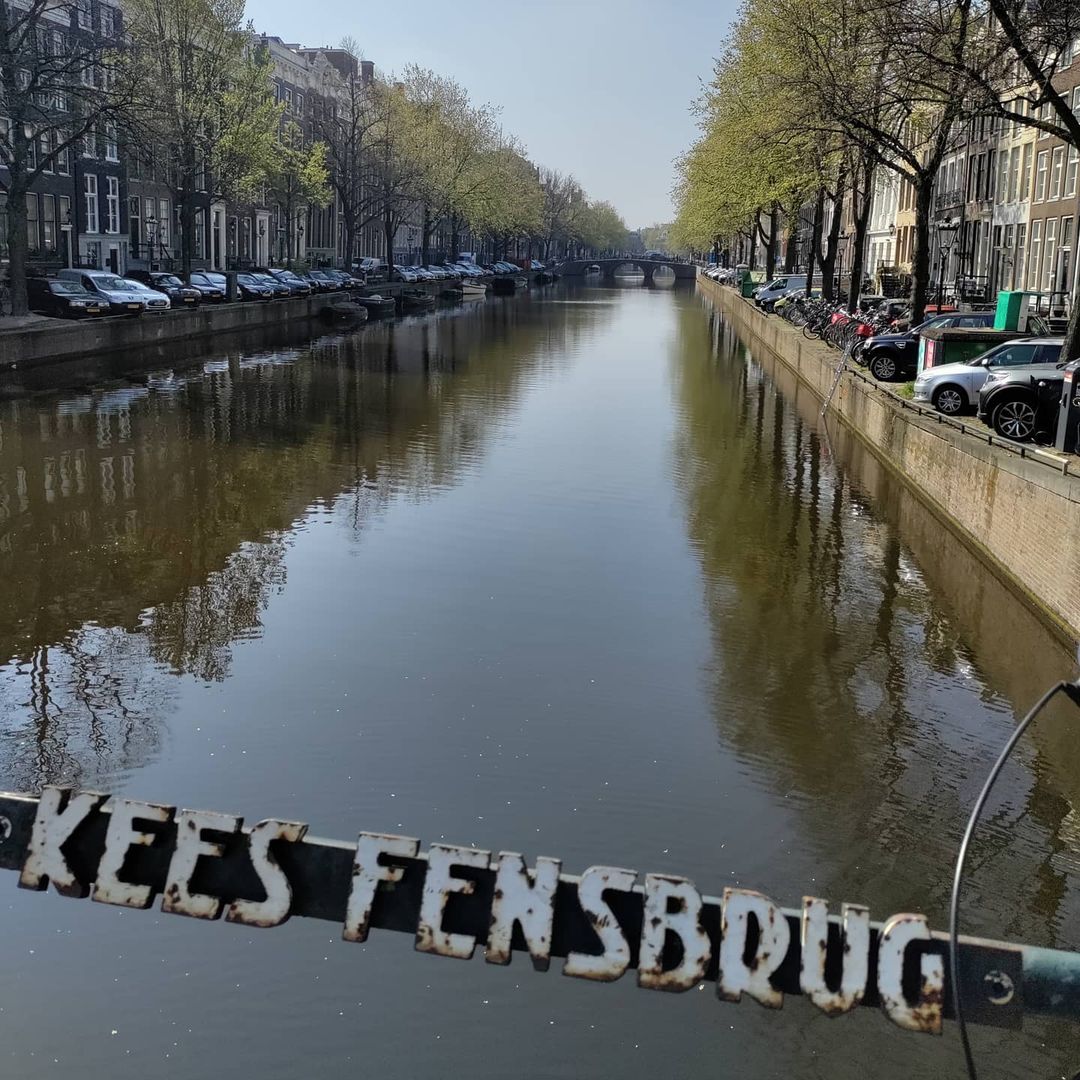
A Fixed Arch Bridge on the Keizersgracht, Connecting the Hartenstraat with the Reestraat, Named on the First Anniversary of Its Namesake’s Death
Most bridge names in Amsterdam are chosen at a distance from the people they honour. A committee meets, a proposal is submitted, a gazette records the decision, and the name is installed on a bridge the person may never have visited. Bridge 49 is different in almost every respect. Brug 49 bij de Keizersgracht, tussen de Reestraat en de Hartenstraat, wordt vernoemd naar schrijver Kees Fens. De feestelijke onthulling van de Kees Fensbrug door burgemeester Job Cohen is op zondag 14 juni 2009 om 15.30 uur. Op zijn eerste sterfdag krijgt Kees Fens een eigen brug in hartje Amsterdam, tussen de Harten- en de Reestraat. Dat is geen willekeurige keuze. Fens, een van de meest spraakmakende literatuurhoogleraren en literatuurcritici van de vorige eeuw, woonde er pal naast, aan de Keizersgracht, en keek uit op de brug.
The man who looked out at the bridge. The bridge that looked back at the man. The naming ceremony held on the exact anniversary of his death, with his widow and granddaughter present, his last book in the mayor’s hands. Bridge 49 is perhaps the most personally situated bridge name in this entire series, and the story behind it is one of the most quietly moving.
Brug nummer negenenveertig was officially named in 2009 after literary critic Kees Fens who overlooked the bridge from his home. The bridge connects Hartenstraat and Reestraat and spans Keizersgracht. It like the previous two bridges is in the boutique shopping area of the Nine Streets (Negen Straatjes) in the historic Amsterdam central canal belt.


1. Etymology and Naming: A Literary Critic, a View From His Window, and the Happiness of a Bridge
In 2009 the bridge was named after literary critic Kees Fens, who looked out at the bridge from his home.
The full biography behind that single sentence is one of the richest in the series. Cornelis Waltherus Antonius Kees Fens was born in Amsterdam on 18 October 1929 and died there on 14 June 2008. He was a leading Dutch literary critic, essayist, and man of letters. Fens was emeritus professor of modern Dutch literature at the Radboud University in Nijmegen and wrote about literature in the Volkskrant for almost forty years.
His route to that chair was unconventional. Fens followed his secondary education at the St. Ignatiuscollege in Amsterdam. He then studied Dutch in the evenings. Between 1959 and 1982 he worked as a teacher of Dutch, first at the Triniteitslyceum in Haarlem and from 1964 at the Frederik Muller Academie in Amsterdam. In 1982 he was appointed professor of modern Dutch literature at the Catholic University of Nijmegen.
Without an undergraduate degree, without the standard academic pathway, Fens became one of the most authoritative voices in Dutch literary life through the sheer quality of his weekly criticism in print. Simultaneously he wrote literary criticism, from 1955 for the weekly De Linie, from 1960 to 1968 for the daily De Tijd, and from 1968 until his death in 2008 for the Volkskrant. Together with J.J. Oversteegen and H.U. Jessurun d’Oliveira he founded in 1962 the influential literary journal Merlyn.
The prizes followed. In 1990 he received the P.C. Hooftprijs and in 2004 he received an honorary doctorate from the University of Amsterdam. He was also made a Knight in the Order of the Dutch Lion. In the Netherlands, where he was referred to in Flanders as “de Nederlandse literatuurpaus,” the literary pope, his weekly column in the Volkskrant was appointment reading for several generations of readers.
The Keizersgracht address where Fens spent the final years of his life, directly beside Bridge 49, defined the last chapter of his writing about Amsterdam. After Fens’ death, his collection was dispersed. The University of Amsterdam took the initiative to preserve it virtually. Five students of Dutch literature, in collaboration with the UvA library, systematically catalogued the extensive library in Fens’ house on the Keizersgracht and photographed the bookshelves in their original state.
In 2008 he published the book “Het geluk van de brug” (The Happiness of the Bridge). Het Amsterdam van Kees Fens. The title tells the whole story. A man who looked out at a bridge from his home wrote his final book about the happiness that bridges embodied for him, about the scale of Amsterdam, about what it meant to live in a city made of water and crossings. He died in June 2008, the book in press. On 14 June 2009, exactly one year after his death, the bridge was opened by mayor Job Cohen together with the widow of Kees Fens and a granddaughter. Cohen held Fens’ book in his hands during the ceremony.
2. Structural Evolution: A Century-Old Arch, a Beauty Committee Overruled in 1881, and a Restoration in the 1970s
There has been a bridge at this location for at least a century when the municipality of Amsterdam decides in 1881 that the bridge must be lowered. The arch or bow bridge, also known as a hump bridge (bochelbrug), must be lowered because otherwise traffic cannot get up the bridge or has accidents while descending. A beauty committee is against this, because the historic townscape would suffer damage from it. The municipality pushes through, but the works were postponed to 1885.
The beauty committee’s counter-argument in 1881 uses exactly the same logic as the equivalent counter-advice recorded at Bridge 48 in 1902: that lowering a high arch bridge would destroy a valued urban view. At Bridge 48 the counter-advice was also overruled. The pattern across the Keizersgracht’s Nine Streets crossings is consistent: the engineering and traffic arguments won in the late 19th century, and the aesthetic arguments won in the late 20th century.
The bridge causes no further problems. In the 1970s the municipal council reversed its earlier decision; the bridge was then restored to its original state, with three vaults and navigation openings.
The 1970s restoration follows the same programme documented at Bridges 44, 45, 46, 47, and 48: a plate bridge rebuilt as a three-arch crossing to restore visual continuity with the historic canal setting. Bridge 49 is therefore the northernmost member of a continuous sequence of arch restorations across the Nine Streets Keizersgracht crossings, all of which were plate bridges between approximately the 1880s and the 1970s to 1980s, and all of which are now arches again.
3. Architectural Lineage: A Fixed Arch Bridge, Surrounded by Rijksmonumenten, Part of the Nine Streets Arch Restoration Sequence
The Kees Fensbrug is a fixed arch bridge (vaste welfbrug) in Amsterdam-Centrum. The bridge forms the connection between the Hartenstraat and the Reestraat and spans the Keizersgracht.
No individual architect is confirmed for the current structure in any source consulted for this post. The bridge belongs to the Dienst der Publieke Werken’s 1970s restoration programme, with no named designer. Like Bridges 44 through 48 before it in this series, it is a 20th-century construction in historical arch form, too recent for heritage designation.
The bridge is surrounded by rijksmonumenten. The Keizersgracht at this point, between the Raadhuisstraat and the Leidsegracht, is one of the most intact stretches of the northern canal belt, with protected 17th and 18th-century canal houses on both banks. Bridge 49 sits within that landscape without carrying its own formal protection.
The Reestraat, which the bridge connects on its western side, extends toward the Prinsengracht where it meets the Reesluis (Bridge 64). The Hartenstraat extends east toward the Herengracht, where Bridge 24 (the unnamed crossing at the Hartenstraat/Herengracht junction, discussed earlier in this series) carries the same alignment across the first of the three great concentric canals. Bridge 49 is therefore the middle crossing of the Hartenstraat/Reestraat axis, flanked by Bridge 24 on the Herengracht to the east and Bridge 64 on the Prinsengracht to the west.
4. Urban and Social Context: Between Wolves and Deer, the Westerkerk Tower, and a Book About the Happiness of Small Things
Bridge 49 connects the Hartenstraat (Hearts Street) with the Reestraat (Roe Deer Street). Both streets belong to the leather-working vocabulary of the Nine Streets. The names of the Nine Streets are reminders of many of the types of work that were carried out here in centuries past, especially the processing of skins, including cow, bear, wolf, and roe deer skins. The Reestraat’s name refers specifically to roe deer hides, the softest and most valuable of the tanning district’s raw materials.
Looking west from Bridge 49 along the Reestraat, the tower of the Westerkerk closes the view. It is one of the classic long canal perspectives of the Nine Streets: a straight alley of protected gabled facades with a church tower filling the end of it. Fens, looking out from his Keizersgracht house at the bridge and hearing the Westerkerk’s carillon, was experiencing the compressed urban poetry of Amsterdam at its most characteristic.
The last book he wrote was about exactly this: the happiness of bridges, the scale of Amsterdam, the way the city’s waterways and crossings create an intimacy that the great metropolises of Europe cannot offer. For the monthly journal of the Genootschap Amstelodamum, Fens described his fascination with the numerous bridges that connect the different neighbourhoods of Amsterdam with each other. The book that emerged from those essays, “Het geluk van de brug,” published in 2008, is available from several Dutch booksellers and remains in print.
The Westerkerk, a five-minute walk from Bridge 49, is the church where Fens’ funeral mass was held in the Krijtberg (the Jesuit church on the Singel, not the Westerkerk), but whose tower carillon he would have heard from his Keizersgracht home every day. The Anne Frank House is two minutes’ walk along the Prinsengracht. The Felix Meritis building at Keizersgracht 324, beside Bridge 48, is a few hundred metres to the south.
5. Technical Specifications
Based on confirmed sources, the following can be stated:
- Bridge type: Fixed arch bridge (vaste welfbrug), three navigation openings, 1970s reconstruction in historical form
- Location: Keizersgracht, connecting the Hartenstraat with the Reestraat, Amsterdam-Centrum (Negen Straatjes)
- Canal: Keizersgracht (dug from 1615, widest canal in Amsterdam’s inner city at 28.31 metres; UNESCO World Heritage Canal Belt, listed 2010)
- Cartographic record: Bridge documented at this location for at least a century prior to the 1881 lowering decision; no specific earlier cartographic date confirmed in sources consulted
- 1881: Municipality decided to lower the bridge; a beauty committee objected, citing damage to the historic townscape; municipality overruled the objection; works postponed to 1885
- 1970s: Municipal council reversed the 1881 decision; bridge restored to three-arch form; part of the same coordinated programme as Bridges 44, 45, 46, 47, and 48
- Designer (current structure): Dienst der Publieke Werken; no individual architect confirmed
- Amsterdam School attribution: None; the bridge is a 1970s construction
- Monument status: Not a monument; the bridge is too young for heritage designation; surrounded by rijksmonumenten
- Official name: Kees Fensbrug, named after Cornelis Waltherus Antonius Kees Fens (Amsterdam, 18 October 1929 to Amsterdam, 14 June 2008), Dutch writer, essayist, literary critic, professor, and author of “Het geluk van de brug” (2008)
- Naming ceremony: 14 June 2009, the first anniversary of Kees Fens’ death; opened by mayor Job Cohen together with Fens’ widow Uta Janssens and a granddaughter; Cohen held “Het geluk van de brug” during the ceremony
- Naming basis: Fens lived beside the bridge at the Keizersgracht and looked out at it from his home
- Wikidata: Q28528196
Sources Consulted
- Wikipedia (nl), “Kees Fensbrug”
- Bruggenvanamsterdam.nl, bridge register entry for Brug 49
- Boekendingen.nl, “Kees Fensbrug, feestelijke onthulling 14 juni 2009”
- Wikipedia (en), “Kees Fens”
- Keesfensstichting.nl, “Biografie van Kees Fens”
- Schrijversinfo.nl, “Fens, Kees (bibliografie)”
- Genealogieonline.nl, “Cornelis Waltherus Antonius Kees Fens (1929 to 2008)”
- Leeskost.nl, “Biografie Kees Fens (Wiel Kusters, 2014)”
- Ilibrariana.wordpress.com, “Biografie van Wiel Kusters een monument voor Kees Fens”
- Geboektinharen.com, “Kees Fens, een terugblik”
- Historiek.net, “Het geluk van de brug: het Amsterdam van Kees Fens”
- Boekwinkelstip.nl, “Het geluk van de brug, Kees Fens”
- Wikipedia (en), “Negen Straatjes”
- Wikipedia (en), “Keizersgracht”
- Wikimedia Commons, Category: Brug 49, Kees Fensbrug
- Wikidata, “Kees Fensbrug” (Q28528196)
Public Domain Images

1. “Stadsarchief Amsterdam, Afb ANWJ00339000001.jpg,” Stadsarchief Amsterdam / Wikimedia Commons This photograph, listed in the Wikimedia Commons category for Bridge 49 as “Stadsarchief Amsterdam, Afb ANWJ00339000001.jpg” (2,884 by 2,183 pixels), is a historical image from the Stadsarchief Amsterdam collection showing the bridge. Available via both the Stadsarchief Beeldbank and Wikimedia Commons. URL: https://commons.wikimedia.org/wiki/File:Stadsarchief_Amsterdam,_Afb_ANWJ00339000001.jpg Attribution: “Collectie Stadsarchief Amsterdam, Afb ANWJ00339000001. Available for non-commercial use with attribution.”

2. “1994-07-14 Keizersgracht, Amsterdam (14).jpg,” Wikimedia Commons This photograph, dated 14 July 1994, is listed in the Wikimedia Commons category for Bridge 49 as “1994-07-14 Keizersgracht, Amsterdam (14).jpg” (1,920 by 1,279 pixels, 330 KB), showing the bridge and its Keizersgracht setting in the year before the bridge’s naming. Available under a free licence. URL: https://commons.wikimedia.org/wiki/File:1994-07-14_Keizersgracht,Amsterdam-_(14).jpg Attribution: “Wikimedia Commons. Available under the licence specified on the file’s description page.”
Kees Fensbrug (bridge 49) Map and location
The bridge connects Hartenstraat and Reestraat and spans Keizersgracht. It like the previous two bridges is in the boutique shopping area of the #NineStreets in the historic Amsterdam central canal belt. A short stroll from the Anne Frank House and the historic Westerkerk


Bridge 49 history and information
The Kees Fensbrug was officially named in 2009 after the literary critic who lived nearby and so is no longer simply #brug49.
The modern history of the bridge starts in the late 1970s when the municipality decided that the old flat bridge (seen in some of the archive photos) had to be restored to its former glory and the bridge was given its now arched look. Amsterdam Gemeente started replacing the bridges along this stretch and built a number of bridges that were more in keeping with the historic centre of the city so around that time #bridge44 #bridge45 #bridge46 #bridge47 and #bridge48 all had replacements in a faux old style.


Pictures from Amsterdam Archive – https://archief.amsterdam/
1 Bridge 49 in front of the Reestraat Collectie Stadsarchief Amsterdam c. 1917
2 Bridge 49 Han van Gool 1976
3 Bridge 49 C.P. Schaap 1959
4 Keizersgracht 240 – 264 from left to right, part of the side wall of Reestraat 1 on the right, seen over bridge 49 Han van Gool 1986
5 Northwest aerial view. In the middle the Westermarkt with the Westerkerk. Bridge 49 in the bottom left corner Dienst Publieke Werken 20 April 1970