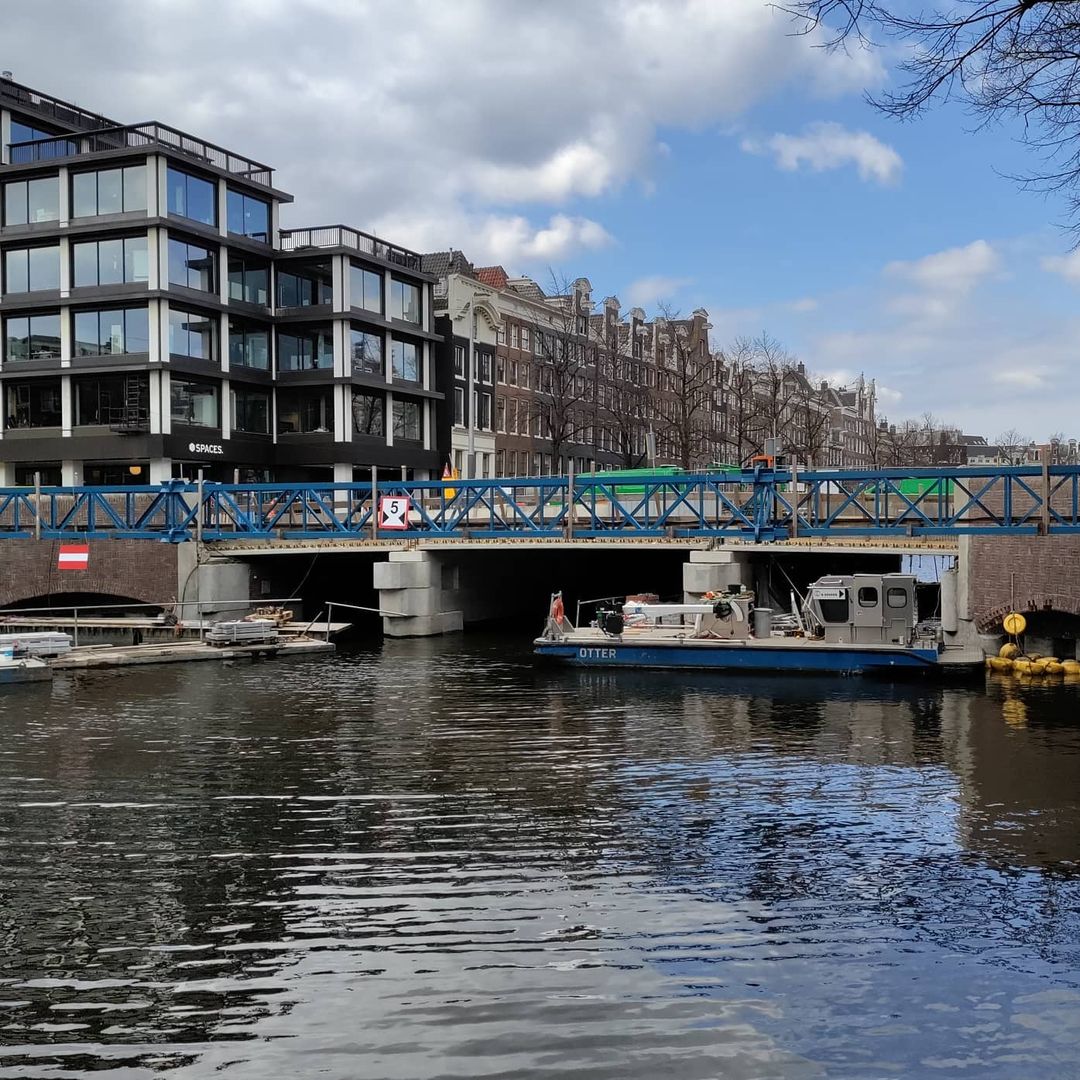
Piet Kramer’s Most Distinctive Vijzelstraat Bridge, at the Keizersgracht, Facing the Building She Helped Create
There is a bridge in Amsterdam that carries a Roman joke. The four natural stone columns at the corners of Bridge 41 bear the inscription “SPQA,” a wry adaptation of the Roman “SPQR,” Senatus Populusque Romanus, the Senate and People of Rome. Kramer’s version stands for “Senatus Populusque Amstelodamensis,” the Senate and People of Amsterdam. He was working, after all, for the Dienst der Publieke Werken. The four corner pilons carry the text “SPQA”: Senatus Populusque Amstelodamensis, the Senate and People of Amsterdam. It is the most playful detail on any bridge in this entire series, and it belongs to the most architecturally ambitious bridge in the Vijzelstraat sequence. It also carries the name of the woman who, without access to a stock exchange floor, guided Netherlands finances through crises that would have bankrupted both the central bank and the state, from her house on the Keizersgracht, a few metres from the bridge that now bears her name.
Bridge 41 Johanna Borskibrug (Johanna Borski Bridge). Brug een enveertig like bridge 30 (De Isa van Eeghenbrug) is located on the Vijzelstraat although this one spans the Keizersgracht.
In 2020/2021, the bridge is being taken apart and then reassembled so my images are not of it at its best. The bridge suffered from subsidence, but had to remain functional for pedestrians and cyclists driving to and from the city center.
Also like bridge 30 it is one of three bridges designed as a group. During the widening of the Vijzelstraat from 1911, architect Jo van der Mey made designs for the three bridges. They have some unity in appearance however, the building of them took place in phases during the widening of the Vijzelstraat. Piet Kramer was forced to design three new bridges, for #bridge30 he largely used the original, but for #bridge41 and #brug70 he made a completely new design. Bridge 41 was not completed until 1923.
The abutments and pillars are made of brick and natural stone and it is surrounded by four natural stone columns on the abutments; these mention SPQA a joke by Kramer referring to the Roman SPQR. He was after all working for theAmsterdam Public Works Department. Kramer’s design signature can also be seen in the year stones (anno 1923) and the decorative ironwork in the balustrades/railings which we have seen on his other bridges. The parapets are built in the style of the Amsterdam School with alternation brick and masonry bonds and at the end natural stone.
The bridge was officially named in 2016 after a famous banker from the seventeenth century.


1. Etymology and Naming: Johanna Borski, the Financier of the Netherlands, Born on the Street the Bridge Carries
Peter Korrel proposed this bridge name. The naming was formally adopted in 2016 and is documented in the Gemeenteblad (official municipal gazette). The biographical justification offered in that gazette entry is among the most compelling of any bridge in Amsterdam’s numbering system.
Johanna Borski’s major achievements were: in 1814 she made the founding of De Nederlandsche Bank possible by buying 2,000 of the 5,000 shares required. In 1824 she stood at the cradle of the Nederlandsche Handelsmaatschappij, which she rescued from bankruptcy in 1840, thereby preventing the Dutch state itself from going bankrupt. The building of the Nederlandsche Handelsmaatschappij was located in the Vijzelstraat at the Keizersgracht. In 1837 she invested heavily in the Hollandsche IJzeren Spoorweg Maatschappij, thereby promoting the modernisation of transport.
The full story behind those facts is one of the most remarkable in Dutch financial history. Johanna Borski (1764 to 1846) was a Dutch banker. She was the director of the “Wed. Borski” bank from 1814 to 1846. She was born in Amsterdam to flax merchant Johannes van de Velde and Bruna Jacoba Schouten, and she married the banker Willem Borski on 19 December 1790. They moved to Keizersgracht 566, which they bought in 1809. They had five daughters and three sons who lived to adulthood.
When her husband died suddenly in 1814, Johanna Borski decided to continue his business as the firm Wed. W. Borski. The firm Wed. W. Borski was the permanent partner of Hope & Co. in, among other things, placing Russian loans, which in the 1820s alone amounted to more than one hundred and twenty million guilders. She led the firm with a firm hand until she was eighty years old.
Her 1816 intervention in the Nederlandsche Bank was the decisive act of her career. In March 1816, the wealthy widow Borski completed the initial capital of the Nederlandsche Bank, saving it from collapse. The Amsterdam business world had seen the bank as a competitor and had sabotaged the share issue. A disaster threatened, until Borski took over the remaining forty percent. She saved another bank, the Nederlandsche Handel-Maatschappij, in 1830 after it had given King Willem I some loans that he had demanded. She also rescued the Nederlandsche Handelsmaatschappij with one and a half million guilders from a crisis situation in 1840, thereby preventing the Dutch government from going bankrupt too, and then in 1840 she did so again with four million guilders.
The geographical connection between Borski and the bridge is direct and threefold. She was born as Johanna van der Velde in the Vijzelstraat, and had her office on the Keizersgracht near the Spiegelstraat. This bridge offers a view of the building of the Nederlandsche Handelsmaatschappij, which she helped to found and which she saved twice from collapse. The street the bridge carries is the street of her birth. The canal it spans is the canal where she kept her office. And the building directly beside the bridge is the corporate headquarters of the institution she rescued with her own capital.
In 2022, her legacy attracted additional scrutiny. In 2022, the Dutch newspaper the Volkskrant published an article about a study concerning the involvement of De Nederlandsche Bank in slavery. The article suggested that Borski had become rich through her involvement in slavery, citing that her capital had been partly created by revenues from Surinam plantations with 565 slaves. The study said that Borski had financed a mortgage on three such plantations in 1804. The study further noted that her involvement would at most have amounted to 1.5% of her wealth, and that she did not advocate abolition but was also not among the many businessmen who tried to dissuade the government from abolition. The naming of the bridge in 2016 predated this scrutiny. The historical record now includes both the extraordinary civic achievements and the colonial financial connections that the 2022 study brought to light.
2. Structural Evolution: From Stalpaert’s Plan of 1662 to a Lowering in 1882, and Kramer’s Completed Design of 1923
City architect Daniël Stalpaert drew the bridge into his design city plan of 1662, when there was still no construction at this location. When Frederik de Wit made a new plan in 1688 there had been considerable building around the bridge. In 1882 the bridge was found to be too high and too narrow; it was lowered and widened. At the same time the same works were carried out at bridges 30 and 70. The bridges lying in each other’s extension have had a shared history ever since.
The trio of Vijzelstraat bridges, 30, 41, and 70, entered their modern phase together in 1882 and were then simultaneously the subject of Van der Mey’s design commission from 1911. During the widening of the Vijzelstraat from 1911, architect Jo van der Mey made designs for the three bridges. They were to form a unity in appearance. However, construction took place in phases during the widening of the Vijzelstraat. Piet Kramer was forced to design three new bridges; for Bridge 30 he largely used the original design, but for Bridges 41 and 70 he made a completely new design.
Around 1919 Piet Kramer found himself obliged to make three new bridge designs. The bridge 41 was not completed until 1923. The year stone confirms this: the bridge carries “anno 1923” inscribed in granite. The delay between Van der Mey’s 1911 commission and Kramer’s 1923 completion reflects the combined disruptions of the First World War, material shortages, and the phased nature of the Vijzelstraat widening itself.
The railings have been subject to specialist restoration. Bridge 41 over the Keizersgracht is a rijksmonument, originally built in the 18th century. All the characteristic details of the elegant railings have been restored to their former glory. The railings were dismantled and taken to the restorer’s workshop in Bleskensgraaf. All components were individually checked, restored, and then treated with a zinc coating and a primer. After this treatment all components were reassembled in the original manner by riveting. The rivet is placed in an oven until it reaches the correct temperature. The red-hot rivet is inserted into the pre-drilled rivet hole. The end of the steel rod is hammered flat, creating the closing head. After the rivet cools, it contracts slightly, creating tension and a strong connection. This description of the riveting process is a reminder of how much craft work goes into maintaining Kramer’s bridges: the ornamental ironwork is not merely decorative but structurally complex, and restoring it requires traditional blacksmithing skills that are increasingly rare.
3. Architectural Lineage: Kramer’s Completely New Design, the SPQA Columns, and a Rijksmonument Since 1995
Bridge 41 is the most architecturally significant bridge in this series since the Koningssluis (Bridge 29), and it represents Kramer at his most inventive. Unlike Bridge 30, where he largely retained Van der Mey’s original structural concept, here he started from scratch.
The abutments and piers are executed in brick and natural stone. The bridge is surrounded by four natural stone columns on the abutments; these carry the inscription SPQA, a joke by Kramer referring to the Roman SPQR, since Kramer was working for the Dienst der Publieke Werken. Kramer’s signature is further visible in the year stones (anno 1923) and the ornamental wrought ironwork in the balustrades and railings. The parapets are built in the style of the Amsterdam School with alternating brick and natural stone, masonry bonding patterns, and at the corners elaborately worked natural stone.
The bridge is a fixed plate bridge (vaste plaatbrug) over the Keizersgracht. Its structural type, a flat plate bridge, is different from the arch bridges of Bridges 31, 35, 36, and 38 encountered earlier in this series. The flat profile reflects the tram and traffic requirements of the Vijzelstraat, a busy artery that needed a level crossing rather than an arched one.
The SPQA columns deserve particular attention because they are unique in Kramer’s bridge output. No other bridge in the Amsterdam numbering system carries an equivalent inscription. The four columns at the four corners of the bridge deck, each inscribed with the same four letters, announce that this crossing belongs to the city of Amsterdam in the most direct possible way, with a classical reference that Kramer must have known would be appreciated by anyone educated enough to recognise SPQR. It is architectural wit at its most precise, built into stone that was intended to last centuries.
The bridge holds Rijksmonument status, confirming its position as one of the most significant bridges produced by Kramer and Publieke Werken during the Amsterdam School period.
4. Urban and Social Context: The Vijzelstraat, De Bazel, and a View That Makes the Name Irresistible
The naming of Bridge 41 after Johanna Borski is, in purely topographical terms, one of the most appropriate naming decisions in the entire series. The bridge spans the Keizersgracht where it meets the Vijzelstraat. Immediately beside it stands De Bazel, the ten-storey Brick Expressionist building designed by Karel de Bazel for the Nederlandsche Handelsmaatschappij.
De Bazel is a building from 1926 on the west side of the Vijzelstraat in Amsterdam. It extends from the Herengracht to the Keizersgracht. It served successively as the head office of the Nederlandsche Handel-Maatschappij (NHM), the Algemene Bank Nederland, and the ABN AMRO Bank. Since 2007 the Stadsarchief Amsterdam has been housed there. The building was declared a rijksmonument in 1991. With ten storeys it dominates the surroundings of canal houses that do not rise above five. Moreover it is unusually wide and along the Vijzelstraat one hundred metres long.
The building was the most important work of the Dutch architect Karel de Bazel and was built from 1919 to 1926 as the head office of the Nederlandsche Handel-Maatschappij. The architect died in 1923, three years before completion. Kramer completed his bridge in 1923, the same year De Bazel died. Both men were working simultaneously on the same intersection, one building the bridge and one building the institution the bridge faces, neither knowing that Borski’s name would eventually connect them both.
This bridge offers a view of the building of the Nederlandsche Handelsmaatschappij, which she helped to found and which she saved twice from collapse. Standing on the bridge and looking west along the Keizersgracht, De Bazel’s vast facade fills the end of the view. The woman who rescued the institution that built that building is now named on the bridge that faces it. The naming is not symbolic in an abstract sense. It is a precise geographical alignment of a life, a building, and a bridge.
The firm’s name Borski disappeared from the business world in 1966. Johanna van de Velde was born in the Vijzelstraat, which at that time (1764) was a narrow street comparable to the Leidsestraat and Utrechtsestraat. The bridge stands on the widened modern Vijzelstraat that was created in the same phased process that produced the bridge itself. The narrow street of her birth no longer exists. What exists instead is a broad commercial artery crossed by one of Kramer’s finest bridges, carrying the name of the woman who was born on the street and whose capital shaped the city’s financial architecture for thirty years.
5. Technical Specifications
Based on confirmed sources, the following can be stated:
- Bridge type: Fixed plate bridge (vaste plaatbrug)
- Location: Vijzelstraat over the Keizersgracht, Amsterdam-Centrum
- Canal: Keizersgracht (dug from 1615, UNESCO World Heritage Canal Belt, listed 2010)
- Part of a trio: Bridge 41 forms a series with Bridge 30 (Herengracht) and Bridge 70 (Prinsengracht), all in the Vijzelstraat; all designed from Van der Mey’s 1911 commission, all executed by Piet Kramer
- Cartographic record: Daniël Stalpaert’s city plan, 1662 (no buildings yet); Frederik de Wit’s map, 1688 (completed bridge in developed area)
- 1882 intervention: Lowered and widened, simultaneously with Bridges 30 and 70
- Design commission: Jo van der Mey, from 1911, for all three Vijzelstraat bridges as a unified sequence
- Executed design: Piet Kramer (P.L. Kramer), entirely new design for Bridges 41 and 70 (Bridge 30 retained Van der Mey’s original more closely)
- Completed: 1923; anno stone “anno 1923” inscribed in granite
- Materials: Brick and natural stone abutments and piers; four natural stone corner columns inscribed SPQA (Senatus Populusque Amstelodamensis); ornamental wrought iron balustrades and railings, riveted construction; alternating brick and natural stone parapets in Amsterdam School style; elaborately worked natural stone at the corners
- Traffic adaptation: Reinstatement in the 1950s due to increasing traffic
- Railing restoration: Specialist riveted restoration at a workshop in Bleskensgraaf; all components individually restored and re-riveted
- Monument status: Rijksmonument (national monument)
- Named after: Johanna Borski-van de Velde (Amsterdam, 26 August 1764 to Amsterdam, 12 April 1846), Dutch banker and director of firm Wed. W. Borski 1814 to 1844; known as “the financier of the Netherlands”
- Name formally adopted: 2016, documented in Gemeenteblad 2016, 7923
- Named by: Peter Korrel (bruggenvanamsterdam.nl)
- Related institution visible from bridge: De Bazel (Vijzelstraat 32), the former NHM headquarters, now Stadsarchief Amsterdam; rijksmonument since 1991
Sources Consulted
- Bruggenvanamsterdam.nl, bridge register entry for Brug 41
- Wikipedia (nl), “Johanna Borskibrug”
- Bridges.cramberts.com, “Johanna Borskibrug, Bridge 41, History and information”
- Amsterdam op de kaart, “Johanna Borskibrug, Vijzelstraat” (Publieke Werken, P.L. Kramer, 1923)
- Amsterdamse School database, “Brug 41, Johanna Borskibrug”
- Wikipedia (en), “Johanna Borski”
- Huygens Instituut, Biografisch Woordenboek van Nederland, “Velde, Johanna Jacoba van de (1764 to 1846)”
- Historiek.net, “Johanna Borski: Financier van Nederland”
- Follow the Money, “De vrouw die De Nederlandsche Bank van de ondergang redde”
- Ons Amsterdam, “Ondernemer Johanna Borski-Van de Velde”
- Kalden.home.xs4all.nl, “Johanna Pieters Borski – van de Velde (1764 to 1846)”
- Zoek.officielebekendmakingen.nl, Gemeenteblad 2016, nr. 7923
- Wikipedia (nl), “De Bazel (Amsterdam)”
- Wikipedia (en), “De Bazel”
- Wikipedia (en), “Hildo Krop”
- Van der Vegt, “Johanna Borskibrug (Brug 41)”
- YourAudioTour.com, “Johanna Borskibrug”
- Wikimapia, “Johanna Borskibrug”
- Sebas Baggelaar and Pim van Schaik, “Piet Kramer, Bruggenbouwer van de Amsterdamse School,” 2016, ISBN 9789079156313
- Archief Publieke Werken, Brug 41, 1882 (dossier 13030) and 1922 (dossier 24250), cited in Wikipedia nl “Johanna Borskibrug”
Public Domain Images
1. Stadsarchief Amsterdam, “Johanna Borski Bridge, 1917” and “Johanna Borski Bridge, 1924” The YourAudioTour entry for the bridge references Stadsarchief Amsterdam photographs from 1917 and 1924, the former showing the bridge before Kramer’s redesign was complete and the latter showing it in its newly completed form. Both are available via the Stadsarchief Beeldbank at archief.amsterdam. Available for non-commercial use with attribution. URL: https://archief.amsterdam/beeldbank (search: “brug 41 Vijzelstraat Keizersgracht 1917” and “brug 41 Vijzelstraat 1924”) Attribution: “Collectie Stadsarchief Amsterdam. Available for non-commercial use with attribution.”

2. Wikimedia Commons: Category Brug 41 (Amsterdam) photographs The Wikimedia Commons category for Bridge 41 holds contemporary photographs showing the SPQA columns, the ornamental wrought iron balustrades, and the Amsterdam School brick and natural stone parapets, as well as views of the bridge in relation to De Bazel. Available under free licences. URL: https://commons.wikimedia.org/wiki/Category:Brug_41_(Amsterdam) Attribution: “Wikimedia Commons, Category: Brug 41 (Amsterdam). Available under the licences specified on individual file description pages.”

Johanna Borskibrug Map and location
#bridge30 #bridge41 and #bridge70 all lie along the Vijzelstraat and have a common design and history since their rebuilding in the early 1900’s. #brug 41 spans the Keizersgracht.
There has been a bridge at this point for centuries and city architect Daniël Stalpaert drew the bridge in his design city plan of 1662, although at that time no buildings were built here yet. When Frederick de Wit made a new plan in 1688, a lot of construction was done and buildings along with the bridge featured on the map.


Johanna Borskibrug history and information
It is one of three bridges designed as a group which includes #bridge30 and #bridge70. During the widening of the Vijzelstraat from 1911, architect Jo van der Mey made designs for the three bridges. They have some unity in appearance however, the building of them took place in phases during the widening of the Vijzelstraat. Piet Kramer was forced to design three new bridges, for #bridge30 he largely used the original, but for #bridge41 and #brug70 he made a completely new design. Bridge 41 was not completed until 1923.


Pictures from Amsterdam Archive
1 Keizersgracht 607 – 18 augustus 1974
2 Op de voorgrond Brug 41 over de Keizersgracht. Rechts Keizersgracht 642-658 – around 1900
3 Links de zijgevel van Vijzelstraat 81, op de achtergrond de Vijzelstraatflat met op de hoek Vijzelstraat 36. – mei 1944
4 Gezien naar Keizersgracht ca. 596-648 – mei 1944
5 Beschrijving De Vijzelstraat gezien vanaf de brug over de Keizersgracht richting Herengracht, vóór de verbreding in 1917 – around 1916
6 Johanna Borski 1809-1860