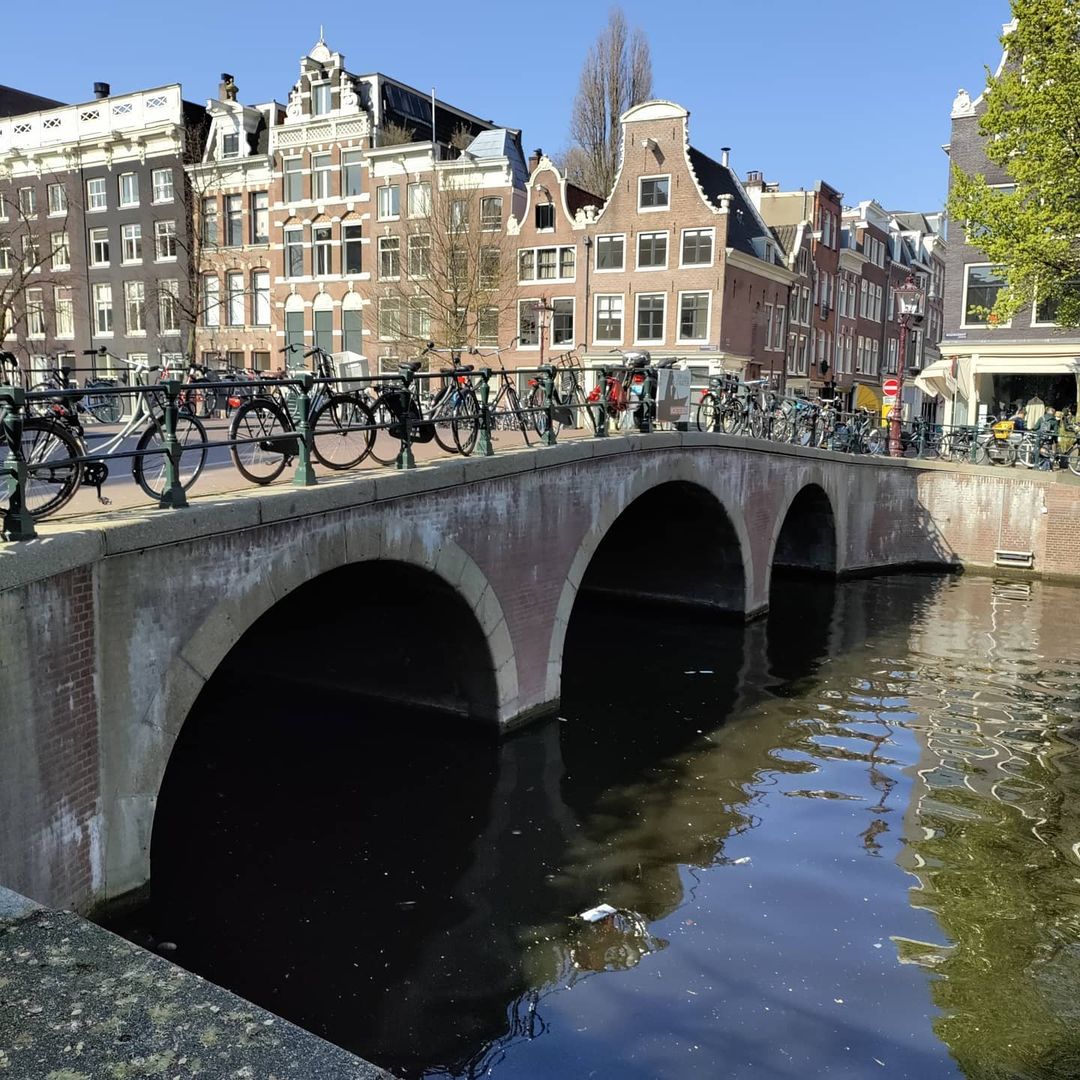
A Fixed Bridge on the Keizersgracht, Connecting the Huidenstraat with the Runstraat in the Heart of the Nine Streets
Bridge 47 carries no official name and has never carried an informal one. It has appeared on city maps since 1599, been painted by at least two significant Dutch artists, and been photographed as the backdrop to one of the most dramatic canal engineering disasters in Amsterdam’s history. It sits in the Negen Straatjes, connecting two streets whose names preserve the memory of a leather-working industry that employed the district for generations. And at the address directly beside it, at Keizersgracht 384, a fire burned during a theatrical performance in 1772 that killed seventeen people, destroyed the most important theatre in the Dutch Republic, and was recorded by Reinier Vinkeles in a painting that shows the bridge at precisely this location. It is a bridge with an extraordinarily rich artistic and historical record, and yet no name has ever been attached to it. Bridge 47 is simply a number, standing in one of the most culturally saturated intersections in the canal belt.
Just like bridge 44, bridge 45 and bridge 46 this is a relatively new bridge rebuilt in the early 1980’s to reflect the new aesthetic for the area. Gone was the old bridge in favour of the new/old arched bridge style.
The bridge connects Huidenstraat with Runstraat and crosses the Keizersgracht in the shopping area of the #NegenStraatjes in the historic Amsterdam canal belt. We saw three other bridges #bridge24 #bridge25 and #bridge26 that also bordered the #NineStreets all crossing the Herengracht.


1. Etymology and Naming: Skins and Run-Bark, Two Streets That Remember a Lost Industry
Bridge 47 connects two of the nine cross streets that form the Negen Straatjes neighbourhood. The bridge connects the Huidenstraat with the Runstraat and spans the Keizersgracht in the area of the Negen Straatjes in the Amsterdam canal belt.
Both street names belong to the leather-working vocabulary that defines the Negen Straatjes as a district. The names of the Nine Streets are reminders of many of the types of work that were carried out here in centuries past, especially the processing of skins, including cow, bear, wolf, and roe deer skins. The streets named include the Runstraat and the Huidenstraat.
Huidenstraat translates directly as Skins Street or Hides Street, preserving the memory of the raw material that defined the district’s trade. The etymology of Runstraat is more specific and less familiar to modern readers. The Runstraat translates as Cow Street in English. But the Dutch word “run” in this context does not refer primarily to cattle: it is an older term for the ground bark of oak trees, which was the primary tanning agent used in the leather industry before synthetic chemicals replaced it. A run-miller ground the bark; a runmolen was a bark mill. The Runstraat was named for this bark-processing trade, which was as important to the leather industry as the hides themselves, and Bridge 47 stands at the point where both halves of that industrial vocabulary, the skins and the tanning agent, meet above the water.
2. Structural Evolution: Six Centuries of Maps, a Theatre Fire, and a Modern History Beginning in 1889
The cartographic record for Bridge 47 is the most extensive of any bridge in this series. There has been a bridge at this location for centuries. Joan Blaeu drew the bridge on his map of 1649, but Pieter Bast and Balthasar Florisz. van Berckenrode had already drawn the bridge on their maps of 1599 and 1625 respectively. It was drawn as a bridge with five navigation openings over the Keysers Graft between the Huyde Straet and the Run Straet.
The 1599 date is remarkable: Pieter Bast’s map, one of the most important cartographic records of Amsterdam at the moment of its great expansion, already shows a bridge here. The Keizersgracht itself was not dug until 1615, meaning the 1599 map shows a crossing over a waterway that would eventually become the Keizersgracht, or records a predecessor crossing over an earlier drainage ditch that was incorporated into the canal. Five navigation openings, documented on all three early maps, confirm that this was always a substantial crossing designed to handle significant boat traffic.
The bridge then acquired one of the most vivid artistic records of any crossing in the series. Reinier Vinkeles painted the bridge in around 1762, in an evening scene when the Schouwburg theatre was still located at Keizersgracht 384, before it burned down on 11 May 1772.
The painting, held in the Wikimedia Commons category for Bridge 47 as “Reinier Vinkeles Keizersgracht with people leaving the theatre 1760.jpg,” shows the bridge with theatregoers on and around it, the Schouwburg visible behind. It is one of the most celebrated paintings of an Amsterdam canal bridge from the 18th century. In 1637, a wooden theatre was built on Keizersgracht. In the seventeenth and eighteenth centuries, it became Amsterdam’s leading entertainment venue, visited by Amsterdammers from all walks of life, and for a century and a half imaginative plays from all over Europe were performed there. Rembrandt and his pupils drew inspiration for their paintings at the theatre. On 11 May 1772, the theatre burned to the ground.
At Keizersgracht 384 there is a gate with ionic pilasters which once was the entrance to the theatre. During a performance on 11 May 1772, a fire broke out in the theatre and seventeen people died in the flames. The diarist Bicker Raye recorded: “On May 11th at half past eight in the evening a fire broke out during a performance. In less than half a quarter of an hour the entire theatre stood in flames and in less than 3 hours the whole building burned down to the ground. The same did a house in Runstraat, where there were horses and which was filled up with straw. Only the horses were saved.”
The fire spread from the Schouwburg to the Runstraat: the very street that gives Bridge 47 one of its two defining connections caught fire on the same night the theatre burned. Bridge 47 stood in the middle of it all, the crossing between the burning theatre and the burning street.
The modern history of the bridge begins in 1889. This date marks the start of the documented modern phase: a series of municipal decisions and renovations that shaped the current structure.
Bridge 47 also appears prominently in the photographic record of the Bridge 46 collapse. Jacob Olie photographed the collapsed Bridge 46 on 25 November 1894, showing the collapsed bridge over the Keizersgracht and Leidsegracht as seen toward Bridge 47 at the Runstraat (left) and Huidenstraat (right). Bridge 47 is therefore visible in what is arguably the most dramatic historical bridge photograph in the Stadsarchief Amsterdam collection, as the undamaged crossing visible in the background behind the collapsed arch of its neighbour.
The Anefo press photography archive, held in the Nationaal Archief, holds two photographs captioned “Nieuwe driebogenbrug in Keizersgracht tussen Huiden- en Runstraat in Amsterdam bijna voltooid,” dated 1 February, year unspecified but from the photographic context likely mid-20th century. These Anefo photographs show a new three-arch bridge on the Keizersgracht between Huiden- and Runstraat almost completed, and are available in the Wikimedia Commons category for Bridge 47. The existence of these “almost completed” photographs confirms that the current bridge is a relatively modern reconstruction, built as a three-arch crossing to replace an earlier structure, in the same tradition established by Bridges 44, 45, and 46 at the neighbouring Leidsegracht crossing.
3. Architectural Lineage: A Three-Arch Reconstruction, Surrounded by Rijksmonumenten, Without Its Own Heritage Designation
The bridge, due to its young age itself not a monument, is surrounded by rijksmonumenten, except on the southeastern side, where there is relatively new construction from the beginning of the 20th century.
No individual architect is confirmed for the current Bridge 47 in any source consulted for this post. The bridge is a three-arch fixed crossing in the canal belt tradition, rebuilt at some point in the 20th century to restore the arch profile appropriate to its historic setting. Like Bridges 44, 45, and 46 at the Keizersgracht/Leidsegracht crossing, Bridge 47 is a bridge whose current form is younger than its setting, rebuilt to harmonise with the surviving 17th and 18th-century fabric around it.
The Anefo photographs confirm the three-arch form: “nieuwe driebogenbrug,” a new three-arch bridge, is the caption. Three arches over the Keizersgracht, the widest inner canal in Amsterdam, is a consistent choice across the canal’s bridge history, matching the three-opening profiles documented on the early maps of Bast, Berckenrode, and Blaeu.
The Michelin-starred restaurant Vinkeles, housed in The Dylan hotel at Keizersgracht 384, is directly beside the bridge. The restaurant is named after the 18th-century painter and engraver Reinier Vinkeles, who made an etching from the entrance of the former theatre that burned down in 1772. The restaurant that occupies the address of the former Schouwburg carries the name of the painter who depicted Bridge 47 in the theatre’s last decade. The bridge, the painting, the fire, the restaurant, and the name are all connected at a single address on the Keizersgracht, visible from the bridge deck.
4. Urban and Social Context: The Nine Streets, Theatre History, and the Most Famous Backdrop in the Neighbourhood
Bridge 47 is the second of the three Keizersgracht crossings within the Negen Straatjes, flanked by Bridge 43 (Leidsestraat/Johanna Borskibrug) to the south and Bridge 42 (Nieuwe Spiegelstraat) to the north. It is the quietest of the three in terms of traffic, serving pedestrians and cyclists rather than trams, and it carries the characteristic scale of a Nine Streets crossing rather than the broad width of a tram artery.
The Keizersgracht at this point is lined with protected 17th and 18th-century canal houses on both sides, interrupted only by The Dylan hotel (the former Schouwburg site) at number 384, which retains the original gate with Ionic pilasters from the theatre entrance. The address where Rembrandt drew theatrical sketches, where seventeen people died in 1772, and where Vinkeles painted the bridge, is now a luxury hotel named, by a different route, after the same painter who depicted the bridge.
The Negen Straatjes around Bridge 47 are among the most actively traded streets in Amsterdam for independent retail. From the very beginning these little cross streets were dominated by trade and culture. And still, after 400 years, it is a lively neighbourhood with artisanal businesses, special restaurants and bars, galleries and a unique variety of small, specialized and authentic shops. The Runstraat and Huidenstraat on either side of the bridge are now occupied by fashion boutiques, vintage shops, delicatessens, and specialist food stores rather than tanners and bark-millers, but the street names endure.
5. Technical Specifications
Based on confirmed sources, the following can be stated:
- Bridge type: Fixed three-arch bridge (vaste driebogenbrug), 20th-century reconstruction
- Location: Keizersgracht, connecting the Huidenstraat with the Runstraat, Amsterdam-Centrum (Negen Straatjes)
- Canal: Keizersgracht (dug from 1615, widest canal in Amsterdam’s inner city at 28.31 metres; UNESCO World Heritage Canal Belt, listed 2010)
- Cartographic record: Pieter Bast map, 1599 (bridge with five navigation openings over the Keysers Graft between Huyde Straet and Run Straet); Balthasar Florisz. van Berckenrode map, 1625; Joan Blaeu map, 1649; this is the earliest-documented bridge in this series
- Artistic record: Reinier Vinkeles painting, c. 1762, showing Bridge 47 with theatregoers and the Schouwburg at Keizersgracht 384 in the background (held in Wikimedia Commons category for the bridge); Jacob Olie photograph, 25 November 1894, showing the collapsed Bridge 46 with Bridge 47 visible undamaged in the background
- Modern history begins: 1889
- Current structure: 20th-century three-arch reconstruction (Anefo photographs captioned “Nieuwe driebogenbrug in Keizersgracht tussen Huiden- en Runstraat in Amsterdam bijna voltooid” confirm the reconstruction; date approximately mid-20th century)
- Designer: Dienst der Publieke Werken; no individual architect confirmed
- Amsterdam School attribution: None
- Monument status: Not a monument (geen monument), bridge too young for listing; surrounded by rijksmonumenten except on the southeastern side, where there is early 20th-century construction
- Current official name: None; designated in the municipal register as Brug 47
- Adjacent address: Keizersgracht 384 (The Dylan hotel, formerly the Amsterdam Schouwburg 1637 to 1772; the Michelin-starred restaurant Vinkeles is housed here, named after the painter Reinier Vinkeles who depicted Bridge 47)
- Street connections: Huidenstraat (Skins Street, leather industry) on the north; Runstraat (Run-bark Street, tanning agent industry) on the south
Sources Consulted
- Wikipedia (nl), “Brug 47”
- Bruggenvanamsterdam.nl, bridge register entry for Brug 47
- Wikimedia Commons, Category: Brug 47 (Keizersgracht, Amsterdam)
- PICRYL, “Brug 47 Keizersgracht Amsterdam” (Anefo photographs)
- Wikipedia (en), “Negen Straatjes”
- Amsterdam Explorer, “De 9 Straatjes”
- De 9 Straatjes, “History of De 9 Straatjes”
- Stadsarchief Amsterdam, “Behind the Scenes: Amsterdam Theatre in the Seventeenth and Eighteenth Centuries”
- Smukkecirsten.wordpress.com, “De oude Schouwburg (the old theater)”
- Rijksmuseum, “Brand van de schouwburg aan de Keizersgracht te Amsterdam, 1772,” Reinier Vinkeles: rijksmuseum.nl/en/collection/object/Brand-van-de-schouwburg-aan-de-Keizersgracht-te-Amsterdam-1772
- Rijksmuseum, “Brand van de schouwburg aan de Keizersgracht te Amsterdam gezien vanaf de Looierssluis, 1772”: rijksmuseum.nl/en/collection/object/Brand-van-de-schouwburg-aan-de-Keizersgracht-te-Amsterdam-gezien-vanaf-de-Looierssluis-1772
- Wikipedia (en), “Reinier Vinkeles”
- Wikipedia (en), “Vinkeles (restaurant)”
- Wikipedia (en), “Keizersgracht”
Public Domain Images

1. Reinier Vinkeles, “Keizersgracht with people leaving the theatre,” c. 1762, Wikimedia Commons Reinier Vinkeles painted the bridge in around 1762, in an evening scene when the Schouwburg theatre was still located at Keizersgracht 384. The painting, held in the Wikimedia Commons category for Bridge 47, shows theatregoers on and around the bridge with the Schouwburg visible behind. Vinkeles (1741 to 1816) is fully in the public domain. URL: https://commons.wikimedia.org/wiki/File:Reinier_Vinkeles_Keizersgracht_with_people_leaving_the_theatre_1760.jpg Attribution: “Reinier Vinkeles, c. 1762. Public domain.”

2. “Nieuwe driebogenbrug in Keizersgracht tussen Huiden- en Runstraat in Amsterdam bijna voltooid,” Anefo / Nationaal Archief, c. mid-20th century, Wikimedia Commons Two Anefo photographs captioned “Nieuwe driebogenbrug in Keizersgracht tussen Huiden- en Runstraat in Amsterdam bijna voltooid,” are held in the Wikimedia Commons category for Bridge 47. These are the primary photographic records of the current bridge during its construction, showing the three-arch structure nearly complete. Available under a Creative Commons Attribution licence (CC BY) through the Nationaal Archief/Anefo collection. URL: https://commons.wikimedia.org/wiki/File:Nieuwe_driebogenbrug_in_Keizersgracht_tussen_Huiden-_en_Runstraat_in_Amsterdam_b,_Bestanddeelnr_931-9450.jpg Attribution: “Nationaal Archief / Anefo. Available under Creative Commons Attribution (CC BY).”

3. Pieter Oosterhuis, “Keizersgracht at Bridge 47,” c. 1860 to 1880, Stadsarchief Amsterdam / Wikimedia Commons The Wikimedia Commons category for Bridge 47 holds a photograph by Pieter Oosterhuis (Afb 010007000270.jpg), a 19th-century photograph showing the bridge and the surrounding Keizersgracht in the pre-collapse era. Pieter Oosterhuis (1816 to 1885) is fully in the public domain. URL: https://commons.wikimedia.org/wiki/File:Pieter_Oosterhuis,_Afb_010007000270.jpg Attribution: “Pieter Oosterhuis, c. 1860 to 1880. Collectie Stadsarchief Amsterdam. Public domain.”
Brug 47 map and location
The bridge connects Huidenstraat with Runstraat crossing the Keizersgracht in the boutique shopping area of the #NineStreets in the historic Amsterdam canal belt. Like many of the other bridges so far there has been a bridge here for centuries and it appeared on many older maps. It was drawn as a bridge with five passageways over the Keysers Graft between the Huyde Straet and Run Straet.


Bridge 47 history and information
Reinier Vinkeles painted the bridge in circa 1762, in an evening view when the theater was still located at Keizersgracht 384, which burned down on 11 May 1772.
The modern history of the bridge starts in 1889 when a request was made to lower the bridge as it was too steep for the traffic at that time. In 1892 it was reported that the iron girders of the bridge had been raised so that it could soon be opened to traffic. Then in 1913 it was proposeed to run a tram across this bridge with a tram stop placed on the bridge but this plan fell through. That bridge lasted until 1981 when the municipality started replacing the bridge and built a bridge that was more in keeping with the historic center of the city in the same was as #bridge44 #bridge45 and #bridge46.
1 Reinier Vinkeles painted the bridge in circa 1762


Pics from the Amsterdam archive
2 Renovation of bridge 47. On the right Huidenstraat. BP Opschoor January 1982
3 The Keizersgracht at number 440, seen in a northerly direction Description In the future Bridge 47 between the Runstraat and the Huidenstraat.
4 Rebuild Bridge 47. ANP Collection Collection of the Amsterdam City Archives: April 22, 1982
5 On the right bridge 47 before the Runstraat April 10, 2007