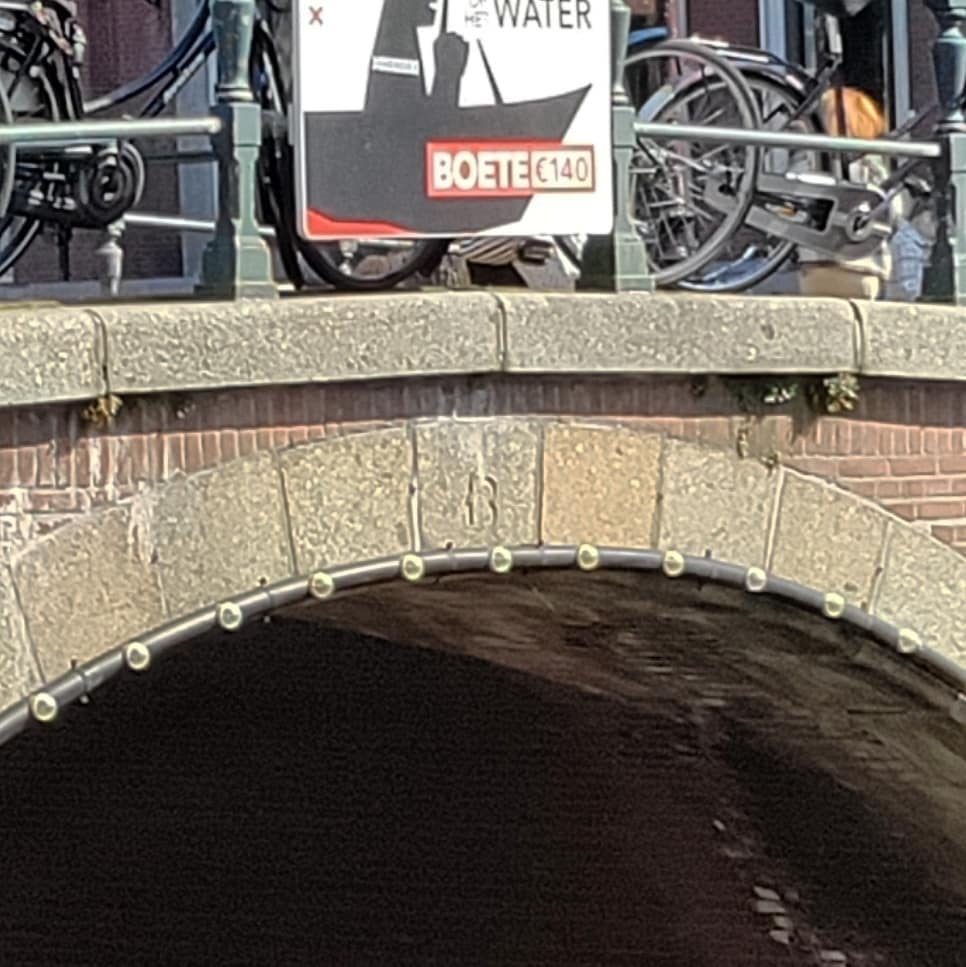
A Three-Arch Bridge on the Keizersgracht, Connecting Wolvenstraat with Berenstraat, Named After the Creator of Tom Poes and Olivier B. Bommel
Bridge 48 has had a more complicated naming history than almost any other crossing in this series. For years it was informally known as the Felix Meritisbrug, after the Enlightenment building beside it. In 2016, that name was rejected because the “commercial link” between the bridge and its neighbour was deemed insufficient grounds for official recognition, and the name failed the guidelines required for the Basic Registration of Addresses and Buildings. The bridge came up on list 2 of two lists of informal bridge names requiring adjustment. And then, after the rejection, something unusual happened: the bridge actually received an official name. De Marten Toonderbrug (brug 48) is a masonry arch bridge in Amsterdam-Centrum, forming the connection between the Wolvenstraat and Berenstraat, spanning the Keizersgracht.
The name Marten Toonderbrug honours the Dutch cartoonist and writer Marten Toonder (1912 to 2005), creator of the beloved comic series Tom Poes and the character Olivier B. Bommel. It connects the bridge to one of the most enduring figures in Dutch popular culture, through a naming process that itself became a small piece of Amsterdam administrative history.
In the early eighties the municipality decided that bridge 48 should be restored to its former glory and it was given three vaulted passages. So just like bridge 44, bridge 45, bridge 46 and bridge 47 this is a relatively new bridge rebuilt in the early 1980’s to reflect the new aesthetic for the area.
The bridge connects Wolvenstraat with Berenstraat and crosses the Keizersgracht in the shopping area of the NegenStraatjes in the historic Amsterdam canal belt. We saw three other bridges bridge 24, bridge 25 and bridge 26 that also bordered the #NineStreets all crossing the Herengracht and of course the previous bridge 47.


1. Etymology and Naming: Felix Meritis Rejected, Marten Toonder Accepted, and the Bear and Wolf Who Frame the Bridge
The bridge was known for years unofficially as the Felix Meritisbrug, after the nearby Felix Meritis. That commercial link was one of the reasons that the bridge was raised in 2016 at the college of mayor and aldermen of Amsterdam. During a check on bridge names it emerged that the name did not meet the guidelines required for inclusion in the Basic Registration of Addresses and Buildings.
The decision to name the bridge after Marten Toonder is documented in the official municipal gazette. Toonder’s connection to the bridge’s location is partly geographical and partly thematic. The bridge connects the Wolvenstraat (Wolf Street) with the Berenstraat (Bear Street), two of the nine cross streets of the Negen Straatjes whose names preserve the memory of the leather-working industry. The bridge forms the connection between the Wolvenstraat and the Berenstraat and spans the Keizersgracht in the shopping area of the Negen Straatjes in the historic Amsterdam canal belt.
Toonder’s most famous character, Olivier B. Bommel, is an anthropomorphic bear. The Wolvenstraat and Berenstraat, Wolf Street and Bear Street, are the streets on either side of the bridge. The naming therefore carries a gentle piece of literary wit: Toonder’s bear crosses a bridge between a wolf street and a bear street, at the heart of a Nine Streets district where four centuries ago tanners processed the hides of the very animals that give the streets their names.
Marten Toonder (1912 to 2005) was a Dutch cartoonist, writer and animation film maker. His most famous character is Tom Poes, a white cat, and the main character is Olivier B. Bommel, an anthropomorphic bear living in the village of Rommeldam. The series ran in the Dutch newspaper De Telegraaf from 1941 to 1986. Toonder’s influence on Dutch popular culture and language was profound: many phrases coined in his strip entered everyday Dutch usage, and his satirical portrait of bourgeois Dutch society through the adventures of Bommel and Tom Poes was one of the most widely read comic series in the Netherlands across four decades.
2. Structural Evolution: A Hunchback Bridge, a Horse That Fell into the Canal, and an Upturned Truck
There has been a bridge at this location for centuries. The bridge that stood here in 1902 was suffering from problems due to the amount of traffic passing over it. Rotted wooden beams were replaced by iron beams and the brickwork had to be repaired. Plans were made to lower the bridge so that it would no longer be a “hunchback bridge” (bochelbrug). A counter-advice was given because lowering the bridge would result in the loss of a “costly view” in Amsterdam. That counter-advice was not adopted by the mayor and aldermen, and the bridge was lowered.
The argument that lowering the bridge would destroy a valuable urban vista is one of the more poignant pieces of heritage reasoning in this series. Someone in the Public Works department in 1902, or among the city’s aesthetic advisers, noticed that the high arch of Bridge 48 created a framed view along the Keizersgracht that would be permanently lost if the bridge were lowered. The counter-advice was overruled, and the view went with the arch.
The consequences of the lowering played out almost immediately in a series of unfortunate vehicle incidents. That lowering had been necessary was evident as recently as 1923, when a horse pulling a cart slid off the bridge and fell into the canal and had to be rescued with the rescue apparatus. Then in 1925 a freight vehicle overturned. Even after lowering, the bridge’s gradient was still sufficient to topple a loaded truck and send a horse into the Keizersgracht within two years of each other.
The widening that shaped the bridge’s current form was carried out at the end of the 1940s, with the last significant involvement of Piet Kramer in any bridge in this series. In 1949 to 1950 the bridge had to be widened, for which Piet Kramer provided advice. Kramer, who was appointed aesthetic adviser to the bridges division of Publieke Werken in 1917 and held the role until 1952, was near the end of his municipal career when he advised on Bridge 48. The widening in 1949 to 1950 is therefore one of his last documented professional contributions to the Amsterdam bridge fabric before his retirement.
The restoration of the arch form followed the same pattern as Bridges 44, 45, 46, and 47. In the early 1980s the municipality decided that the old bridge had to be restored to its former glory and the bridge was given three vaulted passages. The rebuilding was completed around 1981 to 1982, as confirmed by the construction photographs from the Stadsarchief showing Bridge 48 being built from Berenstraat to Wolvenstraat on 8 April 1980 and the completed structure at Keizersgracht 314 to 334 with Felix Meritis at number 324.
3. Architectural Lineage: The Final Bridge in the 1980s Arch Restoration Programme, With Felix Meritis as Its Neighbour
Bridge 48 is the northernmost bridge in the sequence of Keizersgracht crossings that were all rebuilt as arches in the same period: Bridges 44, 45, and 46 at the Leidsegracht junction in the 1970s, Bridge 47 between Huidenstraat and Runstraat, and Bridge 48 between Berenstraat and Wolvenstraat in the early 1980s. Together the five bridges represent a coordinated municipal effort to restore the visual character of this stretch of the Keizersgracht, which had been degraded by a series of precautionary plate-bridge replacements following the 1894 collapse at Bridge 46.
The bridge is a masonry arch bridge (gemetselde welfbrug). No individual architect is confirmed for its current form in any source consulted for this post. The bridge belongs to the Dienst der Publieke Werken’s late 20th-century restoration programme and shares the same design philosophy as its southern neighbours: a new arch built in historical masonry form, too recent for heritage designation but visually consistent with the protected fabric around it.
The building beside the bridge, Felix Meritis at Keizersgracht 324, is the most architecturally significant neighbour of any bridge in this series since the Johanna Borskibrug faced De Bazel. Felix Meritis was built according to a winning design by the architect Jacob Otten Husly for the new society called Felix Meritis established in 1777 for Music, Drawing, Physics, Commerce and Literature. The building opened on 31 October 1788. The oval concert hall was Amsterdam’s main music hall until late in the 19th century and enjoyed a great international reputation. Many famous musicians performed there, including Robert and Clara Schumann, Camille Saint-Saëns, Johannes Brahms, and Julius Röntgen. Beethoven’s Ninth Symphony and Berlioz’s Symphonie fantastique had their Dutch premiere in the concert hall of Felix Meritis.
When the old Felix Meritis society was dissolved in 1888, the printing company Holdert and Co. moved in. In 1932 part of the building was destroyed in a fire. After the Second World War the Communist Party of the Netherlands set up its headquarters there. From 1947 until 1981 its newspaper De Waarheid was printed there. In 1969 the Shaffy Theater opened, which gained a reputation as a stopping place for the Dutch avant-garde, including Ramses Shaffy, Baal, Neerlands Hoop, and Hauser Orkater. In 1988, one hundred years after the old society was dissolved, the Felix Meritis foundation was re-established in the building as a European centre for art, culture and science.
The building was purchased by the Amerborgh company in 2014 and renovated from 2017 to 2020. MATH architects were responsible for the architectural restoration, with the central objective of restoring the historical structure and layout of the building, including the reconstruction of the original roof contour. Felix Meritis is listed as Window 23 in the Canon of Amsterdam, the official national history curriculum’s list of the fifty most significant windows onto Dutch history.
4. Urban and Social Context: The Last Keizersgracht Bridge in the Negen Straatjes, and the View That Was Argued Over in 1902
Bridge 48 is the northernmost of the Keizersgracht crossings within the Negen Straatjes, connecting the Berenstraat/Wolvenstraat axis over the Keizersgracht and completing the grid of Nine Streets bridges from Bridge 43 (Leidsestraat) in the south to Bridge 48 in the north. The bridge connects the Wolvenstraat with the Berenstraat and crosses the Keizersgracht in the shopping area of the Negen Straatjes in the historic Amsterdam canal belt.
The counter-advice given in 1902, that lowering Bridge 48 would destroy a “costly view” in Amsterdam, becomes fully comprehensible when you stand on the bridge today. Looking south along the Keizersgracht from Bridge 48, the successive arches of Bridges 47, 46, 45, and 44 diminish into the distance toward the Leidsegracht. All five bridges are now arches, restored to that form between the 1970s and the early 1980s. The view that the 1902 counter-advice tried to protect, and failed to protect, has been partially recreated by the restoration programme seven decades later. The arches are not original, but the view is back.
The Anne Frank House at Prinsengracht 263 to 267 is a fifteen-minute walk from Bridge 48 along the Prinsengracht. The Westerkerk, whose carillon was cast by the Hemony brothers at the Molenpad around the corner from Bridge 46, is a few minutes’ walk along the Keizersgracht to the north. The Jordaan neighbourhood begins just across the canal.
5. Technical Specifications
Based on confirmed sources, the following can be stated:
- Bridge type: Fixed masonry arch bridge (gemetselde welfbrug), three navigation arches, early 1980s reconstruction in historical form
- Location: Keizersgracht, connecting the Wolvenstraat with the Berenstraat, Amsterdam-Centrum (Negen Straatjes)
- Canal: Keizersgracht (dug from 1615, widest canal in Amsterdam’s inner city at 28.31 metres; UNESCO World Heritage Canal Belt, listed 2010)
- 1902: Bridge suffering from rotted wooden beams, replaced with iron beams; counter-advice given against lowering (citing loss of “costly view”) was overruled; bridge lowered
- 1923: Horse and cart slid off bridge and horse fell into canal; rescued with rescue apparatus
- 1925: Freight vehicle overturned on the bridge
- 1949 to 1950: Bridge widened; Piet Kramer provided advice; one of his last documented professional contributions to Amsterdam’s bridge fabric before his 1952 retirement
- Early 1980s (c. 1980 to 1982): Municipality decided to restore bridge to former glory; three vaulted arches constructed; part of the same coordinated programme that rebuilt Bridges 44, 45, 46, and 47 as arches
- Designer (current structure): Dienst der Publieke Werken; no individual architect confirmed
- Monument status: Not a monument; the bridge is too young for heritage designation; surrounded by rijksmonumenten including Felix Meritis (Keizersgracht 324)
- Former informal name: Felix Meritisbrug; rejected in 2016 for failing the guidelines required for the Basic Registration of Addresses and Buildings; placed on list 2 of informal bridge names requiring adjustment
- Current official name: Marten Toonderbrug, named after Dutch cartoonist and writer Marten Toonder (1912 to 2005), creator of Tom Poes and Olivier B. Bommel; the naming carries a thematic connection as Bommel is an anthropomorphic bear, and the bridge connects Wolvenstraat (Wolf Street) with Berenstraat (Bear Street)
- Adjacent building: Felix Meritis (Keizersgracht 324), designed by Jacob Otten Husly, completed 1788; rijksmonument; Window 23 in the Canon of Amsterdam
Sources Consulted
- Wikipedia (nl), “Marten Toonderbrug (Amsterdam)”
- Bridges.cramberts.com, “Brug Achtenveertig, Bridge 48, History and information”
- Bridges.cramberts.com, “Brug Achtenveertig, Bridge 48, Amsterdam”
- Wikipedia (en), “Felix Meritis”
- Wikipedia (nl), “Marten Toonder”
- MforAmsterdam Tours, “Felix Meritis (Keizersgracht 324)”
- MATH architecten, “Felix Meritis Amsterdam”
- Amsterdam Tourism, “Felix Meritis Amsterdam”
- Wikipedia (en), “Negen Straatjes”
- Wikipedia (en), “Keizersgracht”
- I Amsterdam, “Felix Meritis”
- Wikimedia Commons, Category: Brug 48 (Amsterdam): commons.wikimedia.org/wiki/Category:Brug_48_(Amsterdam)
- Frank V. Smit, “Bruggen in Amsterdam,” Matrijs 2008 (cited in Wikipedia nl, “Marten Toonderbrug”)
Public Domain Images

1. “Building Bridge 48 from Berenstraat to Wolvenstraat over Keizersgracht, 8 April 1980,” Stadsarchief Amsterdam This photograph from the Stadsarchief Amsterdam shows the bridge under construction on 8 April 1980, looking from the Berenstraat toward the Wolvenstraat across the Keizersgracht. This is the primary documentary record of the early 1980s reconstruction. Available via the Stadsarchief Beeldbank at archief.amsterdam. URL: https://archief.amsterdam/beeldbank (search: “brug 48 Keizersgracht Berenstraat Wolvenstraat 1980”) Attribution: “Collectie Stadsarchief Amsterdam. Available for non-commercial use with attribution.”

2. “Keizersgracht 314-334 (from right to left) with Felix Meritis at number 324, right the bridge from Berenstraat (left) to Wolvenstraat (Bridge 48), Uit de serie Vues de Hollande, nr. 30, 1860 to 1865,” Stadsarchief Amsterdam / Wikimedia Commons This photograph from the Vues de Hollande series, dated 1860 to 1865, shows the Keizersgracht with Felix Meritis at number 324 and Bridge 48 visible to the right. This is the oldest photographic record of the bridge in its 19th-century form. Available via both the Stadsarchief Beeldbank and Wikimedia Commons. URL: https://nl.wikipedia.org/wiki/Marten_Toonderbrug_(Amsterdam)#/media/Bestand:Amsterdam_(5274298633).jpg Attribution: “Collectie Stadsarchief Amsterdam, Vues de Hollande nr. 30, 1860 to 1865. Public domain.”
#/media/Bestand:Amsterdam_(5274298633).jpg)
Brug 48 map and location
The bridge connects Wolvenstraat with Berenstraat crossing the Keizersgracht in the boutique shopping area of the #NineStreets in the historic Amsterdam canal belt. Like many of the other bridges so far there has been a bridge here for centuries and it appeared on many older maps.


Bridge 48 history and information
As we mentioned earlier the bridge was unofficially known for years as the Felix Meritis Bridge due to the nearby Felix Meritis. This commercial link was one of the reasons that the bridge was discussed in 2016 by the Mayor and Aldermen of Amsterdam and is now known simply as #brug48.
The modern history of the bridge started around 1949/1950 when the bridge had to be widened, and Piet Kramer provided advice. In the early eighties the municipality decided that the old bridge had to be restored to its former glory and the bridge was given three vaulted passages. When the municipality started replacing the bridges along this stretch and built a number of bridges that were more in keeping with the historic centre of the city so around that time #bridge44 #bridge45 #bridge 46 and #bridge47 all had replacements in a faux old style.


1 & 2 Brug 48 Annemieke van Oord-de Pee, 1990
3 Brug nr. 48 en Keizersgracht nr. 310-316
4 Brug nr. 48 en Keizersgracht 322-302
5 Keizersgracht 303-311, vanaf Wolvenstraat met brug nr. 48
6 Building Bridge 48 from Berenstraat to Wolvenstraat over Keizersgracht 8 april 1980
7 Keizersgracht 314-334 (from right to left) with Felix Meritis at number 324, right the bridge from Berenstraat (left) to Wolvenstraat (Bridge 48) Uit de serie Vues de Hollande, nr. 30. 1860 t/m 1865