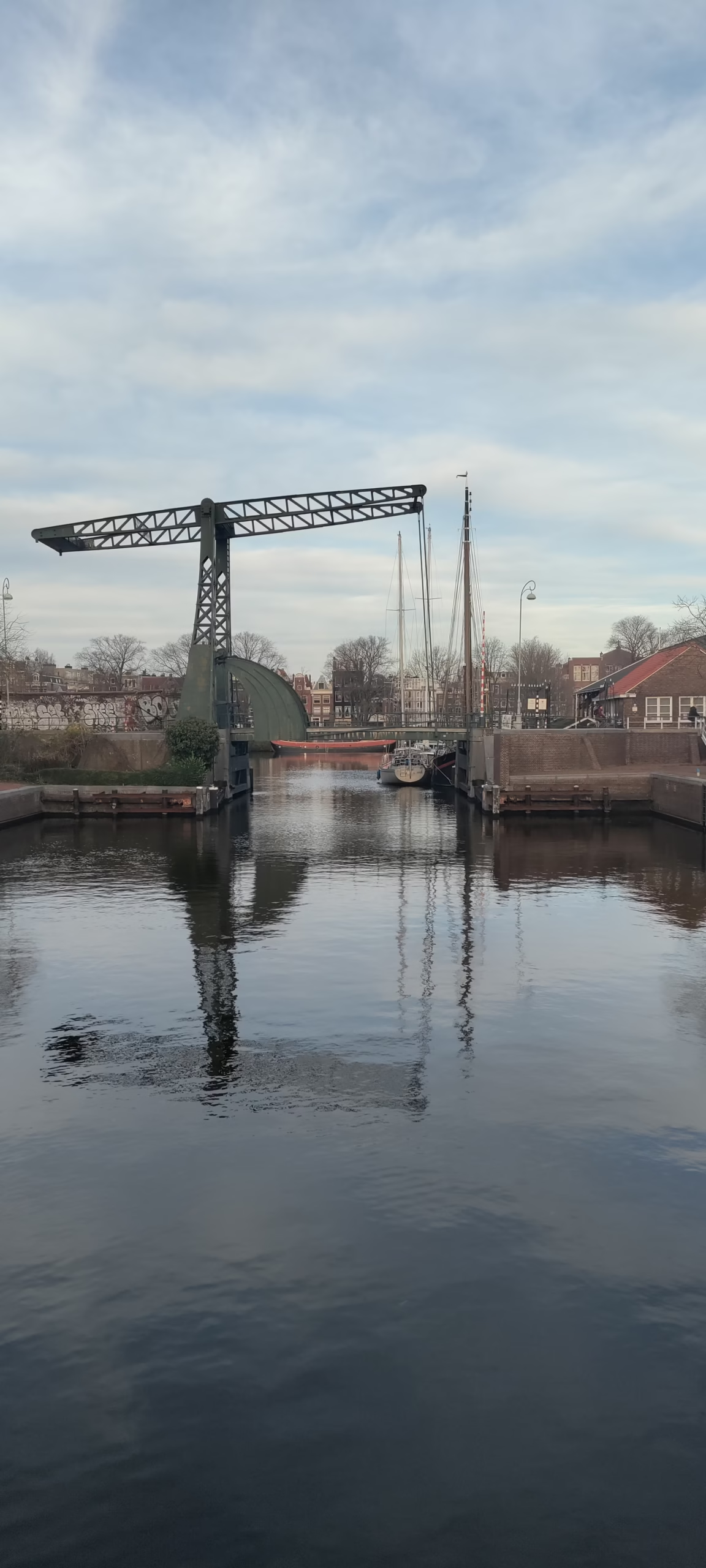
The Customs Bridge: Brug 80, the Bonded Warehouse Dock, and the First Drawbridge in This Series
After five fixed crossings in a row, Brug 80 does something none of its recent neighbours can. It opens.
The Entrepotdoksluis carries the Hoogte Kadijk over the old Entrepotdok lock, linking the Entrepotdok to the Nieuwe Vaart and so to the Oosterdok and the IJ beyond. It is a single-leaf drawbridge, a national monument, and the only bridge we have covered recently whose entire purpose was customs.
Etymology and Origin: What an Entrepot Was For
The name comes from the dock, and the dock was a piece of tax infrastructure.
The Entrepotdok was built in 1827 as a bonded warehouse harbour: a place where imported goods could be landed and stored while the duty owed on them remained unpaid. Nothing left the dock until the customs charge was settled. It is one of the largest warehouse complexes in Europe, a long unbroken run of storage buildings facing the water, each one originally named after a town or a country.
A bonded warehouse only works if it is sealed, and that is the point of the bridge. A lock and a bridge at the entrance meant the dock could be closed, watched and controlled. The Entrepotdoksluis is not a crossing that happens to have a lock beneath it. It is the gate.
Structural Evolution: From Wooden Drawbridge to Iron
The lock itself opened in 1840, thirteen years after the dock, and the first crossing over it was a double wooden drawbridge: two leaves, timber, of the type that had served Amsterdam for centuries and that survives today mostly as the Magere Brug on the Amstel.
The bridge standing today replaced it. The first tender was announced in September 1902, and the structure was built in 1902 and 1903 in iron and steel, with a partly wooden deck and decorative wrought-iron railings. It is a single-leaf drawbridge rather than the double it succeeded, which is the visible sign of the change in engineering: one heavier, stronger, mechanically counterweighted leaf doing the work that two lighter timber ones had shared.
In 1911 the bridge was electrified, the mechanism supplied by the Haarlemsche Machinefabriek. That date is worth noting: a bridge built in the last years of hand-operated infrastructure was converted to electric operation within a decade of opening. Further repairs followed in 1936.

Architectural Lineage: De Graaf, Publieke Werken and Werkspoor
The architect was Wichert Arend de Graaf, working for the Dienst der Publieke Werken, Amsterdam’s Public Works department. The metalwork carries an inscription naming Werkspoor as the manufacturer.
Werkspoor is a name worth recognising. It was one of the great Dutch engineering firms of the industrial age, building locomotives, ships, diesel engines and structural ironwork from its Amsterdam works, and its products were exported worldwide. A bridge stamped with the Werkspoor name is a piece of the same industrial culture that produced the rolling stock of the Dutch railways.
The bridge was designated a rijksmonument in 2001, registered as monument number 518397. Its neighbour, Bridge 327, has been decommissioned.

Urban Context: The Eastern Islands
The Hoogte Kadijk runs along the line of an old sea dike, and this whole district, the Eastern Islands, was made rather than found. It was built out into the IJ in the seventeenth century for shipbuilding, warehousing and the yards of the Dutch East India Company, and it kept that industrial character for three hundred years.
The transformation since has been thorough. The Entrepotdok warehouses were converted to housing in the 1980s, and the district is now residential, with the Artis zoo backing onto the far side of the dock, so that residents look out over the water at giraffes. The bridge that once sealed a customs harbour now carries cyclists between apartments.
It is a short walk from here to Brug 78 at the Funenkade, with the Gooyer windmill in view, which we covered earlier in this series. The two make a good pairing: both out east, both industrial, both left behind by the trade that built them.

Technical Specifications
- Bridge number: 80
- Name: Entrepotdoksluis
- Type: Single-leaf drawbridge (ophaalbrug)
- Carries: Hoogte Kadijk
- Spans: The old Entrepotdok lock, linking the Entrepotdok with the Nieuwe Vaart
- Clearance width: 13.44 m
- Clearance height: 3.02 m
- Materials: Iron and steel, partly wooden deck, wrought-iron railings
- Lock opened: 1840
- Earlier crossing: Double wooden drawbridge
- Current structure: 1902 to 1903 (tender September 1902)
- Architect: Wichert Arend de Graaf, Dienst der Publieke Werken
- Manufacturer: Werkspoor
- Electrified: 1911, mechanism by the Haarlemsche Machinefabriek
- Repaired: 1936
- Status: Rijksmonument since 2001 (number 518397)
Sources Consulted
- In-text image: Railing detail, Bridge 80 by Ceescamel, 2020, via Wikimedia Commons, CC BY-SA 4.0
- Featured image: Photograph by Iain Croll, 2020
- Entrepotdoksluis, Nederlandstalige Wikipedia
- Rijksmonumenten.nl, monument 518397
- Bruggen van Amsterdam
- Frank V. Smit, Bruggen in Amsterdam (2008)
- Stadsarchief Amsterdam, Publieke Werken archives