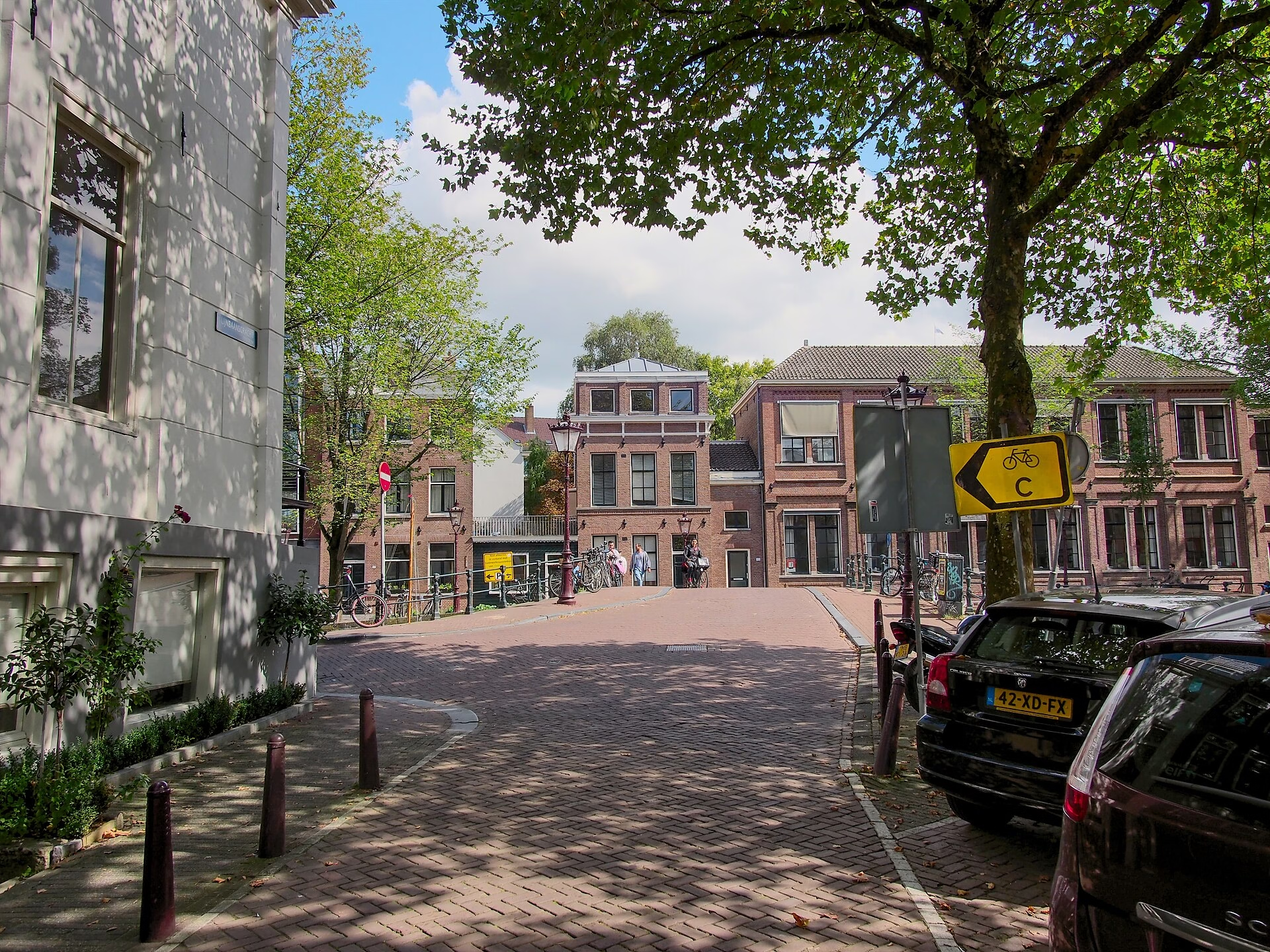
The Seventh Bridge: Brug 81 and the End of the Famous View
Every photograph of the seven bridges of the Reguliersgracht ends here. Brug 81 is the last arch in the row, the small bright ring at the far end of the sightline, and it is the only one of the seven that almost nobody has ever looked at directly.
It carries the northern embankment of the Lijnbaansgracht across the Reguliersgracht, at the point where the Reguliersgracht ends. Beyond it there is no more canal to cross.
A Crossing Since 1662
A bridge has stood on this line for more than three and a half centuries. It appears on Daniel Stalpaert’s design map of 1662, drawn while the fourth expansion of the canal ring was still being laid out, which places it among the original infrastructure of the planned city rather than a later insertion.
What stood there through the nineteenth century was an iron beam bridge on wooden beams, finished with the balustrades that are the signature of Amsterdam’s 1800s municipal work. Photographs show it as an unremarkable working crossing, which is exactly what it was.
The 1976 Replacement, and the Choice Not to Modernise
In 1976 the nineteenth-century structure was taken out and replaced with the bridge standing today, a welfbrug, an arch bridge, most likely in concrete.
The interesting thing is the shape they chose. By 1976 Amsterdam had spent two decades replacing arched bridges with flat decks, because flat decks are cheaper, carry heavier loads and suit motor traffic. Brug 74, a little to the north, is famous on this site precisely for having refused that fate.
Brug 81 was not spared in the same way. It was rebuilt. But whoever specified it asked for an arch, and the reason is not hard to guess: this bridge is the full stop at the end of the most photographed sightline in Amsterdam. A flat deck here would have broken the row of seven nested rings that people cross the city to see. The 1976 bridge is a modern structure wearing the shape the view required.
Further maintenance followed in 2015, with almost no change to the exterior.
Urban Context: Where the Canal Ring Stops
Brug 81 is the last of the seven because the city stopped here. The Reguliersgracht runs south from the Herengracht, crosses the Keizersgracht and the Prinsengracht, and ends at the Lijnbaansgracht, the outermost working canal of the planned seventeenth-century city.
The bridge itself is not a monument, being too recent, but it sits among them: Reguliersgracht 134 to 136 is a rijksmonument and Reguliersgracht 111 a municipal one.
For the full row and how to see it properly, see the seven bridges of the Reguliersgracht.
The Ropewalk Canal, and Why It Ends Here
The Lijnbaansgracht was dug after Amsterdam began its expansion in 1612, and it is named for the lijnbanen, the ropewalks of the ropemakers. Rope was made by twisting fibre along a long straight run, so a ropewalk needed length above all else, and length was the one thing the packed inner city could not offer. The trade was pushed to the edge, and the canal dug to serve it became the outer working boundary of the planned city.
It runs parallel to the Singelgracht, from the Brouwersgracht in the north to the Reguliersgracht in the south. That southern end is this bridge. Brug 81 stands at the terminus of the Lijnbaansgracht, which is a second reason it closes the famous view: it is the point where two of Amsterdam’s canals both run out at once.
What a Welfbrug Is
The Dutch term welfbrug describes a bridge whose deck is carried on a vault or arch rather than on beams. In Amsterdam it usually means the classic brick or stone canal bridge, humped in the middle, with the arch doing the structural work and the parapet following its curve.
The distinction matters here because it is the difference between the seven bridges of the Reguliersgracht reading as a set and reading as six arches and an afterthought. An arch seen end-on makes a ring. A beam bridge seen end-on makes a line. Seven rings nested inside one another is a photograph; six rings and a line is not.
Technical Specifications
- Bridge number: 81
- Name: None, unnamed
- Type: Welfbrug (arch bridge)
- Carries: Lijnbaansgracht, northern embankment
- Spans: Reguliersgracht
- District: Amsterdam-Centrum
- Coordinates: 52.3598 N, 4.8962 E
- Earliest record: Daniel Stalpaert’s map of 1662
- Nineteenth-century structure: Iron beam bridge on wooden beams
- Current structure: 1976
- Maintained: 2015, exterior largely unchanged
- Status: Not a monument
Sources Consulted
- Featured image: Brug 81, Bridge 81, Amsterdam by Alf van Beem, 2017, via Wikimedia Commons, Public domain
- Brug 81, Nederlandstalige Wikipedia
- Reguliersgracht, Nederlandstalige Wikipedia
- Lijnbaansgracht, Nederlandstalige Wikipedia
- Bruggen van Amsterdam
- Stadsarchief Amsterdam, Beeldbank and Publieke Werken archives
- Frank V. Smit, Bruggen in Amsterdam (2008), Uitgeverij Matrijs