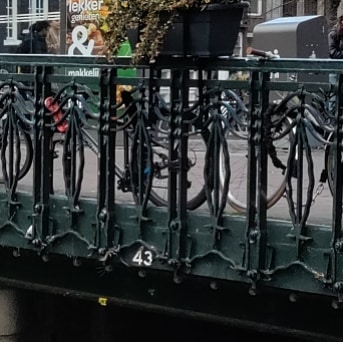
A Rijksmonument Fixed Bridge on the Leidsestraat at the Keizersgracht, Carrying Trams 2 and 12 Across One of Amsterdam’s Busiest Shopping Streets
Bridge 43 has carried more trams, more cyclists, more shoppers, and more tourists than almost any other crossing in Amsterdam’s canal belt. It sits in the Leidsestraat where it crosses the Keizersgracht, one of the busiest pedestrian and tram junctions in the inner city, and it has been doing so since 1922 in the form Piet Kramer gave it. It carries no name. It is simply Brug 43. But it is one of the best-documented, most precisely dated, and most architecturally significant bridges in the entire series, and the story of how it came to be built, through a decade of committee decisions, a world war, wooden blocks that swelled in the rain, and trams that could not pass each other on a single track in the frozen winter of 1921 to 1922, is one of the most entertaining in the history of Amsterdam’s infrastructure.
Bridge 43 Unnamed. Brug drieënveertig.
This wide road bridge, over which tram lines 2 and 12 run, is located on the Leidsestraat and spans the Keizersgracht in the historic Amsterdam Canal Belt. The design is another by the “new bridge man” in Amsterdam during the early part of the 20th centruy, Piet Kramer and is a national monument since 2001. Like another bridge along Leidsestraat, bridge 29 de koningssluis, Hildo Krop had already made a design for a number of sculptures for the bridge and Johan Polet ‘s stonemason manufactured the statues.


1. Etymology and Naming: No Official Name, But a Bridge That Belongs to a Famous Street
Bridge 43 carries no official name and has never carried an informal one. Its identity is entirely bound up with the street it carries: the Leidsestraat, one of Amsterdam’s most celebrated and commercially dense shopping streets, running from the Leidseplein in the south to the Koningsplein and the Singel in the north, crossing the Prinsengracht, Keizersgracht, and Herengracht on the way.
The road bridge, over which tram lines 2 and 12 in particular run, lies in the Leidsestraat and spans the Keizersgracht in the Amsterdam canal belt. The Leidsestraat takes its name from the city of Leiden, the road along which travellers and merchants historically set out toward that city. From the later 17th century onward, it developed as a fashionable shopping street, and its canal crossings became among the most-used in the city.
Bridge 43 forms a trio with Bridge 29 (the Koningssluis at the Herengracht) and Bridge 68 (the Aalmoezeniersbrug at the Prinsengracht), all three spanning the three great concentric canals in the Leidsestraat sequence, all three built at the same moment from the same design programme, and all three carrying the same mythical creatures by Hildo Krop on their abutments. These four mythical creatures by Hildo Krop from 1916 are also found on bridges 29 and 68.
2. Structural Evolution: A 50-Year Series of Delays, Wooden Blocks That Failed, and a Frozen Winter
There has been a bridge here for centuries. City architect Daniël Stalpaert drew the bridge into his map of 1662, but the surroundings are still indicated as undeveloped. Frederik de Wit’s map of 1688 shows the bridge.
The modern history of Bridge 43 begins with a series of municipal decisions that reads, in its accumulated delays and obstacles, as a small comedy of civic governance. The modern history of the bridge begins in 1873, when the city council accepted a plan for the lowering of the bridge: both the bridge and the Leidsestraat needed to be prepared for increasing traffic. The Leidsestraat was given pavements at the same time.
This proved insufficient almost immediately. In 1880 new plans arrived: for and after the bridge, points needed to be created for the tram lines and it needed to be capped (afgetopt). Decision-making was delayed because the predecessor of the bridge over the Prinsengracht, after a similar adaptation for traffic, had proved more difficult to use.
The next crisis was purely material. In 1889 the bridge was struck by a strange phenomenon. The wooden blocks that lay between the rails shrank in the heat, the jointing cement dried out and cracked. As soon as it began to rain, rainwater reached the wooden base, which swelled and pushed the wooden blocks out of position. The bridge became impassable.
The decisive commission finally arrived in 1911. In 1911 a decision was made on the definitive widening of the bridge. Bridge architect Jo van der Mey of the Dienst der Publieke Werken designed a series of bridges at that time, because the bridges over the Herengracht and Prinsengracht also needed to be adapted. Execution was (again) delayed. In 1913 there were proposals to widen the Leidsestraat considerably due to ever-increasing traffic. A consequence would have been the demolition of a series of houses. An alternative for the traffic flow was the filling in of the Leidsegracht.
Then came the First World War. Although the city council approved the plans in March 1916, the bridges were not delivered until 1921 and 1922 due to the shortage of materials as a result of the First World War. Hildo Krop had designed the mythical creatures in 1916, five years before the bridge was actually built.
At the end of 1921 the municipality began with the replacement of the bridge. The design had by that point been adapted by the “new bridge man” in Amsterdam, Piet Kramer. He modified Van der Mey’s design but left the cantilevers on the bridge piers untouched. During the construction of the bridge, trams continued to run over it, but on single track. The trams could no longer pass each other on the bridge, which led to considerable delay. The winter of 1921 to 1922 proved so severe that the work was further delayed by frost. Only in mid-1922 was the bridge delivered.
3. Architectural Lineage: Kramer’s Modifications, Krop’s Fabeldieren, and the Rijksmonumentenregister’s Description
Bridge 43 is the bridge in the Leidsestraat sequence where Kramer’s independence from Van der Mey’s original design is most clearly documented. Unlike Bridge 30, where Kramer largely retained Van der Mey’s concept, and unlike the Koningssluis (Bridge 29), which involved Kramer adapting Van der Mey’s framework while keeping the piers, here Kramer made an almost entirely new design while preserving only the cantilever profile of the piers.
The Rijksmonumentenregister entry, monument number 518394, provides the most authoritative physical description of the bridge’s architectural character: in 1921, as a result of a conversion, a fixed plate or girder bridge (vaste plaat- of balkbrug) with three navigation openings came into being, to a design in Amsterdam School style by P.L. Kramer, commissioned by the bridges division of the then Dienst der Publieke Werken of the municipality of Amsterdam. The sculptural work was designed in 1916 by Hildo Krop and executed by the firm Johan Polet. The abutments and piers are of brick and natural stone. The wings are of brick in a horizontally stepped form, in which a masonry motif has been incorporated, with at the underside near the waterline blocks of natural stone, and covered by sculpted cover plates of grey granite with representations of a mythical creature (4x). The piers are in a vertically stepped form, transitioning into cantilevers of natural stone. Straight steel edge beams with profiled cover strips and balustrades of ornamental wrought ironwork, fixed to the cover strip and the cantilevers.
Kramer’s signature is evident not only in the sculptures but also in the balustrades of exceptional ornamental ironwork in the Amsterdam School style. The bridge has three navigation openings. The largest is 6.70 metres wide and has a height of 1.77 metres.
The mythical creatures on Bridge 43 are the earliest surviving example of the Krop-Kramer collaboration on bridge sculpture. One of the first commissions in the function of city sculptor was for Hildo Krop to make the decoration on the parapets of three bridges in the Leidsestraat. Krop probably worked from a design by architect Piet Kramer for the execution of the mythical creatures. The sculptures form a great unity with the geometric brick piers and are really not much more than worked cover stones. In later commissions for bridges, Krop himself made the designs and the sculptural work gained an increasingly prominent position.
This observation is architecturally important. The fabeldieren of 1916 on Bridge 43 are the point of departure: the moment when sculpture and bridge architecture began their integration at Publieke Werken, before Krop had fully developed his independent sculptural vocabulary. Looking from Bridge 43 to the P.L. Kramerbrug (Bridge 400) or to the Hildo Kropbrug itself is to trace a developmental arc that begins here, at the Keizersgracht crossing of the Leidsestraat.
4. Urban and Social Context: Traffic Bans, Trams, and the Keizersrace
Bridge 43’s urban life after completion has been as eventful as its construction. In 1960, traffic again came to a standstill; the approach ramp to the bridge had been damaged and needed to be renewed. A large sandpit arose which children immediately put to use as a playground. In 1971 the bridge was again a point of discussion; the traffic in the Leidsestraat and its bridges was described by the NRC as life-threatening. This ultimately led to a general ban on traffic in the street from 26 July 1971, except for trams and loading and unloading traffic at certain hours. Only on the bridges is traffic still possible, but then only from one quay to the other.
The traffic ban of 1971 transformed the Leidsestraat into the pedestrianised shopping street it is today, while keeping the bridge itself as the crossing point for the trams that now run in what is otherwise a car-free zone. Bridge 43 therefore sits in an unusual urban condition: the street it carries has been banned to cars for over fifty years, yet the bridge remains a traffic structure, serving trams lines 2 and 12 on tracks that have crossed the Keizersgracht here since the 1920s.
The Keizersrace is a sprint race held between the Leidsestraat and the Spiegelgracht. The winner may call himself the Keizer (Emperor) of Amsterdam. The race was held in 1991, 1996, 1997 and 2012. The race, run along the length of the frozen Keizersgracht in those rare winters when the ice holds, uses Bridge 43’s crossing as one of the visual markers of the course. The canal bridge that was built through a winter of frost delays has become the frame for a winter race on the frozen surface below.
The Leidseplein is a five-minute walk south along the Leidsestraat. The Stadsschouwburg (now DeLaMar Theatre) and the Melkweg music venue are in the same area. The Rijksmuseum is accessible via the Nieuwe Spiegelstraat from Bridge 42 a few hundred metres along the Keizersgracht. The Felix Meritis building at Keizersgracht 324, an Enlightenment-era cultural society building, is visible from the bridge looking north.
5. Technical Specifications
Based on confirmed sources, including the official Rijksmonumentenregister entry (monument number 518394), the following can be stated:
- Bridge type: Fixed plate or girder bridge (vaste plaat- of balkbrug), three navigation openings
- Location: Leidsestraat over the Keizersgracht, Amsterdam-Centrum
- Canal: Keizersgracht (dug from 1615, widest canal in Amsterdam’s inner city at 28.31 metres; UNESCO World Heritage Canal Belt, listed 2010)
- Tram lines: 2 and 12 (current); trams have crossed here since the Leidsestraat tram route was established
- Part of a trio: Bridge 43 forms a series with Bridge 29 (Koningssluis, Herengracht) and Bridge 68 (Aalmoezeniersbrug, Prinsengracht); all three carry the same Hildo Krop mythical creatures from 1916
- Cartographic record: Daniël Stalpaert’s city plan, 1662; Frederik de Wit’s map, 1688
- 1873: First lowering, Leidsestraat given pavements
- 1880: Plans for additional capping and tram points; delayed by lessons from Bridge 68
- 1889: Wooden rail blocks swelled in rain, bridge became impassable
- 1911: Jo van der Mey commissioned to design all three Leidsestraat bridges as a unified sequence
- 1916: Municipal council approved plans; Hildo Krop designed the mythical creatures; First World War caused material shortages
- Late 1921 to mid-1922: Construction; trams ran on single track during works; severe winter caused frost delays
- 1960: Approach ramp damaged and renewed; improvised sandpit appropriated by local children
- 1971: Traffic ban on the Leidsestraat (26 July), except for trams and loading vehicles
- Design: Jo van der Mey (original concept, 1911); Piet Kramer (modified and executed design, retained Van der Mey’s pier cantilevers); Hildo Krop (sculptural programme, designed 1916, executed by Johan Polet)
- Materials: Brick and natural stone abutments and piers; horizontally stepped brick wings with masonry motif; natural stone blocks at waterline; four grey granite cover plates with mythical creatures (fabeldieren) by Hildo Krop; vertically stepped piers with natural stone cantilevers; straight steel edge beams; ornamental wrought iron balustrades
- Navigation opening: Largest 6.70 metres wide, 1.77 metres high
- Monument status: Rijksmonument (national monument) since 2001, monument number 518394
- Wikidata: Q18048079
Sources Consulted
- Bruggenvanamsterdam.nl, bridge register entry for Brug 43
- Wikipedia (nl), “Brug 43”
- Amsterdam op de kaart, “Brug 43, Leidsestraat” (Publieke Werken, P.L. Kramer, 1921)
- Rijksmonumentenregister, monument 518394, “Plaat- of balkbrug”
- Hildo Krop archive, “B 6, Brug nrs. 29, 43 en 68, Leidsestraat bruggen, Amsterdam”
- Buitenbeeldinbeeld.nl, “Fabeldier (1916), Hildo Krop, Leidsestraat Amsterdam”
- Amsterdam op de kaart, “Hildo Krop”
- Wikipedia (en), “Hildo Krop”
- Ons Amsterdam, “Vijftig jaar geleden overleed stadsbeeldhouwer Hildo Krop”
- Amsterdamse School database, “Hildo Krop”
- Wikipedia (en), “Keizersgracht”
- Bruggenvanamsterdam.nl, “Aalmoezeniersbrug, Bridge 68”
- Sebas Baggelaar and Pim van Schaik, “Piet Kramer, Bruggenbouwer van de Amsterdamse School,” 2016, ISBN 9789079156313
- Wikimedia Commons, Category: Brug 43 (Amsterdam)
- Stadsarchief Amsterdam Beeldbank, 10 photographs related to this address: (search: “brug 43 Leidsestraat Keizersgracht”)
Public Domain Images

1. Stadsarchief Amsterdam Beeldbank: “De Vijzelstraat gezien vanaf de brug over de Keizersgracht richting Herengracht, vóór de verbreding in 1917,” c. 1916 This photograph from the Stadsarchief Amsterdam is described in the bridges.cramberts.com entry for Bridge 41 as showing the Vijzelstraat from the bridge over the Keizersgracht toward the Herengracht, before the widening in 1917. An equivalent view from the Leidsestraat side, showing the pre-Kramer bridge over the Keizersgracht, is available in the Stadsarchief Beeldbank under bridge 43, Leidsestraat. The Stadsarchief holds ten photographs related to this address. Available for non-commercial use with attribution. URL: https://archief.amsterdam/beeldbank (search: “brug 43 Leidsestraat Keizersgracht”) Attribution: “Collectie Stadsarchief Amsterdam. Available for non-commercial use with attribution.”

2. Wikimedia Commons: Category Brug 43 (Amsterdam) contemporary photographs The Wikimedia Commons category for Bridge 43 holds contemporary photographs of the bridge showing the ornamental wrought iron balustrades, the brick and natural stone piers, and the mythical creature cover plates in their full urban context. Available under free licences. URL: https://commons.wikimedia.org/wiki/Category:Brug_43_(Amsterdam) Attribution: “Wikimedia Commons, Category: Brug 43 (Amsterdam). Available under the licences specified on individual file description pages.”
Brug 43 map and location
Like most other bridges in Amsterdam’s 17th-century Canal Ring which was added to the UNESCO World Heritage List in 2010, there has been a bridge here for centuries. City architect Daniël Stalpaert already drew a bridge here on the design part of his map of 1662 although like #bridge41 and #bridge42 the district still had to be built around them at that time. Frederick de Wits map from 1688 however showed almost complete buildings along with the bridges.


Bridge 43 history and information
The modern history of #bridge43 begins in 1873, when the council had a plan to lower the bridge: the bridge and the Leidsestraat was being prepared for the anticipated increasing traffic. This turned out to be insufficient so new plans were made in 1880; before and after the bridge there needed to be switches for the tram lines. The decision was delayed because the predecessor of this bridge #bridge68 over the Prinsengracht turned out to be difficult for traffic. In 1911 it was decided to widen the bridge permanently. The bridge architect Jo van der Mey of the Public Works Department had already designed a series of bridges including bridges over Herengracht #bridge29 and Prinsengracht #brug68 Implementation was delayed in 1913 as proposals were made to widen the Leidsestraat considerably because of the ever-increasing traffic. Then the First World War broke out there was a huge price increase of the necessary building materials. Hildo Krop had already designed a number of sculptures for the bridge. At the end of 1921, the municipality finally started replacing the bridge. The design had meanwhile been adapted by the “new bridge man” in Amsterdam, Piet Kramer and he changed Van der Mey’s design, hence the now familiar style of this bridge. In 2001 the bridge was declared a national monument.


Pictures from Amsterdam Archive
1 Winter view: Keizersgracht. Viewed in a westerly direction from bridge 43 between Leidsestraat and Leidsegracht. Meijer, A.H. februari 1954
2 Department store Metz & Co, Keizersgracht 455 corner of Leidsestraat with Bridge 43 in front, Han van Gool 1990
3 Seen from bridge 43 in the Leidsestraat, Frans Busselman February 8, 1981
4 Leidsestraat, bridge 43 over the Keizersgracht, designed by Piet Kramer in 1921, 1953 ca. t/m 1995 ca.
5 The Keizersgracht, seen from the Spiegelstraat to the bridge 43 in the Leidsestraat Collectie Atlas Dreesmann 1867 t/m 1875
6 Bridge 43 over the water of the Keizersgracht at the Leidsestraat Collectie Bureau Monumentenzorg: negatiefvellen 1953 ca. t/m 1995 ca.
7 Panorama of the Keizersgracht and the Leidsestraat, seen in a south-westerly direction towards the Leidseplein, Anonie