The Gentlemen’s Canal: Amsterdam’s Richest Address, the Golden Bend, and the Twelve Bridges That Cross It
If the Singel is the canal that defended Amsterdam, the Herengracht is the canal that displayed it. This is the innermost and the grandest of the three great rings dug in the seventeenth century, the address the wealthiest merchants of the Dutch Golden Age chose above all others, and the place where the city’s money made itself visible in stone.
The name means “Gentlemen’s Canal,” and it is not a courtesy. The Herengracht was zoned, priced and built for the people at the top, and four centuries later it still reads that way.
The Plan: Three Rings, in Descending Order of Grandeur
The canal ring was not organic. It was a planned development, laid out in stages through the seventeenth century as Amsterdam’s population rose from roughly fifty thousand to two hundred thousand in sixty years, and the three main canals were given distinct characters from the outset.
The Herengracht was the most prestigious, closest to the old city. The Keizersgracht came next, broad and merchant-solid. The Prinsengracht was the outermost, more mixed, with warehouses and workshops among the houses. The plots were sold to private buyers who built to their means within municipal rules, which is why the canal ring is simultaneously uniform in rhythm and endlessly varied in detail.
Until 1663, the Herengracht reached only as far as the present Leidsegracht. The decisive change came in 1664, when the fortifications around Amsterdam were enlarged and all three canals were greatly extended eastward and southward.
The Golden Bend: Where the Plots Got Deeper
That 1664 extension produced the single most famous stretch of canal in the Netherlands: the Gouden Bocht, the Golden Bend, running between the Leidsestraat and the Vijzelstraat.
The reason it exists is a matter of geometry and permission. In the new section the three canals were laid out slightly further apart than before, and the building lots were correspondingly deeper. Buyers on the Herengracht were encouraged to purchase two adjacent lots and build double-fronted mansions across them, a scale of house impossible on the older, narrower plots further north.
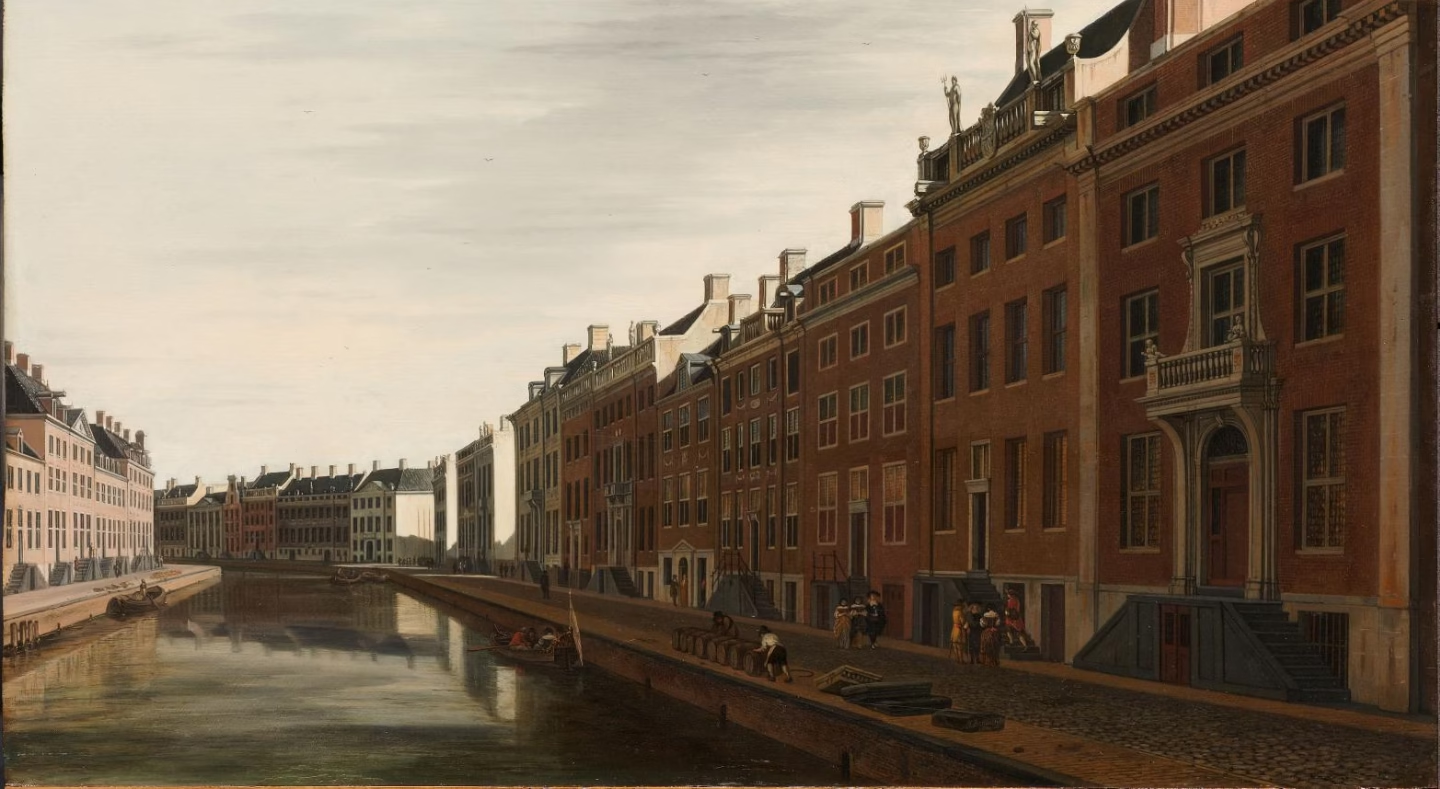
What went up on those double plots were effectively city palaces: classical façades, stuccoed ceilings, formal gardens behind. The curve near the Nieuwe Spiegelstraat drew the very richest citizens of the city, and the name followed. Gerrit Berckheyde painted the view more than once in the 1670s, and those canvases, now in the Rijksmuseum and elsewhere, are among the earliest examples of a European city treating its own new residential architecture as a subject worth painting.
There is a curiosity here that we have written about separately: the Golden Bend has no bridges. The most celebrated stretch of the most prestigious canal is uncrossed, and the reason is precisely the wealth that built it.

The Cromhout Houses and the Museum of Bibles
The best surviving demonstration of what Golden Age money bought on this canal is the group of four houses known as the Cromhouthuizen, at Herengracht 362–370, between the Huidenstraat and the water.
They were designed by Philips Vingboons in the style of Dutch Classicism and built between 1660 and 1662 for the merchant Jacob Cromhout (1608–1669). Vingboons is the architect who did more than anyone to define what a wealthy Amsterdam canal house looks like, and four of his houses in a row, built as a single commission, is as concentrated a statement of his work as the city offers.
Number 366 has a particular afterlife. It was bought in 1887 by the Netherlands Bible Society and became known as the Bijbelhuis; iron columns were installed in the cellar to carry the weight of the Bibles stored there. The Bijbels Museum occupied the Cromhouthuizen until July 2020, and has since become a travelling museum without a fixed home. The houses themselves remain, and the cellar columns remain with them, structural evidence of a very literal weight of scripture.
The Museum of the Canals
Also on the Herengracht is the Grachtenmuseum, the Museum of the Canals, housed in a seventeenth-century canal house with classical period rooms, a canal garden and a permanent multimedia exhibition on the history of the ring itself.
Its founding date is telling. The museum opened in April 2011, prompted directly by the addition of the Amsterdam canal belt on the UNESCO World Heritage List the previous year. It closed shortly afterwards for restoration and reopened at the end of March 2012. A museum about the canals, created because the canals had just been recognised as world heritage, installed in one of the canal houses it exists to explain.
Museum Willet-Holthuysen: A House Given to the City on One Condition
At Herengracht 605 stands the house that shows most clearly what these addresses were for. It was built around 1685 for Jacob Hop, a mayor of Amsterdam, and in 1739 its exterior was remodelled in the then-fashionable Louis XIV style, the frontage you see today.
Its survival is owed to a bequest with strings attached. In 1895 the owner, Louisa Holthuysen, left the building and everything in it, including the art she and her husband Abraham Willet had collected, to the city of Amsterdam, on the condition that it become a museum bearing both their names. The city accepted, and the condition has been honoured for well over a century.
That clause is why the house is not an approximation of an interior but an actual one: the furniture, the paintings, the garden and the arrangement are what a wealthy Amsterdam couple left behind, rather than a curator’s reconstruction of what they might have had.
The KattenKabinet, and the Van Loon Brothers
At Herengracht 497, in the Golden Bend itself, is a museum devoted entirely to art depicting cats. The KattenKabinet is easy to treat as a novelty but worth taking seriously, because the building is a first-rank Golden Bend house.
Number 497 and its neighbour at 499 were built in 1667 for the patrician brothers Willem and Adriaen van Loon, the same family whose later house on the Keizersgracht is now Museum Van Loon. Two brothers building side by side on the most expensive stretch of the most expensive canal is exactly the pattern the 1664 extension was designed to encourage. Later residents included the Amsterdam mayor Jan Calkoen and the city pensionary Engelbert François van Berckel.
The cats, it turns out, are a way into one of the few Golden Bend interiors a visitor can walk through at all. Most of these houses are offices, consulates or private homes; this one is open because a grieving owner made a museum for his cat.
Huis Bartolotti: De Keyser on the Bend of the Canal
Further north, where the Herengracht curves, stands Huis Bartolotti, built around 1620 for the banker and merchant Willem Bartolotti van den Heuvel, and most likely designed by Hendrick de Keyser, the city stonemason whose churches define the skyline of this part of Amsterdam.
It is the counter-example to the Golden Bend. Built four decades earlier, before the classical restraint of Vingboons and his contemporaries took hold, its red-brick façade is extravagantly ornamented with sculptural decoration, curving with the line of the canal. Set it beside the Cromhouthuizen and you can watch Amsterdam’s taste change within a single generation: exuberant Dutch Renaissance giving way to sober Dutch Classicism, on the same canal, a few hundred metres apart.
The Bridges of the Herengracht
Twelve of the numbered bridges cross the Herengracht in our coverage so far, running from Bridge 18 near the northern end down to Bridge 35 at the edge of the Golden Bend. Several are named for people rather than places, a consequence of the city’s recent naming programme, which has been giving Amsterdam’s anonymous crossings the names of citizens who deserved commemorating.
- Bridge 18: Hans van Mierlobrug
- Bridge 19: Brug negentien
- Bridge 20: Anton Jolingbrug
- Bridge 22: Warmoesbrug
- Bridge 24: Brug Vierentwintig
- Bridge 25: De Rachel Ruyschbrug
- Bridge 26: The crossing that once honoured Philips Vingboons
- Bridge 29: De Koningssluis
- Bridge 30: De Isa van Eeghenbrug
- Bridge 32: Kaasmarktsluis
- Bridge 34: The unnamed crossing at the Golden Bend’s edge
- Bridge 35: De Hendrick Jacobsz. Staetsbrug
Bridge 34 has a second life worth noting. It was one of three inner sluices along the Utrechtsestraat, with Bridge 37 on the Keizersgracht and Bridge 75 on the Prinsengracht, built to hold back water from the Amstel until the Amstelsluizen of 1673 made the whole arrangement redundant.
Sources Consulted
- Herengracht, Wikipedia
- Gouden Bocht, Wikipedia
- Cromhouthuizen, Wikipedia; Stadsherstel Amsterdam
- Bijbels Museum, Wikipedia
- Grachtenmuseum Amsterdam, Nederlandstalige Wikipedia
- Gerrit Berckheyde, View of the Golden Bend in the Herengracht, Rijksmuseum
- UNESCO World Heritage Centre, list 1349