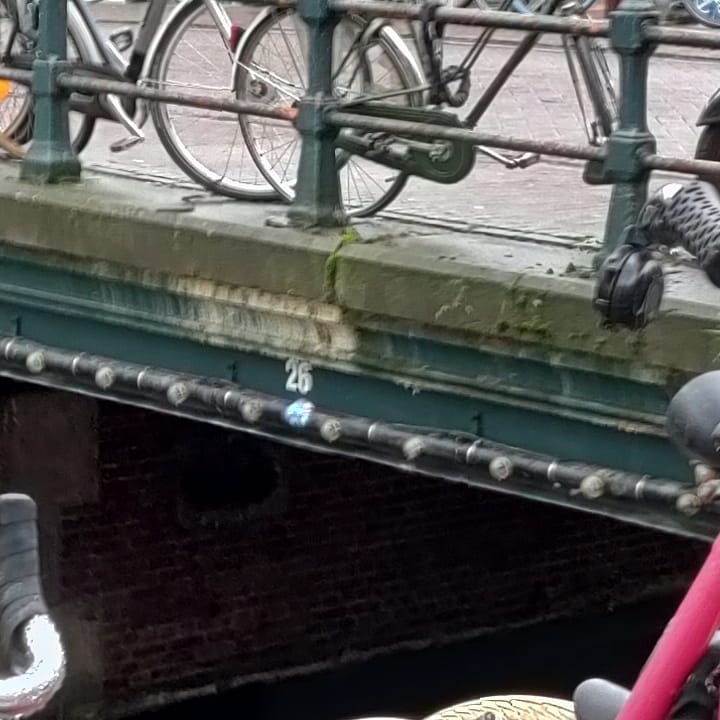
Bridge number 26. (Brug zesentwintig) Unnamed.
Again on the ‘gentleman’s canal’. Another slightly unloved bridge that is neither named nor a monument. The bridge was unofficially designated as the Vingboons Bridge, after the architect Philips Vingboons, who designed the ‘Vingboon’ houses at Herengracht 362-370 all of which are national monuments. In 2016 however, this bridge along with many of our other bridges so far, became unnamed as all unofficial names of bridges expired. Located along the Herengracht rests yet another bridge that often goes unnoticed. This particular bridge lacks both an official name and the status of a monument, making it somewhat unremarkable. Unofficially referred to as the Vingboons Bridge, it derived its name from the renowned architect Philips Vingboons. Philips Vingboons is best known for his exceptional work on the ‘Vingboon’ houses located at Herengracht 362-370, each one deemed a national monument. Unfortunately, in 2016, numerous bridges, including this one, lost their unofficial names as all such designations expired.


A Fixed Steel Bridge on the Herengracht, Between the Wijde Heisteeg and the Huidenstraat
There is something quietly instructive about a bridge that used to have a name and no longer does. Bridge 26 on the Herengracht is precisely that: a crossing that for decades was known informally as the Vingboonsbrug, after one of the most important architects of the Dutch Golden Age, until Amsterdam’s municipality tidied away all unofficial names in 2016 and left it simply as Brug 26 in the register. The bridge has not changed. The canal houses it faces have not changed. But the name that once connected it to a remarkable story of 17th-century architecture and civic ambition is gone. This post sets out to recover that story and place the bridge back in the context it deserves.
1. Etymology and Naming: A Vanished Nickname and the Architect Who Earned It
Bridge 26 is a fixed steel bridge over the Herengracht, situated between the Wijde Heisteeg and the Huidenstraat. Both streets it connects are part of the Nine Streets district, and both carry names rooted in the pre-canal history of the area. The names of the streets are reminders of the types of work carried out here in centuries past, especially the processing of skins, including cow, bear, wolf, and roe deer hides. Huidenstraat, on the southern side of the bridge, translates directly as Skins Street or Hides Street, a name that places the bridge at the tanning end of the district’s historical geography.
The Wijde Heisteeg, on the northern side, has a different register. The alley takes its name from the Heisteeg, which it extends, and which dates from the previous city expansion. The name Heisteeg derives from heath or wasteland, referring to the open, uncultivated ground that lay here before the canal ring was constructed. The street dates from the 16th century, making it one of the older alignments in this part of the city, predating the canal ring itself.
The bridge’s former informal name, Vingboonsbrug, honoured the architect Philips Vingboons, whose most celebrated surviving works stand directly beside it. Until 5 July 2016, the bridge was unofficially known as the Vingboonsbrug, named after the architect Philips Vingboons, who designed the four Cromhouthuizen at Herengracht 362 to 370. Since that date, the unofficial name has been abolished.
The removal of the name was not a judgment on the man. It was the application of Amsterdam’s policy of retaining only officially approved bridge names, which came into force across the entire city on 5 July 2016. The informal Vingboonsbrug, however well-earned, had never been formally adopted, and so it was quietly dropped. It is one of many small losses in Amsterdam’s urban memory that pass without ceremony.
Philips Vingboons himself deserves a fuller introduction. Vingboons was born around 1607 in Amsterdam. His father David Vinckboons was a painter from the Southern Netherlands who had fled from Antwerp to Amsterdam during the Dutch Revolt. Vingboons is particularly well named as the inventor of the Amsterdam “halsgevel,” the neck gable facade type, since in 1638 he designed the oldest surviving example in Amsterdam, at Herengracht 168. This facade type was widely imitated during the period of Dutch Classicism from 1640 to 1665. Vingboons knew how to fit classicism creatively with the typically narrow city houses of Amsterdam, and became the city’s most important architect and designer during the high point of its power and wealth.
The four Cromhouthuizen that stand directly beside Bridge 26, and which gave the bridge its former name, are his finest surviving group of canal houses. The Cromhouthuizen consist of four consecutive canal houses on Herengracht at numbers 362 to 370. They were designed by Philips Vingboons in the style of Dutch Classicism and built between 1660 and 1662 for the merchant Jacob Cromhout (1608 to 1669). The four houses have stone facades decorated with triangular pediments. Natural stone is virtually non-existent in the Netherlands, which makes them quite unusual in the canal belt. The material used to construct the facades must have come from Germany or Wallonia, transported on a large barge, and would have been a costly statement of ambition and prosperity. Since 1970, the buildings have been protected as Rijksmonumenten (national monuments).
2. Structural Evolution: A 1781 Bridge Replaced in 1892, Renovated in 1957
The structural history of Bridge 26 is documented with satisfying precision. The predecessor of the current bridge dated from 1781 and was entirely renewed by Publieke Werken in 1892. In 1957, the bridge underwent a renovation.
This sequence tells a clear story. The 1781 bridge was an 18th-century structure, almost certainly arched and built at a height appropriate for the canal traffic of that period. By the late 19th century, the demands placed on Amsterdam’s bridges had changed fundamentally. The electric tram, introduced to Amsterdam’s streets from 1900 onward, required flat crossings with no steep ramp approaches. Even bridges that did not carry tram lines were subject to the general city-wide policy of replacing high arched structures with flat ones, both to ease traffic flow and to standardise the appearance of the canal belt.
The 1892 complete renewal by Publieke Werken is therefore a product of the same modernisation drive that reshaped dozens of Herengracht crossings during this period. The bridge that emerged from that renewal is the structural ancestor of what stands today: a flat, fixed crossing in steel, built to last and to serve.
The 1957 renovation is noted in the municipal record without further detail in the sources consulted for this post. Given the date, it most likely involved a renewal of the road surface and possible structural reinforcement, consistent with the mid-century maintenance programme carried out on many canal belt bridges of similar age.
A photograph from November 2011, held in the Amsterdam op de kaart image collection, shows the bridge clearly with the remark: “Vermoedelijk zijn oude stenen pijlers hergebruikt bij de verbreding van de brug,” meaning that the old stone piers were probably reused when the bridge was widened. This detail, if confirmed, would mean that some physical fabric from the 1781 or earlier structure still exists within the current bridge, a remarkable continuity hidden beneath a 19th-century steel deck.
3. Architectural Lineage: Publieke Werken, 1892, with No Amsterdam School Attribution
The 1892 reconstruction of Bridge 26 predates both the Amsterdam School movement and the appointments of Piet Kramer and Johan van der Mey as aesthetic advisers at Publieke Werken. The bridge was designed by Publieke Werken. No individual architect’s name is attached to Bridge 26 in any source consulted for this post.
The bridge therefore belongs to the generation of Publieke Werken engineering that preceded the decorative ambitions of the Kramer era: functional, steel-framed, built to meet the demands of a growing city without the wrought iron railings of custom design, the granite nose stones, the abutment sculptures, or the bridge keeper’s houses that would come to define the later Amsterdam School crossings along the same canal. It is honest civil engineering of the late 19th century, and it does not pretend to be anything else.
What it does possess is a setting that few Amsterdam School bridges can match. Standing on Bridge 26 and looking south toward the Cromhouthuizen, you are looking directly at one of the finest groups of 17th-century canal architecture in the city, all dressed Bentheim sandstone, triangular pediments, and neck gables of a type that defined the Golden Age aesthetic for generations. The bridge is the frame; Vingboons’ houses are the picture.
4. Urban and Social Context: The Nine Streets, the Cromhouthuizen, and a View Worth Pausing For
Bridge 26 occupies a distinctive position within the Negen Straatjes grid. The Negen Straatjes comprises nine side streets off the Prinsengracht, Keizersgracht, Herengracht and Singel in central Amsterdam. The construction in this area goes back to the first half of the 17th century, and the neighbourhood contains more than 140 national and municipal monuments. Bridge 26 sits between the Wijde Heisteeg and the Huidenstraat, two of the three Singel-side alleys that form the western edge of the nine-street grid.
The bridge carries only pedestrians and cyclists, and the Wijde Heisteeg itself is a narrow alley by Amsterdam standards, running from the Singel to the Herengracht through a row of protected 17th and 18th-century facades. This makes the crossing quiet by the standards of the inner canal belt. The Herengracht at this point is broad and tree-lined, and the view from the bridge deck in both directions is among the more composed canal panoramas in this part of the city.
Directly beside the bridge, the Cromhouthuizen at numbers 364 to 370 stand as they have since 1662. The museum that occupied numbers 366 and 368 for decades has now departed: the Biblical Museum was located in the Cromhouthuizen from 1975 until July 2020, when it closed its permanent presentation at the Herengracht location and became a nomadic museum. The buildings themselves, however, remain protected Rijksmonumenten in the ownership of Stadsherstel Amsterdam, and the Cromhouthuis at number 366 continues to operate as a museum telling the story of the Cromhout family and their role in Amsterdam’s Golden Age. These houses stand today as impressive and fine as they were in the Golden Age, and are among the most beautiful and sumptuous canal houses in the Amsterdam Grachtengordel.
The Herengracht Canal Museum is also within easy walking distance, housed in Vingboons’ own building at number 386. The building at Herengracht 386 was commissioned by the wealthy merchant Karel Gerards, who assigned Philips Vingboons to design and build it in 1663. The museum features interactive multimedia exhibits tracing the engineering feats behind the 17th-century canal ring’s construction. For anyone who crosses Bridge 26 curious about the Vingboons connection, the museum is the logical next stop.
5. Technical Specifications
Based on confirmed sources, the following can be stated:
- Bridge type: Fixed bridge (vaste brug), steel construction
- Location: Wijde Heisteeg/Huidenstraat over the Herengracht, Amsterdam-Centrum
- Canal: Herengracht (UNESCO World Heritage Canal Belt, listed 2010)
- Predecessor: Bridge dating from 1781
- Current structure date: 1892, entirely rebuilt by Publieke Werken
- Renovation: 1957
- Possible surviving fabric: Old stone piers from the earlier structure may have been reused in the widening of the bridge, according to the Amsterdam op de kaart photographic notes
- Designer: Dienst der Publieke Werken; no individual architect confirmed
- Amsterdam School attribution: None; predates Kramer’s 1917 appointment and van der Mey’s 1911 appointment
- Monument status: Gemeentelijk monument (municipal monument)
- Former name: Vingboonsbrug (informal, after architect Philips Vingboons); abolished 5 July 2016 under Amsterdam’s city-wide unofficial name removal policy
- Current official name: None; designated in the municipal register as Brug 26
Sources Consulted
- Bruggenvanamsterdam.nl, bridge register entry for Brug 26
- Amsterdam op de kaart, “Brug 26, Herengracht” (Publieke Werken, 1892)
- Amsterdam op de kaart, “Wijde Heisteeg”: amsterdamopdekaart.nl/1850-1940/Wijde_Heisteeg
- Wikidata, “Wijde Heisteeg” (street inception 16th century, BAG public space ID 0363300000004872)
- Wikipedia (en), “Negen Straatjes”
- Wikipedia (en), “Cromhouthuizen”
- Wikipedia (en), “Philips Vingboons”
- Stadsherstel Amsterdam, “Herengracht 366–368 (Cromhouthuizen)”
- Amsterdam Light Festival, “Cromhouthuizen: nouveaux riches”
- Museum het Grachtenmuseum (Herengracht 386), “About the building”: grachten.museum/en/about-the-building/
- Wikipedia (en), “Bijbels Museum”
- De 9 Straatjes, “History of De 9 Straatjes”

Map of Brug 26
The bridge connects Wijde Heisteeg with Huidenstraat and crosses Herengracht. It is an extension of the Heibrug (bridge 4) over the Singel. On the Eastern edge of the ‘negen straatjes’ shopping area, this bridge serves as a vital link between these bustling streets. Its elegant design and strategic location make it not only a practical infrastructure but also a charming addition to the cityscape. Offering a seamless connection, it enables residents and visitors alike to traverse the enchanting canal district, admiring the picturesque surroundings. With its historic significance and architectural beauty, the bridge stands as a testament to the rich heritage of the area, blending seamlessly into the timeless charm of Amsterdam.

Bridge 26 a little history
In the year 2016, all unofficial appellations of the bridges expired, and as a result, brug 26 remained nameless. Similar to numerous other bridges in the vicinity, a bridge has stood at this location for centuries, which is evident from its appearances on numerous antique maps. Towards the end of the 19th century, specifically within the last decade, this arched bridge with three thoroughfares was replaced by a plate bridge that also allowed for three passages. The bridge’s supports are notable for their peculiar widening form, designed to offer stability to the road surface. The gradual widening of the pillars is an architectural feature that catches the eye.
Image: Andries Jager created an arch bridge around (1867 to 1883) Herengracht seen from the Vierheemskinderensluis (Bridge 28) over the Leidsegracht to the Beulingstraat and the Vingboomsbrug (Bridge 26) between the Huidenstraat and the Wijde Heisteeg
