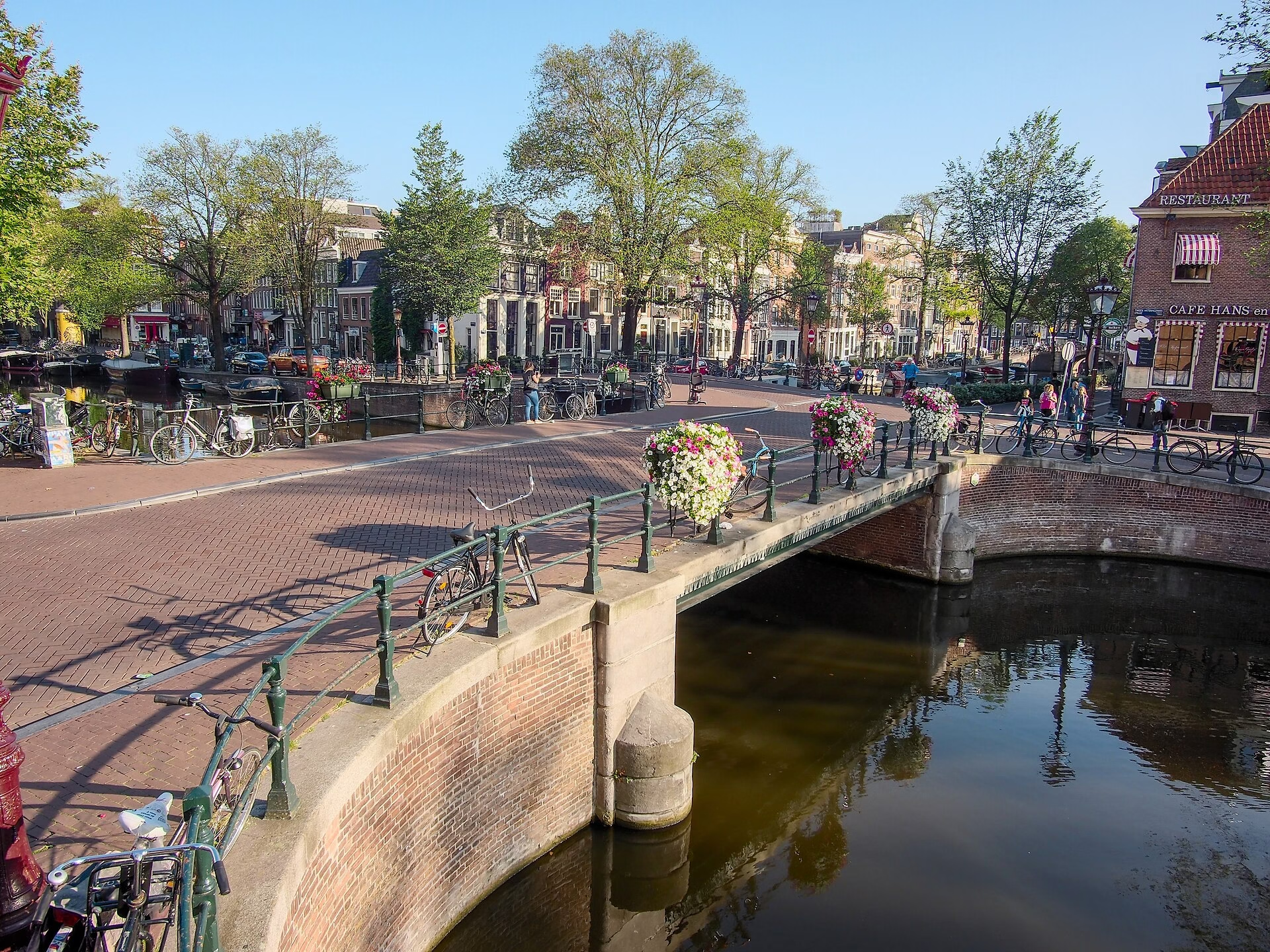
Egg Cups and Evictions: Brug 97 on the Lijnbaansgracht
Brug 97 is a plain beam bridge with two things worth stopping for: a set of ornaments known locally as eierdoppen, egg cups, and a place in one of the more violent episodes of Amsterdam’s squatting years.
It connects the Spiegelgracht to the Weteringschans and the Zieseniskade, crossing the Lijnbaansgracht.
The Twin of Brug 88
This bridge and Brug 88 have been treated as a pair for a century and a half, and their histories are almost inseparable.
- A crossing appears here on Daniel Stalpaert’s plan of 1662.
- The modern structure begins around 1876, with construction drawings and tenders.
- Brug 88 was lowered in 1877, shortly after 97 was completed, bringing the two into line.
- In 1914 both underwent major repairs together.
- In 1969 both were reconstructed together.
That pattern is the normal way Amsterdam maintains its network. Bridges on the same route, of the same age and construction, fail together and are treated together, because closing a street once costs less than closing it twice.
The Eierdoppen
The decorative elements are attributed to Willem Springer, assistant to the city architect Bastiaan de Greef and the man behind a great deal of Amsterdam’s nineteenth-century ornamental ironwork.
The eierdoppen are exactly what the nickname says: rounded finials that look like egg cups. It is a very Amsterdam sort of naming, unimpressed and domestic, applied to a piece of municipal decoration that was presumably intended to read as classical.
Springer and de Greef are the same pairing behind the Blauwbrug of 1883, and much of what visitors take for the old city is in fact their work: iron balustrades, hardstone piers and cast ornament produced in quantity between about 1870 and 1900.
The Grote Wetering, 1980
In 1980 the bridge was the site of conflict during the eviction of squatters from the Grote Wetering building.
That year was the peak of the Amsterdam squatting movement. The city had a severe housing shortage and a large stock of empty speculative property, and the kraakbeweging occupied buildings on the argument that empty housing in a housing crisis was indefensible. Evictions were fought street by street, and 30 April 1980, the day of Queen Beatrix’s coronation, produced running battles that included the Blauwbrug and gave A.F.Th. van der Heijden the title of his novel De slag om de Blauwbrug.
A narrow bridge is a natural choke point in a street fight, which is why so many of these confrontations are remembered by the crossing they happened on rather than the building they were about.
The Squatting Years
The confrontation at the Grote Wetering was not an isolated incident but part of a decade-long conflict over housing in Amsterdam.
The arithmetic behind it was stark. The city had a severe shortage of affordable homes while a large stock of buildings stood deliberately empty, held by owners waiting for permission to demolish or for prices to rise. The kraakbeweging, the squatters’ movement, occupied those buildings and argued that leaving housing empty during a housing crisis was the offence, not the occupation.
At its height the movement housed tens of thousands of people and had genuine political weight. Evictions required riot police, armoured vehicles and sometimes tanks, and they were fought in the streets. The city eventually changed course, buying up buildings and legalising many occupations, and a good deal of what is now ordinary Amsterdam housing association stock entered public hands that way.
Squatting was finally criminalised in the Netherlands in 2010. The bridges remember it because the fighting happened on them.
Working in Pairs, Again
The 1914 repairs and the 1969 reconstruction of bridges 88 and 97 together are worth flagging for anyone reading through this series, because the pattern is everywhere once noticed.
Amsterdam maintains its bridges by route rather than by structure. Crossings of the same age on the same street get surveyed together, fail together, and are funded together, and the disruption of closing a street is the dominant cost. When a bridge in this series has a rebuild date that seems unmotivated, the motivation is often a neighbour.
Technical Specifications
- Bridge number: 97
- Name: None, unnamed
- Type: Liggerbrug (beam bridge), metal construction
- Carries: Spiegelgracht to Weteringschans and Zieseniskade
- Spans: Lijnbaansgracht
- District: Amsterdam-Centrum
- Coordinates: 52.3616 N, 4.8870 E
- Earliest record: Stalpaert’s plan of 1662
- Modern structure begins: circa 1876
- Repaired: 1914, alongside Brug 88
- Reconstructed: 1969, alongside Brug 88
- Ornament: Eierdoppen (egg cups), attributed to Willem Springer
- Status: Not a monument, surrounded by monuments
Sources Consulted
- Featured image: Brug 97, Bridge 97, Amsterdam by Alf van Beem, 2017, via Wikimedia Commons, Public domain
- Brug 97, Nederlandstalige Wikipedia
- Kraakbeweging, Nederlandstalige Wikipedia
- Willem Springer, Nederlandstalige Wikipedia
- Lijnbaansgracht, Nederlandstalige Wikipedia
- Bruggen van Amsterdam
- Stadsarchief Amsterdam, Beeldbank
- Frank V. Smit, Bruggen in Amsterdam (2008), Uitgeverij Matrijs