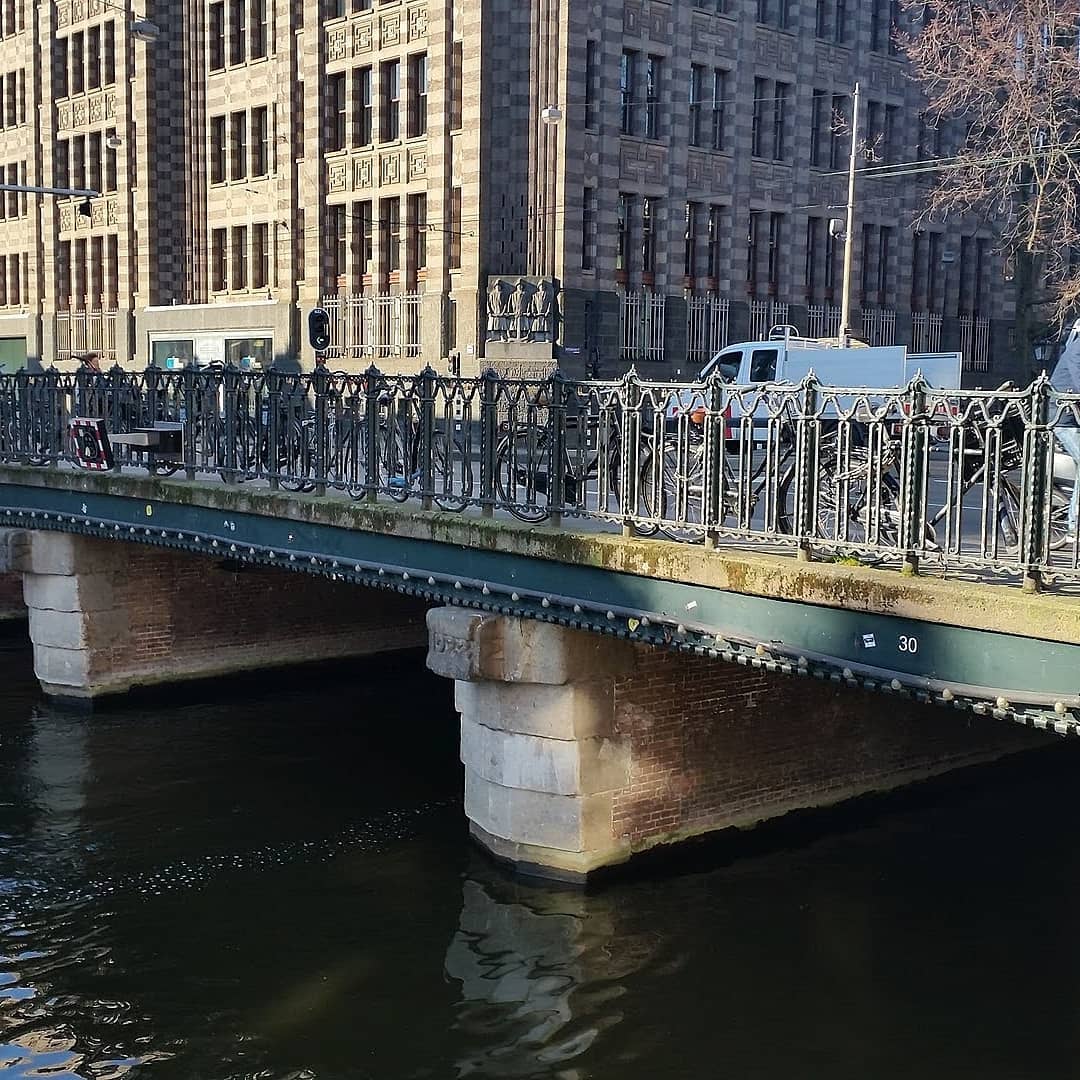
This bridge is currently undergoing renovations, so here are a couple of pictures to give you an idea of what it usually looks like.
Bridge number 30 (De Isa van Eeghenbrug), also known as brug nummer Dertig, is another impressive design created by Piet Kramer. Interestingly, this bridge was officially named in 2016 and is dedicated to Isabella Henriette van Eeghen, an esteemed archivist and historian at the nearby Amsterdam City Archives. Initially, the bridge was situated on the Amsteldijk. However, since 2007, it has found its home in the De Bazel Building on Vijzelstraat, right next to the bridge itself. The current bridge – assigned the number 30 – stands proudly over the Herengracht, spanning a location where a bridge has existed since approximately 1727.


A Piet Kramer Bridge on the Vijzelstraat, at the Herengracht
Some bridges carry the names of kings, admirals, or merchants who shaped their cities through power and commerce. Bridge 30 on the Vijzelstraat carries the name of a woman who spent her working life in an archive, never sought high office, and left behind a bibliography of approximately one thousand publications on the history of Amsterdam. The bridge was named in 2016 after the historian Isabella van Eeghen (1913 to 1996), who worked for more than thirty years at the municipal archive, now housed in the building immediately beside the bridge. The proximity is not coincidental. It is a piece of deliberate urban poetry: the woman who spent her life excavating the history of Amsterdam’s built environment is commemorated on the threshold of the archive that holds that history, at a bridge she must have crossed thousands of times.
1. Etymology and Naming: Isabella, Isa, and the “Queen of Amsterdam Studies”
Peter Korrel, the compulsive bridge documenter behind the bruggenvanamsterdam.nl archive, proposed the name for this bridge. The city adopted it formally when the bridge received its official name through the Gemeenteblad of 12 December 2016, alongside several other bridges in the centrum district that were named at the same time.
The woman honoured is one of the most significant figures in the history of Dutch urban scholarship. Isabella Henriette van Eeghen was born in Amsterdam on 3 February 1913 and died there on 26 November 1996. She was the fourth of six children of a prominent Mennonite patrician family. Her father was a partner in Van Eeghen and Company, a trading company, and she grew up in a stately house at number 497 in the Golden Bend of the Herengracht, which the family had owned since 1885.
Her upbringing on the Herengracht, within a family whose trading firm had operated from the same canal since the 17th century, gave her an intimate familiarity with Amsterdam’s built environment and social history that informed everything she would later write. Among various projects, she was responsible for the exact dating and attribution of Amsterdam artworks of the 17th century. She was a specialist in historical stories about children, women, marriage, crime, and personal diaries.
The path to her career was not straightforward. When she gained her archivist’s diploma in 1943, she was not considered for a job as an archivist. She accepted a position as administrator at the archives in 1944. It was not until 1947, when the Maastricht archives offered her a job as archivist, that the Amsterdam archives appointed her as chartermaster. From 1951 until her retirement in 1978 she worked as deputy archivist at the Amsterdam archive. She deliberately chose not to progress further, because administrative duties would have distracted her from her scholarly work.
Geschiedschrijfster dr Isabella Henriette van Eeghen was the driving force behind the monthly journal Amstelodamum, for which she wrote many articles. Her complete bibliography runs to approximately one thousand titles, and she is accordingly called the Queen of Amsterdam Studies (de Koningin van de Amsterdamkunde). From 1951 to 1978 she was deputy archivist at the Amsterdam Gemeentearchief. For her work she received the Buchelius Prize (1958), the Menno Herzberger Prize (1965), the Silver Medal of the City of Amsterdam (1971) and the Silver Museum Medal of the City of Amsterdam (1988).
The name is also deeply appropriate in a geographical sense. Van Eeghen grew up at Herengracht 497, the Golden Bend, just a few hundred metres from the bridge that now bears her name. She crossed this stretch of the Herengracht throughout her life. The bridge carries her memory at the precise point where her personal world and her professional world meet above the water.
2. Structural Evolution: An 18th-Century Bridge, a Victorian Lowering, and the Phased Widening of the Vijzelstraat
The Isa van Eeghenbrug is a fixed plate bridge with three navigation openings in Amsterdam-Centrum. The bridge carries number 30 and is located in the Vijzelstraat, spanning the Herengracht. A bridge has stood at this location since around 1727.
The structural history of Bridge 30 is inseparable from the history of the Vijzelstraat itself, a street that was progressively widened across several decades in the late 19th and early 20th centuries to accommodate the growing demands of a modernising city. Around 1882 the bridge was adapted to meet the requirements of traffic: it was lowered and widened. When that version too was no longer sufficient, architect Jo van der Mey of the Dienst der Publieke Werken made new designs around 1911 for three bridges in the Vijzelstraat: numbers 30, 41 and 70. The intention was that together they would form a series, creating a unified visual identity along the entire length of the Vijzelstraat. The execution took place in intervals, caused by the phased widening of the Vijzelstraat. Around 1919, Piet Kramer found himself obliged to make three new bridge designs, retaining Van der Mey’s bridge structure but departing from the original central concept.
The first designs, from 1911 and 1915, were by Van der Mey. Kramer completed the commission. The bridge was built as the widening of the Vijzelstraat reached this particular point.
The bridge was completed in 1922, and to mark the occasion, annual stones in granite were placed on both sides of the bridge pillars recording the year of completion.
The most recent major intervention is precisely documented and carries an unusual footnote. The bridge was renovated in 2020 to 2021. During the renovation it was discovered that the bridge beams had been placed 2.6 centimetres too low. This was corrected by placing rubber blocks between the piers and the beams, before the concrete was poured. The Isa van Eeghenbrug, at 1.71 metres clearance height, was already lower than most Amsterdam bridges, which are 1.80 metres or higher. The chair of the Association of Amsterdam Boat Operators commented that the restoration had been a missed opportunity: even after correction to its original height, the bridge barely accommodates the canal tour boats, and a modest additional increase of ten centimetres would have made navigation significantly easier. The municipality confirmed that no damage claims had been received.
3. Architectural Lineage: Van der Mey’s Concept, Kramer’s Execution, and a Series of Three
The design story of Bridge 30 is one of the clearest examples in this series of how the Amsterdam School’s bridge vocabulary emerged from the creative tension between Van der Mey’s initial vision and Kramer’s practical execution.
Around 1919 Piet Kramer found himself obliged to make three new bridge designs, retaining Van der Mey’s bridge structure but with the original central thought lost. The phrase “central thought lost” is significant. Van der Mey had conceived bridges 30, 41, and 70 as a unified trilogy, a set of three crossings along the same street that would read as a single architectural statement. The phased widening of the Vijzelstraat, which meant the three bridges were built at different times over several years, disrupted that unity. Kramer absorbed the structural logic of Van der Mey’s designs but adapted them to the practical and aesthetic vocabulary he was independently developing at Publieke Werken.
Kramer’s distinctive design extended to the four natural stone columns enveloping the abutments, elegantly merging into the bridge deck. These columns feature intricate oriental motifs, likely envisioned by Kramer. Additionally, he introduced a new balustrade adorned with decorative ironwork, departing from Van der Mey’s original lantern designs. The granite year stones on the bridge piers, recording 1922, are another characteristic Kramer detail: a material flourish that marks the crossing as a completed civic act.
The foundation supporting the entire structure is built on a wooden pile foundation, ensuring stability and longevity. This is a reminder that even the most expressively decorated Amsterdam bridges sit on foundations that belong to the city’s oldest building tradition: timber piles driven into the soft peat soil below the canal belt, a method used continuously since the medieval city.
The bridge carries Rijksmonument status (monument number 518391), placing it in the highest category of Dutch heritage protection.
4. Urban and Social Context: The Vijzelstraat, De Bazel, and the Archive at the Bridge’s Edge
Bridge 30 occupies one of the most architecturally layered positions of any crossing in this series. On its western side stands De Bazel, one of the most significant works of Brick Expressionism in the Netherlands, which has housed the Stadsarchief Amsterdam since 2007.
De Bazel is a building from 1926 on the west side of the Vijzelstraat in Amsterdam, at address Vijzelstraat 32. It extends from the Herengracht to the Keizersgracht. The building served successively as the head office of the Nederlandsche Handel-Maatschappij, the Algemene Bank Nederland and ABN AMRO Bank. Since 2007 the Stadsarchief Amsterdam has been housed there. The building is named after the architect Karel de Bazel and is considered his most important work.
The building has a concrete framing covered by interchanged layers of brick and granite, which gave rise to its nickname De Spekkoek, or Layer Cake. Almost all interior parts of the building, including floor mosaics, frames of the airducts, telephone booths, room decorations, and its furniture, were also designed by De Bazel. The building stretches the full length of the block between the Herengracht and the Keizersgracht, directly beside Bridge 30, ten storeys tall where the canal houses on either side reach only five. Its presence beside the bridge creates one of the most arresting visual contrasts in the canal belt: Kramer’s measured Amsterdam School crossing directly at the foot of De Bazel’s towering Brick Expressionist facade.
The connection between the building and the bridge’s namesake is direct and meaningful. Isabella van Eeghen worked for more than thirty years at the Gemeentearchief, which is now located beside the bridge. The archive she served for most of her professional life is now housed in the building that looms over the bridge that carries her name. No other bridge in this series has so tight a biographical and topographical relationship between its namesake and its immediate setting.
Bridge 30, along with bridge numbers 41 and 70, forms a series of three bridges in the Vijzelstraat. This means the Isa van Eeghenbrug is best understood not as a standalone structure but as the first in a sequence, the northernmost of the three Vijzelstraat crossings that Kramer built from Van der Mey’s designs. Walking south along the Vijzelstraat, the three bridges present themselves in succession, each spanning a different canal (Herengracht, Keizersgracht, and Prinsengracht respectively), each carrying the same family of design details: brick piers, natural stone accents, ornamental ironwork, and granite year stones.
The Vijzelstraat today is a busy mixed-use street carrying trams, cyclists, and pedestrians between the inner canal ring and the Muntplein. It is not a quiet street. But the bridge itself, at the Herengracht crossing, offers a pause: the canal opens up on both sides into long tree-lined perspectives, and De Bazel’s vast facade to the west demands attention from anyone who crosses slowly enough to notice it.
5. Technical Specifications
Based on confirmed sources, the following can be stated:
- Bridge type: Fixed plate bridge (vaste plaatbrug), three navigation openings
- Location: Vijzelstraat over the Herengracht, Amsterdam-Centrum
- Canal: Herengracht (UNESCO World Heritage Canal Belt, listed 2010)
- First bridge at this location: Around 1727
- 1882 intervention: Lowered and widened to meet 19th-century traffic requirements
- Design history: First designs by Jo van der Mey, 1911 and 1915; commission completed by Piet Kramer, around 1919 onward
- Construction completed: 1922 (granite year stones on the bridge piers)
- Key design features: Four natural stone columns at the abutments with oriental motifs; ornamental wrought iron balustrades; wooden pile foundation; granite year stones recording 1922
- Renovation: 2020 to 2021; beams initially placed 2.6cm too low due to measurement error, corrected before concrete was poured
- Clearance height: 1.71 metres (below the standard Amsterdam bridge height of 1.80 metres)
- Part of a series: Bridge 30 forms a trio with Bridge 41 (Keizersgracht) and Bridge 70 (Prinsengracht), all on the Vijzelstraat, all by Kramer from Van der Mey’s structural designs
- Monument status: Rijksmonument (national monument), monument number 518391
- Name officially conferred: 12 December 2016, via Gemeenteblad 173953
- Named by: Peter Korrel (bruggenvanamsterdam.nl), who proposed the name to the municipality
- Wikidata: Q17291490
Sources Consulted
- Bruggenvanamsterdam.nl, bridge register entry for Brug 30
- Bridges.cramberts.com, “De Isa van Eeghenbrug, Bridge 30, History and information”
- Bridges.cramberts.com, “De Isa van Eeghenbrug, Bridge 30, Map and location”
- Wikipedia (nl), “Isa van Eeghenbrug”
- Amsterdam op de kaart, “Isa van Eeghenbrug, Vijzelstraat” (Publieke Werken, J.M. van der Mey and P.L. Kramer, 1922)
- Wikipedia (en), “Isabella Henriette van Eeghen”
- Journal of Historians of Netherlandish Art, “Isabella Henriette van Eeghen, a Biography”
- Biografisch Woordenboek van Nederland 1880 to 2000, “Eeghen, Isabella Henriette van (1913 to 1996)”
- AT5.nl, “Te lage brug Vijzelstraat verhoogd na fout tijdens restauratie”
- Wikipedia (nl), “De Bazel (Amsterdam)”
- Wikipedia (en), “De Bazel”
- Gemeente Amsterdam, Gemeenteblad 173953, 12 December 2016: “Naamgeving openbare ruimte: Vaststellen Joes Kloppenburgbrug en andere in Centrum”
- Rijksmonumentenregister, monument 518391, “Isa van Eeghenbrug”
- Wikimedia Commons, Category: Brug 30, Isa van Eeghenbrug
- Sebas Baggelaar and Pim van Schaik, “Piet Kramer, Bruggenbouwer van de Amsterdamse School,” 2016, ISBN 9789079156313
Public Domain Images

1. “Brug 30, overzicht (1).jpg” and “Brug 30, overzicht (2).jpg,” Wikimedia Commons Two overview photographs of the bridge showing its full profile spanning the Herengracht, with De Bazel visible in the background of one. Both are in the Wikimedia Commons category for the bridge and are available under free licences. URL: https://commons.wikimedia.org/wiki/Category:Brug_30,_Isa_van_Eeghenbrug Attribution: “Wikimedia Commons, Category: Brug 30, Isa van Eeghenbrug. Available under the licence specified on each file’s description page.”
2. “Brug 30, leuning, detail (1).jpg,” Wikimedia Commons A close-up photograph of the bridge’s ornamental wrought iron balustrade, showing the decorative ironwork that distinguishes Kramer’s execution from Van der Mey’s original lantern design. Available in the same Wikimedia Commons category. URL: https://commons.wikimedia.org/wiki/File:Brug_30,_leuning,detail(1).jpg Attribution: “Wikimedia Commons, Category: Brug 30, Isa van Eeghenbrug. Available under the licence specified on the file’s description page.”

3. Portrait of I.H. van Eeghen, photographer W.M. Alberts, 1978 Published in the Jaarboek van het Genootschap Amstelodamum, volume 70 (1978), and reproduced in the Journal of Historians of Netherlandish Art biography of Van Eeghen. The 1978 portrait is the most widely reproduced image of the bridge’s namesake. Reproduced in the JHNA article under a Creative Commons Attribution-NonCommercial 4.0 International licence. URL: https://jhna.org/articles/isabella-henriette-van-eeghen-biography/ Attribution: “W.M. Alberts, 1978. Published in Jaarboek van het Genootschap Amstelodamum 70 (1978). Reproduced in JHNA under CC BY-NC 4.0.”
Map of Brug 30
De Isa van Eeghenbrug
Along with bridge numbers 41 and 70, bridge number 30 forms a series of three bridges in the Vijzelstraat. This one spans the herengracht.


The area around Vijzelstraat and Herengracht in Amsterdam is a vibrant and historically rich neighborhood, offering a perfect blend of cultural landmarks, upscale shopping, and charming canals. Located in the heart of the city, this area is part of the famous Amsterdam Canal Belt, which is a UNESCO World Heritage site. Here are some key highlights of the area:
- Amsterdam Canal Belt: Vijzelstraat and Herengracht are part of the iconic Amsterdam Canal Belt, a network of canals that were built during the 17th century. The canals were designed to facilitate trade, transportation, and city expansion, and today, they serve as a major tourist attraction, offering scenic boat cruises and picturesque views of the city’s canal-side architecture.
- Historical Significance: The area around Vijzelstraat and Herengracht is steeped in history. The canal houses that line the canals date back to the Golden Age of Amsterdam, and many of them have been beautifully preserved. These canal houses once belonged to wealthy merchants and aristocrats, reflecting the prosperity and cultural heritage of the city.
- Shopping and Dining: Vijzelstraat is known for its diverse shopping options, with a mix of high-end boutiques, specialty stores, and well-known brands. It’s a great place to indulge in some retail therapy and find unique fashion items. The area is also home to various restaurants, cafes, and eateries, offering a wide range of culinary experiences, from traditional Dutch cuisine to international delicacies.
- Cultural Attractions: Within walking distance from Vijzelstraat and Herengracht, you’ll find several cultural landmarks and attractions. The renowned Rijksmuseum, home to an extensive collection of Dutch art, is just a short walk away. The Van Gogh Museum, dedicated to the works of Vincent van Gogh, is also nearby. Additionally, the Royal Theater Carré, a historic theater, hosts various performances and shows throughout the year.
- Accessibility: The area is well-connected to other parts of Amsterdam through public transportation. Trams and buses run along Vijzelstraat, providing easy access to different areas of the city. Biking is also a popular mode of transport in Amsterdam, and you’ll find bike lanes and rental services readily available.
- Charming Canals: Herengracht, one of the four main canals in Amsterdam, is renowned for its picturesque scenery and romantic ambiance. The tree-lined canals, historic bridges, and classic canal houses create a quintessential Amsterdam experience.
Overall, the area around Vijzelstraat and Herengracht offers a delightful mix of history, culture, shopping, dining, and canal-side charm. It’s a must-visit destination for anyone exploring Amsterdam and seeking to immerse themselves in the city’s unique and captivating atmosphere.
Bridge 30 Information
During the restoration in the summer of 2020 it was discovered the beams were positioned 2.6 centimeters too low. As a result tour boats were damaged as the bridge was already one of the lowest bridges in Amsterdam before the restoration.
The bridge only received its official name in 2016, named after Isabella Henriette van Eeghen an archivist and historian at the Amsterdam City Archives. During her lifetime it was located on the Amsteldijk but from 2007 it has been located in the De Bazel Building on the Vijzelstraat, next to this bridge.
Located in the Vijzelstraat and gracefully spanning the Herengracht, Bridge Number 30 holds a fascinating history that dates back to around 1727 when the first bridge was constructed. Over the years, as traffic requirements evolved, the bridge underwent several modifications. In 1882, it was lowered and widened to meet the growing needs of the city.
Fast forward to the early 20th century, architect Jo van der Mey, from the Public Works Service, took on the challenge of redesigning three bridges in the Vijzelstraat, including Bridge Numbers 30, 41, and 70. The vision was to create a cohesive unit with these three bridges forming a series along the Vijzelstraat.
However, the execution of the plan occurred in intervals, partly due to the phased widening of the Vijzelstraat. In 1919, Piet Kramer, another prominent architect, took over the project, retaining Van der Mey’s bridge structure while adding his own artistic touch. The result was a bridge that combined elements of both architects’ styles.
In 1922, the bridge was completed, and to commemorate the occasion, annual stones in granite were placed on both sides of the bridge pillars, showcasing the year of completion. The abutments and pillars were crafted using brick and brickwork, showcasing a blend of durability and aesthetics.
Kramer’s distinctive design extended to the four natural stone columns enveloping the abutments, elegantly merging into the bridge deck. These columns feature intricate oriental motifs, likely envisioned by Kramer. Additionally, he introduced a new balustrade adorned with decorative ironwork, deviating from Van der Mey’s original lantern designs.
The foundation supporting the entire structure is built on a wooden pile foundation, ensuring stability and longevity.

Picture of Miss Van Eeghen. The significance of Miss Van Eeghen for the historiography of Amsterdam is difficult to overestimate. For her work she received the Buchelius Prize (1958), the Menno Herzberger Prize (1965), the Silver Medal of the City of Amsterdam (1971) and the Silver Museum Medal of the City of Amsterdam (1988).