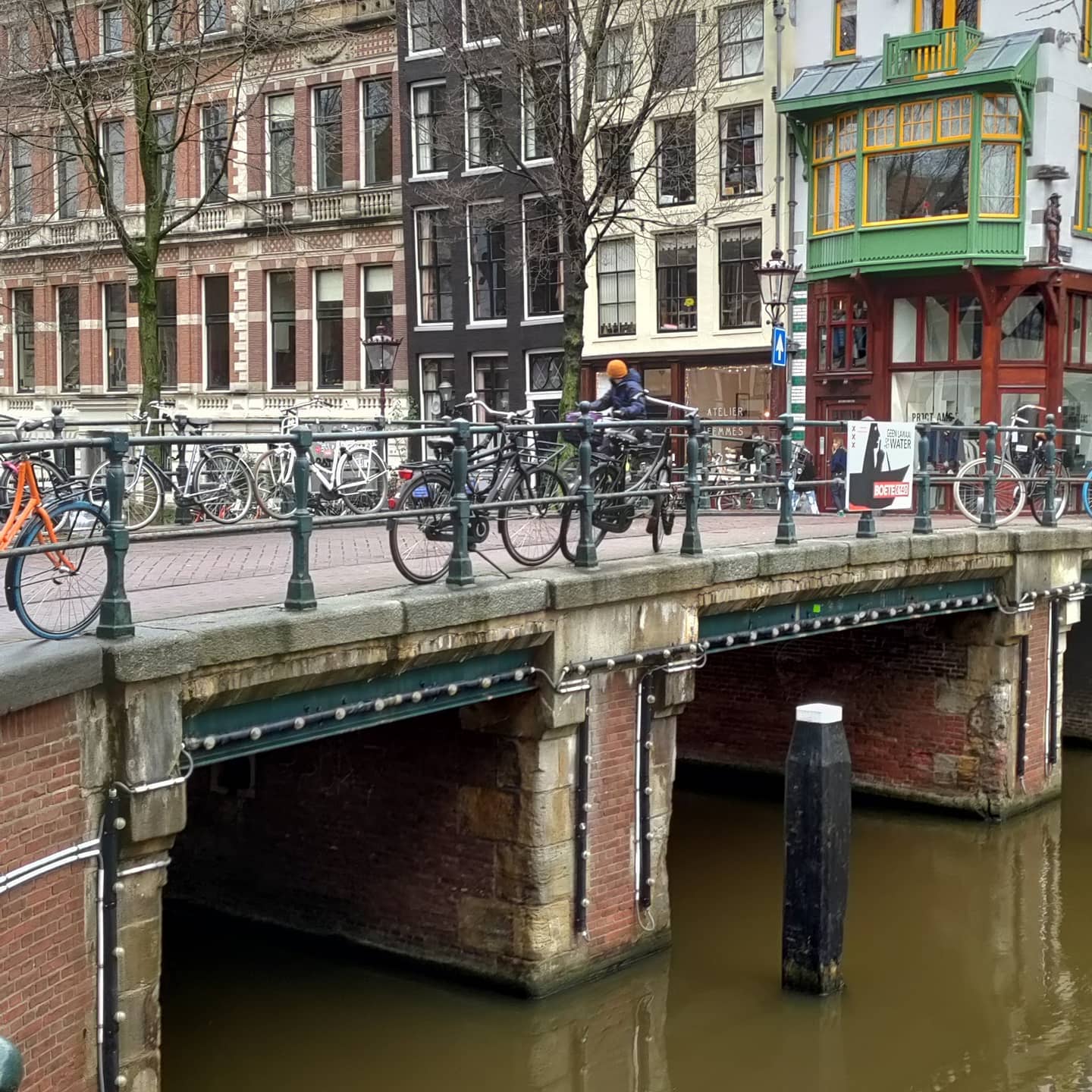
Bridge 24: An Unnamed Crossing at the Heart of Amsterdam’s Golden Age
Amsterdam is known for its many beautiful bridges, but some are more well-known than others. Bridge 24, located in the heart of the city, is a hidden gem that often goes unnoticed by visitors. In this article, we’ll explore the history of Bridge 24, its unique features, and why it’s worth a visit.
Bridge number 24. (Brug vierentwintig) Unnamed.
We are back on the Herengracht (AKA the gentleman’s canal) where Bridge 24 is located, it is not named and it is not a monument, so it feels a little unloved. Unless you need to cross between Gasthuismolensteeg and Hartenstraat that is.
Bridge 24’s Transformation Over Time: How It Reflects Amsterdam’s Development and Modernisation
Bridge 24 has undergone significant transformation over time, reflecting Amsterdam’s development and modernisation. The original wooden drawbridge was replaced in the 1930s with a new steel and concrete structure that reflected the city’s growing population and increased traffic. The bridge’s unique design was influenced by the Art Deco and Amsterdam School architectural styles popular at the time. Today, Bridge 24 continues to be an essential part of Amsterdam’s canal system and serves as a symbol of the city’s continued growth and development. Its transformation over time is a testament to Amsterdam’s ability to preserve its cultural and historical heritage while adapting to the changing needs of its residents and visitors.


The Design Inspiration Behind Bridge 24: Art Deco and Amsterdam School Architecture
Bridge 24’s unique design combines elements of Art Deco and Amsterdam School architecture. The bridge’s original wooden structure was replaced in the 1930s with a new steel and concrete design that reflects the city’s modernization during that period. The bridge’s distinctive arches, geometric shapes, and intricate details are characteristic of the Art Deco style, while the use of brick and the decorative features are typical of the Amsterdam School.
The combination of these two architectural styles gives Bridge 24 a distinctive look that sets it apart from other bridges in the city.
A Fixed Bridge Where the Hartenstraat Meets the Herengracht
There is a particular kind of Amsterdam bridge that does not call attention to itself. It carries no famous name on an official plaque. It does not appear on the tourist maps as a “must-see.” But stand on it for a moment and look in any direction, and you understand immediately why it matters. Bridge 24 is a fixed bridge in the centre of Amsterdam, forming the connection between the Gasthuismolensteeg and the Hartenstraat, and spanning the Herengracht. It sits at the northeast corner of the Negen Straatjes shopping area. That single sentence of geographical fact contains centuries of history.
1. Etymology and Naming: Streets of Leather, Mills, and the Lords’ Canal
Bridge 24 currently carries no official name. Since July 2016, when Amsterdam’s municipality formally abolished all unofficial bridge names that did not meet the city’s naming criteria, the bridge has existed simply as Brug 24 in the municipal register. Understanding the crossing, then, means understanding the two streets it connects and the canal it spans.
The Herengracht, which Bridge 24 crosses, is one of the three great concentric canals of Amsterdam’s 17th-century expansion. The Herengracht, meaning “Lords’ Canal,” was constructed primarily between 1613 and 1625 as part of Amsterdam’s Third Extension, stretching approximately 2.4 kilometres from the Singel canal in the north to the Amstel River in the south, flanked by tree-lined embankments and grand gabled townhouses built for the merchant elite during the Dutch Golden Age. The name was chosen deliberately, a signal to the city’s most prosperous citizens that this was where they were expected to build and live.
The Hartenstraat, which Bridge 24 carries toward the Keizersgracht and Prinsengracht, is one of nine cross streets that form the area known since the 1990s as De Negen Straatjes. The construction in this area goes back to the first half of the 17th century, and the Negen Straatjes is bordered on the north by the Raadhuisstraat and on the south by the Leidsegracht. The street names across this grid are not arbitrary. The names of the streets remind us of the old artisans dealing with all kinds of skins for the leather industry, from the Huidenstraat (Skins Street), Berenstraat (Bears Street), Wolvenstraat (Wolves Street), Hartenstraat (Hearts Street) to the Runstraat and Reestraat (Deer Street).
The etymology of Hartenstraat (Hearts Street) is less straightforward than its neighbours. Hartenstraat has an unclear origin but may relate to the district’s artisanal past. Whether the name derives from a craftsman who worked harts (male deer hides), a house sign, or some older local usage, it has not been definitively resolved in the available historical record. What is documented is that this street, and the bridge that carries it over the Herengracht, were part of the same planned urban expansion of the early 17th century that made Amsterdam the most admired city in the western world.
On the other side of the bridge, the Gasthuismolensteeg carries its own layered story. The Gasthuismolensteeg arose as a short connecting alley between the Singel and Herengracht during the first expansion outside the medieval city, around 1585. On the corner of the Singel with what is now the Gasthuismolensteeg there once stood a mill belonging to the Sint Elisabethgasthuis. This hospital is already mentioned in 1361, making it, on paper, the oldest in the city. The alley’s name therefore preserves the memory of a medieval grain mill that ground flour for a hospital, and of a medieval hospital whose walls no longer stand. Bridge 24 is the point where these two street histories meet above the water.
2. Structural Evolution: Five Arches to One, and the Tram That Changed Everything
There has been a bridge at this location for centuries. Balthasar Florisz. van Berckenrode drew the bridge on his map of 1625, shown there as a high bridge with five openings or arches spanning the Heere Graft. That is a remarkable degree of antiquity. The Herengracht itself was only being dug during those very years, which means a bridge was placed here almost as soon as the canal was open.
The five-arched profile of the original bridge tells us something important about the priorities of 17th-century Amsterdam. A high bridge with five openings allowed tall-masted vessels to pass underneath and through the side arches as needed, keeping the flow of maritime trade unimpeded. The Herengracht was not merely a prestigious residential address; it was also, in its early decades, a working waterway.
By the 19th century, that tall arched profile had become a problem rather than an asset. In 1882 it was decided that the bridge needed to be lowered (verlaagd), because traffic was suffering from the steep approach ramps on either side. The steep inclines that had once accommodated the canal’s maritime ambitions were now obstacles to the horses, carts, and pedestrians of a modernising city.
The decision, however, did not translate quickly into action. The work was delayed and was not discussed again until 1885. The director of the Amsterdamsche Omnibus Maatschappij offered to cover the cost of the lowering himself, so that his trams could navigate the bridge. This is a vivid detail. The transformation of Bridge 24 from a high arched crossing to a flat urban bridge was partly financed by a tram company that needed the route to work. The logic of modern city transit, and the commercial interests behind it, physically reshaped one of the oldest crossings on the Herengracht.
The bridge was subsequently reconstructed in a flattened form. In 1959, the road surface of the bridge had to be renewed in such a way that the clearance height for boats underneath was reduced. No major changes have been made since then. The 1959 resurfacing represents the last significant intervention on record, leaving the bridge in the form it carries today.
3. Architectural Lineage: Publieke Werken and an Unnamed Bridge in a Named Neighbourhood
The current bridge was designed by the Dienst der Publieke Werken (Amsterdam’s municipal public works department). No individual architect’s name is formally attached to Bridge 24 in the available records consulted for this post, and no attribution to Piet Kramer or Johan van der Mey has been confirmed in the sources. The bridge is, in this respect, an honest product of the anonymous municipal engineering tradition: functional, proportioned, and constructed to serve its street rather than to make a statement.
The bridge itself is not a monument, although being in the centre of the city it is surrounded by municipal and national monuments. This is a significant distinction. Bridge 24 sits within one of the most protected urban landscapes in the Netherlands, the UNESCO World Heritage listed canal belt, yet it does not carry its own formal heritage designation. The canal houses flanking the Herengracht on either side of it, the historic facades of the Hartenstraat, and the gabled streetscapes of the Gasthuismolensteeg all hold protected status; the bridge connecting them does not.
This makes Bridge 24 a structurally honest member of its neighbourhood: it supports and serves the historic fabric rather than claiming a place within it.
4. Urban and Social Context: The Northeast Corner of the Nine Streets
The Negen Straatjes is a neighbourhood of Amsterdam located in the Grachtengordel, a UNESCO World Heritage Site. It comprises nine side streets off the Prinsengracht, Keizersgracht, Herengracht and Singel in central Amsterdam, and together they form a sub-neighbourhood within the larger western Canal Belt, one with many small and diverse shops and restaurants.
Bridge 24 occupies a specific node in that grid: the northeast corner, where the Hartenstraat crosses the Herengracht toward the Gasthuismolensteeg and the Singel beyond. Bridge 24 is one of three bridges bordering the Nine Streets area that cross the Herengracht, alongside Bridge 25 and Bridge 26. Together they form the eastern boundary of the Negen Straatjes, each spanning the same canal at successive cross streets.
The Herengracht at this point offers one of Amsterdam’s most photogenic prospects. Looking south from the bridge deck, the canal stretches away between its double rows of 17th and 18th-century facades, all gabled rooflines and brick in the amber tones of Dutch autumn afternoons. Looking north, the Singel is visible in the near distance. And directly below, the dark water of the Herengracht reflects the buildings on either bank with the clarity that makes canal photography in Amsterdam so endlessly rewarding.
The Museum Het Grachtenhuis (the Canal Museum), dedicated to the history and engineering of Amsterdam’s canal belt, sits on the Herengracht itself, within easy walking distance of Bridge 24. Housed in a lavish 17th-century canal mansion, the museum features interactive multimedia exhibits, including holograms, scale models, and films that trace the engineering feats behind the 17th-century canal ring’s construction and its role in the Dutch Golden Age. For anyone who crosses Bridge 24 and wants to understand how the canal beneath their feet came to exist, the museum is the obvious next stop.
5. Technical Specifications
Based on confirmed sources, the following can be stated with confidence:
- Bridge type: Fixed bridge (vaste brug), single span
- Location: Hartenstraat/Gasthuismolensteeg over the Herengracht, Amsterdam-Centrum
- Canal: Herengracht (UNESCO World Heritage Canal Belt, listed 2010)
- Designer: Dienst der Publieke Werken (municipal public works department); no individual architect confirmed
- Original structure: High arched bridge with five openings, documented on the Berckenrode map of 1625
- Key renovation: Lowered (verlaagd) following the 1882/1885 decision, partially funded by the Amsterdamsche Omnibus Maatschappij for tram access
- Last significant intervention: 1959 road surface renewal, reducing boat clearance height
- Monument status: Not a monument; the bridge is surrounded by Rijksmonumenten and gemeentelijke monumenten but does not hold its own designation
- Coordinates: 52°22’20.17″N, 4°53’13.42″E (Wikidata, Q31879716)
Bridge 24 rewards patience. It is the kind of crossing you walk over without noticing, on your way from one Negen Straatjes boutique to the next, or cutting through the canal belt toward the Singel. But pause on it, look down at the Herengracht, and consider what it took to get here: a 17th-century arched bridge that was already old when Rembrandt was painting around the corner, lowered at the insistence of a tram company, resurfaced mid-century, and left quietly in place while the monuments rose up around it. That is not neglect. That is Amsterdam.
Map of Bridge 24. Unnamed.
Bridge 24 is a fixed bridge in the centre of Amsterdam. It forms the connection between Gasthuismolensteeg and Hartenstraat and spans the Herengracht. It’s the north east corner of the ‘negen straatjes’ shopping area. The bridge, itself is not a monument, although being in the centre it is surrounded by municipal and national monuments.
Bridge 24’s Role in Amsterdam’s Canal System: Connecting Two Historic Neighborhoods
Bridge 24 plays a vital role in connecting two of Amsterdam’s most historically significant neighborhoods: Jordaan and De Pijp. The Jordaan district is known for its charming streets, traditional Dutch architecture, and vibrant arts scene. In contrast, De Pijp is a melting pot of cultures and home to some of the city’s best bars, restaurants, and shops. Bridge 24’s location between these neighbourhoods has contributed to their continued development and has facilitated cultural and economic exchange between them. Walking across the bridge today, visitors can experience the unique characteristics of both areas and understand how they have shaped Amsterdam’s culture and identity.

Bridge 24 some history
In 1882 it was decided that bridge 24 had to be lowered because the traffic was affected by the steep slopes. The director of the Amsterdamsche Omnibus Maatschappij wanted to overcome the delays of that reduction so that his trams could “take” the bridge. In 1959 the road surface of the bridge had to be renewed in such a way that the vertical clearance had to be lowered. No major changes have been made since then.
Bridge 24’s Transformation Over Time: How It Reflects Amsterdam’s Development and Modernisation
Bridge 24 has undergone significant transformation over time, reflecting Amsterdam’s development and modernisation. The original wooden drawbridge was replaced in the 1930s with a new steel and concrete structure that reflected the city’s growing population and increased traffic. The bridge’s unique design was influenced by the Art Deco and Amsterdam School architectural styles popular at the time. Today, Bridge 24 continues to be an essential part of Amsterdam’s canal system and serves as a symbol of the city’s continued growth and development. Its transformation over time is a testament to Amsterdam’s ability to preserve its cultural and historical heritage while adapting to the changing needs of its residents and visitors.

The Preservation and Maintenance of Bridge 24: Ensuring Its Continued Functionality and Beauty
As an important link in Amsterdam’s canal system, Bridge 24 requires regular maintenance to ensure its continued functionality and beauty. The bridge is cleaned and painted every few years, and the steel structure is checked for corrosion and damage. The preservation of the bridge’s unique design is also a priority, with any necessary repairs made using materials and techniques that maintain the original character of the bridge. The maintenance and preservation of Bridge 24 are essential not only for its continued use but also for its cultural and historical significance.

The Importance of Bridges in Amsterdam’s Culture and Identity: A Closer Look at Bridge 24’s Significance
Bridges are an essential part of Amsterdam’s culture and identity. They are a symbol of the city’s unique relationship with water, and their design reflects the city’s architectural and engineering expertise. Bridge 24 is an excellent example of how bridges play a significant role in Amsterdam’s cultural and historical heritage. Its location between two historic neighborhoods, its distinctive design, and its continued use all contribute to its significance. As visitors cross Bridge 24, they are not only experiencing a beautiful structure but also connecting with Amsterdam’s rich history and culture.
Sources and Further Reading
- Wikimedia Commons, Category: Brug 24 (in Amsterdam)
- Bruggen van Amsterdam
- Stadsarchief Amsterdam, Beeldbank and Publieke Werken archives
- Frank V. Smit, Bruggen in Amsterdam (2008), Uitgeverij Matrijs