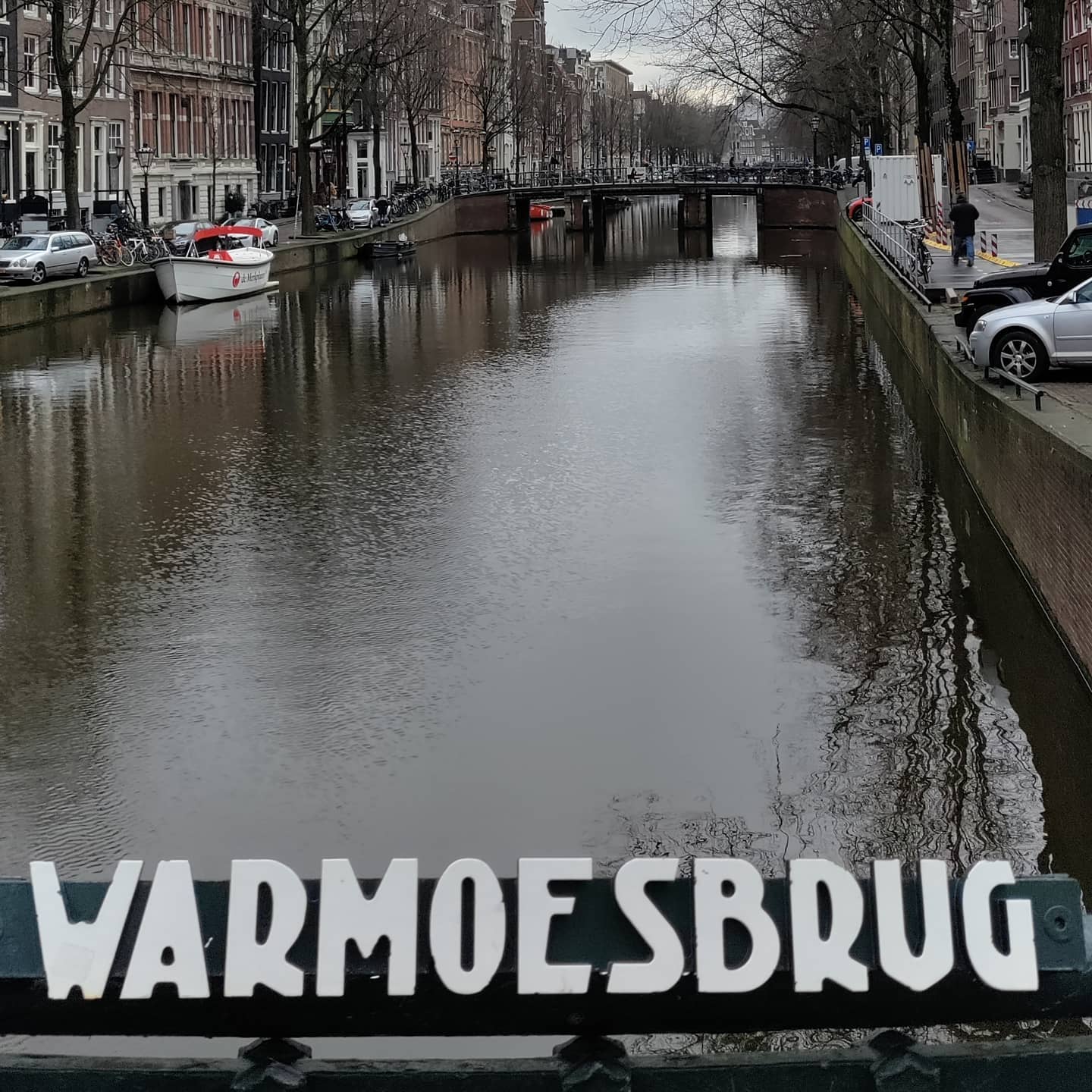
Okay so Warmoesbrug is not near Warmoestraat just in case you thought that might be the case. The bridge owes its name to the Warmoesgracht, which was renamed Raadhuisstraat after being filled in so the bridge is located in the Raadhuisstraat and spans the Herengracht. It is super close to Dam square but also not that beautiful you need to make a trip although right now there is a temporary bridge with artwork (see below). The bridge has a number of characteristics of Piet Kramer’s designs including this ornamental ironwork in the balustrades.


The bridge is currently undergoing renovation – see below for details (in dutch)

During the renovation there is artwork on the temporary bridge


The Warmoesbrug: Piet Kramer’s Gateway to a Modernising Amsterdam
To stand on the Warmoesbrug today is to stand at a fascinating crossroads of Amsterdam’s history. You are positioned on the busy Raadhuisstraat, a thoroughfare carved through the old city fabric, as you cross the tranquil and prestigious Herengracht. The bridge itself, with its sculptural stone pylons and elegant ironwork, is not just a crossing; it is a narrative of a city breaking through its ancient boundaries to embrace the modern age.
A Name from a Vanished Waterway
The bridge’s name, Warmoesbrug, is a direct link to the past, a topographical ghost. It does not refer to a person or a saint, but to the Warmoesgracht, the very canal that once flowed where Raadhuisstraat lies today. The name “Warmoes” is an old Dutch word for vegetables, specifically garden vegetables, indicating that this area, just outside the medieval city walls, was once home to market gardens that supplied the growing city. When the Warmoesgracht was filled in at the end of the 19th century to create the new Raadhuisstraat (literally “Town Hall Street”), the bridge over the Herengracht retained the memory of its lost waterway.
Structural Evolution: From Five Arches to a Single Span
The story of the Warmoesbrug’s physical form is one of response to relentless urban pressure. Our journey begins centuries ago.
- The Early Bridges: The bridge is ancient. The cartographer Pieter Bast already depicted a bridge at this spot on his detailed map of Amsterdam in 1599. By the time of Balthasar Florisz van Berckenrode’s famous 1625 map, it was a substantial structure: a high arch bridge with five passageways or arches spanning the Herengracht.
- The 19th-Century Bottleneck: Around 1895, a new arch bridge was built. But it was soon overwhelmed. The decision to dam the Rozengracht (another canal turned into a street) created a major new traffic artery leading directly to the expanding districts of Amsterdam-West. All this new traffic, a mix of carts, carriages, and people, was funnelled over the Warmoesbrug. The arch bridge, with its hump, became a bottleneck. Furthermore, the coming of the electric tram required flatter, more manageable grades.
- Piet Kramer’s 20th-Century Solution: Enter Piet Kramer, the city’s master bridge architect and a key figure in the Amsterdam School movement. He saw not just an infrastructure problem, but an opportunity for public art. Kramer produced his first design for a new bridge as early as 1921. However, the economic turmoil and soaring material costs in the wake of the First World War delayed the project. It was not until February 1925 that construction finally began on the bridge we see today.
Architectural Lineage: The Signature of Piet Kramer
The current Warmoesbrug is a quintessential example of Piet Kramer’s bridge design and the Amsterdam School style. Unlike the anonymous Public Works designs of the 1880s, this bridge announces itself as a work of architecture.
Look closely and you will find all the Kramer hallmarks:
- Sculptural Masonry: The bridge is not a flat, functional slab. The stone pylons and abutments are treated as monumental, sculptural forms. They are clad in brick and natural stone, with decorative banding and textured surfaces that catch the light.
- Wrought Iron Artistry: The railings and balustrades are masterpieces of siersmeedwerk, decorative wrought ironwork. They feature the geometric, stylised patterns typical of the Amsterdam School, a far cry from the simple industrial railings of earlier bridges. They are designed to be seen both from the street and from the water below.
- Integrated Detailing: As with many Kramer bridges, the functional elements are also decorative. The stone pylons likely feature sculptural accents, and the overall composition is carefully balanced, treating the bridge as a complete artistic ensemble integrated into the cityscape.
Urban & Social Context: A Conduit for Change
The Warmoesbrug’s social role is deeply tied to its location. It was built to be a gateway. Raadhuisstraat, the new street, was a bold project to connect the old centre with the rapidly growing western districts. The bridge was the critical link in this chain. It had to carry the modern city: cars, delivery trucks, and most importantly, trams.
The Wikipedia article reveals a fascinating technical detail about its role in public transport. Until 1 September 1957, the bridge carried a unique three-rail track. This was a dual-gauge system: one track was normal gauge for the city’s own trams, while the other was metre gauge for the electric tram line that ran all the way to Zandvoort. For decades, these two systems shared a single rail, a physical symbol of the city connecting with the coast. It was only during track renewal works in the 1970s that this historical curiosity was finally replaced with standard gauge tracks for city trams alone.
Today, the bridge is a bustling artery. It carries a constant flow of car, bicycle, and tram traffic (with lines 13, 14, and 17 crossing daily), acting as a seam between the canal belt’s elegance and the vibrant Jordaan and western districts. From its deck, you have a quintessential Amsterdam view: looking down the Herengracht towards the soaring tower of the Westerkerk, framed by the bridge’s own artistic ironwork.
Technical Specifications: A Modern Classic
- Bridge Type: Fixed Plate Bridge (vaste plaatbrug)
- Current Structure Date: 1925 (designed by Piet Kramer from 1921)
- Location: Spans the Herengracht at Raadhuisstraat, Amsterdam-Centrum.
- Key Materials: Brick and granite for the sculptural pylons and abutments. Steel for the hidden deck structure. Wrought iron for the decorative railings.
- Key Features: Three-rail tram track until 1 September 1957, standard gauge for the city tram and metre gauge for the Amsterdam to Zandvoort line sharing one rail; Piet Kramer’s Amsterdam School design; a crucial link on the Raadhuisstraat axis.
- Heritage status: Rijksmonument, national monument number 518388.
The Warmoesbrug is far more than bridge 22 in the municipal registry. It is a monument to Amsterdam’s ambition, a testament to the vision of Piet Kramer, and a functional piece of art that has gracefully carried the city into the modern era for a century.
Sources and Further Exploration
- Amsterdam City Archives (Stadsarchief Amsterdam): Search their Beeldbank for “Warmoesbrug” to find historical photos of the 1895 bridge and the construction of Kramer’s bridge in 1925. Also look for maps by Pieter Bast (1599) and Balthasar Florisz van Berckenrode (1625) to see the earliest depictions of the bridge.
- BAG Viewer (maps.amsterdam.nl): Use the official municipality map to find the exact technical data for “Brug 22”.
The bridge is located in the Raadhuisstraat and spans the Herengracht. The bridge owes it’s name to the Warmoesgracht, which was renamed Raadhuisstraat after being filled in.

A new arched bridge was built here around 1895, but it could not cope with the traffic, when the Rozengracht was also filled in creating an exit road to Amsterdam West. Both horse tram and electric trams would have difficulty with an arch bridge. Piet Kramer already made a design for the bridge in the Amsterdam School style in 1921, but because of the price increases as a result of the First World War, it was not possible to start installing a new bridge until February 1925. The bridge has a number of characteristics of Kramer’s bridges, such as the ornamental ironwork in the balustrades and decorations on the natural stone pylons. Until September 1, 1957, three-rail track for the tram was in use here, standard gauge for the city tram, and meter gauge for the Amsterdam – Zandvoort tram line, and it wasn’t until the 1970’s the current tramlines were in place.


Below you can see video (in dutch) about the renewing of the bridge.
