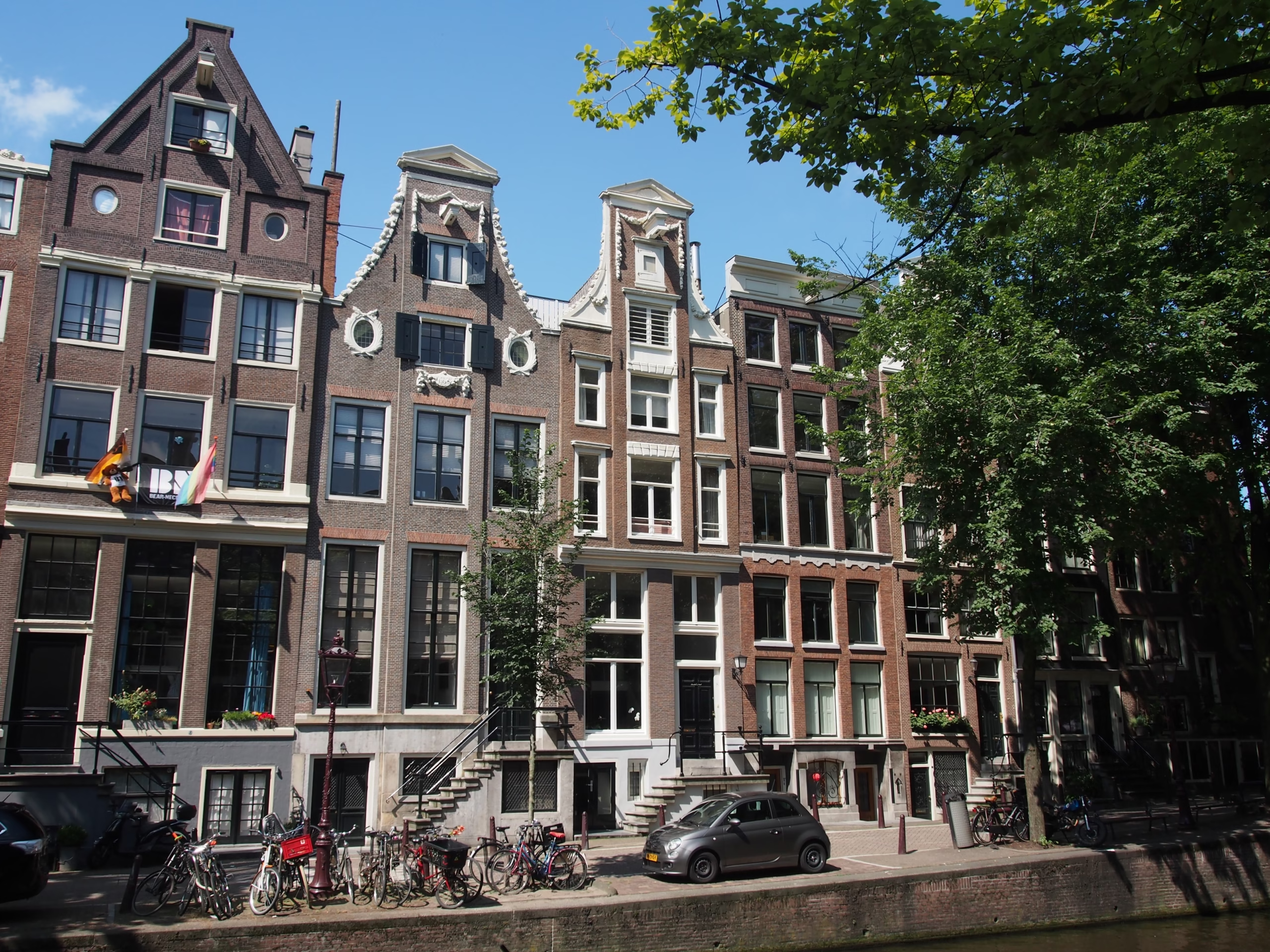
The Seam in the Canal Ring
The Leidsegracht is short, about half a kilometre, and easy to miss between the Leidsestraat and the Leidseplein. It is a cross canal: it starts at the Herengracht, cuts across the Keizersgracht, the Prinsengracht and the Lijnbaansgracht, and runs out into the Singelgracht by the Marnixstraat and the Leidsekade. Seventy-two of the buildings along it are rijksmonuments (national monuments), and almost all of its canal houses and former warehouses are now homes.
What makes it interesting is where it lies. The Leidsegracht is the seam between the two halves of the canal ring, the line where the city stopped in the 1610s and started again in the 1660s. It is also a canal that was moved before it was dug, because the city’s own workshops were standing in the way. Seven numbered bridges cross it.
Where the First Canal Ring Stopped
The Third Expansion, from 1613, dug the Herengracht, Keizersgracht and Prinsengracht southwards from the Brouwersgracht as far as roughly the present Leidsegracht. The new earthen rampart was then joined back to the older city wall, leaving a strange kink at the line of the Beulingstraat and the Leidsegracht that is still visible on Joan Blaeu’s map of 1649 and in the bend of the Herengracht today. According to Dutch Wikipedia, the Leidsegracht was the southern limit of the city between 1615 and 1658, and it was named after the city of Leiden in 1658.
The edge of a seventeenth-century city was where the noisy and dirty trades went. Along the old rampart here stood the city stone yard, which was kept busy with the new town hall on the Dam, and the bell and gun foundry where the city installed the famous bell founder François Hemony in 1655, joined later that year by his brother. The city fencing school was here too, and a long building that may have been a ropewalk. Nearby, by the rampart and the Prinsengracht, stood the corn mill De Tor.

The Canal That Was Moved
When the city resumed the expansion around 1658 and 1659, it meant to do things properly this time: square building blocks, luxury plots, shops confined to the cross streets and industry banned altogether. The plan for the Fourth Expansion, presented in 1662 by the surveyor Cornelis Danckertsz de Rij and shown on Daniël Stalpaert’s map of that year, put a radial canal at the bend in the ring, in line with the Beulingsloot. That canal would become the Leidsegracht.
In 1662 the institutions on the rampart were told they would all have to move, because the ground was wanted for luxury housing. The stone yard and the foundry were working flat out on the city’s gates, bastions, walls and bells, and a lobby persuaded the city council not to disturb them. The council changed the plan instead. The Leidsegracht was shifted south, onto the line of the old city moat, in line with the Beulingstraat, so that the yards on the rampart could stay where they were. The local historian Theo Bakker calls the result het smetje op de grandioze grachtengordel, the blemish on the grand canal ring: the shift spoiled the planned rectangular blocks, and the strips left unbuilt grew wider towards the outer canals. The canal was known as the “verheling”, the joint, the place where the Fourth Expansion was joined onto the Third.
Even then the foundry stayed in the way. It stood in the line of the new canal and was enlarged in 1666. Only after François Hemony died in 1667 and his brother in 1680 was it partly demolished, and in 1683 the business moved to a new workshop on the Lijnbaansgracht. To keep the Herengracht and Keizersgracht works going in the meantime, a temporary dam was thrown across the Leidsegracht, and the Herengracht was dug through and its new plots put on sale from 1664. A new city mason’s yard was laid out from 1665 on a dam at the outer end of the canal, with a house for the master mason. That house survives at Leidsegracht 108, a rijksmonument (3388), and Dutch Wikipedia says Stalpaert lived and worked there.
A Mixed Canal, and a Late Ending
Despite the strict rules, the Leidsegracht never became an address like the Herengracht. The established workshops nearby, and plots that were not deep enough for full houses, produced a mix of heights and uses: houses, warehouses and workshops side by side. A sugar refinery, De Granaatappel, set up just round the corner on the Lijnbaansgracht, with a large chimney in full view, and the area at the outer end went downhill. Bakker concludes that the Leidsegracht never acquired the allure of a canal such as the Reguliersgracht.
For two centuries the canal did not reach the Singelgracht at all. From 1744 the building of the Hollandsche Manege, a riding school, stood across its end on the old rampart. In 1881, with the city’s fortifications largely dismantled, it was decided to extend the Leidsegracht to the newly regularised Singelgracht. The riding school moved to a new building in the Vondelstraat in 1888, and the last stretch of the Marnixstraat and the Leidsekade was built between 1886 and 1888. The sharp curve in the Marnixstraat there is a leftover of all this.
In the 1910s the city drew up plans to fill the Leidsegracht and turn it into a main road out of the centre. They were never carried out: when the Leidsestraat bridges were rebuilt for the trams around 1920, Dutch Wikipedia notes, the city was able to drop the idea.
People of the Leidsegracht
The hydraulic engineer Cornelis Lely (1854 to 1929), whose plans shaped the enclosure of the Zuiderzee, was born at Leidsegracht 39 and spent much of his childhood on the canal. A gable stone shows him standing between the Zuiderzee and the new IJsselmeer. The painter Paul Gabriël and the conductor and soprano Leida Hulscher were also born on the Leidsegracht, and the geographer and historian Olfert Dapper died here in 1689.
The canal also has a place in the city’s best-known song. The lyricist Pieter Goemans is said to have found the inspiration for Aan de Amsterdamse grachten on the bridge where the Leidsegracht meets the Prinsengracht. That bridge now carries his name, and the bridge in the Marnixstraat at the far end of the canal is named after Wim Sonneveld, who sang it.
The Bridges, From the Herengracht Outwards
At the Herengracht end, the Vier Heemskinderenbrug, bridge 28, carries the west quay of the Herengracht over the mouth of the Leidsegracht. It is named after the gable stone of the Four Sons of Aymon on horseback at Herengracht 394. Stones on the bridge read “Anno” and “1722”, and the triple arch now standing can already be seen in a photograph of about 1870. It has been a municipal monument since 1995.
At the Keizersgracht two bridges face each other across the junction. The Steenhouwerijbrug, bridge 45, on the north-east quay, is named after the city mason’s yard. Bridge 44, on the south-west quay, was unofficially the Hemonybrug, after the bell founders, until the city dropped the name in 2016. Their histories run together. At the end of the nineteenth century the neighbouring arch bridge 46 collapsed, and fear that other arches would follow led to both being replaced by plain plate bridges. In 1978, when they needed major work, the city rebuilt them as arches again, in seventeenth-century style over concrete spans and foundations, which was described at the time as an “architectural lie”. Bridge 46 itself stands on the Leidsegracht’s north quay and crosses the Keizersgracht.
At the Prinsengracht the bridges were renewed together in the late 1890s, under the city architect Willem Springer, as iron girder bridges. The Beudekerbrug, bridge 122, on the north-east quay, is named after Frans Beudeker (1815 to 1897), who ran the city’s institution for foundlings and orphans beside it for more than forty years; the children in its care were known as “Beudeker’s children”. Opposite, on the west quay, is the Pieter Goemansbrug, bridge 93, formerly called the Bestedelingenbrug after the same institution. When it was due for replacement in 1987, the city was busy swapping iron girder bridges for stone arches, but this one escaped and was reconstructed in steel. It took Goemans’s name in 2007 or 2008. Across the junction, the Angenietje Swarthofbrug, bridge 67, carries the Leidsegracht’s north quay over the Prinsengracht. It was named in 2022 after a wet nurse who cared for 126 infants until they were old enough for the orphanage.

Bridge 94 links the Raamdwarsstraat with the Lijnbaansgracht quay, beside Leidsegracht 108. The present iron girder bridge dates from 1902, and unlike most of the city’s bridges it was never lowered. In 1938 a bargeman struck his head on its beams, fell into the water and was rescued with a fractured skull.
The last crossing is the Wim Sonneveldbrug, bridge 175, which carries the Marnixstraat and the trams over the end of the canal. Piet Kramer designed it in 1935 and 1936 as a plain bridge without sculpture. It was long known unofficially as the Marnixbrug. In 2017 it was named after Sonneveld, the centenary of his birth, because of the nearby DeLaMar Theater where he performed many times. The proposer had suggested bridge 40 on the Keizersgracht, which appears on the sleeve of his 1962 recording of the song; the city chose this one instead.
The Bridges Across the Leidsegracht
- Bridge 28: Vier Heemskinderenbrug, west quay of the Herengracht
- Bridge 45: Steenhouwerijbrug, north-east quay of the Keizersgracht
- Bridge 44, south-west quay of the Keizersgracht
- Bridge 122: Beudekerbrug, north-east quay of the Prinsengracht
- Bridge 93: Pieter Goemansbrug, west quay of the Prinsengracht
- Bridge 94, Raamdwarsstraat to the Lijnbaansgracht
- Bridge 175: Wim Sonneveldbrug, Marnixstraat
Two more bridges stand on the Leidsegracht’s quays and cross other canals: bridge 46 over the Keizersgracht and the Angenietje Swarthofbrug (bridge 67) over the Prinsengracht. A few steps away, the Aalmoezeniersbrug (bridge 68) carries the Leidsestraat over the Prinsengracht. Every bridge documented so far is listed in the bridge index.
Sources Consulted
- Leidsegracht, Nederlandstalige Wikipedia
- Theo Bakker, “Die Verheelinghe: het smetje op de grandioze grachtengordel”, theobakker.net (PDF)
- Uitleg van Amsterdam in de 17e eeuw and Grachtengordel (Amsterdam), Nederlandstalige Wikipedia
- Leidsegracht 108, Nederlandstalige Wikipedia and Rijksmonumentenregister, monument 3388
- Cornelis Lely, Nederlandstalige Wikipedia
- Vier Heemskinderenbrug, Brug 44, Steenhouwerijbrug, Brug 46, Nederlandstalige Wikipedia
- Beudekerbrug, Pieter Goemansbrug, Angenietje Swarthofbrug, Nederlandstalige Wikipedia
- Brug 94, Wim Sonneveldbrug, Aalmoezeniersbrug, Nederlandstalige Wikipedia
- Lijst van bruggen in Amsterdam, Nederlandstalige Wikipedia
- Leidsegracht, Amsterdam, Wikimedia Commons
- Frank V. Smit, Bruggen in Amsterdam (2008), Matrijs
- Featured image: the Leidsegracht between the Keizersgracht and the Herengracht, Alf van Beem, 2016, public domain