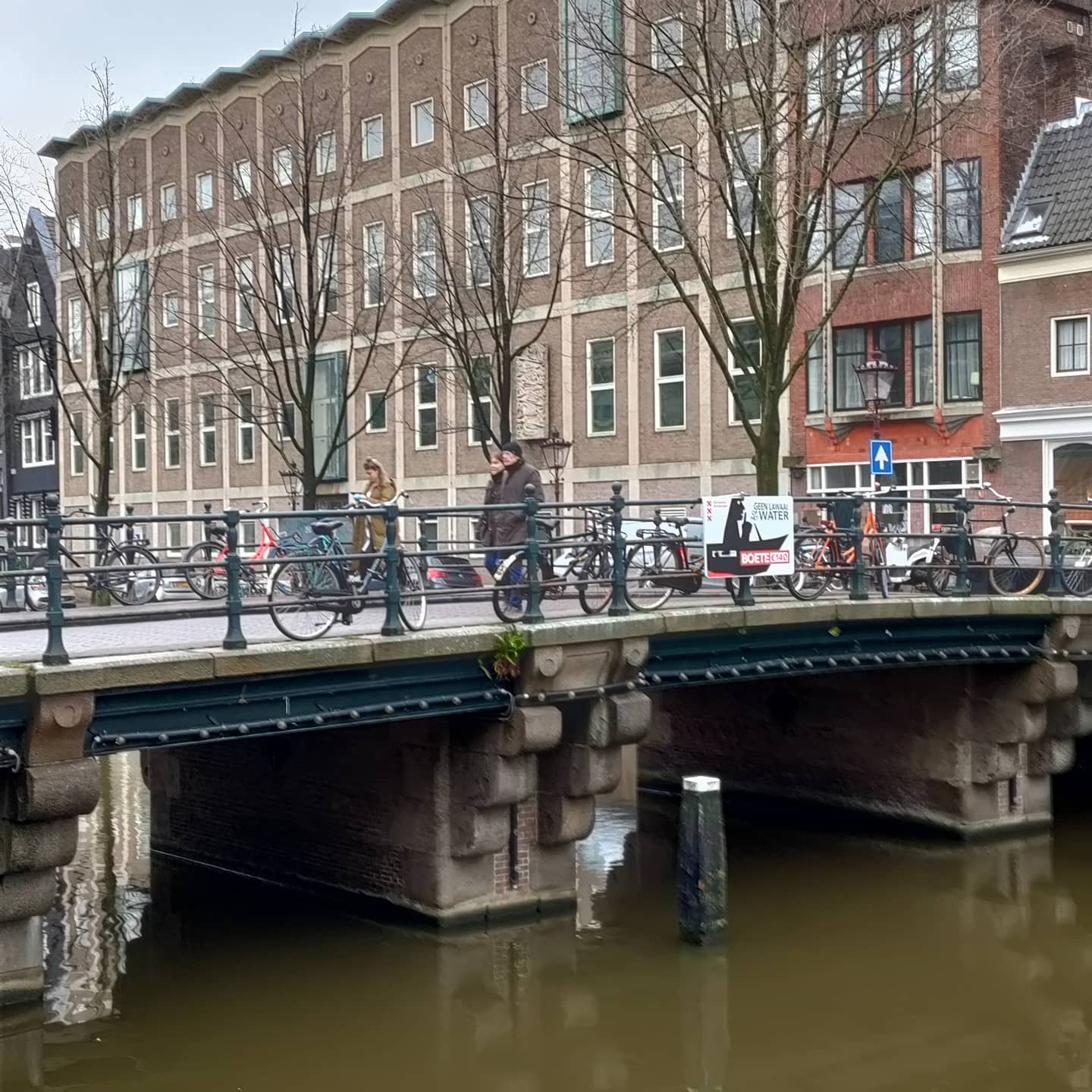
Bridge 25: The Rachel Ruyschbrug, Where Wolf Pelts Once Traded and a Painter Still Presides
Further along the Herengraght we have a municipal monument although it is an unnamed bridge. The bridge became a monument on October 10, 1995, in part due to its striking cantilevers on the pillars.


A Fixed Bridge on the Herengracht in the Heart of the Negen Straatjes
Some bridges in Amsterdam carry the names of statesmen and engineers. Bridge 25 carries the name of a painter. Specifically, it honours one of the most successful Dutch artists of the Golden Age, a woman who raised ten children, served as a court painter to a German prince, and sold her canvases for more money than Rembrandt earned for his. To stand on the Rachel Ruyschbrug and look west along the Herengracht is to stand at an intersection of centuries: a street named for wolf pelts, a canal dug for merchant lords, and a bridge rebuilt in iron in the autumn of 1910, all presided over by the memory of a painter who understood, better than almost anyone, how to make beautiful things last.
1. Etymology and Naming: Wolves, Tanners, and a Remarkable Woman
Bridge 25 forms the connection between the Oude Spiegelstraat and the Wolvenstraat, in the area of the Negen Straatjes in the Amsterdam canal belt, spanning the Herengracht. Both streets it connects are among the nine that give the neighbourhood its identity, and each carries a name rooted in the district’s pre-canal past.
The names of the Nine Streets are reminders of the types of work that were carried out here in centuries past, especially the processing of skins: cow, bear, wolf, and roe deer skins. The Wolvenstraat, which Bridge 25 carries on its south side, therefore translates literally as Wolf Street, a name preserving the memory of the tanners and furriers who processed wolf pelts in this district before the canal ring was laid out in the early 17th century. Around 1612, during the Twelve Years’ Truce, the third expansion of the city began with the reclamation of the Grachtengordel, including the area now known as the Negen Straatjes. The craft industries were absorbed into the expanding city and their street names stayed behind as a permanent record of what had been there before.
On the north side of the bridge, the Oude Spiegelstraat (Old Mirror Street) heads toward the Singel. Its name most likely refers to an older mirror-maker’s trade or a house sign, though the exact etymology has not been definitively resolved in the sources consulted for this post.
The bridge’s official name commemorates a very different kind of Amsterdam figure. The bridge was named after Rachel Ruysch, the daughter of the anatomist and botanist Fredrik Ruysch, who was known worldwide as a painter of flower still lifes and was the first woman to join the painters’ guild Confrerie Pictura. The full biography behind that name is extraordinary.
Rachel Ruysch was born on 3 June 1664 in The Hague, to the scientist Frederik Ruysch and Maria Post, the daughter of the architect Pieter Post. Her father was also a professor of anatomy and botany and an amateur painter, with a vast collection of animal skeletons and mineral and botany samples which Rachel used to practice her drawing skills. The family moved to Amsterdam during her childhood, and it was in Amsterdam that she trained with the flower painter Willem van Aelst from 1679. By the time Ruysch was eighteen she was producing and selling independently signed works.
Her career defied every convention of her era. Due to a long and successful career that spanned over six decades, she became the best documented female painter of the Dutch Golden Age. In her lifetime her paintings were sold for prices as high as 750 to 1200 guilders. In comparison, Rembrandt rarely received more than 500 guilders for a painting in his lifetime. She was appointed court painter to Johann Wilhelm, Elector Palatine, in Düsseldorf, a role she fulfilled from Amsterdam, sending one painting per year to the court while continuing to live and work in the city with her husband, the portraitist Jurriaan Pool, and their ten children. She died in Amsterdam on 12 October 1750, and remains a widely respected artist.
Bridge 25 became a municipal monument (gemeentelijk monument) in 1995. The bridge was officially opened under the name Rachel Ruyschbrug on 28 August 2024, by Geertje Hulzebos, the person who initiated the naming proposal. The naming and listing together make a clear statement: this is a bridge worth remembering, for both its structural history and the life it commemorates.
2. Structural Evolution: From Five Arches to Three, and the Flattening of 1910
The bridge at this location has an exceptionally well-documented history, stretching back to the earliest years of the canal ring itself.
There has been a bridge here for centuries. Balthasar Florisz. van Berckenrode drew the bridge on his map of 1625. There it appears as an arched bridge with five openings spanning the Heere Graft toward the Wolve Straet. The five-arched profile was characteristic of 17th-century Herengracht bridges, designed to allow multiple lanes of boat traffic to pass simultaneously through a canal that was, in its early decades, still actively used by commercial shipping.
The current structure is the product of a decisive intervention in 1910. The current bridge dates from 1910. At that time a tender was issued for the renewal of the bridge and of Bridge 5 between Raamsteeg and Oude Spiegelgracht over the Singel. The old bridges would be closed to traffic during the period from 18 August 1910 to 17 January 1911. The bridge was simultaneously flattened (afgevlakt) during this work. The flattening is the critical change. Like many Herengracht crossings in this period, the steep approach ramps of the original arched structure had become incompatible with the demands of modern city traffic, particularly the electric tram that had been introduced to Amsterdam’s streets from 1900 onward.
High bridges were replaced by low ones, sometimes very monumental examples. This had to do with the requirements of the electric tram from 1900 onwards. Bridge 25 is a direct product of that city-wide process of adapting a 17th-century infrastructure for 20th-century use.
The bridge was also reduced in the number of its spans during the 1910 reconstruction: it now has three navigation openings, the widest of which is 5.65 metres wide and 1.79 metres high. Three spans replaced five, and the arched profile gave way to a flat crossing that could carry a tram without the dramatic height changes that had characterised the original bridge.
The Stadsarchief Amsterdam Beeldbank holds a photograph from July 1910, taken just before the renewal work began, showing the earlier bridge in its final days. The caption in the archive records it as taken “vlak voor de vernieuwing en aftopping” (just before the renewal and lowering). That image is among the most direct primary sources available for understanding what was lost and what was gained in 1910.
3. Architectural Lineage: Publieke Werken, the Aesthetic Adviser, and the Context of 1910
The 1910 reconstruction of Bridge 25 precedes Piet Kramer’s appointment as aesthetic adviser to the bridges division of Publieke Werken by seven years. P.L. Kramer was appointed as aesthetic adviser at the bridges division of the Dienst der Publieke Werken in 1917 by engineer Wichert Arend de Graaf. He would hold this position until 1952. Equally, Johan van der Mey’s appointment as aesthetic adviser was made in 1911, also after Bridge 25 was rebuilt.
A new period began when Johan van der Mey was appointed in 1911 and Piet Kramer in 1917 as aesthetic advisers at Publieke Werken. With artistic balustrades in wrought iron and the use of sculpture, a distinctive style was developed that would become known in architecture under the name of the Amsterdam School.
Bridge 25, rebuilt in 1910, therefore sits just outside that Amsterdam School period. Its design belongs to the generation of Publieke Werken bridge engineering that immediately preceded the movement’s arrival: functional, flat, and built to last, but without the wrought iron railings of custom design, the granite nose stones, and the sculptural abutment figures that would characterise Kramer’s later bridges along the same canal.
What can be confirmed is the broader institutional context. The department of Publieke Werken believed in the idea of the Gesamtkunstwerk, in which engineers, architects, and artists worked together on a project. From 1916, under Allard Hulshoff, first head of Buildings and later director, the department built in a consistent style: a carefully detailed form of the Amsterdam School. In 1916, Hildo Krop was appointed as city sculptor. Bridge 25, predating all of this by six years, is an interesting structural ancestor of the bridges that would later define the Kramer era.
4. Urban and Social Context: A Corner of the Nine Streets, a Bakery, and a View
The Herengracht at Bridge 25 is one of the quieter stretches of what is, in tourist terms, one of Amsterdam’s busiest neighbourhoods. The Negen Straatjes draws visitors from around the world to its over 250 independent boutiques emphasising unique, high-quality retail experiences, including fashion, contemporary design, antiques, vintage items, and artisanal products. But the bridge itself sits slightly off the main pedestrian flows, and the view from it across the Herengracht retains an everyday quality that the most photographed canal corners have largely lost.
The building at the corner of the Wolvenstraat and the Herengracht, directly at the bridge’s southern end, has one of the most quietly remarkable histories in the neighbourhood. The building at Herengracht 300, on the corner of the Herengracht and the Wolvenstraat, was built in 1620 as a bakery, a trade that continued in the premises for approximately 350 years. The first description in the archives of the site dates from 1631, when Willem Hermanszn van Werdel, a baker, bought it for 1,600 guilders. A photograph by the painter George Breitner from 1906, held in the Stadsarchief Amsterdam, shows this corner building with Bridge 25 visible in the background. The building is now a coffee establishment rather than a bakery, but the corner has been inhabited continuously since before the canal ring was complete.
The Stadsarchief Beeldbank also holds a photograph with the caption: “Herengracht 298 (gedeeltelijk) and 300, corner Wolvenstraat 1 to 5 and higher (left to right), seen toward the Keizersgracht. Foreground: Bridge 25.” That view, looking west across the bridge toward the Keizersgracht with the Wolvenstraat corner building in the foreground, is the characteristic photographic angle on this bridge, and it has remained essentially unchanged since the early twentieth century.
The Herengracht, named after the Heeren regeerders (the lord rulers) of the city, began as a ditch and inner moat and was widened in 1612 to its current form, as the first of the three main canals. At the point where Bridge 25 crosses it, the canal is lined on both sides by protected 17th and 18th-century facades. The bridge serves exclusively pedestrians and cyclists today; it carries no tram line and no heavy vehicular traffic. This makes crossing it a genuinely calm experience, which is not something that can be said of every bridge within walking distance.
The neighbourhood around Bridge 25 is also exceptionally rich in museums at very close range. The Museum Huis Marseille, a photography museum housed in a 1665 canal mansion, is a short walk along the Keizersgracht. The Anne Frank House is a two-minute walk along the Prinsengracht from the Negen Straatjes, and the Bloemenmarkt, the city’s floating flower market, is a two-minute walk along the Singel from the southerly edge of the neighbourhood. The flower market detail carries a quiet appropriateness for a bridge named after the woman who made flower painting the most commercially successful art form of the Dutch Golden Age.
5. Technical Specifications
Based on confirmed sources, the following can be stated:
- Bridge type: Fixed bridge (vaste brug), three spans
- Location: Wolvenstraat/Oude Spiegelstraat over the Herengracht, Amsterdam-Centrum
- Canal: Herengracht (UNESCO World Heritage Canal Belt, listed 2010)
- Original structure: Arched bridge with five openings, documented on the Berckenrode map of 1625
- Current structure date: 1910, constructed during the period 18 August 1910 to 17 January 1911
- Key change in 1910: Bridge flattened (afgevlakt) and reduced from five arches to three spans, in response to modern traffic requirements
- Widest navigation opening: 5.65 metres, height 1.79 metres
- Designer: Dienst der Publieke Werken; no individual architect confirmed for the 1910 reconstruction
- Amsterdam School attribution: None confirmed; the bridge predates Kramer’s 1917 appointment and van der Mey’s 1911 appointment
- Monument status: Gemeentelijk monument (municipal monument) since 1995
- Named after: Rachel Ruysch (1664 to 1750), Dutch flower still-life painter
Sources Consulted
- Wikipedia (nl), “Brug 25,” last updated January 2021. URL
- Bruggenvanamsterdam.nl, Bridge register entry for Brug 25. URL: bruggenvanamsterdam.nl
- Stadsherstel Amsterdam, “Herengracht 300 / Wolvenstraat 1A.” URL
- Wikipedia (en), “Rachel Ruysch.” URL
- Wikipedia (nl), “Bruggen van Amsterdam.” URL
- Wikipedia (nl), “Dienst der Publieke Werken (Amsterdam).” URL
- Amsterdamopdekaart.nl, “Publieke Werken.” URL
- Wikipedia (en), “Negen Straatjes.” URL
- De 9 Straatjes, “History of De 9 Straatjes.” URL
- Stadsarchief Amsterdam Beeldbank, archief.amsterdam (photographs of Wolvenstraat and Herengracht at Bridge 25)
- Balthasar Florisz. van Berckenrode, map of Amsterdam, 1625. Rijksmuseum collection, rijksmuseum.nl
- Tripadvisor entry for the Rachel Ruyschbrug (secondary source, citing municipal monument status 1995)
- Mauritshuis, “Rachel Ruysch (1664 to 1750).” URL
Bridge 25: A Historic Link in Amsterdam’s Nine Streets
Nestled within the charming neighbourhood of the Nine Streets in Amsterdam’s ring of canals, the Wolvenstraat Bridge forms an essential connection between the Oude Spiegelstraat and the Wolvenstraat, spanning gracefully over the picturesque Herengracht. With its three passageways, the bridge stands as a testament to Amsterdam’s rich history, with a width of 5.65 meters and a height of 1.79 meters.
A Bridge of Centuries Past:
The presence of a bridge at this location dates back centuries, captured on Balthasar Florisz. van Berckenrode’s map from 1625. This historic cartographic artifact reveals an arch bridge with five passages, guiding travellers over the Lord Graft towards the enchanting Wolve Straet, a name still reminiscent of the Wolvenstraat today. The Wolvenstraat Bridge has been a witness to the ever-evolving life along Amsterdam’s canals throughout the ages.
A Renewed Vision:
The current iteration of the Bridge was constructed in 1910, a testament to Amsterdam’s dedication to preserving and enhancing its infrastructure. A tender was called for tons of iron, marking the renewal of this bridge and another nearby, Bridge 5 between Raamsteeg and Oude Spiegelgracht, which spans over the Singel, a canal leading back into the city.
The Transformation Process:
The renovation of the Bridge took place between August 18, 1910, and January 17, 1911. The previous bridge was carefully dismantled to make way for the new construction. During this process, one incident involving a horse and cart falling into the water due to a steep slope highlighted the need for improved design and safety measures.
A Bridge Restored:
After the renewal, the Bridge saw few major alterations, with traffic flow reclassification being one of the key changes. The bridge retained its iconic charm while meeting modern safety standards, allowing pedestrians and vehicles to traverse it seamlessly.
A Monument of Significance:
Recognising the historical and architectural importance of the Bridge 25 in Amsterdam, the municipality declared it a municipal monument on October 10, 1995. This designation celebrates the bridge’s enduring presence and its role in Amsterdam’s rich cultural heritage.
The Striking Cantilevers:
One striking feature of the Bridge 25 lies in the cantilevers, ingeniously integrated into the pillars. These cantilevers contribute to the bridge’s distinctive appearance while showcasing Amsterdam’s artistic flair and engineering prowess.
Summary:
The Bridge 25 stands as a cherished link between Amsterdam’s Oude Spiegelstraat and Wolvenstraat, gracefully spanning the Herengracht in the historic neighbourhood of the Nine Streets. From its inception centuries ago to its renewal in 1910, the bridge has borne witness to the city’s growth and transformation. Today, it stands as a testament to Amsterdam’s commitment to preserving its cultural heritage while embracing modernity. The Wolvenstraat Bridge continues to charm locals and visitors alike, drawing them into the enchanting world of Amsterdam’s ring of canals.
Map of Brug 25
Bridge 25 forms the connection between the Oude Spiegelstraat and the Wolvenstraat in the area of the iconic Nine Streets in the Amsterdam canal belt. This charming bridge, just like its predecessor bridge 24, gracefully spans the picturesque Herengracht, one of the most beautiful canals in the city. Its elegant structure adds to the timeless beauty of this historic neighborhood, attracting locals and tourists alike to admire its architectural splendor and take leisurely strolls along its banks. Stepping onto this bridge is like stepping into a piece of Amsterdam’s rich history, where the past and present coexist harmoniously, inviting you to explore the vibrant atmosphere of the surrounding area. So whether you’re a visitor or a resident, this bridge is sure to captivate your imagination, offering a charming glimpse into the enchanting world of Amsterdam’s canal network.

Bridge 25 a little history
Just like many of our bridges so far there has been a bridge here for centuries. So long in fact, that Balthasar Florisz. van Berckenrode drew the bridge on his map of 1625. Then an arch bridge with five passageways that led over the Heere Graft to the Wolve Straet, the old names of the Herengracht and Wolvenstraat. The current bridge dates from 1910 when the bridge, just like Bridge 24 along the Herengracht, was lowered to make it easier for traffic. Just before the renovation a horse and carriage went into the water because of its very steep slope. For centuries, this location has been home to one of our historical bridges, just like many others in our city. The bridge’s history dates back to the 17th century when Balthasar Florisz. van Berckenrode included the bridge on his map in 1625. At that time, it was an arch bridge with five passageways that connected the Heere Graft to the Wolve Straet, which were the former names of the Herengracht and Wolvenstraat, respectively. Since then, the bridge has undergone changes. The current structure was built in 1910, alongside Bridge 24 along the Herengracht, to accommodate the increasing traffic flow. To achieve this, the bridge was lowered, making it more accessible for vehicles. However, prior to its renovation, there was an unfortunate incident where a horse and carriage plunged into the water due to the bridge’s steep incline. Despite this incident, the bridge has continued to serve as an important crossing point over the waterway throughout its long history.
As of October 10, 1995, the bridge is a municipal monument.
