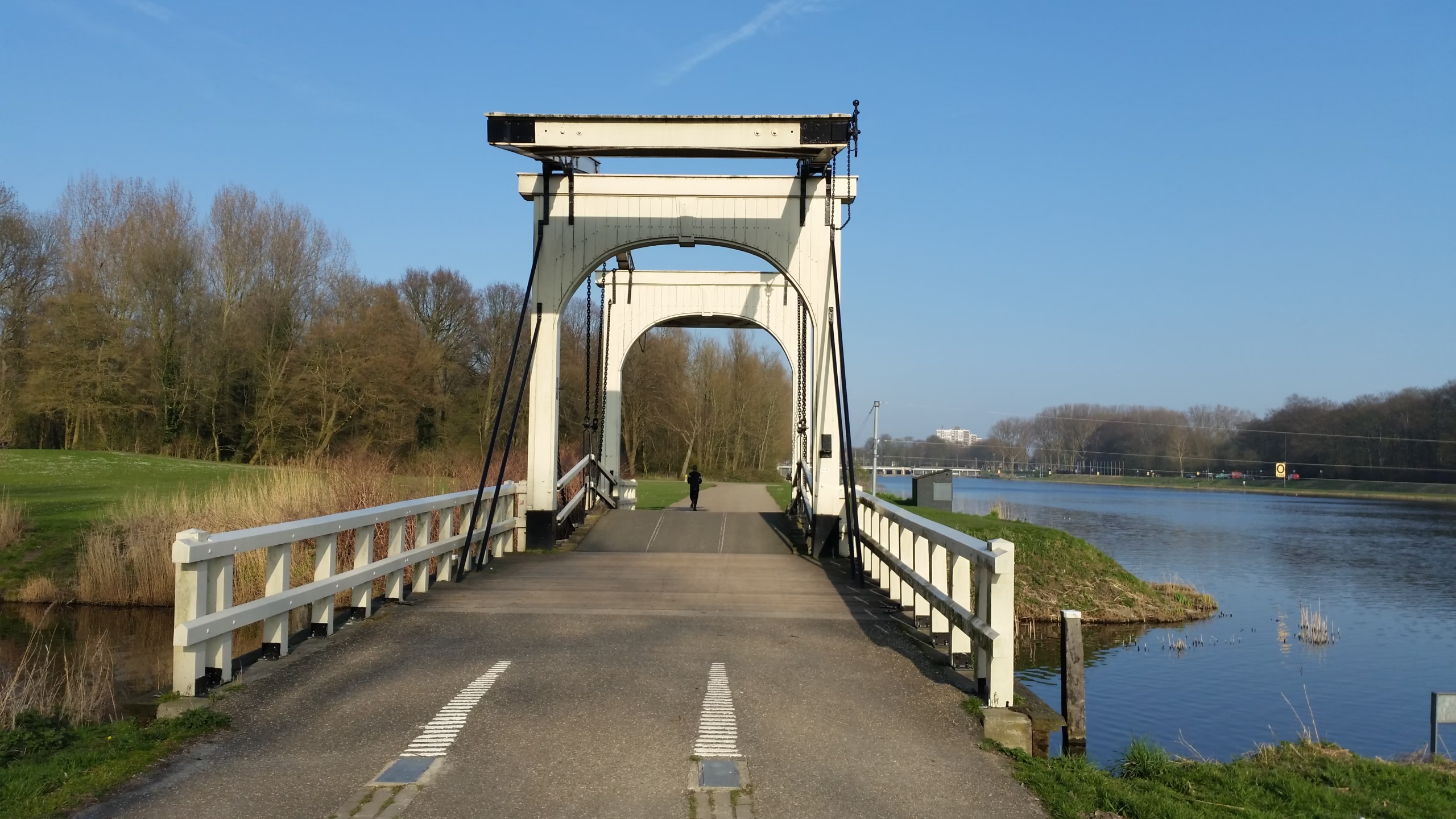
A Forest With 116 Bridges
Most of the bridges on this site cross canals between houses. The ones in the Amsterdamse Bos cross ditches between trees. The city’s great park and forest, laid out from 1934 on drained polder land south-west of Amsterdam, has 116 bridges according to its managers. A large share of them were designed by Piet Kramer, the architect who gave Amsterdam’s canal bridges their Amsterdam School look, and in the Bos he worked differently from the city: in small families of bridges, in wood, concrete and brick, painted in colours that have long since disappeared from his bridges in the city.
Nearly all of them carry numbers in the 500s, and the reason is administrative. The Bos lies mostly in the municipality of Amstelveen, but Amsterdam owns it and runs it. Because Amsterdam maintains the bridges, they are entered in Amsterdam’s bridge register, which is why a footbridge in a wood outside the city boundary can be called Brug 530.
The Boschplan
The naturalist Jac. P. Thijsse had argued for a wood south of the Nieuwe Meer around 1900. In 1928 the Amsterdam council decided to create a large recreation area there. The plan was drawn up inside the municipal Dienst der Publieke Werken, the Public Works department, and finished in 1931 as the Boschplan, the Forest Plan. It was then folded into the General Extension Plan of 1935 as the largest of the green wedges that were meant to reach from the countryside deep into the growing city.
Dutch Wikipedia credits the design to the planners Cornelis van Eesteren (1897 to 1988) and Jakoba Mulder (1900 to 1988). The Bos’s own history page gives it to Mulder, who decided where the water, roads, woods and hills would go. It was her first large commission after she joined the department’s urban development section in 1930. She became known as de juffrouw van het Bos, the lady of the Bos, and in 1958 succeeded Van Eesteren as head of the section.
The design mixes the English landscape style, with its curving woodland edges, sweeping lawns and long views, with the German Volkspark, a park meant for active sport as well as walking. It laid out separate networks of paths for walkers, cyclists and riders, which cross the ditches, ponds and channels of the water system again and again, and every crossing needed a bridge. That, more than anything, is why there are so many.
Five Years of Work for a Thousand Men
Work began on 30 April 1934, in the depths of the Depression. According to the Bos’s managers, Amsterdam then had more than 50,000 unemployed people, and the city was looking hard for werkverschaffing, relief work, with the advantage that the national government paid part of the wages. The Boschplan was launched under the slogan “five years of work for a thousand men”, with the Nederlandsche Heidemaatschappij, a land reclamation company, in charge of the works.
It took far longer than five years. Between 1934 and 1940 alone, about 20,000 people worked on the Bos, much of the earthmoving done with shovels and wheelbarrows. Unemployed office workers were put to work alongside manual labourers. Since around 1980 a wooden wheelbarrow by Leon van der Heijden, a copy of the type the workers used, has stood on the Grote Speelweide in their honour.
The Bosbaan and Its Bridges
One of the first large jobs was digging the Bosbaan, the rowing course, and the first bridges in the Bos were built around it. The course, 2,200 metres long and originally 72 metres wide, held its first race on 6 May 1937: the 60th Varsity, the Dutch university rowing race. Widened twice since, to 118 metres in 2001, it has hosted the world rowing championships in 1977 and 2014, and again in August 2026. The boathouse with its standing terrace, built around 1936 to a design by P. van Niftrik of Public Works, is a national monument.
On 16 November 1936 the city put out to tender a batch of eight bridges around the course. The best known are bridges 504 and 507, a pair of white wooden double bascule bridges, less than a hundred metres apart, on the channel that links the Bosbaan with the Nieuwe Meer. Kramer drew them in the style of nineteenth-century North Holland drawbridges, with a round-arched gantry over the deck. Where the Nieuwe Meer side still had the look of old polder country, the Bos’s managers explain, the drawbridges marked the change from forest to polder. Kramer had made a renovation design for the Magere Brug in 1934, and both the Bos and Dutch Wikipedia suggest that work may have given him the idea.
The course also had to be closed off. Regatta organisers charged admission, so a shallow boundary ditch was dug around the Bosbaan, and the bridges over it had to lock. At the western end Kramer designed hekbruggen, gate bridges: 514 and 515, of 1938, carry gates painted white, with red spikes to stop people climbing over. Bridge 512 is a 1968 copy. The open-air theatre needed the same treatment, which explains the gate on bridge 522 between the theatre and the Grote Speelweide.
The showpiece of the course is bridge 532 of 1938, which carries the Bosbaanweg over the link between the course and a pond. Dutch Wikipedia singles it out, with bridge 543, as an exception among Kramer’s mostly wooden and concrete Bos bridges: a brick bridge in an urban Amsterdam School manner, whose raised footway serves as a viewing platform during races. Granite blocks on the abutments are carved on one side with a sailing ship and a figure holding Amsterdam’s coats of arms, and on the other with the word Amsterdam among waves and crosses. Just south of it, wooden bridge 508 is known as the Drogebrug, the dry bridge: its north end spans not water but a strip of grass over which canoeists drag their boats between the Bosbaan and the lower water of the rest of the Bos.
Kramer in the Bos
How many of the 116 bridges are Kramer’s depends on the source. The Bos’s facts page says 67. Its bridge route says 78. English Wikipedia’s article on Kramer gives 64 out of about 220 bridges he saw built. What is not in doubt is that his Bos bridges were built over a long stretch: the managers give 1937 to 1952 for construction, with his programme running on to 1954. Several bridges he drew in 1940 and 1941 were held up by the war and built in the late 1940s and 1950s, and one of his last, the little lift bridge 592 at the Koenensluis, went up around the time he retired at the turn of 1952 and 1953.
In the city, the Bos’s managers point out, no two Kramer bridges look the same. In the Bos he worked in small series instead: groups of two, three or five bridges that share a basic design but differ in every detail. Dutch Wikipedia sorts them into wooden foot and cycle bridges, brick bridges in the Amsterdam School manner, and plainer, more modern concrete bridges, with the movable bridges as a family of their own. Many wooden bridges have separate decks at different heights for walkers and for cyclists or riders.
Kramer had started out working for master carpenters, and he was also a furniture maker and an ornamental smith. Both trades show: shaped joints and capped posts on the wooden bridges, curling wrought-iron railings on the concrete ones. One thing is missing. In the city Kramer’s bridges are rich in sculpture, much of it by Hildo Krop, but the bridges in the Bos have almost none. The managers note only some helmeted heads on bridge 581.
The Ball Bridges

The most distinctive Bos bridges are the ballenbruggen, the ball bridges: 516, 519, 520, 530 and 531. They are small double bascule bridges over ditches that carry nothing bigger than a canoe. They open not for boats but to seal off the Bosbaan during races and the open-air theatre during performances. There was no electricity on site, so they had to be worked by hand. Kramer’s answer was a lifting frame hung with heavy iron balls as counterweights. Pressing the balls down raises the deck, and wooden channels stop them sinking into the soft ground. According to the Bos and Dutch Wikipedia, Kramer took the idea from the eighteenth-century French engineer Bernard Forest de Bélidor.
The woodwork of these bridges was originally left unpainted and the balls were painted blue. Kramer’s successor Dick Slebos added two more ball bridges in 1956, 548 and 549, whose six balls in three weights are painted red.
Wood, Brick and Concrete
The wooden bridges are the most numerous. 517 and 518 of 1938, near the south-west end of the Bosbaan, have white railings with red caps on the main posts, each cap a slightly different shape. 528, 533, 534 and 535, near the maze and the goat farm, form another family. Wooden 556, designed in 1941 and dated to 1957, is steeper than any crossing of a canoe ditch needs to be. Dutch Wikipedia compares its shape to the bridges of old Japan as drawn by Hiroshige, and reads it as an aesthetic statement by an architect who loved Asian art.

Colour is where the Bos differs most from the city. According to the managers, Kramer’s use of colour can now only be seen here: his bridges elsewhere have mostly been repainted in standard canal green. They trace his colours to Japan, China and Indonesia, and to Scandinavia. The clearest examples are 558, 559, 560 and 562, the so-called Volendam bridges, designed around 1940 and built around 1953, which keep their original colours. Bridge 562 has yellow girders, white railings and grey-green lower rails. Concrete 540 of 1939 to 1940 is light blue, and others are cream, orange, green or beige.
The concrete bridges carry the busier routes, such as 525 and 527 of 1938 on the Duizendmeterweg, the main road into the Bos for cars. On 569, designed in 1940 and built in 1955, the railings end in a pair of swan necks with hearts, which is why the Bos calls it the Hartjesbrug, the heart bridge.

Brick is rare. Besides bridge 532 on the Bosbaanweg, the clearest example is 543, of 1940, at the entrance from the Oude Karselaan in Amstelveen. Its angled retaining walls give it the look of a small fort, and the granite caps on its round piers are carved with the four points of the compass, a theme Kramer also used on the Vierwindstrekenbrug in Amsterdam-West. The viaducts 536 and 537, tendered in 1938 in Amsterdam School brick and stone, carried the Burgemeester A. Colijnweg, now part of the A9 motorway, over the paths linking the two halves of the Bos.
Forced Labour in the Bos
During the German occupation, work on the Bos went on at a smaller scale. The German occupier set up thirteen labour camps for Jewish men in and around Amsterdam, with Dutch authorities also playing a part; according to the Stadsarchief, four of them were in the Amsterdamse Bos. In 1941 and 1942 Jewish Amsterdammers worked there in dozens of gangs, digging and widening ditches and working on quays, locks, paths, roads and bridges. This forced labour was part of the persecution of the Jews of the Netherlands, and for many it came directly before deportation. In 1942 the occupier moved many of these men to labour camps elsewhere in the country or deported them through Westerbork.
Of the roughly 80,000 Jews living in Amsterdam in 1941, around 60,000 were murdered, the highest proportion in Western Europe. The German occupier deported them, with substantial help from the Amsterdam municipal police in the round-ups, by way of the Hollandsche Schouwburg and Westerbork to Auschwitz and Sobibor. The Joods Monument records the names and addresses of the Jewish Amsterdammers who were murdered.
After Kramer
After the war the Bos kept changing, and Kramer’s successors added to it in their own styles. When the entrance at the Koenenkade was moved in 1954 and 1955, Slebos designed bridge 501, a concrete bridge 36 metres long and 42.70 metres wide, its broad footpaths surfaced in grass. Dirk Sterenberg designed the wooden Brug van Broerse, bridge 553, one of the few bridges in the Bos with a name.
The newest bridges have numbers outside the old series. The bamboo bridge, 1545, was built in 2000 at the edge of the Bloesempark as an experiment in building entirely in bamboo. It is 175 metres long. The weather won, and it was rebuilt in 2020 and early 2021 with bamboo and composite posts and a galvanised steel deck. Bridge 594, a wooden bridge by Blom & Moors near the Nieuw Amstelland riding school, opened in 2014; its designers described it as a bold design in Kramer’s tradition.
Who Looks After the Bridges
The Bos is owned and managed by the municipality of Amsterdam, which runs it through a dedicated Bos organisation. Amstelveen, on whose land most of it lies, protects the bridges. In 1999 the landscape architects MTD surveyed every bridge in the Bos for its cultural value, commissioned by the municipality, and in 2013 Amstelveen designated many of Kramer’s bridges as municipal monuments. The Bos’s managers and Dutch Wikipedia both give the total as 53. They are municipal monuments, not national ones.
Timber in a wet wood does not last, and many Kramer bridges have needed restoration. Where possible the original colours have been reconstructed. Some badly decayed bridges that were not monuments have been replaced with new bosbruggen, forest bridges of steel and wood. Money is tight: according to the Bos, Amstelveen contributes 10,000 euros a year towards overdue maintenance of the monumental bridges, which is enough to restore about two bridges a year.
A Bridge Route Through the Bos
The Bos publishes its own bridge route, designed for cycling, with a map. It starts at the visitor centre, De Boswinkel, near the main entrance on the Amstelveenseweg at the Van Nijenrodeweg. In outline:
- The Koenensluis, at the end of the Hoornsloot north of the Bosbaan: the lift bridge 592, concrete bridge 591 with its built-in bench, and the drawbridges 504 and 507.
- The gate bridges 512, 514 and 515 at the Bosbaanweg and Nieuwe Meerlaan, then wooden bridges 517 and 518 at the Berkenhoek.
- Gate bridge 522 and ball bridge 520 by the Grote Speelweide, and wooden bridge 528 near the pumping station.
- The blue concrete bridge 540, the ivy bridge 546 on the Burgemeester A. Colijnweg, and the coloured Volendam bridges 558 to 560.
- Bridge 581 with its helmeted heads, 582 and 583 by the Bloesempark, the compass bridge 543 at the Oude Karselaan entrance, and 544.
- The heart bridge 569, the concrete road bridges 525 and 527 on the Duizendmeterweg, 551 near the Karnemelksegat, Slebos’s red ball bridge 549, and finally the dry bridge 508 beside the Bosbaan.
The lift bridge and lock at the Koenensluis are now worked by volunteers, by appointment. In summer the museum tram from the Haarlemmermeerstation stops at the Koenenkade.
The Bos on This Site
Few Bos bridges have their own entries here yet; as they are added, they will appear in the bridge index. Kramer’s work in the city is covered in the article on Kramer, Krop and the Amsterdam School. For the bridge register as a whole, see how many bridges Amsterdam actually has.
Sources Consulted
- Amsterdamse Bos, Nederlandstalige Wikipedia
- Bosbaan, Nederlandstalige Wikipedia
- Jakoba (Ko) Mulder, Nederlandstalige Wikipedia
- Cornelis van Eesteren, Nederlandstalige Wikipedia
- Piet Kramer, Nederlandstalige Wikipedia
- Piet Kramer, English Wikipedia
- Brug in het Amsterdamse Bos, Nederlandstalige Wikipedia category, including the articles on bridges 501, 504, 508, 514, 530, 532, 536, 540, 543, 548, 551, 556, 562, 565, 592, 594 and 1545
- Bruggenroute door het Amsterdamse Bos, Amsterdamse Bos (Gemeente Amsterdam)
- Feiten & Cijfers, Amsterdamse Bos (Gemeente Amsterdam)
- Werkverschaffing, Amsterdamse Bos (Gemeente Amsterdam)
- Jakoba Mulder, de ‘juffrouw van het Bos’, Amsterdamse Bos (Gemeente Amsterdam)
- Joodse werkkampen, Stadsarchief Amsterdam
- Rijksmonument 506203: botenhuis met staantribune, Bosbaan, Rijksdienst voor het Cultureel Erfgoed
- Joods Monument
- Wim de Boer and Peter Evers, Amsterdamse bruggen 1910-1950 (1983), Amsterdamse Raad voor de Stedebouw
- Sebas Baggelaar and Pim van Schaik, Piet Kramer, Bruggenbouwer van de Amsterdamse School (2016), Stokerkade
- Featured image: Bridge 504 beside the Bosbaan, 22 March 2019, Ceescamel, Wikimedia Commons, CC BY-SA 4.0