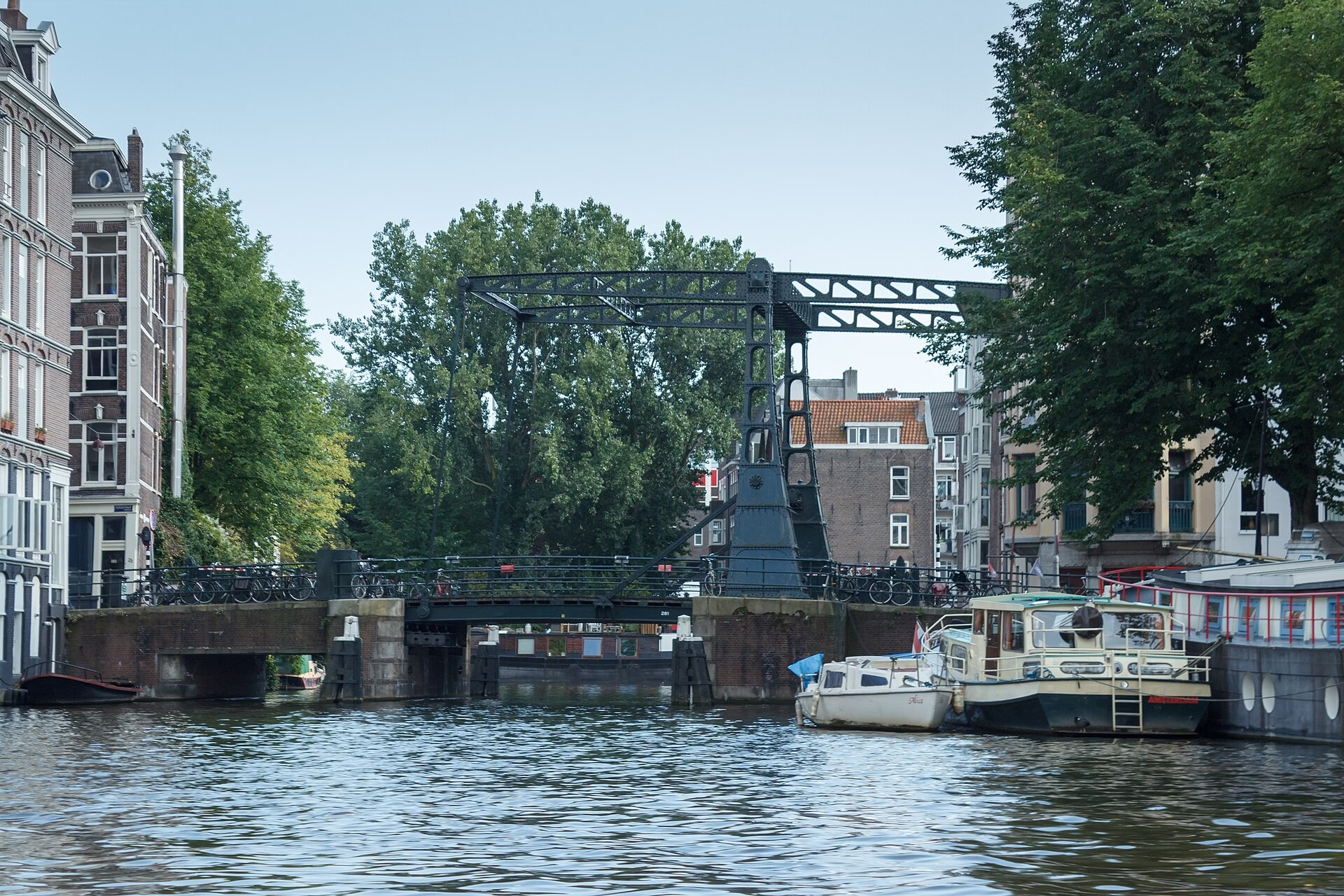
Pepper, Bonded Cargo and a Bridge That Still Lifts: Brug 281
Amsterdam has thousands of bridges and only a small number that still open by machine for a boat. The Peperbrug is one of them, and it has been doing it since 1929 without meaningful alteration.
Brug 281 crosses the Rapenburgwal, joining the Peperstraat to the Nieuwe Uilenburgerstraat. It is a cast-iron ophaalbrug, a single-leaf drawbridge of the classic Dutch counterweighted type, and it has been a rijksmonument since 2002.
Etymology: The Street Named After the Cargo
The bridge is named for the street, and the street is named for pepper.
This is the eastern warehouse district, laid out in the 1590s expansion on ground reclaimed from the marshy edge of the IJ, and its street names read like a ship manifest. Peperstraat, Rapenburg, Foeliestraat for mace, Kromme Waal and Nieuwe Uilenburgerstraat. The names date from the decades in which the Dutch East India Company turned Amsterdam into the clearing house for the spice trade of the Indonesian archipelago, and pepper was the volume commodity that paid for everything else.
It is worth being precise about what that meant on this particular street. Pepper arriving here was not a luxury for the table. It was bulk freight, landed by the ton, weighed, taxed and stored in warehouses whose ground floors opened onto the water. The bridge existed so that carts could cross the Rapenburgwal and lighters could still get underneath. That double requirement is exactly why it was built to open, and why it still does.
Structural Evolution: 1599, 1860, 1929
A crossing has stood here for more than four centuries. The cartographer Pieter Bast, whose 1599 four-part map is the first reliable survey of the city, drew a double drawbridge at this point. Two leaves, timber, rising from either bank.
That wooden structure was replaced around 1860 by an iron drawbridge designed under Bastiaan de Greef, the city architect whose office produced a great many of the bridges Amsterdam still stands on, including, two decades later, the Blauwbrug over the Amstel. The de Greef bridge served for roughly seventy years.
The current bridge went up in 1929, built by the Dienst der Publieke Werken and completed in six months. It was electrically operated from the start, which places it firmly on the modern side of a line: the bridge it replaced would have been wound by hand.
Since then the deck has been renewed repeatedly, as timber decks must be, but the structure itself is essentially unaltered. That is unusual, and it is the reason the bridge is protected.
Architectural Detail: Hameipoort, Balans and Balusters
A Dutch drawbridge of this type has a vocabulary worth knowing, because once you have the words the bridge becomes readable.
The hameipoort is the tall frame standing on the bank, the gate-like portal through which the leaf swings. On Brug 281 it is riveted iron, and the rivets are visible, which dates the fabrication as clearly as a maker plate would. The balans is the counterweighted beam pivoting overhead, and here it is an open lattice rather than a solid baulk of timber, a deliberately light structure doing heavy work. The railings are wrought-iron balusters, and the deck is wood.
The bridge has three passages between brick piers finished in natural stone. The southernmost of the three has been sealed off, which is the sort of detail that tells you the water traffic here changed shape at some point and nobody saw a reason to reopen it.
For the broader family this bridge belongs to, see our survey of wooden and metal drawbridges in Amsterdam.
Urban Context: Uilenburg and Rapenburg
The islands on either side of this bridge were manufactured. Uilenburg was reclaimed around 1593, when the city sold twenty-two plots to shipbuilders displaced by the Lastage expansion. Timber storage went on the west side, shipyards and anchor smiths on the east.
By 1680 every shipwright had left for the Eastern Islands, where the water was deeper and the approach easier, and Uilenburg turned to warehousing and workers housing. From the mid-seventeenth century it became one of the poorest Ashkenazi Jewish quarters in the city; by the late 1700s more than ninety per cent of the island was Jewish, and the Uilenburger Synagogue of 1766 still stands. In 1879 the Boas diamond cutting factory opened here, the largest in Amsterdam and in Europe, employing 357 cutters.
The overcrowding was appalling. By 1910, 368 of the island’s 861 dwellings were formally condemned, and the socialist alderman Floor Wibaut cleared much of it in the 1920s under his two-thousand-homes plan, cutting the Nieuwe Uilenburgerstraat through the wreckage. The street the Peperbrug feeds into is that street, which means the bridge of 1929 and the road it serves are the same project.
What came next is the part the plaques struggle with. In the occupation Uilenburg was designated Judenviertel I, and almost all of its remaining Jewish residents were deported and murdered. The bridge is a survivor of a neighbourhood that largely is not.
Technical Specifications
- Bridge number: 281
- Name: Peperbrug
- Type: Single-leaf drawbridge (ophaalbrug), electrically operated
- Carries: Peperstraat to Nieuwe Uilenburgerstraat
- Spans: Rapenburgwal
- District: Amsterdam-Centrum
- Coordinates: 52.3714 N, 4.9075 E
- Materials: Cast iron, riveted iron hameipoort, lattice balans, wrought-iron balusters, wooden deck
- Passages: Three, the southernmost sealed
- Recorded on Pieter Bast’s map: 1599, as a double drawbridge
- Iron predecessor: circa 1860, under Bastiaan de Greef
- Current structure: 1929, built in six months
- Builder: Dienst der Publieke Werken, Amsterdam
- Status: Rijksmonument since 2002, number 518398
Sources Consulted
- Featured image: Peperbrug, Bridge 281, Amsterdam by Slaunger, 2016, via Wikimedia Commons, CC BY-SA 4.0
- Peperbrug, Nederlandstalige Wikipedia
- Rijksmonumentenregister, monument 518398
- Uilenburg, Nederlandstalige Wikipedia
- Rapenburg, Nederlandstalige Wikipedia
- Pieter Bast, Nederlandstalige Wikipedia
- Wikimedia Commons, Category: Brug 281, Peperbrug
- Stadsarchief Amsterdam, Beeldbank and Publieke Werken archives
- Bruggen van Amsterdam
- Frank V. Smit, Bruggen in Amsterdam (2008), Uitgeverij Matrijs