There is no single official answer, and anyone who gives you one without qualification is guessing. The figure most often quoted is 1,281, from a count made in 2006. Round numbers between 1,200 and 1,900 all appear in print, and all of them can be defended, because they are counting different things.
What is not in dispute: Amsterdam has more bridges than Venice, by a wide margin, and it has them because the city is built on water rather than beside it.
Why the Number Changes Depending Who You Ask
The disagreement is not sloppiness. It is a definition problem, and there are at least five places where reasonable people draw the line differently.
- Does a culvert count? Many short crossings are technically closed culverts carrying a road over a watercourse. They function as bridges and are often maintained as bridges, but they do not look like bridges.
- Do private bridges count? Courtyards, gardens, industrial sites and housing complexes all have crossings the city does not maintain.
- Do viaducts and flyovers count? A road bridge over a motorway is a bridge, but it is not what anyone picturing Amsterdam has in mind.
- Does a lock count? In Amsterdam the word sluis in a bridge name usually indicates a stone bridge rather than a working lock, and several structures are genuinely both.
- Which Amsterdam? The historic centre, the municipality, and the wider metropolitan area give three very different totals.
Count only the road and foot crossings that the municipality maintains within the city, and you land near 1,200 to 1,300. Count every structure on the register, including culverts and viaducts, and you approach 1,900.
The Numbers Are Not a Count
Here is the thing that confuses almost everyone, including people who write about Amsterdam bridges for a living.
Every bridge in Amsterdam has a number, and the numbers run well past 2,000. That does not mean there are 2,000 bridges.
The numbering is a register, not a tally. Numbers were assigned as structures entered the municipal system, and the sequence has been extended outward over more than a century as the city grew. So the Jan Schaefer Bridge is number 2000, the Nescio Bridge is 2013, and the Oosterdoksdraaibrug is 2270, while the bridges in the medieval centre carry numbers in the low double digits.
The register also has holes. Bridge 33 is vacant: the number exists, the bridge does not, and it was marked vervallen, lapsed, on the Public Works ledger. A numbering system with gaps in it cannot be read as a count of anything.
This is why this site works through the bridges by number rather than by name. The numbers are the only complete index Amsterdam has, even where they are imperfect.
How the Total Grew
The direction of travel is clearer than any single total.
- 1544: roughly 35 bridges appear on Cornelis Anthonisz’s woodcut map, the earliest detailed view of the city.
- 17th century: around 200, after the canal ring was dug and the city roughly quadrupled in area.
- Late 20th century: around 350 in the historic centre.
- Today: somewhere between 1,200 and 1,900 across the municipality, depending on the definition above.
The jump from 350 to over a thousand is not a building boom in the old city. It is the municipality growing outward to absorb districts, harbours, islands and motorway crossings that were never part of the canal ring at all.
The Bridges People Actually Come to See
A handful carry most of the attention.
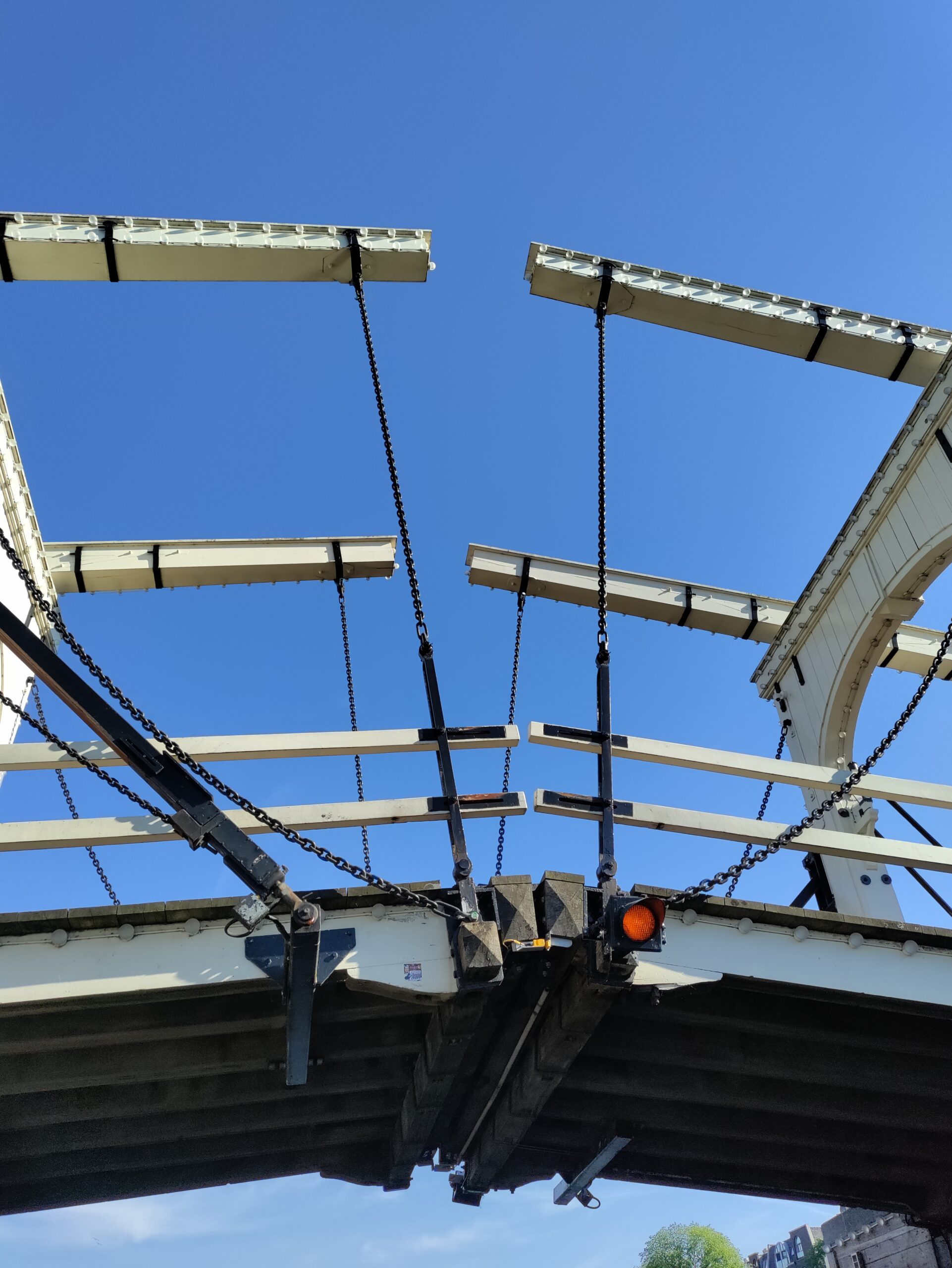
- The Magere Brug, Bridge 242, the white timber drawbridge over the Amstel, and the most filmed bridge in the country.
- The seven bridges of the Reguliersgracht, the nested row of arches seen from the Herengracht, and the single most photographed sightline in Amsterdam.
- The Torensluis, Bridge 9, completed in 1648, the oldest bridge still standing in its original form and one of the widest in the city.
- The Python Bridge, Bridge 1998, the red coiling footbridge in the Eastern Docklands that won the International Footbridge Award in 2002.
- The Nescio Bridge, Bridge 2013, the country’s first cycling suspension bridge, by the architects of London’s Millennium Bridge.
If you want to walk a single canal end to end and see how the numbering works in practice, the Singel and its fourteen bridges is the best place to start.
The Short Answer
If you need one number: about 1,280 bridges in Amsterdam on the most widely cited count, and comfortably more than 1,500 if you include everything the municipality maintains. More than Venice. Fewer than the bridge numbers suggest.
Sources Consulted
- I amsterdam, Bridges of Amsterdam
- Gemeente Amsterdam, bridge and quay wall programme
- Lijst van bruggen in Amsterdam, Nederlandstalige Wikipedia
- UNESCO World Heritage Centre, Seventeenth-Century Canal Ring Area of Amsterdam, reference 1349
- Bruggen van Amsterdam
- Stadsarchief Amsterdam, Beeldbank and Publieke Werken archives
- Frank V. Smit, Bruggen in Amsterdam (2008), Uitgeverij Matrijs


