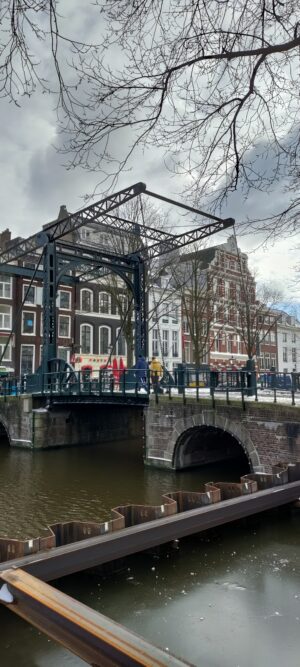
The first bridges in Amsterdam were all made of wood. Amsterdam has a number of drawbridges made of wood. The most famous example of this is the Magere Brug (aka the skinny bridge) over the Amstel. Very close by is a copy of that famous bridge, the the Walter Süskindbrug (237) is a bridge over the Nieuwe Herengracht at the Amstel.
There are also wooden drawbridges over Groenburgwal (Staalmeestersbrug) / Hoek Staalstraat, and another over Prinseneiland as well as Zandhoeksbrug over the Realengracht


What is a Drawbridge? A Guide to Amsterdam’s Iconic Bascule Bridges
Imagine a bridge that tilts up like a seesaw to let boats pass – that’s a drawbridge! It’s a type of bridge that moves by rotating around a horizontal point, kind of like how a door swings on its hinges. Think of it as the older cousin of those bridges that lift straight up.
The key difference between a drawbridge and other lifting bridges is that it uses weights to balance the bridge deck. These weights, called counterweights, make it much easier to raise and lower, so you don’t need a lot of power.
One downside of traditional drawbridges is that they don’t allow for very tall boats to pass underneath. To fix this, sometimes the counterweight box is placed on the arms of the balance itself, instead of hanging between them. This allows for a bit more clearance.
There are many variations of the drawbridge design. You can find bridges with two separate tilting sections, or single tilting sections, and even bridges where the road surface is angled. In these angled bridges, there’s only one tower supporting the bridge.
If a drawbridge is perfectly balanced, you could even open it by hand, simply by pulling on a chain connected to the counterweight box. Closing it might just involve letting the chain go and maybe giving the bridge a little push. However, weather conditions like wind or rain can mess with the balance, making it harder to open or close.
Traditional Dutch Drawbridges in Amsterdam are made of various materials including De Aluminiumbrug (222) which is now named after it’s building material since it was rebuilt in 1955. Just along the Staalstraat crossing the Groenburgwal is De Staalmeestersbrug (brug 227) which is less photographed but most tourists will know it very well since from this bridge is a perfect shot of the Zuiderkerk framed along the canal.


The difference between these two bridge types is primarily a matter of scale, engineering necessity, and the width of the water they span. In the Amsterdam canal system, the “Ophaalbrug” (drawbridge) is a signature element of Dutch water management.
The Single Drawbridge (Enkele Ophaalbrug)
The single drawbridge is the most common variety found on smaller, narrower canals. It consists of a single movable deck (the leaf) that is pulled upward by a single overhead balance beam.
- Mechanism: It uses a single set of “towers” (the uprights) and one balance beam. When the chains are pulled, the entire span of the bridge rises from one side.
- Engineering Purpose: These are ideal for narrow crossings where the weight of a single wooden or metal deck is manageable for the counterweight system.
- Aesthetics: They are often asymmetrical and tucked into quieter corners of the Jordaan or the smaller connecting canals.
The Double Drawbridge (Dubbele Ophaalbrug)
The double drawbridge, most famously exemplified by the Magere Brug (Bridge 242) over the Amstel, is designed for much wider spans where a single deck would be too heavy or structurally unstable to lift.
- Mechanism: It consists of two independent leaves that meet in the middle of the canal. Each side has its own set of uprights and balance beams. When the bridge opens, the two halves rise simultaneously toward their respective quays.
- Engineering Purpose: By splitting the span into two smaller sections, the mechanical stress on the wooden beams and chains is reduced. This allowed historical engineers to bridge wide rivers like the Amstel without needing massive stone arches that would block tall ships.
- Aesthetics: These bridges are perfectly symmetrical. Because they usually span major waterways, they are often painted white and decorated with more ornate lighting and ironwork.
Comparison table
| Feature | Single Drawbridge | Double Drawbridge |
| Span Length | Short (Narrow canals) | Long (Rivers and wide canals) |
| Number of Leaves | One | Two (Meeting in the center) |
| Symmetry | Asymmetrical | Perfectly Symmetrical |
| Typical Material | Wood or Lightweight Metal | Traditionally Wood (Reinforced with Steel) |
| Best Example | Bridge 19 (Sloterkade) | Magere Brug (Bridge 242) |
Many of the more recently refurbished drawbridges are made of metal rather than wood. One of my favourites being the Scharrebiersluis (brug 278) which was refurbished in 2001, since on a summer evening you can sit on the Kadijksplein on a sunny terrace with views of the bridge and canal while drinking a beer. Other recently refurbished metal drawbridges include Bridge 148 refurbished in 2017 which spans Brouwersgracht.
Still more bridges were converted into fixed span bridges when they were refurbished like the old drawbridges over the Singelgracht which are no more.
This kind of bridge is obviously more picturesque than the usual fixed bridge so if you want to get a few different bridges in a short period of time then the area around the Waterlooplein is a good location as many of the bridges mentioned above are within 5-10 minutes and within the space of an hour you could see most of them.
.jpg/1200px-2022_Brug_237%2C_Asd-zijaanzicht_(8).jpg)

kantelbrug wordt niet genoemd [2015].
Een ophaalbrug wordt ook klap of wip genoemd. Men spreekt dan over een één- of tweeklap. De wip is een éénklap.

The Magere Bridge
As one of Amsterdam’s most photographed landmarks, the Magere Brug (Skinny Bridge) is a perfect example of how the city’s wooden bridge traditions survived into the modern era. While many of the early 17th-century wooden drawbridges shown in the 1652 Jan Micker or 1662 Daniel Stalpaert maps were eventually replaced by stone arches, the Magere Brug retains that iconic double-leaf Dutch bascule design. Its history is deeply intertwined with the development of the Amstel River banks, evolving from a narrow 17th-century footbridge into the grand, illuminated wooden monument that defines the city’s skyline today.