Welcome to my personal catalogue of the spans that connect Amsterdam. After exploring and photographing hundreds of the city’s 1,200+ crossings, I have curated a list of my favourite ten. This collection is not a definitive ranking, but rather a cross-section of the city’s diverse engineering and history. From iconic Golden Age draws to innovative new bicycle paths, these bridges represent the very best of “Mokum’s” connection.
1. Magere Brug (Skinny Bridge)
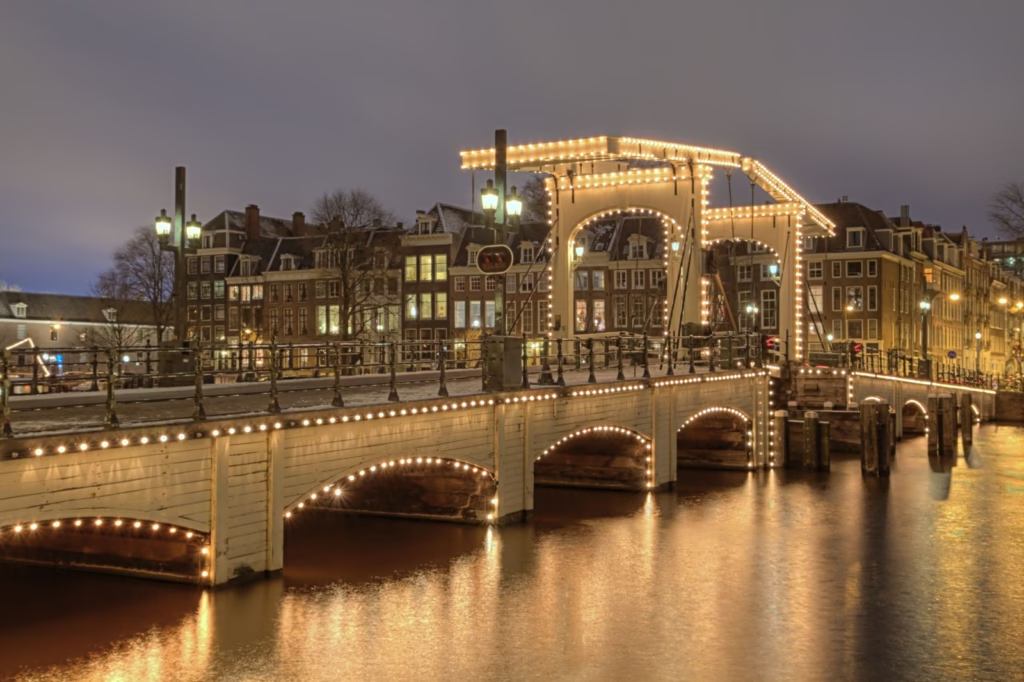
The Magere Brug, or “Skinny Bridge,” is without a doubt the most famous bridge in Amsterdam. Legend says it was named for two wealthy, frail sisters who lived on opposite sides of the Amstel and wanted a faster way to visit. In reality, the name likely comes from the original structure of around 1691, which was so narrow that two people could barely pass. This is bridge 242, and it has been rebuilt twice, in 1871 and again in 1934. The version you see today is a double-leaf drawbridge, an ophaalbrug, elegantly painted white and spanning the wide, open Amstel. The 1934 rebuild came from Piet Kramer at Public Works, the same hand behind several hundred other Amsterdam bridges.
This bridge is a true time traveler. It is one of the few remaining large wooden drawbridges in the city center, offering a stark and beautiful contrast to the massive, concrete, 21st-century infrastructure that now dominates the outskirts. For me, it is at its absolute best at dusk. When the 1,200 small lights outline its white framework against the evening sky, and its image is reflected in the water, it perfectly captures the romantic, historical heart of Amsterdam.
2. Torensluis

Welcome to Bridge No. 9, the Torensluis. If you are looking for the absolute soul of Amsterdam, this is it. Built in 1648, the Torensluis (Tower Lock) is 42 metres across, one of the widest in the city, and the width came first. The bridge was built wide because it had to carry a massive defensive tower, the Jan Roodenpoortstoren, which stood on it until 1829. While it was being designed there was a plan to line it with shops, as on the Rialto in Venice, and let the rents pay off part of the construction. The traffic was judged too heavy and the plan was dropped, although small houses did later go up against the tower. It is the oldest Amsterdam bridge still preserved in its original state.
This bridge is packed with layers of history. You can still see a bronze bust of the 19th-century writer Multatuli (Eduard Douwes Dekker) on the bridge, a fitting spot as the city’s heart. Perhaps its most fascinating feature is hidden below: the bridge’s massive foundations were used as dungeon cells for centuries, and you can still see the barred, low windows that once held prisoners just above the waterline. The Torensluis is a perfect example of a bridge that functions as a destination, not just a crossing.
3. Blauwbrug (Blue Bridge)
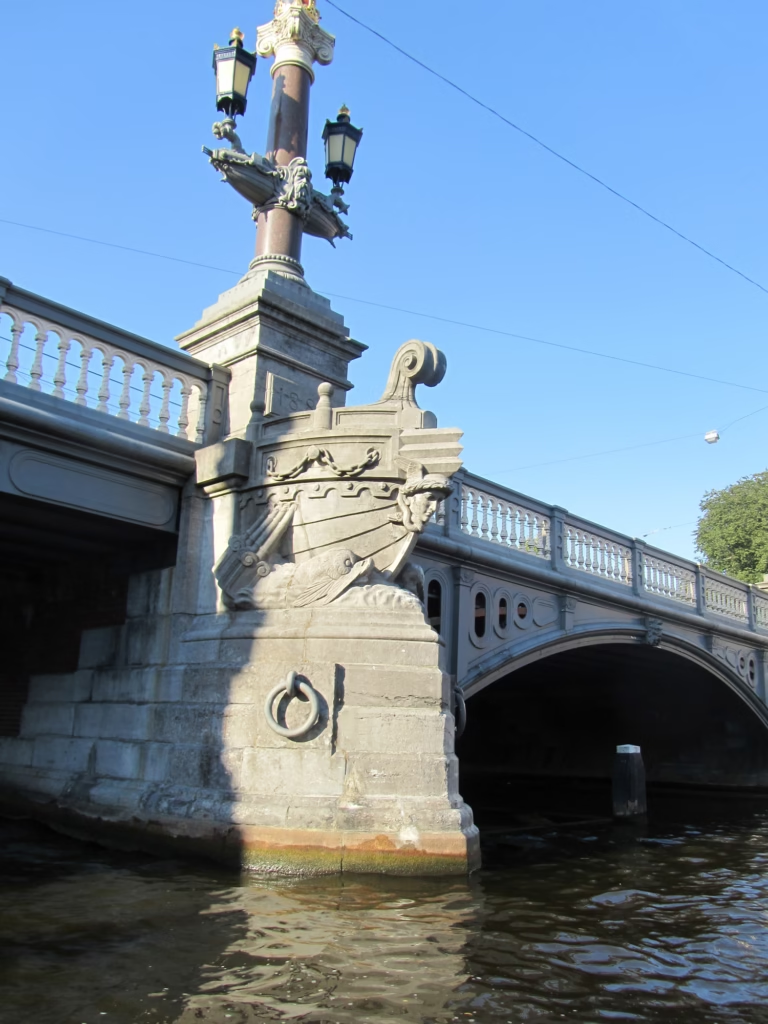
The Blauwbrug (Blue Bridge), officially bridge 236, is a gorgeous, contradictory name. It is not blue at all, but a beautiful Parisian-style stone arch bridge. The name is a direct reference to a 17th-century wooden bridge that was indeed painted a bright, distinctive blue. That original structure was a simple crossing, but in 1883 the city wanted a tram across the Amstel and something worth showing off during the Colonial Exhibition of that year, and it replaced the old bridge with the ornate stone one you see today. Bastiaan de Greef and his assistant Willem Springer drew it, in the manner of the great Paris river bridges, and Springer’s son Jan designed the decoration. The bridge has another name worth knowing: in Yiddish it was the Bloubrik, because it was a way into the old Jodenbuurt, and it turns up in a whole family of Yiddish sayings about never getting free of where you came from.
This bridge is a stunning piece of Imperial-style architecture, clearly inspired by the crossings of the Seine. Its lamp posts are capped with ornate crowns, the imperial crown of Amsterdam’s arms, and the stonework features sculptural elements depicting maritime history, complete with tridents and ship’s prows. It crosses a wide stretch of the Amstel, offering a powerful, symmetrical vantage point. The Blauwbrug is a reminder that Amsterdam was not just a merchant city, but a world capital that embraced the architectural language of empire.
4. Sint Anthoniesluis (St. Anthony’s Lock)

While many visitors admire the medieval towers of the De Waag (the Weigh House), the crossing worth a few minutes of the Nieuwmarkt is found just a few steps away at bridge 287, the Sint Anthoniesluis, carrying the Sint Antoniesbreestraat into the Jodenbreestraat. The sluice beneath it is genuinely old, placed around 1602 and already drawn on Pieter Bast’s map of 1599. The bridge on top of it is not: this one was built in 1968 and 1969 by Dick Slebos for Public Works, and the giveaway is the stark white concrete span. What sits on that span is the odd part, a set of nineteenth-century balustrades based on those of the old bridge, redrawn by Slebos, a deliberate anachronism bolted onto a modern deck.
Standing on this bridge offers one of the most evocative views in the city. To one side, you have the massive, fairy-tale towers of the Weigh House, and to the other, a row of notoriously “leaning” houses that look as though they are holding each other up. Because it functions as a lock, you can often watch the water levels being adjusted, a slow, mechanical reminder of the city’s constant battle with the sea. It is a perfect spot to capture the maritime soul of the old Lastage district, where ships were once built and goods from the corners of the globe were weighed and taxed.
5. Jan Schaeferbrug

If you are a fan of modern engineering, the Jan Schaeferbrug, bridge 2000, is a must-see. It is named for Jan Schaefer, the Amsterdam housing politician, and it was designed by Ton Venhoeven and built in 2001. At 230 metres it crosses the IJhaven to carry the Piet Heinkade over to the Java-eiland in the Eastern Docklands. Its best trick is at the southern end, where the bridge runs straight through a hole cut in Pakhuis de Zwijger, a warehouse that lost parts of its lower floors to let the road through.
It does not open in the ordinary way. It does not open at all, most of the time. Instead two sections of it are built to be lifted out entirely, so that tall ships can get into the Javahaven during Sail Amsterdam. The middle span and its central pier stay put; everything either side of them comes away. That was first done at Sail in August 2005, and it remains one of the strangest sights in the city, a main road with two pieces missing and square-riggers moored where the traffic was.
6. Nesciobrug

This is a bridge I have come to appreciate deeply, bridge 2013, named for the Dutch writer Nescio (Frits Grönloh). It came into use in 2006, a curving suspension and cable-stayed hybrid designed by Jim Eyre with the engineers Grontmij and Arup, and it took the National Steel Prize that year for its elegance. At 780 metres it is one of the longest cycle and foot bridges in the Netherlands. Amsterdammers call it the Palingbrug, the eel bridge, for the way it wriggles across the Amsterdam-Rhine Canal.
It solved a real disconnect, linking Amsterdam and Diemen with IJburg by way of the Diemerzeedijk and the Diemerpark, and it is closed to anything with an engine. For me its beauty lies in how the curve of the deck answers the flat land around it, and how the cables draw an abstract pattern of lines and shadows against the sky. There is a piece of hidden engineering worth knowing about too: the deck carries three tuned mass dampers to stop it bouncing underfoot, and the main one, at midspan, weighs ten tonnes.
7. The Hoge Brug, better known as the Pythonbrug

Its official name is the plainest in the city and nobody uses it. Bridge 1998 is on the books as the Hoge brug, the high bridge, because four hundred metres west of it sits the Lage brug, the low one, bridge 1997. Everyone calls it the Pythonbrug instead, for the violent red curve it throws over the water, and early on people tried Anaconda, Salamander and Dinosaur too. It crosses the 93-metre Spoorwegbassin in the Eastern Docklands, linking the Panamakade on Sporenburg with the Stuurmankade on Borneo-eiland, and it was delivered in 2001 to a design by Adriaan Geuze of West 8, who also drew housing in the streets on either side.
For me the entire purpose of this bridge is the climb. Because it humps up to nine and a half metres to let boats under, the walk over it is a small ascent and descent rather than a flat crossing, and the top is a viewpoint over the docklands and the moored boats below. The judges agreed: it took the International Footbridge Award in 2002, and Architectural Digest put it on a list of the eighteen most beautiful bridges in the world in 2019. Underneath all of it, invisibly, the Piet Heintunnel passes below both the high bridge and the low one.
8. Nieuwe Amstelbrug

The Nieuwe Amstelbrug (New Amstel Bridge, bridge 101) is a powerful historical marker. It was built between 1901 and 1903 and opened on 5 July 1903, carrying the Ceintuurbaan across the Amstel and giving the growing city its nearest fixed crossing upstream for the next thirty years. It is a bascule bridge, and the architect was H.P. Berlage, three decades before he drew the Berlagebrug further south. That makes it a useful thing to look at first: it is the generation before the Amsterdam School, the rationalist brick and stone that Piet Kramer and his contemporaries would push into something far more decorative.
I love this bridge for its robust, confident design. It features a specific type of draw mechanism called a bascule, where the massive central leaf is counterweighted and pivots up on a single axis. The heavy stone pillars and intricate metal railings are a testament to early 20th-century craftsmanship. When it opens to allow large ships to pass on the Amstel, it operates with a powerful, industrial grace. It is a bridge that feels like a solid, essential part of the city’s anatomy.
9. Kikkerbilssluis
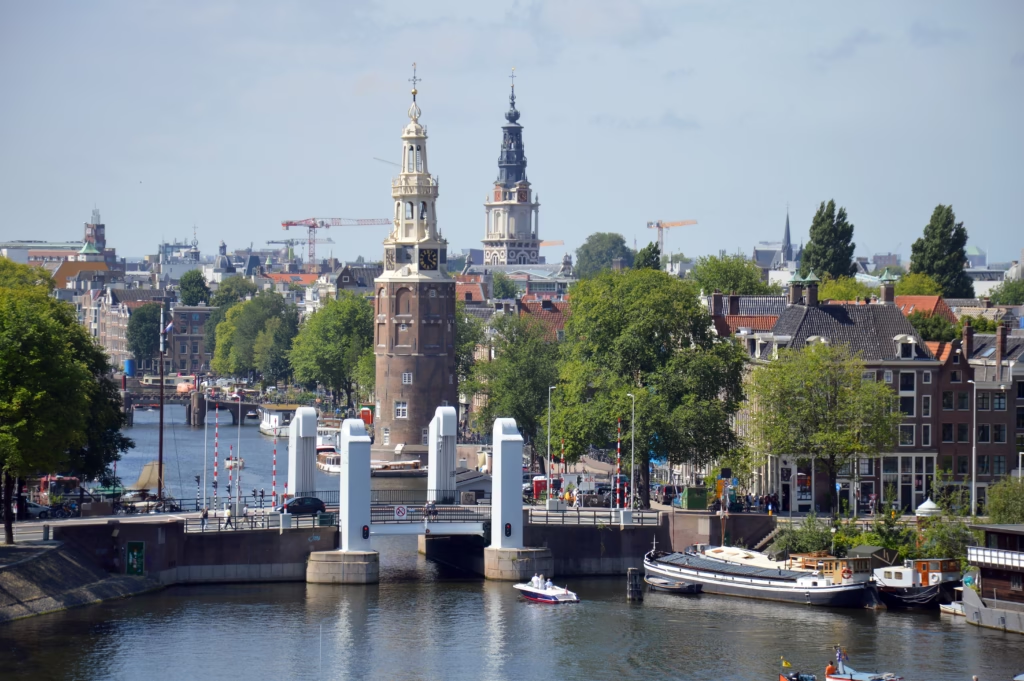
The Kikkerbilssluis (bridge 279) is on this list because it should not exist. It is a vertical lift bridge, a hefbrug, standing in the Prins Hendrikkade over the Oudeschans in the middle of the old city, where lift towers are exactly what the conservation-minded do not want. Piet Kramer designed it and it went up between June 1940 and September 1941, in the first year of the German occupation, working from a drawing of the towers he had made back in 1930. It was one of the very few lift bridges Kramer ever drew and one of fewer still that still work; the Omvalbrug is the other. From the day it opened it was operated remotely, from the Kortjewantsbrug.
The name means something like frog’s leg, and nobody can prove why. One account says it comes from de Kikkerbil, a seventeenth-century timber merchant’s yard that stood nearby. Another says a kikkerbil is itself a piece of shipbuilding timber. The Dutch sources are honest enough to say that neither has been demonstrated. The bridge has had other names as well, the Kalkmarktsluis, the West-Indische sluis, and the Ken-U-Zelvesluis after an inscription on a neighbouring house. Kramer’s hand shows in the wrought iron balustrades, kept deliberately plain here, and in one detail I like very much: the name of the bridge is not on a metal plate like most of the city’s, but chiselled straight into the granite. It has been a municipal monument since 1995.
10. Berlagebrug
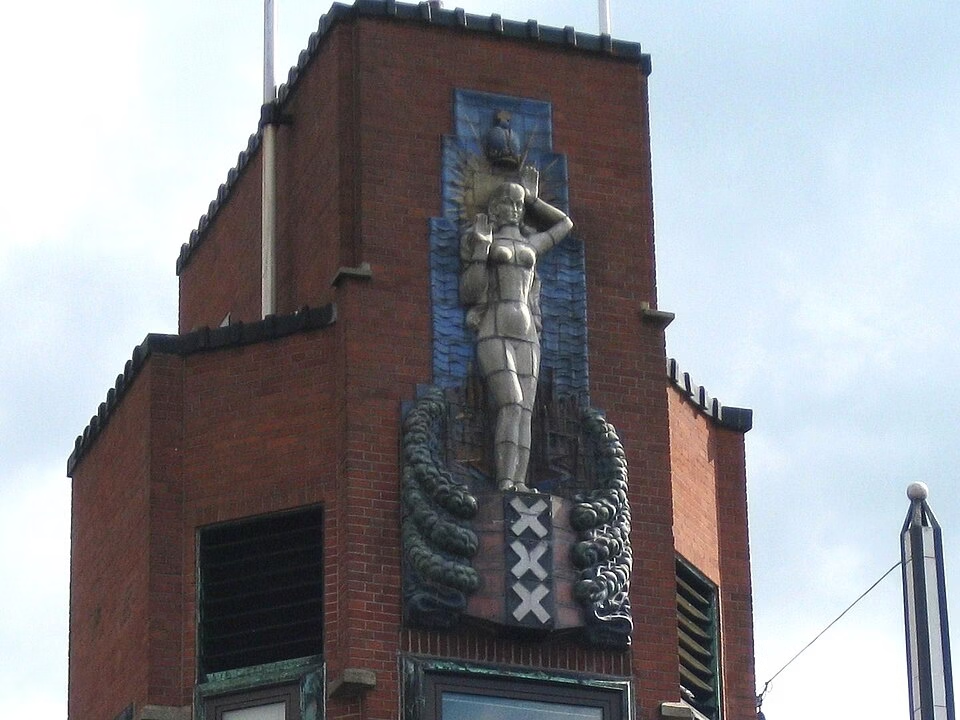
The Berlagebrug (bridge 423) is arguably the most monumental collaboration between Hildo Krop and the city’s architects, serving as a grand ceremonial entrance to southern Amsterdam. Completed in 1932, this massive span across the Amstel river was designed by H.P. Berlage himself, but it is Krop’s sculptural tower that gives the bridge its soul. Rising high above the water on a brick and stone pillar sits the “Genius of Amsterdam,” a seated figure clad in shimmering golden-yellow ceramic tiles. This figure represents the spirit of the city, rising from the water and gazes toward the future, flanked by reliefs that depict the city’s maritime power and historical strength.
Krop’s work on the Berlagebrug is a masterclass in scale and symbolic storytelling. While the “Genius” sits atop the pillar, the base of the bridge features heavy granite reliefs that ground the structure in the physical reality of the Amstel. These carvings depict “The Amstel” as a powerful figure, alongside themes of trade and industry that built the city’s wealth. The use of vibrant ceramics alongside the somber, dark granite creates a visual tension that is unique to the later period of the Amsterdam School. For the bridgehunter, the Berlagebrug is the ultimate “destination bridge” because it functions as a total work of art, where every brick, tile, and stone carving works together to tell the story of a city at the height of its modern ambition.
This is my list of the top ten bridges in Amsterdam. I hope this has shown you that a bridge is never just a crossing, it is a connection, a historical marker, and an architectural statement.
I’m on a mission to photograph and catalog all 1,200+ spans, and you can follow along on my project pages. Which of these bridges is your favourite, and which Amsterdam bridge do you think I should cross next?
Image Credit
Featured image: Genius van Amsterdam, Hildo Krop’s 1932 sculpture on the Berlagebrug, photographed by Marion Golsteijn, via Wikimedia Commons, CC BY-SA 3.0
Corrections
Corrected 25 September 2026. An earlier version of this post carried the wrong bridge number for eight of these ten bridges, placed the Hoge Brug in Amsterdam-Noord rather than the Eastern Docklands, said the Jan Schaeferbrug lifts vertically when in fact two of its spans are lifted out altogether, dated the Nieuwe Amstelbrug to 1913 rather than 1903, and credited the Kikkerbilssluis with four granite frogs by Hildo Krop. There are no frogs on the Kikkerbilssluis and Krop did no work on it. All ten entries have been checked against the sources and rewritten where they were wrong.