
For millennia, bridges have served as the vital connective tissue of human progress, acting as much more than simple crossings. They have functioned as the primary catalysts for the birth and expansion of early civilizations by facilitating the fluid exchange of ideas, the growth of both local and continental trade routes, and the creation of the world’s first organized transportation networks.
The story of bridge engineering is one of constant, iterative evolution. What began as rudimentary crossings fashioned from the most basic natural materials has transformed into a sophisticated discipline capable of supporting massive multi lane decks. These modern marvels now conquer once impassable obstacles, from churning rivers and jagged gorges to the complex, multi layered demands of dense 21st century urban infrastructure.
A Timeline of Structural Mastery
The technical journey of the bridge can be categorized by the materials that defined each era:
- The Ancient Foundations (c. 13th Century BC): The earliest surviving examples, such as the Corbel arch bridges of the Greek Bronze Age (the Arkadiko Bridge), relied on heavy stone and gravity. These early structures proved that a well built crossing could endure for thousands of years.
- The Mastery of the Arch: The Romans perfected the stone arch, a shape that remains in compression and allowed for the first truly long distance aqueducts and roadways. This remained the dominant global standard for nearly two thousand years.
- The Industrial Leap: The 18th and 19th centuries introduced iron and then steel into the engineer’s toolkit. This shift allowed for the birth of suspension and cantilever designs, which could span distances previously thought impossible.
- The Modern Era: Today, the widespread adoption of reinforced concrete, high tension steel cables, and advanced carbon fiber composites allows engineers to build thinner, stronger, and more resilient structures. These modern designs are built to withstand not just the weight of high speed rail and heavy freight, but also the environmental stresses of a changing climate.
By looking at a bridge, you are looking at a physical record of a society’s technical capability. From the hand laid brickwork of a 17th century Amsterdam canal crossing to the towering steel pylons of a modern sea bridge, these structures remain the most visible markers of our collective ambition to connect the world.
Bridges by Structure
This guide provides an overview of the primary bridge engineering types, replacing general references with iconic European examples. While the structural physics remains universal, Europe’s architectural history offers some of the most diverse and storied examples of these forms.
1. Beam Bridges (Liggerbruggen)
The beam bridge is the foundational form of civil engineering. It consists of a rigid horizontal structure (the beam) resting on two or more supports (piers or abutments).
- Structural Mechanics: The fundamental principle of a beam bridge is the management of compression and tension. When a load (like a truck) passes over the beam, the top fibers of the material are pushed together (compression), while the bottom fibers are stretched apart (tension).
- Engineering Constraints: Because beams are prone to “sagging” or deflection, they are generally used for shorter spans. To extend their reach, engineers use “continuous spans” supported by multiple piers.
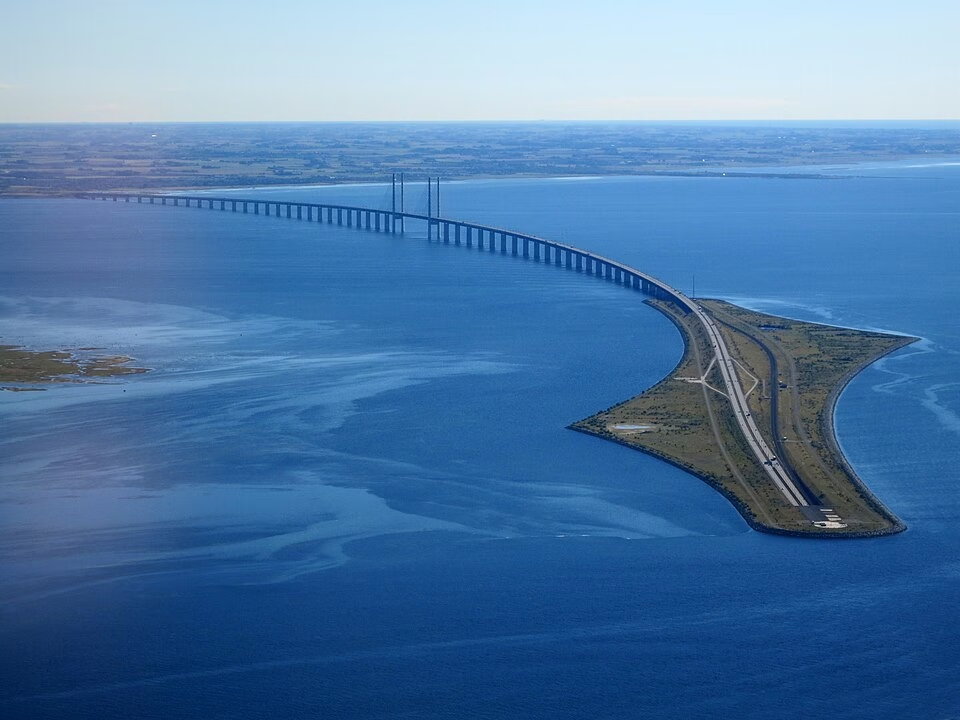
- European Masterpiece: The Öresund Bridge (Approaches), Sweden/Denmark. While the center is cable-stayed, the miles of approach ramps are massive concrete beam structures carrying the weight of heavy rail and international traffic.
2. Arch Bridges (Boogbruggen)
Arch bridges are among the oldest and most resilient structures in history. Their semicircular design transfers the weight of the deck and its loads into horizontal “thrust” maintained by the abutments.
- Structural Mechanics: The beauty of the arch lies in its ability to keep materials in a state of pure compression. This is why ancient builders could use stone and brick (materials weak in tension) to create spans that have lasted 2,000 years.
- The Keystone: The central “sluitsteen” at the top of the curve is the final piece that locks the entire structure into a self-supporting unit.
- European Masterpiece: The Pont du Gard, France. This Roman aqueduct utilizes three tiers of precise masonry arches, standing as a testament to the longevity of compression-based engineering.
3. Suspension Bridges (Hangbruggen)
Suspension bridges are the giants of the engineering world, capable of spanning the widest gaps (over 2,000 meters) where piers cannot be placed in the water.
- Structural Mechanics: Unlike arches, suspension bridges operate almost entirely on tension. The deck is hung from vertical suspender cables, which are attached to massive main cables draped over towers. These main cables are anchored into deep concrete blocks on either shore.
- Engineering Constraints: Aerodynamics are critical. Because the deck is “flexible,” engineers must design against wind-induced oscillation (vibration).
- European Masterpiece: The 25 de Abril Bridge, Lisbon. Often compared to San Francisco’s landmarks, this steel giant spans the Tagus River and carries both a motorway and a railway on its suspended deck.
4. Cable-Stayed Bridges (Tuitbruggen)
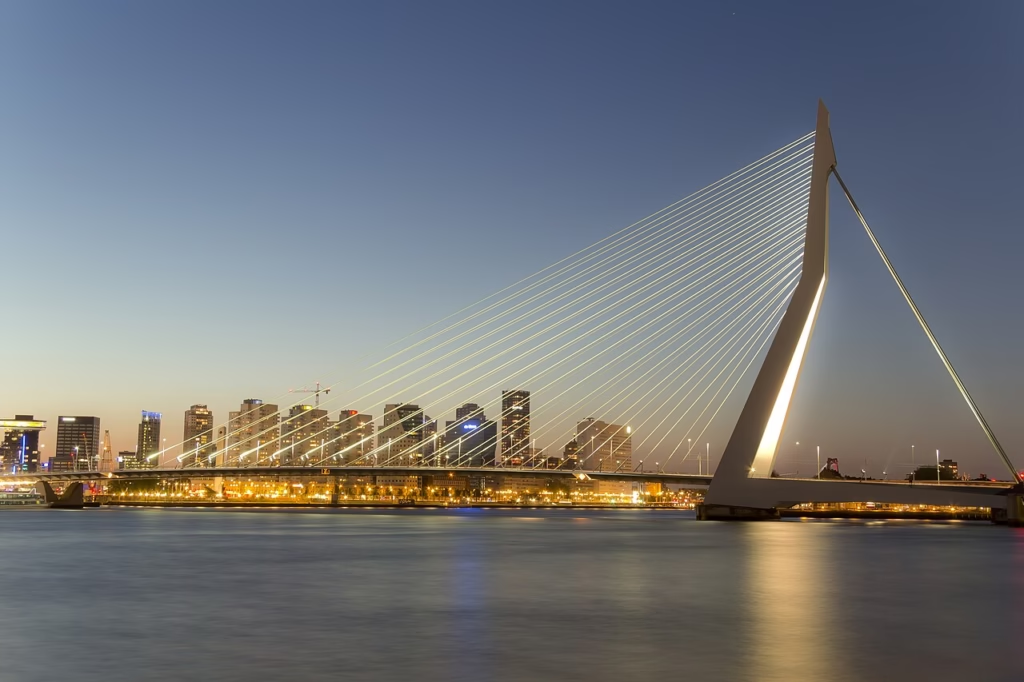
Cable-stayed bridges offer a modern, aesthetically striking alternative to suspension bridges for medium-to-long spans.
- Structural Mechanics: In this design, the cables run directly from the tower (pylon) to the deck, usually in a “fan” or “harp” arrangement. This creates a highly rigid deck compared to a suspension bridge.
- Efficiency: They require less cable than suspension bridges and can be constructed by extending the deck sections outward from the tower one by one.
- European Masterpiece: The Millau Viaduct, France. As the tallest bridge in the world, its multiple white pylons and delicate cable stays make it look like a fleet of sailboats crossing the Tarn Valley. [Image comparing a suspension bridge vs a cable-stayed bridge]
5. Cantilever Bridges (Uitkraagbruggen)
A cantilever bridge uses structures that project horizontally into space, supported only on one end (like a diving board).
- Structural Mechanics: Usually, two cantilever arms extend from opposite piers and meet in the center. They are often joined by a “suspended span” that rests on the ends of the arms. The weight is balanced by massive counterweights or anchors at the shore-side ends.
- European Masterpiece: The Forth Bridge, Scotland. This UNESCO World Heritage site is famous for its three massive, red steel cantilevers. It was the first major structure in the UK to be built entirely from steel.
6. Truss Bridges (Vakwerkbruggen)
Truss bridges are easily identified by their “triangular” skeletons. The triangle is the only geometric shape that cannot be deformed without changing the length of its sides, making it incredibly stable.
- Structural Mechanics: The truss distributes the load among various straight “members.” Depending on their position, some members are in tension while others are in compression. This allows for a very strong bridge using a relatively small amount of material.
- European Masterpiece: The Dom Luís I Bridge, Porto. This double-deck iron bridge utilizes a massive trussed arch to carry the city’s metro line above and local traffic below.
7. Bascule Bridges (Basculebrug)
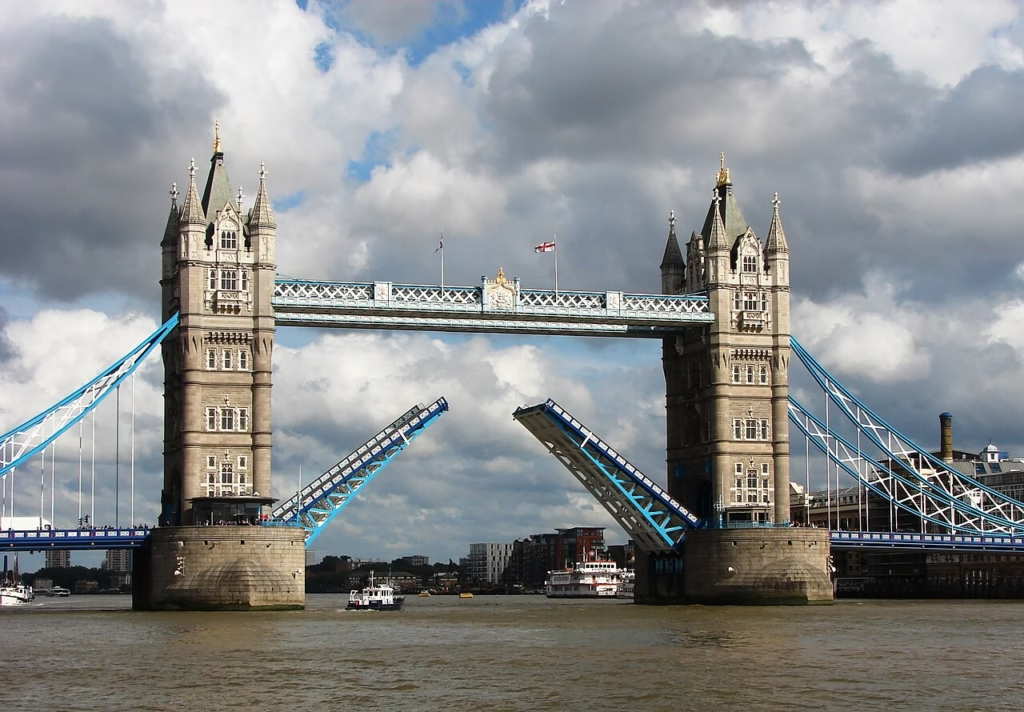
Commonly known as “moveable” bridges, these use a counterweight system to lift the bridge deck to allow tall ships to pass.
- Example: Tower Bridge, London. While it looks like a suspension bridge, its central span is a bascule bridge. The “bascules” (French for see-saw) are the two leaves that lift up.
- Amsterdam Context: The city is famous for its Magere Brug (Skinny Bridge), a traditional wooden double-drawbridge that is a specialized, smaller variation of the bascule principle.