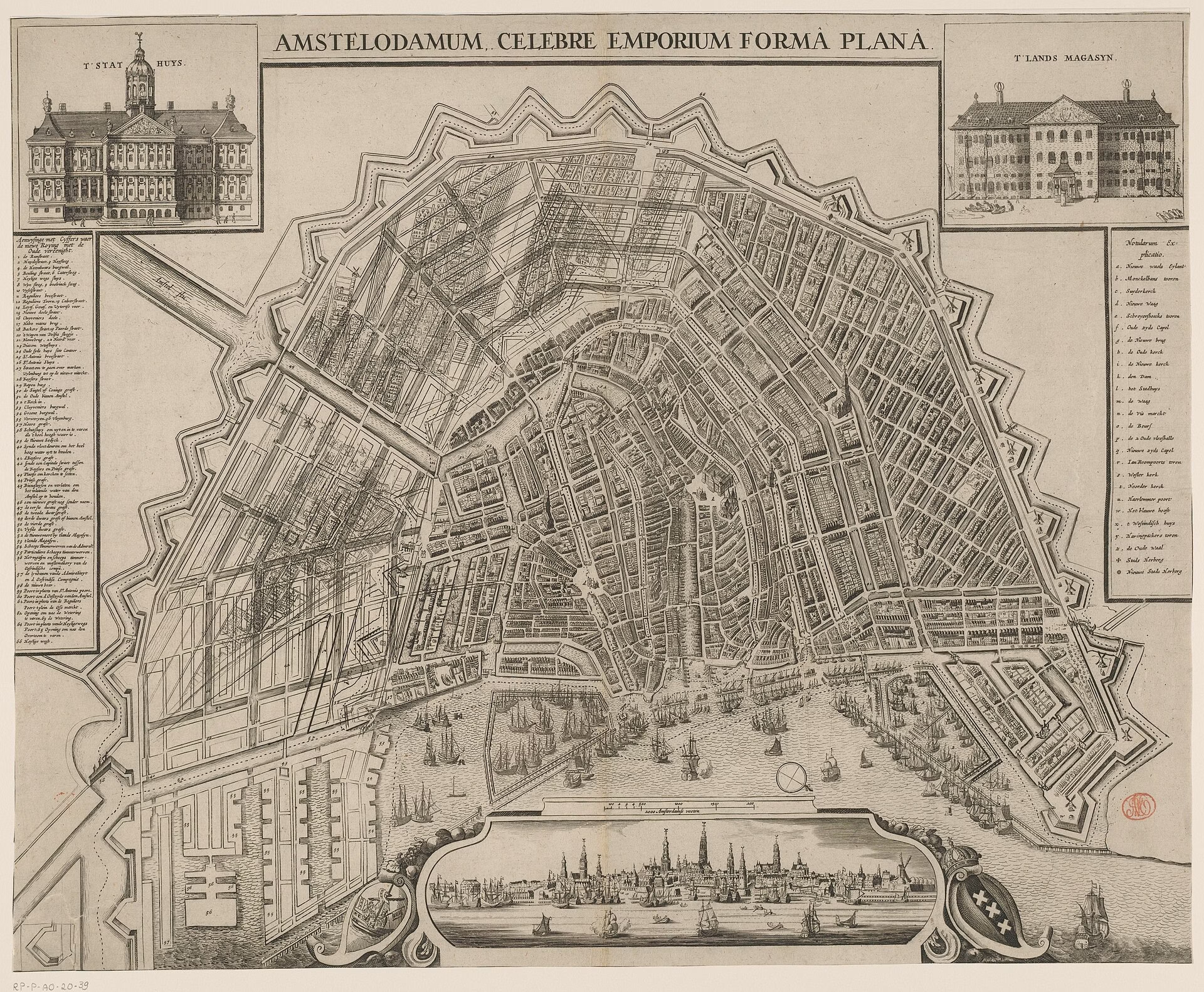
Four Men Planned the Canal Ring. Amsterdam Gave Each of Them a Bridge.
The Third Expansion is the piece of work that made Amsterdam look like Amsterdam. It is the phase that dug the western canal ring, laid out the Jordaan behind it, and turned a medieval trading town inside a moat into the city on the postcards.
Four men are credited with preparing and executing it: Hendrick Jacobsz. Staets, Lucas Jansz. Sinck, Frans Hendricksz. Oetgens and Hendrick de Keyser. A carpenter, a surveyor, a burgomaster and an architect.
Each of them now has a bridge. Not a statue in a square, not a street in a suburb, but a numbered crossing of the canal ring they built. It is one of the most complete pieces of civic commemoration in the city, and almost nobody notices it, because the four bridges are scattered across the numbering and you would only spot the pattern by walking the sequence in order.
The Carpenter: Hendrick Jacobsz. Staets, Bridge 35
Staets was the city carpenter, and in the seventeenth century that title carried far more than the modern word suggests. Amsterdam is built on piles driven into peat and sand. Every house, every quay and every bridge on the canal ring stands on timber, and the man responsible for timber was responsible for whether the city stood up.
The plan for the expansion is traditionally attributed to him in its earliest form. Bridge 35, the Hendrick Jacobsz. Staetsbrug, carries his name on the Herengracht.
The Surveyor: Lucas Jansz. Sinck, Bridge 36
Sinck was the surveyor, and the surveyor is the reason the canal ring is a piece of geometry rather than a sprawl. Somebody had to convert an intention into measured lines on marshy ground: where the water went, how deep the plots ran, where one owner’s frontage ended and the next began.
That work is invisible in a way the architecture is not. Nobody photographs a property boundary. But the reason the Herengracht, Keizersgracht and Prinsengracht hold their spacing for kilometres, and the reason the plots are consistent enough that the whole ring reads as one composition, is that a surveyor got it right the first time on ground that was mostly bog.
Bridge 36, the Lucas Jansz. Sinckbrug, crosses the Keizersgracht. Fittingly for a man who drew the city into existence, the bridge that bears his name was later redesigned by Piet Kramer.
The Burgomaster: Frans Hendricksz. Oetgens, Bridge 76
Oetgens was a burgomaster of Amsterdam, and his role was the one that made the others possible: the political and financial machinery of a project on this scale. Land had to be acquired, capital raised, contracts issued and objections managed. The canal ring was a speculative property development as much as a piece of urban planning, and someone had to run it as one.
Bridge 76, the Frans Hendricksz. Oetgensbrug, carries the western bank of the Amstel over the mouth of the Prinsengracht. Its position is the best of the four. This is the last bridge on the Prinsengracht, standing on the south-eastern boundary of the canal ring, at the exact point where the planned city stops and the river takes over. The man who organised the expansion is commemorated at its edge, on a bridge whose date stones read Anno 1773.

The Architect: Hendrick de Keyser, Bridge 77
De Keyser (1565 to 1621) is the one name of the four that a visitor might already know. He was city stonemason and sculptor, and the buildings that define the skyline of the canal ring are his: the Westerkerk on the Prinsengracht with the imperial crown on its tower, the Noorderkerk on the Noordermarkt, the Zuiderkerk, and the extravagantly ornamented Huis Bartolotti on the Herengracht.
When people say a building looks characteristically Amsterdam, they usually mean they are looking at De Keyser, or at somebody working in his manner: red brick with stone banding, sculptural decoration, spires that step and taper. He died in 1621, before the Westerkerk was finished, and his son Pieter completed it.
Bridge 77, the Henrick de Keijserbrug, spans the Achtergracht a short walk from Oetgens’s bridge, using the older spelling of his name. There is a small joke buried in it: the bridge looks out over a run of protected canal frontage, the Amstelsluizen and the Koninklijk Theater Carré, and the one structure in that view he did not design is the bridge itself, which dates from 1909.

Why the Numbers Are Scattered
The four bridges are 35, 36, 76 and 77. Two pairs, forty numbers apart, and the pairing is geographic rather than commemorative.
Amsterdam numbered its bridges from the centre of the web outwards, starting at the Muntsluis where the Singel meets the Amstel. Staets and Sinck sit next to each other because Bridge 35 on the Herengracht and Bridge 36 on the Keizersgracht are neighbouring crossings on the same run. Oetgens and De Keyser sit next to each other for the same reason, out at the Amstel end.
Nobody arranged for the planners of the expansion to be commemorated in adjacent pairs. The numbering came first, by a couple of centuries, and the names were attached later as the city worked through its long backlog of anonymous crossings. The pattern is an accident of geography, which somehow makes it better.
Walking the Four
They divide neatly into two short walks.
- Bridges 35 and 36, the Staetsbrug on the Herengracht and the Sinckbrug on the Keizersgracht, are a few minutes apart in the eastern canal belt.
- Bridges 76 and 77, the Oetgensbrug and the De Keijserbrug, sit on the western bank of the Amstel where the Prinsengracht and the Achtergracht meet the river.
Do the second pair at the end of the day, when the light is on the Amstel and Carré is lit from across the water. You will be standing where the canal ring ends, on a bridge named for the man who paid for it, looking at a lock complex built seventy years later to fix a water problem the expansion created. Amsterdam rarely lays out its own history quite so conveniently.
Sources Consulted
- Featured image: Plan of Amsterdam showing the design for the Fourth Expansion, 1662 by Rijksmuseum, 1662, via Wikimedia Commons, CC0
- Frans Hendricksz. Oetgensbrug, Nederlandstalige Wikipedia
- Henrick de Keijserbrug, Nederlandstalige Wikipedia
- Lucas Jansz Sinckbrug, Nederlandstalige Wikipedia
- Hendrick de Keyser, Wikipedia
- Lijst van bruggen in Amsterdam
- Bruggen van Amsterdam