


A Square That Is a Bridge (and a Bridge That Is a Square)
Stand at the Muntplein on a bright morning and you might reasonably think you are in one of Amsterdam’s more modest city squares: a broad, open expanse of stone paving where six streets converge, trams clang past, cyclists weave between tourists consulting their maps, and the elegant silhouette of the Munttoren rises against the sky like a reminder of everything that has come before. You would not be wrong about any of this. But you would be missing the most extraordinary fact about the place beneath your feet: you are standing on a bridge. Not a bridge in the conventional, narrow sense of the word. The Muntsluis, officially designated Bridge Number 1 in Amsterdam’s municipal numbering system, is one of the widest in the old centre, wide enough that most people who cross it never register it as a bridge at all. Beneath the broad stone plaza, beneath the tram tracks and the bicycle lanes and the worn paving stones, the waters of the Singel canal flow quietly into the Amstel river, just as they have done for more than five centuries. The bridge does not announce itself. It simply absorbs everything that the city requires of it, and has done so, in one form or another, since the late fifteenth century. The engineering that allows a structure to carry a bustling six-way intersection, tram tracks, and thousands of daily pedestrians is a matter of progressive expansion. The Muntsluis achieved its current colossal width through a series of widenings over the centuries, each generation of city builders extending the platform to accommodate the growing demands of urban traffic. The most significant of these expansions, as we shall see, came in the late 1930s. But the story begins much earlier, at a gate in Amsterdam’s medieval city wall.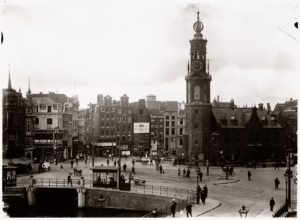
The Regulierspoort and the Origins of Bridge 1
The land beneath Muntplein was, in the fifteenth century, the edge of the world as Amsterdam knew it. The city was growing rapidly, pushing its walls outward in concentric expansions, and in the years between 1480 and 1487 the municipality constructed the Regulierspoort, one of the three principal gates in the medieval city wall. Like most defensive gates of the period, the Regulierspoort was an imposing structure: two towers flanking a central gatehouse, with a narrow passageway between them for the movement of people and goods. Beside it, a slender wooden bridge crossed the water at the point where the Singel met the Amstel, connecting the city to the meadows and farmland beyond the walls. The gate bore the name “Reguliers” in reference to the Augustinian canons, the Reguliere Kanunniken, whose monastery stood nearby. For over a century it served its function as a gateway and checkpoint, until Amsterdam’s second great expansion made the old city wall redundant. The wall was demolished to make way for new streets and buildings; a glassworks appeared on the site in 1613, followed by a guardhouse in 1616. The gate itself, stripped of its defensive purpose, had already begun its long transformation into something else entirely. The decisive moment came in 1618. A fire broke out in the glassworks and consumed most of what remained of the Regulierspoort complex: the old gatehouse, the watchtower, and the houses that had grown up between the structures. When the smoke cleared, only a fragment of the original gate survived: the lower section of one tower, standing alone beside the water. That fragment would become the base of the Munttoren, the Mint Tower, which dominates the Muntplein to this day.Hendrick de Keyser and the Tower That Stands
In 1620, just two years after the fire, Amsterdam’s celebrated city architect Hendrick de Keyser was commissioned to make something of the surviving tower stump. De Keyser, already famous for churches like the Westerkerk and the Zuiderkerk, brought his characteristic Amsterdam Renaissance sensibility to the task. He raised an octagonal brick section atop the medieval base, crowned it with an elegant open spire of painted wood, and installed a clock with four faces. The carillon came later. The result was a tower that managed to look both ancient and contemporary, a quality that the Dutch have always prized. The carillon the tower has now was not made for it. The Hemony brothers cast it in Zutphen in 1651 for Hendrick de Keyser’s Beurs, where it was hung in 1655. When the Beurs tower had to go in 1668 to make room for an extension, the bells were moved to the Munttoren, and Pieter Hemony enlarged the set of twenty-two that year with six new heavy bells cast in Amsterdam, the largest of them sounding C sharp and weighing close to two thousand kilograms. In 1669 he made the bronze playing drum that still strikes the bells every quarter of an hour. After later restorations the instrument now numbers 38 bells, two more than Hemony left.
The Name: Munt, Sluis, and a Pleasing Linguistic Mystery
The name “Muntsluis” repays a little investigation, because both of its components contain surprises. The word munt (mint) reflects an episode that was brief but historically vivid. In the catastrophic year of 1672, known in Dutch history as the Rampjaar or “Year of Disaster,” the Dutch Republic found itself simultaneously at war with England and France. French forces occupied large portions of the country, and the established minting cities of Dordrecht and Enkhuizen were cut off from the circulation of precious metals. In this emergency, the guardhouse attached to the Munttoren was pressed into temporary service as a coin-minting facility. The arrangement lasted only a few years, but it was long enough to give the tower its permanent name, and through the tower, the square and the bridge beneath it inherited the same designation. The word sluis (sluice, or lock) is the more intriguing component. A visitor today will find no lock at Muntplein: the water beneath the bridge flows freely, unimpeded by any gate or mechanism. Yet the structure is called a “sluis” and not a “brug” (bridge). This is because, in older Amsterdam Dutch, the word sluis was routinely applied to stone bridges, particularly those that replaced earlier wooden crossings or those associated with water management infrastructure. When the narrow wooden crossing at this location was replaced with a more substantial stone structure, it acquired the designation sluis as a matter of local convention, even though there was no functioning lock involved. The nearby Doelensluis bears the same etymological imprint. It is, as these things tend to be in Amsterdam, a small fact that opens a window onto a much older city.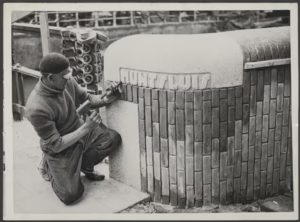
The Number That Is Not First
Bridge Number 1 is not the oldest bridge in Amsterdam, nor was it the first to be built. The numbering system was introduced in the modern era as a practical administrative tool for a city with more than 1,700 bridges, and the Muntsluis was assigned the number 1 because it occupies the geographical and conceptual center of Amsterdam’s canal network. From this point the low numbers run north along the Singel and then out through the canal ring, though the sequence is not a clean spiral: bridge 7 sits out in Oud-West, because its number was freed up when the original bridge 7 disappeared with the filling in of the Warmoesgracht in 1894 and was handed on to a new crossing elsewhere. It is, in other words, the origin of the city’s official counting of itself.Jo van der Mey and the Amsterdam School Bridge
By the early twentieth century, the bridge at Muntplein had been widened several times from its medieval dimensions, but it was the commission of 1915 that gave it its lasting architectural character. The designer was Joan (Jo) Melchior van der Mey (1878-1949), a figure of outsized importance in Amsterdam’s architectural history. Van der Mey had trained under Eduard Cuypers and won the prestigious Dutch Prix de Rome in 1906, after which he was engaged by the city as its “Aesthetic Advisor.” This was a role that suited him precisely, because van der Mey was not simply a builder but a theorist of the urban environment, a man who believed that every element of the streetscape, from the largest facade to the smallest lamp post, should be part of a coherent artistic vision. His great early commission was the Scheepvaarthuis (Shipping House, begun 1912), a building generally credited as the founding text of the Amsterdam School movement. The Amsterdam School, which flourished roughly between 1915 and 1930, was characterized by expressive brickwork, organic ornamental details, sculptural facades, and a rejection of the austere rationalism that was simultaneously emerging in other parts of Europe. It was, in its own way, a total art philosophy: architects designed not just buildings but bridges, street furniture, and decorative ironwork, all in a style that was unmistakably Dutch and unmistakably of its moment. Van der Mey’s design was approved on 30 April 1914 by the commission advising on building on municipal land, and the almost entirely renewed bridge opened in January 1916. It reflected these principles. The bridge incorporated decorative stonework in the expressive idiom of the Amsterdam School, with the kind of sculptural attention to ornamental detail that his colleagues Michel de Klerk and Piet Kramer were simultaneously bringing to social housing projects across the city. Van der Mey also drew a small bridge house, a kiosk, which went up on the northwest side, its modest dimensions belying the architectural ambition applied to it. A separate house for the traffic police came later, in 1949, and was taken off the bridge again in 1992 and re-erected elsewhere.Piet Kramer and the Great Widening
If van der Mey gave the Muntsluis its architectural identity, it was Piet Kramer (1881-1961) who gave it its present scale, and in the process replaced most of what van der Mey had built. In 1938 and 1939, Kramer oversaw the widening of the bridge to its current extraordinary proportions, the intervention that transformed a wide bridge into effectively a city square. Kramer was, by this point, Amsterdam’s foremost bridge architect, a man who had spent decades designing and rebuilding the city’s crossings in a style that combined Amsterdam School expressionism with civic pragmatism. He had collaborated with van der Mey on the Scheepvaarthuis, and like his colleague he shared the conviction that infrastructure could be architecture. His bridges are distinguished by their wrought-iron railings, their stone sculptures, and the quality of attention paid to surfaces that most designers would have treated as purely functional. The widening of the Muntsluis was a substantial engineering undertaking, requiring the extension of the bridge’s platform across the full width required to accommodate the traffic demands of a city that had grown enormously since 1917. In appearance it amounted to an entirely new bridge. Van der Mey’s railings went, and so did the kiosk. Seats were added on the north side, and the decoration became worked natural stone and motifs set into the brick. The result is the structure we see today, broad enough to function as a public square while still being, at its heart, a bridge. Which of the two is actually the widest bridge in the old centre is a question the sources will not settle: the Dutch entry for the Muntplein awards the title to the Muntsluis after its successive widenings, while the entry for the Singel gives it to the Torensluis, bridge 9, at forty-two metres.The Flower Market at the Edge of the Bridge

The Rode Loper and the Modern Muntplein
For much of the twentieth century, Muntplein was, despite its historic character, something of an urban problem: a complicated intersection where trams, cars, cyclists, and pedestrians competed for space in conditions that were, by any reasonable measure, chaotic. The convergence of six streets and multiple tram lines at a single point was always going to create friction. The transformation began in 2017, when the city included Muntplein in the ambitious “Rode Loper” (Red Carpet) project. The Rode Loper was conceived as a pedestrian and cycling priority corridor running south from Central Station along the route of the new Noord-Zuidlijn (North-South Metro, Line 52), which opened in July 2018. The philosophy was straightforward: now that a metro line ran directly beneath the city’s busiest north-south axis, the surface streets could be reclaimed from motor traffic and given over to slower, more human-scaled movement. At Muntplein, a section of tram track was rebuilt from double track to single track, freeing up significant pavement width for pedestrians and cyclists. The Rode Loper was followed by the related Oranje Loper project (launched from 2023), which extended the same pedestrian-priority logic to parallel corridors. Together, these interventions have dramatically changed the character of Muntplein: where once a never-ending tangle of vehicles made the square feel more like a junction than a place, it now functions, increasingly, as the city square it has always technically been.Trams at Muntplein Today
As of 2025, the tram lines serving Muntplein and the immediately adjacent Rokin area are lines 4 and 14. Both run between Centraal Station and Rembrandtplein, passing through Dam Square and along the Rokin before arriving at Muntplein. Tram 14 follows a longer route, continuing east from Rembrandtplein through the Plantage district and into Amsterdam-Oost via Zeeburgerdijk. Tram 4 provides a more direct corridor between the station and the southern part of the city centre. Tram line 24, which previously ran the full length of Vijzelstraat from Centraal Station, was truncated in November 2023 and now terminates at Frederiksplein, considerably south of Muntplein. The reduction in surface tram traffic along Vijzelstraat reflects the success of Metro 52 beneath it: the underground line covers the same north-south corridor in four minutes, with a stop at Rokin that places passengers a short walk from the bridge. For visitors approaching from the north, the metro station at Rokin is now typically the most direct route to Muntplein on foot.Standing on Bridge Number 1
The Muntsluis repays more than a glance. Most visitors to Amsterdam pass across it without registering what it is, drawn forward by the Munttoren or the flower market or the tram that has just arrived. But the bridge rewards the visitor who pauses to look down at the water flowing beneath the paving, to trace the worked natural stone and the motifs in the brick that Kramer chose when he rebuilt it, or to consider the improbable continuity of this place: a fifteenth-century city gate, a seventeenth-century mint, an Amsterdam School bridge, a twenty-first-century pedestrian priority square, all layered on top of one another at the precise point where the Singel meets the Amstel. It is Bridge Number 1 not because it was built first, but because it is the center: the place from which all other bridges, and in some sense all of Amsterdam, are counted. To stand on it is to stand at the origin point of a numbering system that encompasses more than 1,700 crossings and stretches to every corner of a city built, in the most literal sense, on water.Research compiled February 2026. Sources consulted include the Amsterdam city information portal (DutchAmsterdam.nl), the Bridges of Amsterdam archive (bridges.cramberts.com), Wikipedia entries on the Munttoren, Amsterdam School architecture, and Amsterdam tram lines, and GVB public transport information. For primary source research, the Stadsarchief Amsterdam (Amsterdam City Archives) holds extensive photographic and documentary records relating to the Muntsluis, including drawings from the van der Mey and Kramer commissions.
Key Facts at a Glance
Official name: Muntsluis Bridge number: 1 (Brug 1) Location: Muntplein, where the Singel meets the Amstel Status: One of the widest bridges in the old centre, rivalled by the Torensluis (bridge 9) Streets connected: Singel (east quay), Kalverstraat, Rokin, Amstel (west quay), Reguliersbreestraat, Vijzelstraat Historical predecessor: Regulierspoort (city gate), 1480-1487 1618: Fire destroys the Regulierspoort; Munttoren base survives 1620: Hendrick de Keyser rebuilds the tower in Amsterdam Renaissance style 1672: Munttoren guardhouse temporarily used as a coin mint (Rampjaar) 1915/1917: Bridge redesigned by Jo van der Mey (Amsterdam School) 1938/1939: Bridge widened by Piet Kramer to current dimensions 2017/2018: Rode Loper project prioritizes pedestrians and cyclists Current tram lines: 4 and 14 Adjacent landmark: Bloemenmarkt (eastern terminus at Muntplein) “Sluis” note: Term historically applied to stone bridges in Amsterdam; no functioning lock exists here today
 See also


Muntsluis (Amsterdam) – Wikipedia
Brug 1 met links onderbouw van de Munt en rechts kassen van de Bloemenmarkt (mei 2018)
nl.wikipedia.org
History and information
Muntsluis (bridge 1) on the Muntplein over the Singel was one of the first bridges to be officially named If you ever visited Amsterdam before 1985 you would be forgiven for thinking you were in the wrong location when looking for Muntsluis. Until 1985 there was an island tram stop in the middle of the bridge with four tracks, two in each direction. Don’t worry though the area is still well served by public transport and tram stops have been relocated into neighbouring streets. At the turn of the twentieth century Vijzelstraat was designated by the municipality of Amsterdam as an exit road from the city center and that was predicted to result in more traffic. So the northern facade of the street was demolished and rebuilding took place far behind the old building line widening the road. In 1938/1939 the bridge was widened to a design by Piet Kramer. Kramer (will be a name you come to know in the following posts as he was a prolific architect in Amsterdam) designed a bridge in an elaborated form of the Amsterdam style. There were seats on the north side and processed natural stone and motifs in the brick. Architects 1915: J.M. van der Mey 1939: Piet Kramer
Muntsluis/brug 1/Doelensluis/brug 220
Situation sketch centred on Schapenplein (Muntplein)/upward view of openwork bridge decks/stand
archief.amsterdam

Muntsluis (brug 1) op het Muntplein over het Singel. “u00c9én van de eerste bruggen die een officiële naam krijgt
Muntsluis (bridge 1) on the Muntplein over the Singel. one of the first bridges to be officially named
archief.amsterdam

Muntplein
Statue of Lady Fortuna by sculptor Hildo Krop, 1948, on the railing of the Muntsluis, from the Rokin near the Langebrugsteeg.
archief.amsterdam
Map and location
Muntplein (Mint square) is actually the bridge span over the Singel canal. If you’ve ever been to the famous Amsterdam flower market then you’ve likely crossed over this bridge. On some maps this is literally “centrum” or centre of Amsterdam and sometimes it feels that way with the number of tourists! To find this bridge it’s about a fifteen minute walk from Amsterdam Centraal station via Damrak and Rokin.


Sources and Further Reading
- Muntsluis, Nederlandstalige Wikipedia
- Wikimedia Commons, Category: Brug 1, Muntsluis
- Bruggen van Amsterdam
- Stadsarchief Amsterdam, Beeldbank and Publieke Werken archives
- Frank V. Smit, Bruggen in Amsterdam (2008), Uitgeverij Matrijs