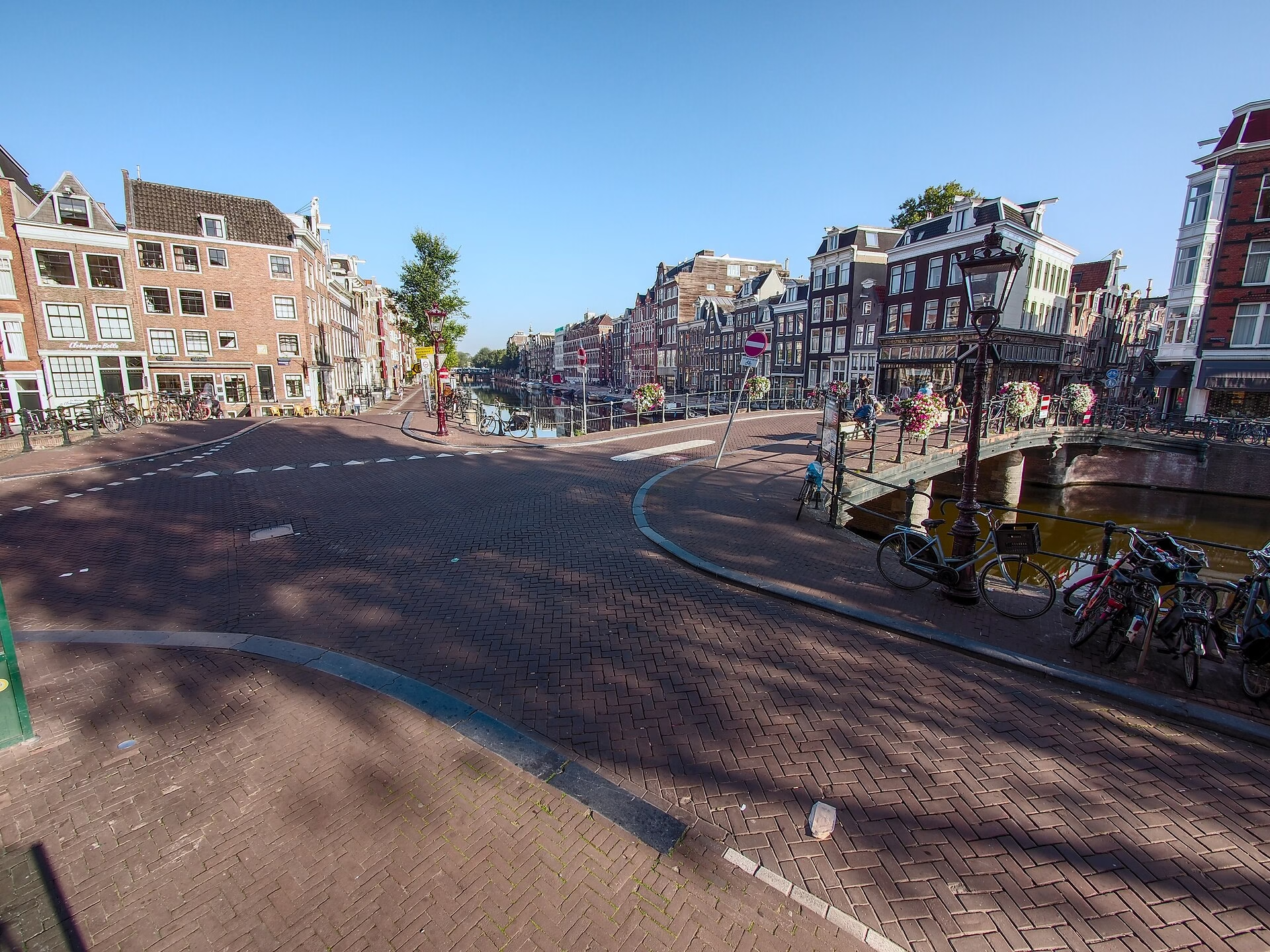
The Bridge the War Delayed: Brug 87 and the Spiegelgracht
Brug 87 carries the western embankment of the Prinsengracht over the Spiegelgracht. It is a Piet Kramer design, and it was finished in 1949, nine years after it was needed, because a war got in the way.
Three Centuries of Timber
A fixed wooden bridge stood here from at least 1675, when it appears on the maps of the completed canal ring. Timber crossings were the Amsterdam default for a long time: cheap, quick to build, and quick to rot.
By 1886 the structure needed renewing and widening, which was the fate of most bridges in this stretch as traffic grew through the nineteenth century. The deck that came out of that work lasted about fifty years.
In 1937 the deck was found to be deteriorating badly, and around 1940 the city began planning a replacement.
Why 1940 Became 1949
The German invasion came in May of that year, and the occupation that followed made ordinary municipal construction close to impossible. Steel, cement and timber were requisitioned or unobtainable. By the final winter of the war the city was burning its own wooden infrastructure for fuel, and Amsterdam lost tram sleepers, doors, joists and the timber decks of bridges to the Hongerwinter of 1944 to 1945.
Construction eventually ran in 1948 and 1949, and the bridge opened in 1949. It is one of a small group of Amsterdam bridges that were designed before the occupation and built after it, and the gap shows in the finish.
Architectural Lineage: Kramer, Simplified
The bridge is a welfbrug, a single-arch fixed bridge, with natural stone at the embankments and a deliberately plain treatment elsewhere.
That combination is the tell. Kramer’s pre-war bridges are elaborate: sculpted stone, ornamental ironwork, the full Amsterdam School vocabulary. This one keeps the good stone at the points that matter and simplifies everything else, which is what an architect does when the materials budget of a bankrupt post-war city will not stretch to more.
It is a late Kramer, and it reads as one. Compare it with Bridge 43 on the Leidsestraat, twenty-odd years earlier and unrestrained, to see what the intervening decades cost.
The Spiegelkwartier
The Spiegelgracht is short, and it is the spine of the Spiegelkwartier, Amsterdam’s antiques and art dealing quarter. The street runs from here up to the Rijksmuseum, and the shopfronts along it have sold paintings, furniture, silver and porcelain for well over a century.
Its other bridge, Brug 69 over the Prinsengracht, was once nicknamed the Antiquairbrug for exactly this reason. The two bridges bracket the quarter, and this one is the quiet end.
The bridge is not itself a monument, but the buildings on both banks are municipal and national monuments, and the setting is protected as part of the UNESCO canal ring.
In 2016, along with the rest of the city’s unofficial names, its old name Spiegelbrug was discontinued.
The Nineteenth Century’s Appetite for Rebuilding
The 1886 renewal was not unusual. Amsterdam rebuilt an enormous number of its bridges between roughly 1860 and 1900, and the reasons were cumulative: horse-drawn traffic was getting heavier, the first horse trams and then electric trams needed flatter approaches and stronger decks, and the timber structures inherited from the seventeenth and eighteenth centuries were simply reaching the end of their lives all at once.
The result is that many bridges in the canal ring look older than they are. The setting is seventeenth-century, the stonework may be, and the structure carrying you across very often dates from the 1880s or later. Brug 87 makes the point more sharply than most: a crossing recorded in 1675, on the site of continuous timber bridges, carrying a deck built after the Second World War.
Technical Specifications
- Bridge number: 87
- Former name: Spiegelbrug, discontinued 2016
- Type: Welfbrug (single-arch fixed bridge)
- Carries: Prinsengracht, western embankment
- Spans: Spiegelgracht
- District: Amsterdam-Centrum
- Coordinates: 52.3626 N, 4.8877 E
- Architect: Piet Kramer, Dienst der Publieke Werken
- Earliest record: Wooden fixed bridge, by 1675
- Renewed and widened: 1886
- Deck failing: 1937, replacement planned around 1940
- Current structure: 1948 to 1949
- Materials: Natural stone embankments, otherwise simplified
- Status: Not a monument, surrounded by monuments
Sources Consulted
- Featured image: Brug 87, Bridge 87, Amsterdam by Alf van Beem, 2017, via Wikimedia Commons, Public domain
- Brug 87, Nederlandstalige Wikipedia
- Spiegelgracht, Nederlandstalige Wikipedia
- Piet Kramer, Nederlandstalige Wikipedia
- Hongerwinter, Nederlandstalige Wikipedia
- Bruggen van Amsterdam
- Stadsarchief Amsterdam, Beeldbank
- Sebas Baggelaar and Pim van Schaik, Piet Kramer, Bruggenbouwer van de Amsterdamse School (2016)