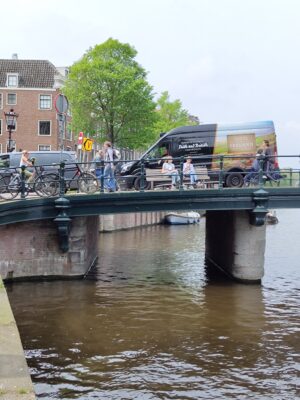
The Bridge to the Antique Quarter, Rebuilt in 1951 With Kramer’s Fingerprints on Its Piers
Bridge 69 connects the Spiegelgracht with the Nieuwe Spiegelstraat, spanning the Prinsengracht between them. It is unnamed, and it is the gateway to one of the most specialised streets in Amsterdam: the Spiegelkwartier, the city’s antiques and art-dealing quarter, which runs from this bridge towards the Rijksmuseum.
Structural Evolution: Jacob Bosch’s Map of 1679, the Tender of 1866, and the Lowering of 1890
The bridge appears on Jacob Bosch’s map depicting the Fourth Expansion, from around 1679. That places it in the last great phase of Amsterdam’s planned growth, when the canal ring was extended east and south to its final seventeenth-century extent.
In 1866 a tender was issued for placing a new bridge, which contractors could build for 20,000 guilders. The figure is a useful anchor: it tells us that a Prinsengracht crossing in the 1860s was a substantial but not extravagant piece of municipal spending, procured through open competition in the ordinary way.
In 1890 the bridge had to be lowered and widened. This is the same pressure that flattened bridges all along the Prinsengracht in the closing decades of the nineteenth century — wheeled traffic increasing, arched profiles becoming obstacles, and the city consistently deciding in favour of the road over the water. At Bridge 62 the skippers formally protested the equivalent decision and lost; the same argument was being had, and settled the same way, up and down the canal.
Architectural Lineage: A 1951 Bridge That Looks Older Than It Is
The bridge standing today dates from 1951 and was designed by the Department of Public Works. It is, in other words, a post-war structure — younger than a visitor would guess from a canal-side glance.
What makes it interesting is that it carries several characteristics of Piet Kramer’s hand, in the Amsterdam School manner, and these are found especially in the bridge piers. Kramer had been the dominant figure in Amsterdam bridge design since the 1910s, and by 1951 the Public Works department had absorbed his vocabulary so completely that a bridge produced by the office rather than by the man still spoke with his accent. The piers are the place to look: the massing, the profile and the treatment of the masonry follow patterns Kramer established decades earlier.
This is a common but under-appreciated phenomenon in Amsterdam. A great many of the city’s “Amsterdam School” bridges are not by Kramer at all; they are by a municipal department that learned his idiom and continued speaking it long after the movement itself had passed.
Urban and Social Context: The Spiegelkwartier
The Nieuwe Spiegelstraat, which this bridge feeds, is the spine of the Spiegelkwartier. Since the late nineteenth century the street has been concentrated with antique dealers, art galleries and specialists in everything from Delftware to scientific instruments — a clustering that followed the opening of the Rijksmuseum at the street’s southern end in 1885.
That gives Bridge 69 a defined role in the city’s geography. It is the point at which a visitor crossing from the canal belt enters a street with a single, sustained commercial identity, and it is the last crossing of the Prinsengracht before the museum quarter. The bridge is the threshold, and the widening of 1890 makes rather more sense in that light: this was becoming a route to somewhere.
Wider Context: An Unnamed Bridge in a Named City
Amsterdam has more than a thousand bridges and, until recently, names for only about a quarter of them; more than 1,300 remained unnamed. In July 2016 the city council formally adopted a number of long-used unofficial names and removed 88 others that were unsubstantiated or confusing. A public call followed, inviting residents to suggest names for the unnamed spans, and around 1,500 proposals were submitted, of which roughly a hundred have been adopted.
Neighbouring crossings have been through that process in both directions. Bridge 67 lost the name Kleine Brouwerssluis in 2016 and became the Angenietje Swarthofbrug in 2021; Bridge 93 shed the unofficial Bestedelingenbrug and became the Pieter Goemansbrug. Bridge 69 has not yet been through it. Standing at the entrance to the antiques quarter, on a crossing recorded in 1679 and rebuilt three times since, it remains a number.
Technical Specifications
- Bridge number: 69
- Name: None (unnamed)
- Type: Fixed bridge
- Spans: Prinsengracht
- Connects: Spiegelgracht with Nieuwe Spiegelstraat
- First recorded: Jacob Bosch map of the Fourth Expansion, c. 1679
- Tendered: 1866, at 20,000 guilders
- Lowered and widened: 1890
- Current structure: 1951, Department of Public Works
- Style: Amsterdam School characteristics, particularly in the piers
Sources Consulted
- Brug 69, Nederlandstalige Wikipedia
- Wikidata Q30133165
- Jacob Bosch, map of the Fourth Expansion, c. 1679
- Stadsarchief Amsterdam Beeldbank — Brug 69 en Spiegelgracht 1–7
- Het Nieuwe Instituut, project records for Brug Prinsengracht / Nieuwe Spiegelstraat
- Gemeente Amsterdam, bridge naming decisions of July 2016
Bridge 69, previously known by the nickname Antiquairbrug (Antiquarian Bridge), is notable in Amsterdam. It spans the Prinsengracht canal at the intersection with the Nieuwe Spiegelstraat and Spiegelgracht. This bridge is located in a historic and picturesque area, close to significant landmarks and tourist destinations like the Rijksmuseum.
The bridge connects the Spiegelsgracht with the Nieuwe Spiegelstraat by running over the Prinsengracht. It first appears on the map of Jacob Bosch around the fourth expansion in approximately 1679.
In 1866 there was a tender for the installation of a new bridge, the contractors were able to build the bridge for only 20,000 guilders. Then in 1890, the bridge had to be lowered and widened. The current bridge dates from 1951 and is listed as being designed by the Public Works Service. The design dates back more than ten years earlier however, the German invasion postponed the placement of the bridge. The bridge has several features reminiscent of Piet Kramers’s hand in the Amsterdam School Style, most notably found in the bridge pillars. The iron-iron railings are of a more simple design. Striking on this bridge are the extra supports/carriers of the bridge deck, which are mounted outside the bridge pillars.
The bridge suffers an anonymous life, without a notable architect attached to it and its anonymity is further enhanced by the fact that in April 2016 the municipality removed the unofficial name Antiquairsbrug (at the Spiegelgracht and by extension the Nieuwe Spiegelstraat many antique dealers operate). The bridge is now officially known only by its number.
History and information
Brug 69 is one of the many bridges we have seen that no longer goes by a name although historically it was known by the name Antiquairbrug.
In Amsterdam, the disappearance of bridge names is primarily due to historical changes and urban development. Many bridges in Amsterdam originally had names linked to their location, the function they served, or notable landmarks nearby. Over time, as the city expanded and evolved, some of these names were lost or became less relevant.

A significant reason for the loss of bridge names is urban modernisation and administrative changes. With the construction of new bridges and the renovation of old ones, the original names were sometimes not retained, leading to bridges being identified only by their assigned numbers. Additionally, the city’s extensive network of over 1,700 bridges has necessitated a systematic way of cataloguing and maintaining them, often resulting in a shift from traditional names to numerical identifiers for practical reasons.
This process is also heavily influenced by the administrative simplification efforts of the local government, aiming to streamline the management and documentation of the numerous bridges. As a result, some bridges are now more commonly referred to by their numbers rather than their historical names, especially in official records and city maps.
Efforts to preserve historical names are ongoing, but the challenge remains to balance modern administrative needs with the cultural heritage of Amsterdam’s iconic bridges.

The name “Antiquairbrug” translates to “Antiquarian Bridge,” likely derived from the presence of numerous antique shops in the area, particularly along the Nieuwe Spiegelstraat. The bridge not only facilitates pedestrian and vehicular traffic but also serves as a cultural landmark reflecting the historical ambiance of Amsterdam.

Map and location
Bridge 69, along with nearby Bridge 87 (Spiegelbrug), creates a scenic crossing point in the city, offering beautiful views of the surrounding canals and historic buildings. The bridge is often highlighted in tours and photographic guides of Amsterdam due to its aesthetic appeal and the vibrant cultural atmosphere of the surrounding neighbourhood.
The bridge first appeared on maps in 1679. Jacob Jansz Bosch, an engineer and cartographer, meticulously mapped the city’s canal belt, which was part of a large urban expansion plan initiated in the mid-17th century. The map of Amsterdam created by Jacob Bosch around 1679 is a significant historical artefact and shows Bridge 69 in the location we see today.
Nieuwe Spiegelstraat is a prominent street in Amsterdam, renowned for its antique shops and art galleries. Located in the historic Spiegelkwartier district, it stretches between the Rijksmuseum and the Keizersgracht canal. This street has a long history dating back to the 17th century and is celebrated for its picturesque Dutch houses and vibrant cultural scene.
The Spiegelkwartier area, where Nieuwe Spiegelstraat is situated, has over 70 art and antique dealers offering a wide range of items, from ancient Egyptian artefacts to 17th-century Delftware and contemporary art. The district became a hub for antique dealers in the late 19th century, and many of the shops have been in business for generations, maintaining the area’s rich heritage.
In addition to antiques, the street features contemporary art galleries with exclusive collections from famous artists like Banksy and Picasso. It also hosts one of Amsterdam’s largest second-hand clothing stores, Episode, which attracts vintage fashion enthusiasts.


More location details from geohack.