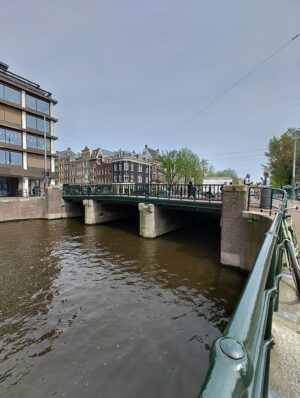
The Walenweeshuissluis (Walen Orphanage Lock – Amsterdam bridge 70) is a fixed bridge in Amsterdam Center. Despite the name Sluis here there is a stone bridge.
The bridge’s name, Walenweeshuissluis, is derived from the “Weeshuys” (an orphanage) located near the bridge in the 17th century, and Walen refers to the old central district of the city, which had a connection to the harbour and shipbuilding.

The bridge forms the connection between Vijzelstraat and the filled-in Vijzelgracht. It is located over the Prinsengracht canal. The name Walenweessluis is a naming after the orphanage for children from the French or Walloon church. The building was better known in the 20th century as Maison Descartes, the French cultural centre.
The bridge is already shown on Jacob Bosch’s design plan from around 1681, which also shows the nearby orphanage. In 1850, an earlier version of the bridge was in the news because a rearing horse of a rubbish cart came down on the bridge railing and died on the spot.
The current bridge (data 2017) comes from ‘the office of’ Piet Kramer, who was the bridge architect of the Public Works Department. For Vijzelstraat, Kramer designed the bridges to the outside. Bridge 30, bridge 41, bridge 70 and bridge 86 are sisters to each other in that respect. Due to delays in the filling in of Vijzelgracht, this bridge was the last to be completed, 1935. The bridge was built in two phases between 9 July 1934 and 8 June 1935 (building sections side by side) to keep traffic flowing. When the new section was finished and they wanted to renovate the old section, the contractor came across the wooden pile foundation of an older version, estimated at the time to be from 1770. Kramer’s style is recognisable in everything. Kramer’s is famous for the Amsterdam School style and this shows on the bridge in the brick abutments. Furthermore, the interaction with natural stone, the bridge piers, the ornamental wrought-iron balustrades and the sculptures show this was Kramers design.


Tram lines 16, 24 and 25 ran over the bridge for many years, and there was even a stop on the bridge (as is still the case on the bridges in Leidsestraat). In 1975, the bridge was redesigned and the stops were mover to the quays on the side. Tram line 25 disappeared on 14 December 2013, line 16 on 22 July 2018 and line 24 disappeared from the bridge on 8 December 2023.
For the first 20 years of this century, the bridge was continually rearranged as needed during the construction of the North-South Metro Line. In 2020/2021, the bridge was taken apart in parts and then reassembled. The bridge suffered from subsidence but needed to remain functional for pedestrians and cyclists travelling to and from the city centre but Trams were diverted during that period. The refurbishment revealed just how many cables were embedded in the bridge deck. Two temporary emergency bridges were necessary to maintain these connections.
Further reading:
https://www.bruggenvanamsterdam.nl/prinsengracht_hoek_vijzelstraat.htm
Map and Location
Bridge 70 in Amsterdam forms the connection between Vijzelstraat and the now filled-in Vijzelgracht. It is located over the Prinsengracht canal. The name Walenweessluis is after the becausse of the nearby orphanage for children from the French or Walloon church. The building was better known in the 20th century as Maison Descartes, the French cultural centre.
The bridge is already shown on Jacob Bosch’s design plan from around 1681, which also shows the orphanage.


History and information
Literally translated as Walen orphanage lock is named after the nearby orphanage at Vijzelgracht 2
1017 HR, Amsterdam. Like many of the buildings in central Amsterdam this is a national monument. The current building is the ‘new’ building as in 1586, the city council of Amsterdam assigned a former monastery chapel to the purpose but by 1631 the orphanage was in Laurierstraat. When that building became too small, they moved to a ‘new’ building on the Vijzelgracht.
Hospice Wallon (Walloon Orphanage) was needed as the Walloons or Huguenots were persecuted in France. In the sixteenth century the first wave of Walloons came to the Netherlands and around twelve thousand Huguenots settled in Amsterdam. By 1700 about six percent of the population of Amsterdam was French, from France, or a descendant of French parents.
The Orphanage is a large complex consisting of a rectangular main building under a hipped roof from around 1669-1671 by architect Adriaan Dortsman, a lower left wing on Weteringdwarsstraat (1683) and a low right wing on Prinsengracht (1726). The front façade with boxed brick corner isosceles and a wide central risalit encloses two door frames.
The Bridge at this location was already drawn on the map of Jacob Bosch from circa 1681 and the orphanage was also shown at this time. Around 1850 an earlier version of the bridge was in the news because a horse from a garbage cart landed on the bridge railing and died on the bridge.
More information:


https://weteringbuurt.nl/project/5056/walenweeshuis
https://rijksmonumenten.nl/monument/6181/walenweeshuis/amsterdam
https://www.monumenten.nl/monument/6181
Sources and Further Reading
- Walenweeshuissluis, Nederlandstalige Wikipedia
- Wikimedia Commons, Category: Brug 70, Walenweeshuissluis
- Bruggen van Amsterdam
- Stadsarchief Amsterdam, Beeldbank and Publieke Werken archives
- Frank V. Smit, Bruggen in Amsterdam (2008), Uitgeverij Matrijs