The Prince’s Canal: Amsterdam’s Working Ring, the Annexe at Number 263, and the Fourteen Bridges That Cross It
The Prinsengracht is the outermost of the three great rings, the longest, and the one where Amsterdam actually got on with things. Where the Herengracht was zoned for display and the Keizersgracht for solid merchant respectability, the Prinsengracht was built with warehouses among the houses, workshops behind the frontages, and the Jordaan, the artisans’ district, immediately across the water.
It is also the canal that carries the single most visited address in the Netherlands, and the one where the most bridges in our coverage are found.
A Canal Built for Storage
The commercial logic of the ring is written into the Prinsengracht’s structure. After 1585, as the Netherlands took its central role in world and colonial trade, Amsterdam’s population climbed from around fifty thousand to two hundred thousand in sixty years. The canals were dug for freight as much as for frontage: merchants stored their stock in waterside warehouses, and goods came to the door by water.
That is why so many buildings on this canal have hoisting beams projecting from the gable, and why the warehouse conversion is the characteristic Prinsengracht building type. Prinsengracht 263 was built in 1635 as a private house with two warehouses adjacent, an entirely ordinary arrangement for this canal, and one that would matter enormously three centuries later.
Prinsengracht 263: The Secret Annexe
The Anne Frank Huis occupies Prinsengracht 263–267. It was here, in the concealed rooms behind Otto Frank’s business premises, that Anne Frank hid with her family and four other people from July 1942 until their betrayal and arrest in August 1944. All eight were deported. Seven of them were murdered: Anne and her sister Margot died at Bergen-Belsen, most probably in February 1945, weeks before the camp was liberated. Otto Frank was the only one of the eight to survive, and it was he who published his daughter’s diary. The museum opened on 3 May 1960.
The building’s suitability for hiding was a direct consequence of how this canal was built. A house with attached warehouses, deep plot, a rear annexe invisible from the street, and a working business at the front to explain the comings and goings: that combination is standard Prinsengracht architecture, and it is what made the Achterhuis possible.
The Westerkerk stands about fifty metres away, and Anne wrote in her diary about the sound of its bell striking every quarter hour, one of the few pieces of the outside world that reached the annexe unaltered. Anyone standing on Bridge 61, the Leliesluis, a short distance south, has both buildings in view at once.
The Westerkerk and the Churches of the Prinsengracht
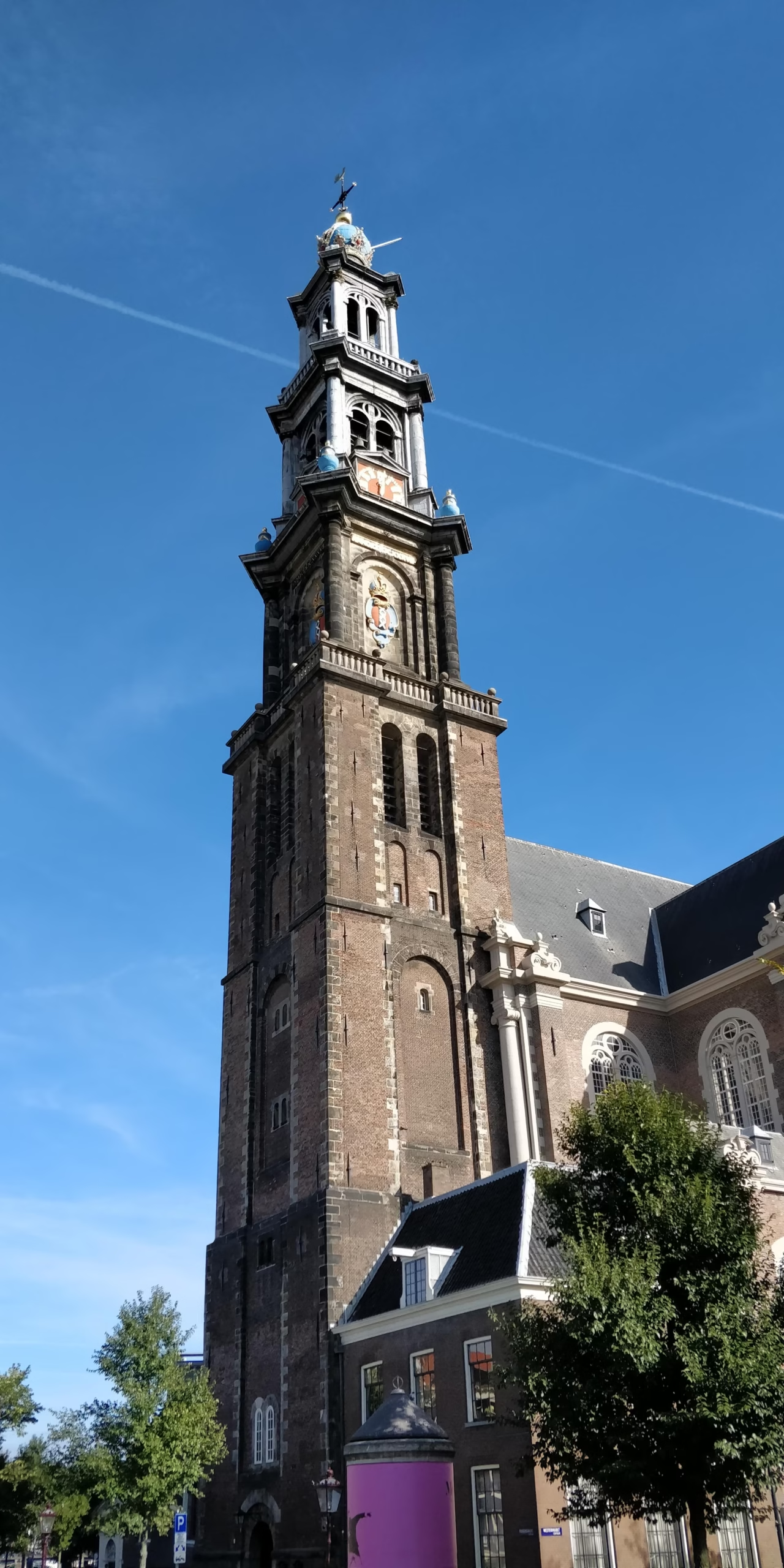
The Westerkerk, at Prinsengracht 281, was built between 1620 and 1631 to a design by Hendrick de Keyser, the architect who did more than anyone to give Amsterdam its Renaissance face. Its tower is the tallest church tower in the city, and the imperial crown of Maximilian I sits on top of it, the same borrowed imperial dignity that gave the Keizersgracht its name.
Rembrandt was buried in the Westerkerk in 1669, in an unmarked rented grave, the exact location of which is unknown. If you want to know more about him you should visit the excellent Rembrandt House Museum on Jodenbreestraat.
Two other churches punctuate the canal. The Noorderkerk, at the northern end on the Noordermarkt, was also begun by De Keyser and completed after his death, a Greek-cross plan built for the working population of the Jordaan, deliberately plainer than the Westerkerk and designed so that the whole congregation could see and hear the pulpit. The Amstelkerk, at the southern end on the Amstelveld, was built in 1668 as a temporary wooden church while a permanent one was planned. The permanent church was never built. The temporary one is still standing three and a half centuries later, which may be the most Amsterdam fact on this canal.

Living on the Water: The Houseboat Museum
The Woonbootmuseum, the Houseboat Museum, is moored on the Prinsengracht a short walk from the Anne Frank Huis, in a former freight barge fitted out as a home. It exists to answer the question every visitor asks about the boats lining these canals, which is simply: what is it like inside?
The answer turns out to be roomier than expected, and the museum’s real subject is the postwar housing shortage that turned redundant cargo vessels into permanent homes. Amsterdam’s houseboats are not a picturesque tradition dating from the Golden Age; they are a twentieth-century response to not having anywhere to live, subsequently regulated, licensed and made very expensive indeed.
The Noorderkerk and the Noordermarkt: A Church for the Jordaan
At the northern end of the canal, on the Noordermarkt square, stands the Noorderkerk, and it is the most revealing building on the Prinsengracht precisely because it is the plainest.
It was designed by Hendrick de Keyser, who also gave Amsterdam the Zuiderkerk and the Westerkerk, and completed in 1623. But where the Westerkerk is a statement, the Noorderkerk is a solution. Built on a Greek-cross plan for the working population of the Jordaan, it puts the congregation on four short arms around a central pulpit so that everybody can see and hear. It was a church for labourers and artisans, and it looks like one.
The square around it is older than the church. The Noordermarkt dates from 1616 and was originally called the Prinsenmarkt, after this canal; it took its present name once the Noorderkerk was finished. It is still a working market square, a general market on Mondays, and on Saturdays an organic farmers’ market that is one of the few things in the centre of Amsterdam still aimed squarely at people who live there.
Café Papeneiland and the Tunnel to the Hidden Church
Across the water stands Café Papeneiland, in business since 1641 and among the oldest and most traditional brown cafés in the city. It is a national monument, it is famous well beyond the Netherlands for its apple pie, and underneath it is a tunnel.
The name translates as “Papists’ Island,” and the café sits atop an escape route that allowed Roman Catholics to move unseen to their hidden church at Prinsengracht 7 during the Reformation. The old cellar route survives.
This is the same story the Singel tells with its schuilkerk at number 452, and it is worth stating plainly, because Amsterdam’s reputation for tolerance is often described in a way that flattens it. Catholic worship was illegal. It was also, in practice, permitted, provided it stayed invisible. The result was a city of concealed sanctuaries and connecting tunnels, and a café whose cellar was part of the arrangement.
The Prinsengrachtconcert
Every August since 1981, an orchestra has played on a pontoon anchored in the Prinsengracht in front of the Hotel Pulitzer, with the audience watching from boats, bridges, quaysides and the windows of the houses opposite. The Prinsengrachtconcert is broadcast nationally and is one of the few occasions when the canal is used as a room rather than a road.
By tradition the concert closes with Aan de Amsterdamse grachten, “On the Amsterdam Canals”, the city’s unofficial anthem. Its lyricist was Pieter Goemans, who found the inspiration for it in the 1950s while standing on a bridge over the Leidsegracht. That bridge, Brug 93, now carries his name: the Pieter Goemansbrug, a short walk from Bridge 67 on this list.
A song written on a canal bridge, sung every year from a pontoon on the canal, on a bridge that was later named after the man who wrote it. It is as complete a loop as this city offers.
The Bridges of the Prinsengracht
Fourteen numbered bridges cross the Prinsengracht in our coverage, more than on any other canal. Four of them in a row, Bridges 64, 65 and 66, plus the Looiersgracht crossing beyond, carry names drawn from a single vanished industry: the Reestraat for roe deer hides, the Berenstraat for bear hides, the Runstraat for the tanbark used to cure them, and the Looiersgracht for the tanners themselves. The elegant frontages of the Prinsengracht face a district that once stank of the leather trade.
- Bridge 42: The unnamed cycling bridge at the antique quarter’s gateway
- Bridge 57: Papiermolensluis
- Bridge 59: Lekkeresluis
- Bridge 60: Prinsensluis
- Bridge 61: Leliesluis
- Bridge 63: Nieuwe-Wercksbrug
- Bridge 64: De Reesluis
- Bridge 65: Berensluis
- Bridge 66: Brug 66, at the Runstraat
- Bridge 67: Angenietje Swarthofbrug
- Bridge 68: Aalmoezeniersbrug
- Bridge 69: Brug 69, at the Spiegelgracht
- Bridge 70: Walenweeshuissluis
- Bridge 71: De Duifbrug
Bridge 62, which crosses the Leliegracht from the Prinsengracht’s eastern bank, and Bridge 75, which carries the Utrechtsestraat over this canal, are covered separately.
Where It Ends
The Prinsengracht runs from the Brouwersgracht in the north to the Amstel in the south-east, where it stops at the Frans Hendricksz. Oetgensbrug. Just beyond that point sit the Amstelsluizen, the locks built in 1673 to flush the city’s water and keep the salt out, the structure that rendered a whole generation of inner sluices, including three along the Utrechtsestraat, obsolete within fifteen years.
The outermost ring of the planned city, ending at the river the plan was built to accommodate. It is a good place to finish a walk.