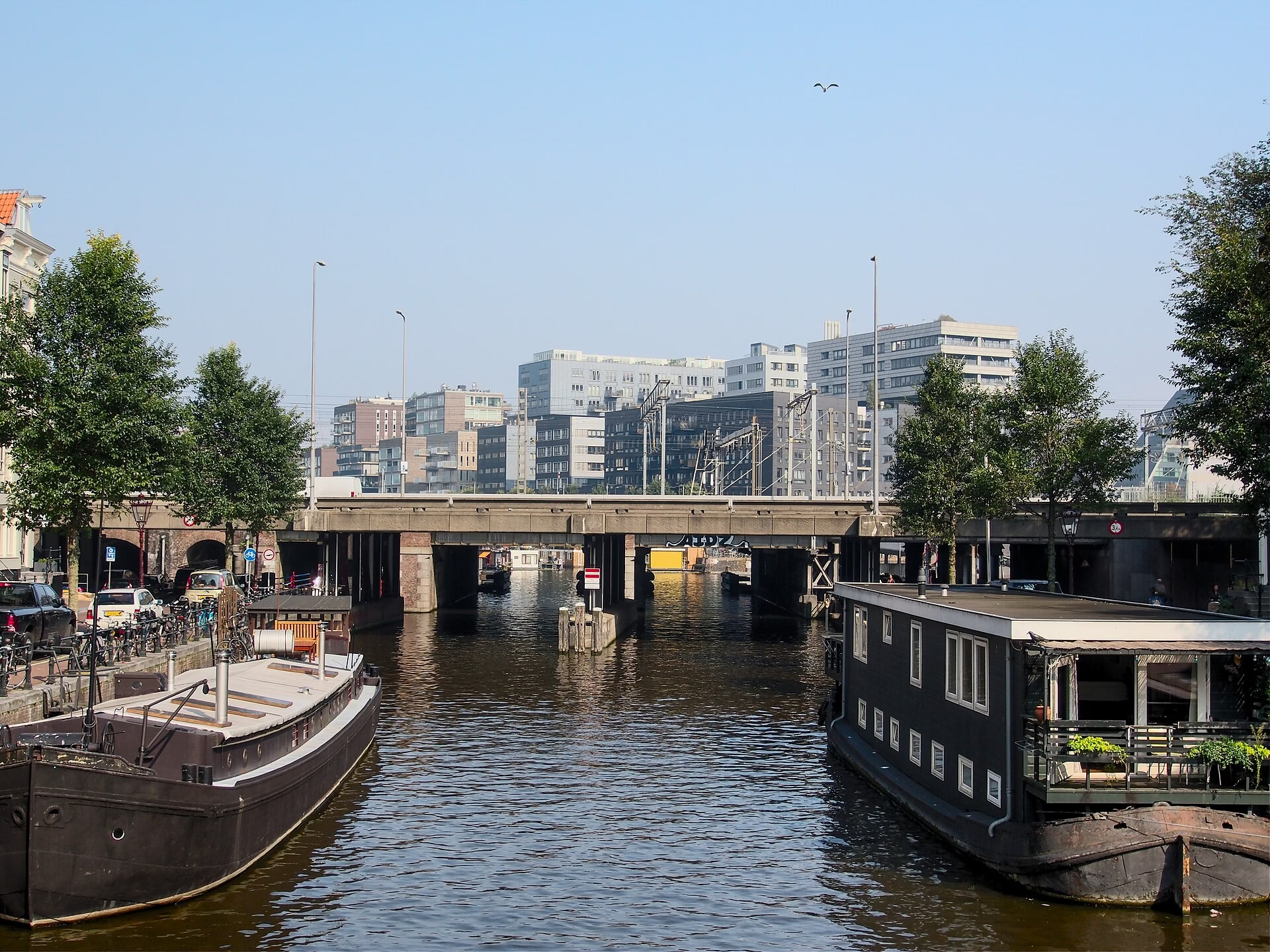
The 385-Metre Bridge Amsterdam Wants Rid Of: Brug 95
Brug 95 is 385 metres long and 23 metres wide, which makes it less a bridge than a section of motorway on legs. It was built between 1970 and 1972, cost 14 million guilders, and the city has been planning to demolish it since 2018.
What It Is and What It Replaced
It runs between the Haarlemmer Houttuinen and the Nieuwe Westerdokstraat, crossing the Korte Prinsengracht and its embankments. It is a concrete viaduct, designed by Dirk Sterenberg for the Dienst der Publieke Werken.
What it replaced was an 1878 railway bridge, which places this crossing in the industrial history of the waterfront rather than the canal ring proper.
The Plan That Built It
The viaduct exists because of a decision taken in 1931, and it is the same decision that produced Piet Kramer‘s Brug 86 on the other side of the centre.
The city had concluded that the Haarlemmerstraat could not go on being the main route west, and drew up plans to divert that traffic onto the Haarlemmer Houttuinen instead. The scheme was enormous, requiring the demolition of roughly 1,200 homes and 275 business premises, and it took decades to execute. Trams left the Haarlemmerstraat in 1955. The viaduct was the last major piece, finished in 1972.
By the time it opened, the thinking behind it was already being abandoned. The Nieuwmarktrellen came three years later, in 1975, and Amsterdam turned decisively away from driving motorways through its centre. Brug 95 is one of the largest surviving fragments of the plan that lost.
Why It Is Coming Down
In 2018 the municipality scheduled demolition for the first half of the 2020s, as part of a wider reconstruction of the area.
The stated reason is worth quoting plainly: the city wants more space for cyclists. Bicycle traffic on this route has grown to the point where a structure built to move cars over the water is now the obstacle.
That is the same reversal visible on the Museumbrug, widened for trams in 1913 and narrowed for bikes in 2023, and on Brug 90, widened for cars in 1959 and given tram tracks in 2018. Amsterdam has spent a century building capacity for one mode and then handing it to another. Brug 95 is the case where the structure itself is judged not worth keeping.
When it goes, it will be one of the largest bridge demolitions in the modern history of the centre, and the number will presumably join 33 and 83 among the vacancies in the register.
The Painted Bridge Underneath
One detail rewards a look from below. Running partly beneath Brug 95 is Brug 1901, a small brightly coloured bridge also designed by Dirk Sterenberg.
Sterenberg designed more than two hundred Amsterdam bridges across his career, and the pairing here is his range in a single spot: a 385-metre concrete traffic viaduct and, tucked underneath it, a piece of colour at walking scale.
What Happens to a Number When a Bridge Goes
If Brug 95 is demolished, the register will not close up behind it. Amsterdam issues bridge numbers as structures enter the system and leaves them vacant when structures leave, which is why 33 has never carried a bridge and 83 stopped carrying one in 1933.
So the likely outcome is a third hole in the first hundred, and a fairly conspicuous one, since 95 is not a minor culvert but 385 metres of concrete. The numbered series is a historical record of what the city has built, not an inventory of what it currently has, and each vacancy marks a decision rather than an absence.
Sterenberg, and What a Prolific Career Looks Like
Dirk Louis Sterenberg (1921 to 1996) designed more than two hundred bridges for Amsterdam, and the range is extraordinary: the Hortusbrug of 1960, the Latjesbrug of 1968, the Walter Suskindbrug of 1972, the Keizersbrug of 1982, and this viaduct.
He often worked with the sculptor Herman van der Heide, who designed decorative railings while Sterenberg handled structure, and both belonged to the Liga Nieuw Beelden, a post-war group committed to integrating art into the built environment.
That commitment is why a 385-metre traffic viaduct has a small painted bridge tucked beneath it. Sterenberg’s generation took it as read that infrastructure should be looked at as well as used, even when the infrastructure in question was a motorway approach.
Technical Specifications
- Bridge number: 95
- Name: None, unnamed
- Type: Concrete viaduct, fixed
- Carries: Haarlemmer Houttuinen to Nieuwe Westerdokstraat
- Spans: Korte Prinsengracht and its embankments
- District: Amsterdam-Centrum
- Coordinates: 52.3823 N, 4.8900 E
- Length: 385 m
- Width: 23 m
- Built: 1970 to 1972
- Architect: Dirk Sterenberg, Dienst der Publieke Werken
- Cost: 14 million guilders
- Replaced: An 1878 railway bridge
- Future: Demolition scheduled from 2018, for the first half of the 2020s
Sources Consulted
- Featured image: Brug 95, Bridge 95, Amsterdam by Alf van Beem, 2017, via Wikimedia Commons, Public domain
- Brug 95, Nederlandstalige Wikipedia
- Dirk Sterenberg, Nederlandstalige Wikipedia
- Haarlemmer Houttuinen, Nederlandstalige Wikipedia
- Nieuwmarktrellen, Nederlandstalige Wikipedia
- Bruggen van Amsterdam
- Stadsarchief Amsterdam, Beeldbank
- Frank V. Smit, Bruggen in Amsterdam (2008), Uitgeverij Matrijs