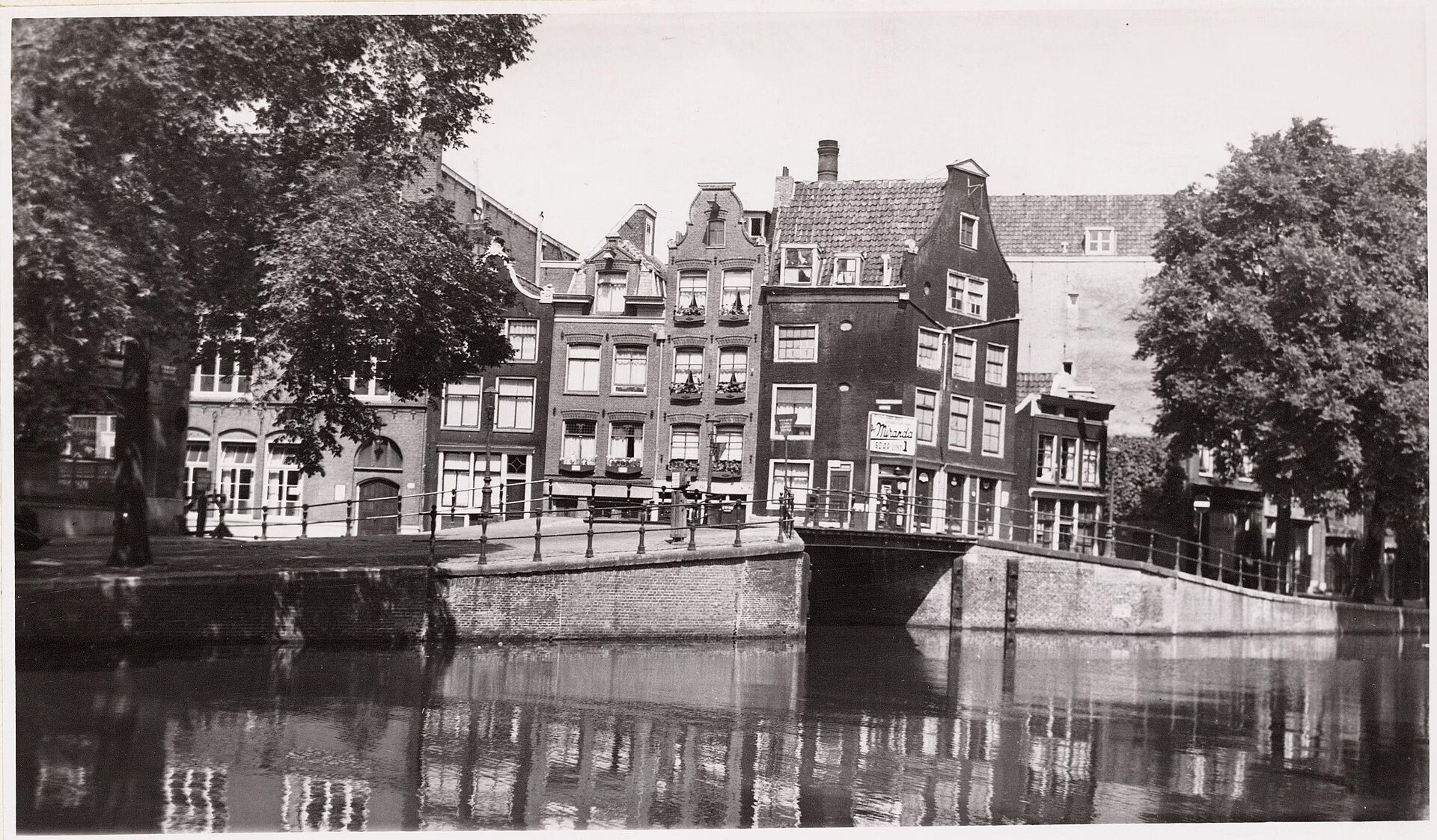
A Jewel for the City: Brug 96 and the Bridge They Refused to Fake
When Brug 96 was rebuilt in 1952, Amsterdam faced the choice it faced repeatedly in the twentieth century: replace a plain beam bridge in the historic centre with a stone arch that would look convincingly seventeenth-century, or rebuild what was actually there.
It chose honesty, and a newspaper of the day called the result a jewel for the city.
Structural Evolution
A bridge has stood on this line for centuries, documented on maps from 1625 onward. It carries the western embankment of the Prinsengracht over the Passeerdersgracht.
By the middle of the twentieth century the existing structure had become, in the phrase used at the time, too narrow for modern traffic. The replacement went in during 1951 and 1952, opening in May 1952.
The new bridge is an iron liggerbrug, a beam bridge, 10.70 metres wide overall: a 6-metre roadway with footways of 2.50 and 2.20 metres on either side. The asymmetry is worth noticing, and it is the sort of detail that only appears when a bridge is fitted to an existing street rather than laid out from scratch.
The Decision Not to Build an Arch
This is the interesting part, and it recurs across this stretch of the numbered series.
Amsterdam’s default instinct when rebuilding in the canal ring was to reach for the welfbrug, the humped stone arch, because it reads as historic and satisfies the expectation of what a canal bridge should be. A great many crossings that look seventeenth-century are in fact twentieth-century arches built to look the part.
At Brug 96 the city reinstalled a beam bridge instead, on the grounds that a beam bridge was what had been there and an arch would have been a fabrication. The same judgement was made at Brug 93 in 1988, where an iron girder bridge was rebuilt in steel rather than replaced with masonry.
Two bridges, thirty-six years apart, on the same principle. It is a small but real thread in how Amsterdam has thought about its own authenticity, and it runs against the more famous instinct to prettify.
The Gas Lines
One further decision was taken during the rebuild: gas lines were incorporated into the structure.
This is the least glamorous fact about any bridge in this series and one of the most useful. A city bridge is not only a road over water, it is the only fixed crossing available to every pipe and cable that has to get to the other side. Gas, water, electricity, telephone and now fibre all run through bridge decks, and the working life of a bridge is frequently determined less by traffic than by the services buried in it.
When Amsterdam rebuilds a canal bridge, a large part of what is being rebuilt is invisible.
The Passeerdersgracht
The Passeerdersgracht is a short canal on the Jordaan edge of the ring, and it is the water crossed by three bridges in this final block of the first hundred: 96, 98 and, at the Lijnbaansgracht end, the neighbours around 99 and 100.
A passeerder was a leather dresser, one of the trades in the tanning and hide-working cluster that occupied this edge of the city alongside the ropewalks and the cloth tenters. The Looiersgracht, the tanners’ canal, runs parallel a short distance south.
Why So Much of the Canal Ring Is Younger Than It Looks
Brug 96 is a useful corrective to a common assumption. The canal ring is a seventeenth-century plan, and the houses along it are largely seventeenth and eighteenth-century, but the bridges are mostly not.
Timber does not last. The original crossings were wooden, and wooden bridges over water in a wet climate need replacing roughly every human generation. By the time Amsterdam began building in iron and stone at scale, in the nineteenth century, almost every crossing in the ring had been rebuilt several times over.
So the honest answer to how old an Amsterdam canal bridge is, is usually: the line is seventeenth-century, the abutments may be eighteenth or nineteenth, and the thing carrying you is twentieth. Brug 96 is a 1952 iron beam bridge on a line drawn before 1625, and it does not pretend otherwise.
Technical Specifications
- Bridge number: 96
- Name: None, unnamed
- Type: Liggerbrug (beam bridge)
- Carries: Prinsengracht, western embankment
- Spans: Passeerdersgracht
- District: Amsterdam-Centrum
- Coordinates: 52.3674 N, 4.8822 E
- Material: Iron
- Total width: 10.70 m
- Roadway: 6 m, with footways of 2.50 m and 2.20 m
- Earliest record: Maps from 1625 onward
- Current structure: 1951 to 1952, opened May 1952
- Notable: Rebuilt as a beam bridge rather than a stone arch, and carries gas lines
Sources Consulted
- Featured image: Brug 96, Bridge 96, Amsterdam by Eck, J. van (Jacobus, 1873-1946), 1939, via Wikimedia Commons, Public domain
- Brug 96, Nederlandstalige Wikipedia
- Passeerdersgracht, Nederlandstalige Wikipedia
- Prinsengracht, Nederlandstalige Wikipedia
- Bruggen van Amsterdam
- Stadsarchief Amsterdam, Beeldbank and Publieke Werken archives
- Frank V. Smit, Bruggen in Amsterdam (2008), Uitgeverij Matrijs