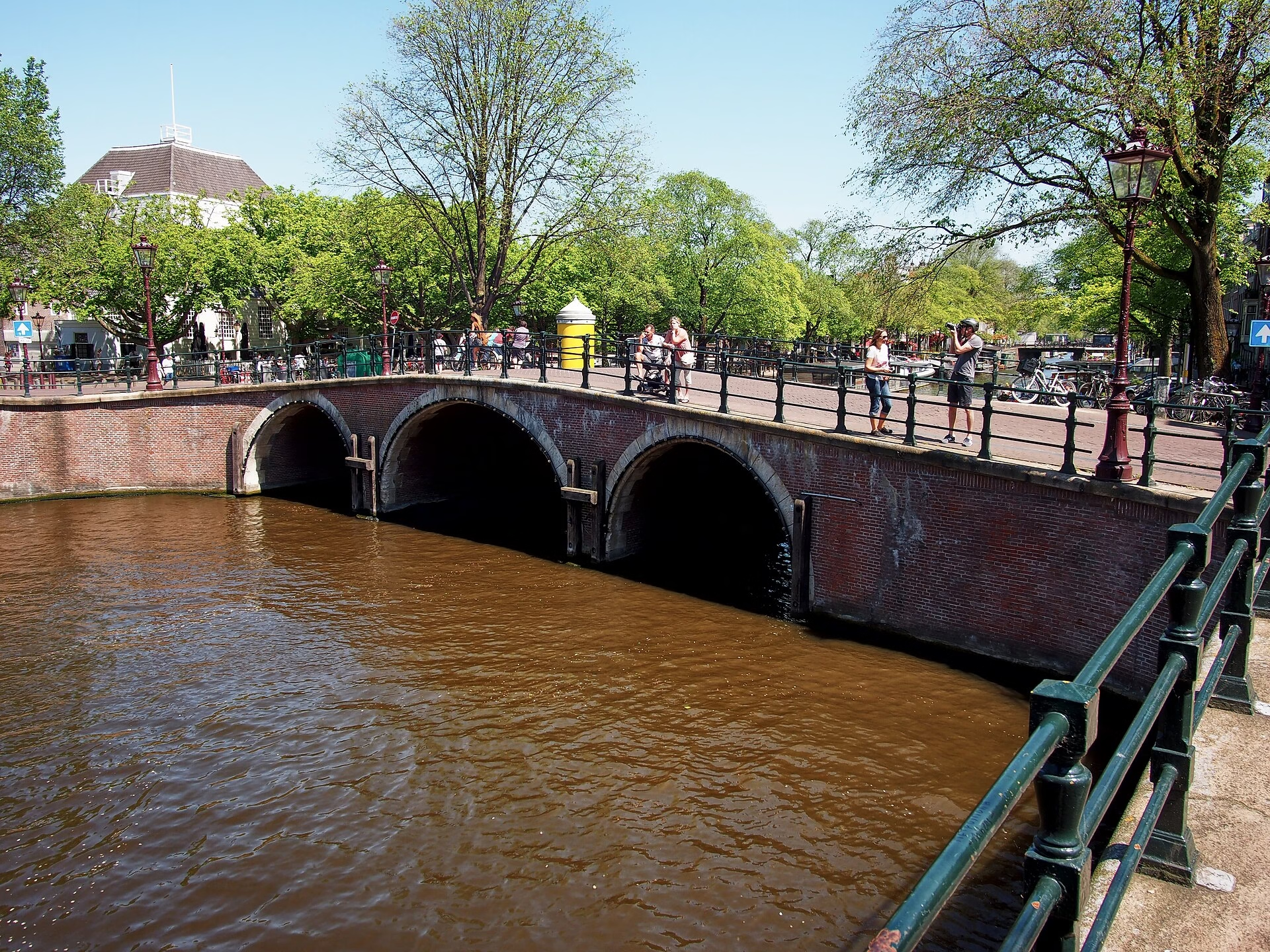
Bridge of the Week: De Duifbrug, Brug 71
Welcome to the first instalment of our “Bridge of the Week” feature. Each week we pick one of Amsterdam’s more than 1,200 numbered bridges, slow down, and ask: who built this, what came before it, and what does it tell us about the city? This week we begin at a crossing that has everything: a name rooted in centuries of religious history, an architectural controversy, a pair of companion bridges nearby, and one of the most famous canal views in the world just steps away. This is De Duifbrug, Brug 71.
What’s in a Name?
The bridge carries several names in historical sources. It appears variously as De Duifbrug, Duyfjesbrug, and Duyfjessluis, all variants on the same Dutch word for dove or pigeon. The name is not arbitrary. The bridge is named after De Duif, the church at Prinsengracht 756 that stands just a short distance away on the same bank. And De Duif’s own name has its roots in something older still.
The church’s name, meaning “The Dove,” originates from its predecessor: a 17th-century clandestine Catholic church called Het Vrededuifje, “The Dove of Peace,” which operated hidden during times of religious persecution. The church that stands today was built in 1858 as the Roman Catholic Sint-Willibrorduskerk, designed by architect Theo Molkenboer, and was a replacement for an earlier church on the same site that had itself been built on the former grounds of a sugar factory called Het Fortuyn, which had burned down at the close of the 18th century. The neoclassical facade, modest from the outside and dramatically spacious within, has looked across the Prinsengracht at the bridge for over 165 years. The bridge, in taking the church’s name, carries that whole chain of history in two syllables: duif, dove.
Location: Where the Prinsengracht Meets the Reguliersgracht
De Duifbrug is a closed spandrel deck arch bridge faced with red brick that spans the Prinsengracht at the Reguliersgracht. The Prinsengracht, the outermost of Amsterdam’s three great concentric canals, was constructed starting in 1612, on the initiative of Mayor Frans Hendricksz. Oetgens, after a design by city carpenter Hendrick Jacobsz Staets and city surveyor Lucas Jansz Sinck. The Reguliersgracht, which it crosses, was dug in 1664 as a connecting channel, narrower than the main canals, running roughly north to south through the Grachtengordel. The result of their intersection is one of the most photographed canal junctions in Amsterdam.
There is a notable quirk to the bridge’s abutment geometry that the Dutch Wikipedia entry flags with mild delight: one of the bridge’s abutments appears to have been set directly into the Prinsengracht itself, giving the structure an unexpectedly assertive presence in the water below. Stand on the quayside and look: the masonry seems almost to wade into the canal.
A Bridge in This Location Since 1662
The crossing here is not new. There has been a bridge at this location for centuries. On the 1662 plan of the city drawn by municipal architect Daniël Stalpaert, a bridge is already marked here, even though the plots on either side had not yet been built up. On that map, the Reguliersgracht crosses the Prinsengracht at this very point. A drawing of 1758 by the artist Jan de Beijer, preserved in the Stadsarchief Amsterdam’s Atlas Splitgerber collection, already shows the view north along the Prinsengracht toward the bridge’s predecessor, with the Amstelveld and the Amstelkerk visible behind it. The view from roughly this vantage point has been painted and drawn for nearly three centuries.
The De Greef and Springer Bridge: A Flat Interlude
The bridge that stood here before the current structure was the product of Amsterdam’s great 19th-century wave of municipal infrastructure. Bastiaan de Greef (1818-1899) was appointed city architect in 1856, and his assistant Willem Springer (1815-1907) joined in 1858; together they oversaw the maintenance and new construction of all public buildings in the city, including the bridges that had to be lowered and modified to accommodate tram traffic, realised with new materials and techniques that would define the 19th-century appearance of Amsterdam to a great extent.
Their bridge at Brug 71 was a flat girder or plate bridge, a “liggerbrug” in Dutch, the practical solution for a city increasingly managed around the needs of horse-drawn and later electric trams. The three bridges at this junction, Brug 71, 72, and 73, had all been replaced with flat plate bridges and carried that appearance for approximately 90 years. De Greef and Springer produced a great deal of civic infrastructure in this manner during their long tenure: the Blauwbrug over the Amstel was one of their more celebrated works, an eclectic design probably inspired by bridges over the Seine in Paris. The flat bridges at the Prinsengracht and Reguliersgracht were considerably more workaday, and that, it turned out, would eventually count against them.
The Controversy of 1963 and 1965: “Terugrestaureren” and the “Architectural Lie”
This is where De Duifbrug’s story becomes genuinely interesting from a heritage perspective. In the early 1960s it was established that major maintenance was needed on this bridge and on bridges 72 and 73. The Public Works department considered the De Greef and Springer bridges too plain, and replaced them with arched bridges considered more historically appropriate, in what was later called “terugrestaureren,” meaning back-restoration, or an “architectural lie.”
The term “terugrestaureren” captures a real and recurring tension in Dutch heritage practice. The question it poses is pointed: is it acceptable to demolish a historically authentic bridge, even an unglamorous one, in order to build a new bridge that looks more like what you imagine stood there originally? Bridges 72 and 73 were completed first, in 1963. Brug 71 was completed two years later, in 1965, because work had to wait for renovation on another bridge in the Weesperstraat to finish first. After delivery, the bridges were fitted with specific illumination. Since then, only the road surface has been relaid on a number of occasions.
The bridge you stand on today, then, is not a restored 17th-century arch bridge, nor is it the honest Victorian-era flat plate bridge that preceded it. It is a 1965 arch bridge built in deliberate historical costume, dressed to look as though it had always been there. Whether you find that dishonest or simply pragmatic will tell you something about your own attitude to the contested idea of authenticity in city-making. The debate has never entirely resolved.
The Setting: Storks, a Wooden Church, and the Seven Bridges
De Duifbrug sits at one of the richest corners in Amsterdam for incidental encounters with history. At the 17th-century corner house of Prinsengracht and Reguliersgracht there is a statue of a stork, which belonged to a midwife who had her practice at the house. The stork, a traditional signal of new births in the Netherlands, still protrudes from the facade, a piece of 17th-century advertising that has outlasted almost everything around it.
A few paces away is the Amstelveld, a quiet square anchored by the Amstelkerk, a wooden church built in 1668 as a temporary structure while funds were raised for something more permanent. The funds never materialised in quite the way intended, and the wooden church has stood for more than 350 years. It now contains a café called Nel, which occupies the building alongside occasional services, a pleasingly Dutch combination of the practical and the sacred.
And then there is the view. Where the Prinsengracht crosses the Reguliersgracht, you can see the famous seven bridges. At night the illuminations of the bridges give the impression of a tunnel, “the tunnel of love” as this view is also called. From a specific point on the Herengracht, looking south down the Reguliersgracht, you can see not seven bridges but fifteen by looking in different directions; the fifteen bridges are best seen from a low vantage point, such as a boat on the canal, because the alignment only works below street level. De Duifbrug, sitting on the Prinsengracht, is the closest fixed bridge to this famous junction. Tour boats slow down just ahead of you, passengers leaning to catch the stacked arches receding into the distance. Stand on the bridge and you are, in effect, standing in the frame of one of Amsterdam’s most reproduced canal photographs.
Photo tip for readers: the view from De Duifbrug looking north along the Prinsengracht toward the Westerkerk, whose tower has presided over this neighbourhood since 1638, is one of the most enduring canal vistas in the city. It has been painted, drawn, and photographed for centuries. The church is at its most dramatic in early morning or late afternoon light, when the brick glows amber above the elm-lined quays.
Why De Duifbrug Matters
De Duifbrug is a bridge with layers. The name reaches back to a hidden Catholic chapel and the long, slow emergence of religious tolerance in Amsterdam. The masonry arch beneath you is, in the most technical sense, an act of historical fiction from 1965, replacing a functional 19th-century flat bridge with something that looked better to a particular generation of planners. And yet the crossing itself has been in this location since at least 1662, part of the canal fabric for more than 360 years.
It is also the perfect starting point for one of Amsterdam’s most rewarding short walks: south along the Prinsengracht to the Amstelveld, east to the seven-bridge junction on the Reguliersgracht, or further east still to the Herengracht’s Gouden Bocht, the Golden Bend, where the grandest patrician houses in the city stand in their double-plot grandeur. The dove on the bridge’s nameplate has, it turns out, an awful lot to show you.
Primary sources: Dutch Wikipedia (nl.wikipedia.org/wiki/De_Duifbrug), Wikidata (Q41588318), Brug 72 Wikipedia entry (nl.wikipedia.org/wiki/Brug_72), Stadsarchief Amsterdam Beeldbank collection (including the 1758 Jan de Beijer drawing from Atlas Splitgerber, inventory 010001000425), and Guido Hoogewoud’s “Bastiaan de Greef en Willem Springer, architecten van een veranderende stad (1856-1890),” published in Bulletin KNOB 111/2 (2012), pp. 70-82. Featured Image Door Alf van Beem – Eigen werk, Publiek domein, https://commons.wikimedia.org/w/index.php?curid=61366123
Sources and Further Reading
- Brug 71, Nederlandstalige Wikipedia
- Bruggen van Amsterdam
- Stadsarchief Amsterdam, Beeldbank and Publieke Werken archives
- Frank V. Smit, Bruggen in Amsterdam (2008), Uitgeverij Matrijs