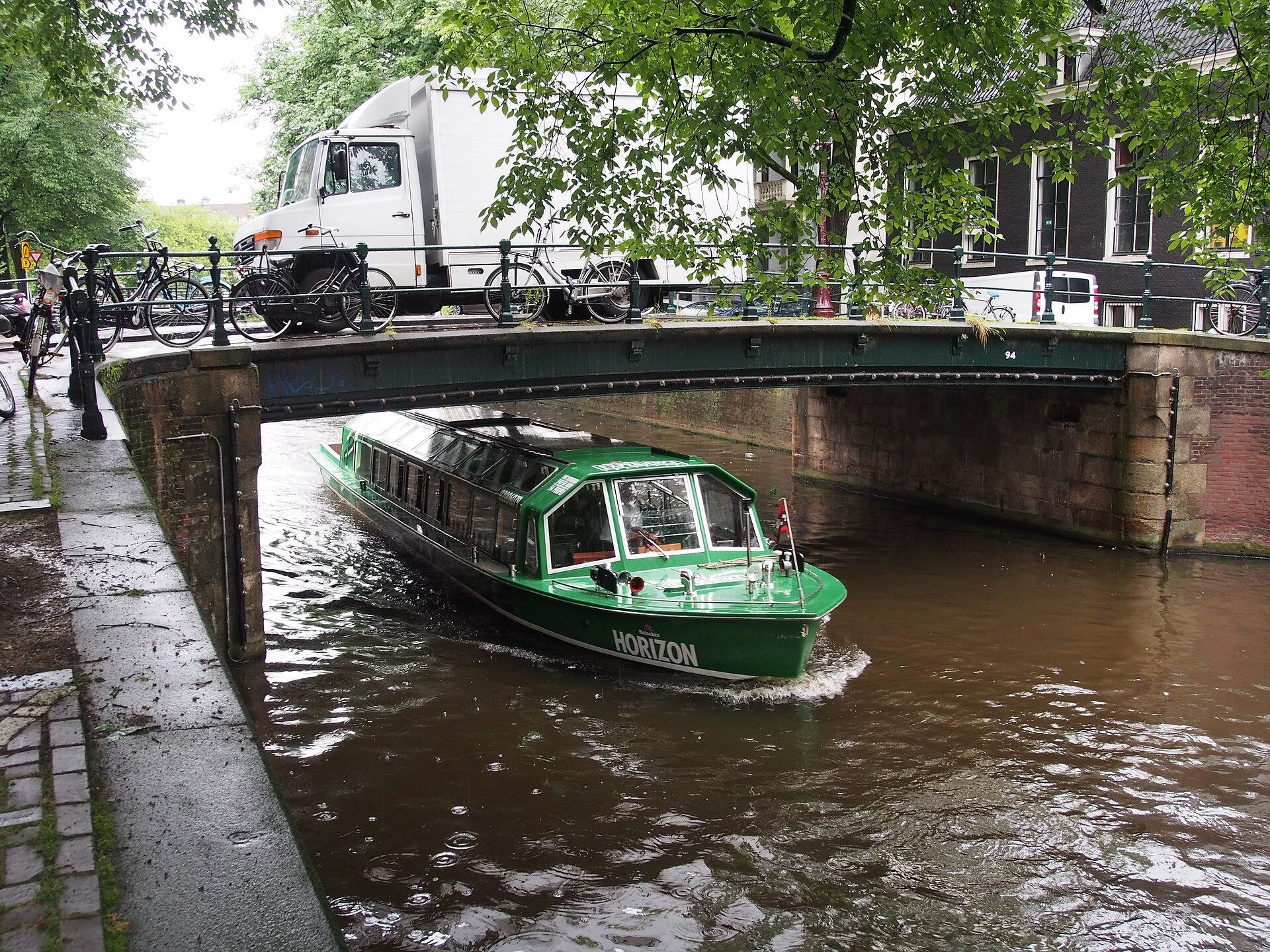
The Bridge That Was Never Lowered: Brug 94 on the Leidsegracht
Amsterdam spent the second half of the nineteenth century flattening its bridges. Brug 94 is one that kept its height, and a bargeman found out the hard way what that meant.
Structural Evolution: 1662 to 1902
A crossing has been on this line for centuries. Daniel Stalpaert drew one on his design map of 1662, placing it among the original fabric of the fourth expansion.
What stood there until the turn of the twentieth century was wooden. The tender for its replacement went out in February 1902, and the fixed iron girder bridge standing today was built that year.
It links the Raamdwarsstraat on the north side to the Lijnbaansgracht on the south, crossing the Leidsegracht.
Keeping Its Height, and the Price of That
The detail that distinguishes Brug 94 is negative: through every subsequent renovation, it retained its original height.
That is unusual. Amsterdam lowered bridges throughout the late nineteenth and twentieth centuries, and the reason was always the same. A humped bridge is hard work for horses, impossible for trams, and awkward for motor traffic, so the city repeatedly traded headroom on the water for an easier gradient on the road. Neighbouring Brug 88 was lowered in 1877; the pattern repeats across the canal ring.
A bridge that was not lowered keeps its clearance, and clearance on an Amsterdam canal is measured in centimetres rather than metres.
In 1938 a barge skipper struck his head on the bridge’s beams and was seriously injured.
It is a grim little footnote, and it is also the clearest possible illustration of what these decisions cost. Every bridge in the city sits at a height that is a compromise between the road above and the water below, and the compromise is not abstract. Amsterdam’s canals are working waterways with people standing up in boats.
Urban Context: The Raamdwarsstraat and the Ropewalks
The raam in Raamdwarsstraat is a tenter frame, the rack on which newly woven cloth was stretched and dried. The street names around here, Raamstraat, Raamplein, Raamdwarsstraat, record the cloth-finishing trade that occupied this edge of the city, in the same way the neighbouring Lijnbaansgracht records the ropewalks.
This is the outer working edge of the seventeenth-century plan: the trades that needed space and made a mess were pushed here, against the boundary, where land was cheap and nobody prestigious had to look at them.
The bridge sits beside Leidsegracht 108, a protected heritage building, with a modern police station on its southern side, which is a fairly typical Amsterdam pairing.
Why Amsterdam Lowered Its Bridges
The lowering campaign that Brug 94 escaped ran for the better part of a century, and it was driven by a straightforward conflict of interests.
A canal bridge has to clear the water by enough to let boats pass, and it has to meet the street at a gradient that traffic can manage. Those two demands pull against each other, and every bridge is a settlement between them. In the seventeenth century the boats won, because the canals were the freight network and the streets carried pedestrians and handcarts.
Through the nineteenth century that reversed. Horse-drawn omnibuses, then horse trams, then electric trams, then motor vehicles all needed flatter approaches, and trams in particular cannot manage a hump. So the city lowered bridge after bridge, buying gradient with headroom, and the canals gradually stopped being usable by anything with a superstructure.
The result is a network optimised for flat-bottomed tour boats, which is broadly what uses it now. Brug 94 is a reminder that the outcome was not inevitable, and that somebody had to decide it each time.
The Leidsegracht
The Leidsegracht is a connector rather than a ring canal. It was cut to link the canal ring westward towards the Leidse routes out of the city, and it runs at an angle to the concentric pattern, which is why the bridges along it feel oddly placed.
It is also short, expensive and quiet, one of the stretches where the seventeenth-century city is least disturbed by the twentieth. Bridges 93 and 94 both cross it, a few hundred metres apart, and between them they cover the two nineteenth-century solutions: an iron girder bridge rebuilt honestly in steel, and an iron girder bridge that simply stayed as it was.
Technical Specifications
- Bridge number: 94
- Name: None, unnamed
- Type: Fixed iron girder bridge
- Carries: Raamdwarsstraat to Lijnbaansgracht
- Spans: Leidsegracht
- District: Amsterdam-Centrum
- Coordinates: 52.3655 N, 4.8809 E
- Material: Iron
- Earliest record: Stalpaert’s map of 1662
- Earlier structure: Wooden bridge
- Current structure: 1902, tender announced February 1902
- Unusual feature: Retained its original height through later renovations
- Status: Not a monument, adjacent to Leidsegracht 108
Sources Consulted
- Featured image: Brug 94, Bridge 94, Amsterdam by Alf van Beem, 2016, via Wikimedia Commons, Public domain
- Brug 94, Nederlandstalige Wikipedia
- Leidsegracht, Nederlandstalige Wikipedia
- Lijnbaansgracht, Nederlandstalige Wikipedia
- Bruggen van Amsterdam
- Stadsarchief Amsterdam, Beeldbank and Publieke Werken archives
- Frank V. Smit, Bruggen in Amsterdam (2008), Uitgeverij Matrijs