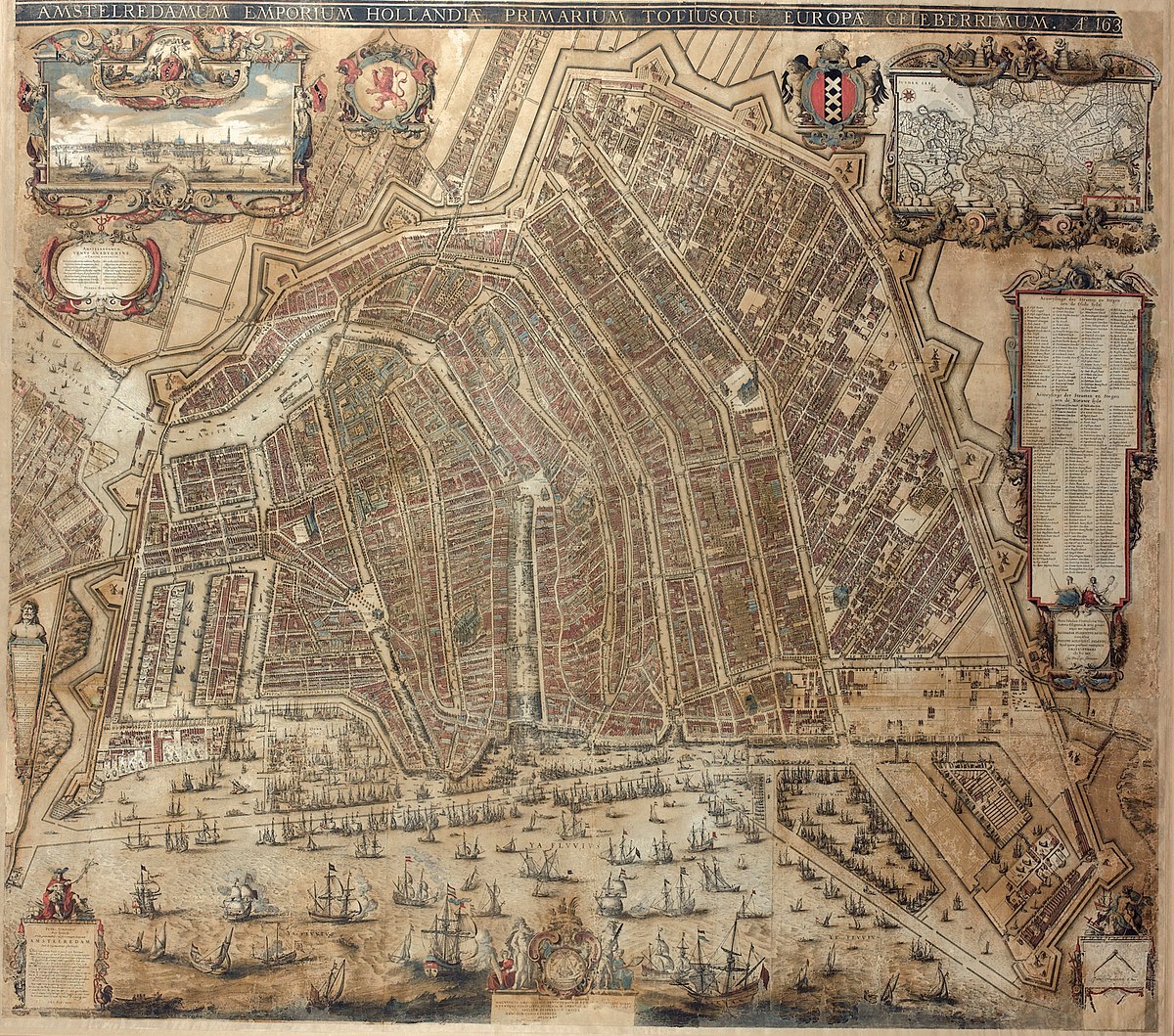
The 1625 map by Balthasar Florisz. van Berckenrode is widely considered one of the most significant and visually stunning urban plans of the Dutch Golden Age. While earlier works like the 1599 Pieter Bast map showed a city still largely medieval, Van Berckenrode’s massive nine-sheet wall map captures Amsterdam during its most explosive period of growth. This was the era of the “Grote Uitleg” (Great Expansion), and this map serves as the definitive visual record of the ambitious urban planning that created the world-famous horseshoe-shaped canal belt.
What sets the 1625 edition apart is its extraordinary “parallel perspective” or isometric projection. Unlike a flat overhead map, Van Berckenrode drew every single house, warehouse, church, and tree with three-dimensional depth. This allows modern viewers to see the city exactly as it appeared to a 17th-century merchant. You can trace the construction of the Herengracht, Keizersgracht, and Prinsengracht, which at this time were completed up to the Leidsegracht. The map beautifully illustrates the contrast between the grand, symmetrical plots of the new canal houses and the older, more organic density of the medieval center.
Technically, the 1625 map was a feat of copperplate engraving. Because it was printed on nine separate sheets, it reached a massive scale that allowed for granular detail. Van Berckenrode meticulously rendered the city’s new defensive perimeter, including the first set of modern bastions that replaced the old medieval walls. He also captured the bustling life of the IJ waterfront, depicting a harbor filled with Dutch East India Company (VOC) ships, which were the engines of the city’s unprecedented wealth. The map even includes details like the “bleaching fields” on the outskirts and the specific decorative gables of the newly built estates.
For historians, the 1625 Van Berckenrode map is more than just a geographic tool; it is a portrait of a city at the height of its confidence. It was designed to be a luxury object, often hand-colored and hung in the homes of the city’s regents and wealthy elite. By documenting the successful integration of the new canals with the historic core, Van Berckenrode created a lasting image of Amsterdam as an orderly, prosperous, and mathematically perfect metropolis. It remains the most important primary source for understanding the architectural transition from the late Renaissance to the height of the Baroque period in the Netherlands.

Explore the Evolution of Amsterdam
The 17th-century cartography of the Dutch Republic is a testament to the city’s rapid global expansion. This post is part of our comprehensive chronological archive.
- ← Previous Map: 1599 Pieter Bast
- Main Collection: Maps of Amsterdam: A Chronological Guide
- Next Map: → 1649 Joan Blaeu


This 1625 map of Amsterdam by Balthasar Florisz. van Berckenrode is a key part of our Chronological Guide to the Maps of Amsterdam, which documents the city’s growth from a medieval port to a global capital.
Disclaimer: These works are in the public domain in their country of origin and other countries and areas where the copyright term is the author’s life plus 100 years or fewer.