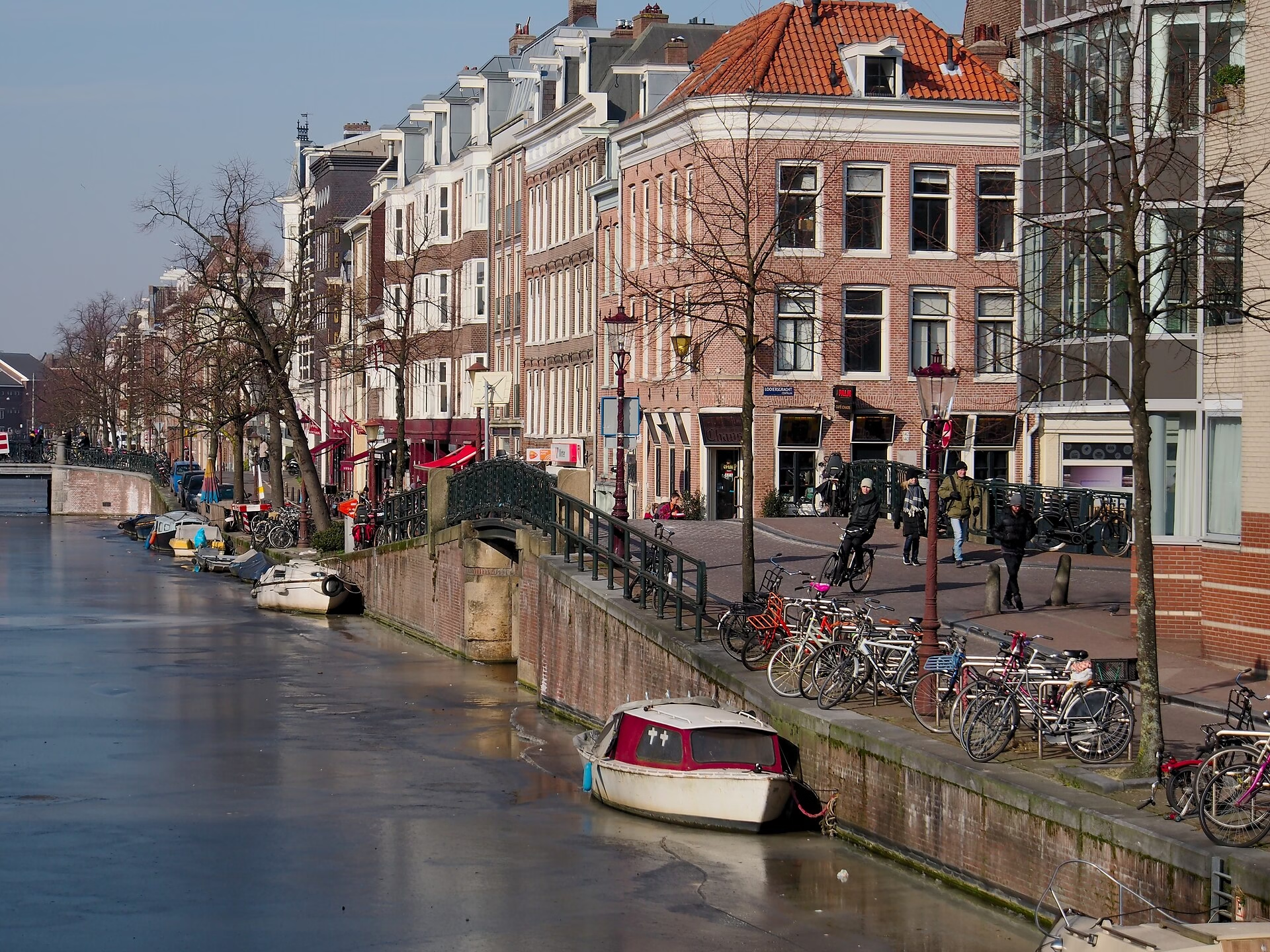
The Hundredth Bridge: Tetje de Jongbrug and the First Woman to Run a Police Force
The hundredth entry in Amsterdam’s bridge register carries the name of Tetje de Jong, the first paid female police commissioner in the Netherlands. It sits between two police headquarters buildings, which is not a coincidence.
The bridge was built by Piet Kramer in 1927 and 1928. It waited ninety-two years for the name.
Etymology: A Name Given in 2020
The bridge was renamed on 25 May 2020, in honour of Tetje de Jong.
Amsterdam has spent the last two decades correcting an imbalance in its own map. The city’s streets and bridges commemorate a great many men and very few women, and successive naming rounds have deliberately gone looking for women whose work merited a place on it. Readers of this series will have met several: the Angenietje Swarthofbrug, the Johanna Borskibrug, the Rachel Ruyschbrug, the Isa van Eeghenbrug, the Tante Saarbrug.
Placing de Jong’s name on the crossing between two police buildings is a piece of deliberate siting. The bridge is not simply named after her; it is named after her in the place where the point is legible.
Structural Evolution
A bridge has been on this line since at least 1649, when it appears on Joan Blaeu’s map. The immediate predecessor was a wooden bridge of 1885.
The current structure was built between December 1927 and May 1928, completing the set of three Kramer designed for this corner. It carries the Lijnbaansgracht over the Looiersgracht.
It is steel, concrete and granite, on wooden pile foundations, which is the standard Amsterdam arrangement and the reason so much of the city requires such careful monitoring: the entire centre stands on timber driven into the mud, and timber piles survive only as long as they stay below the water table.
Clearance beneath is 1.80 metres with a passage width of 5.30 metres, which is to say that anything larger than a small open boat is not getting through.
The Last of the Set
Brug 100 is the third of the three Kramer bridges built here in 1927 and 1928, with 98 and 99. All three are gemeentelijke monumenten, listed in 1995, and all three share the same detailing: decorative wrought iron balustrades running into granite columns.
The Looiersgracht is the tanners’ canal, and with the Passeerdersgracht of the leather dressers it completes the record of the hide-working quarter that occupied this edge of the seventeenth-century city.
Ending the First Hundred
This is where the first hundred of the numbered series stops, and it is a reasonable place to look back at what the register actually contains.
Of the hundred numbers, not all carry bridges. 33 stood at Sloterdijk until 1956 and its successor was renumbered 172P. 83 was emptied in 1933 when the Vijzelgracht was filled. 85 was reassigned from a demolished footbridge to a tram viaduct on the other side of the city. And 95, a 385-metre viaduct, is scheduled for demolition, which will probably make a third vacancy.
The numbers run from the Muntsluis at the heart of the medieval city to a garden village in Amsterdam-Noord, and they include stone arches of the seventeenth century, iron girders of the nineteenth, Amsterdam School ironwork of the twentieth, and concrete traffic viaducts the city now regrets. The full run is in the bridge index.
Wooden Piles and the Ground Amsterdam Stands On
The detail that Brug 100 rests on wooden pile foundations deserves more than a line in a specification table, because it is the single most important fact about building anything in this city.
Amsterdam sits on peat and clay. Neither will carry a building, so since the Middle Ages the solution has been to drive timber piles down through the soft ground to the firm sand layer, roughly 11 metres below the surface, and build on top of them. The Royal Palace on the Dam famously stands on 13,659 of them.
Timber piles last indefinitely while submerged, because the water excludes the oxygen that fungi need. They rot when the groundwater level drops and their tops are exposed to air. This is why Amsterdam monitors its water table so carefully, why the Noord/Zuidlijn construction caused such alarm when buildings on the Vijzelgracht settled by up to 23 centimetres, and why paalrot, pile rot, is a phrase every Amsterdam property owner knows.
A canal bridge is therefore a structure whose survival depends on the canal staying wet. It is a neat closing thought for the first hundred: the water these bridges cross is also the thing holding them up.
Technical Specifications
- Bridge number: 100
- Name: Tetje de Jongbrug, named 25 May 2020
- Type: Fixed bridge
- Carries: Lijnbaansgracht
- Spans: Looiersgracht
- District: Amsterdam-Centrum, Jordaan
- Coordinates: 52.3678 N, 4.8792 E
- Built: December 1927 to May 1928
- Architect: Piet Kramer, Dienst der Publieke Werken
- Materials: Steel, concrete and granite, on wooden pile foundations
- Clearance height: 1.80 m
- Passage width: 5.30 m
- Earlier structures: On Blaeu’s map of 1649, wooden bridge of 1885
- Named for: Tetje de Jong, first paid female police commissioner in the Netherlands
- Status: Gemeentelijk monument since 1995
Sources Consulted
- Featured image: Tetje de Jongbrug, Bridge 100, Amsterdam by Alf van Beem, 2018, via Wikimedia Commons, CC0
- Tetje de Jongbrug, Nederlandstalige Wikipedia
- Looiersgracht, Nederlandstalige Wikipedia
- Piet Kramer, Nederlandstalige Wikipedia
- Amsterdamse School, Nederlandstalige Wikipedia
- Bruggen van Amsterdam
- Stadsarchief Amsterdam, Beeldbank
- Sebas Baggelaar and Pim van Schaik, Piet Kramer, Bruggenbouwer van de Amsterdamse School (2016)