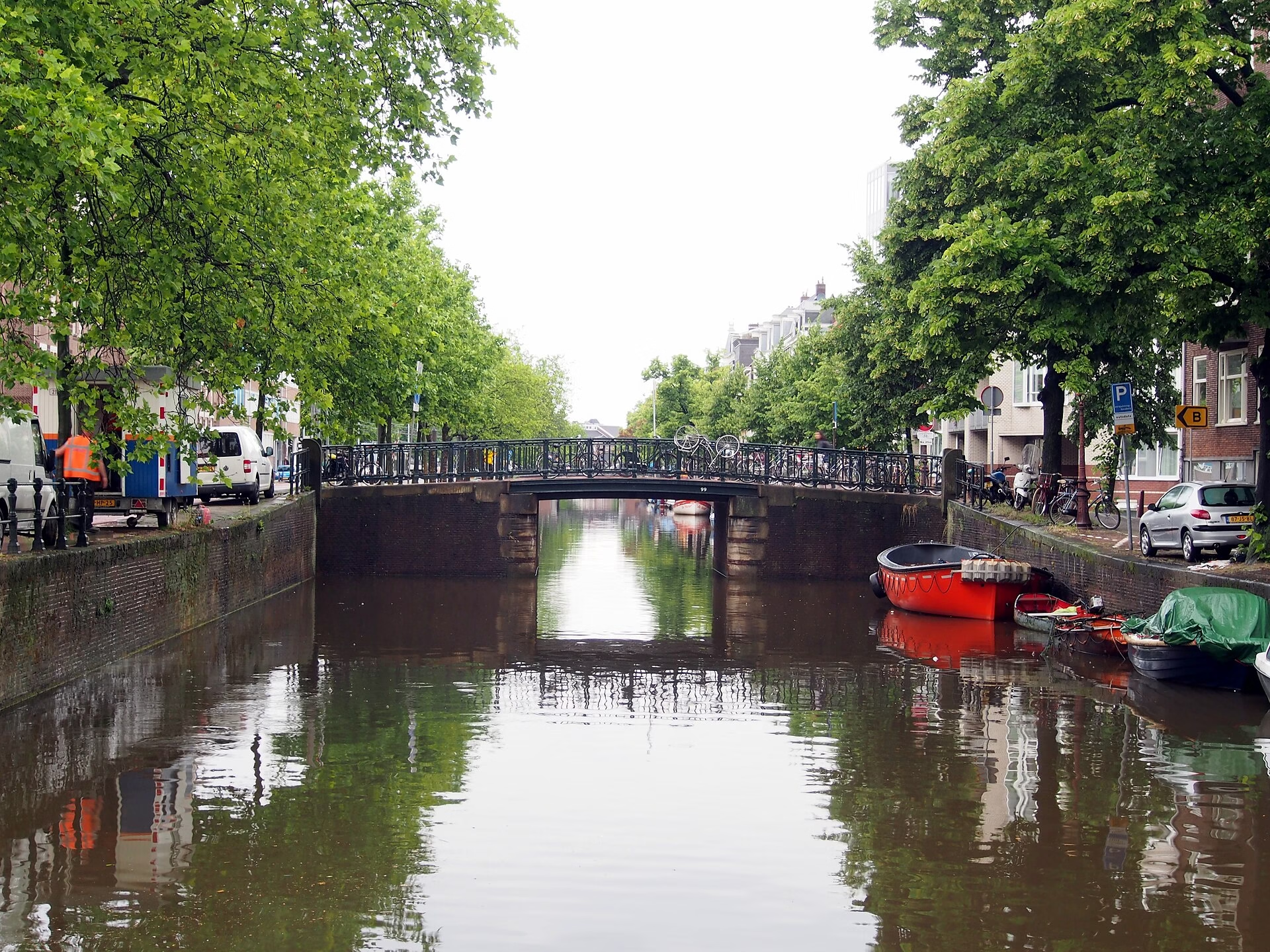
Flower Boxes and Wrought Iron: Brug 99 in the Jordaan
Brug 99 carries the Passeerdersstraat over the Lijnbaansgracht, on the Jordaan edge of the canal ring. It was built by Piet Kramer in 1927, between August and December, as the middle member of the set of three he designed that year.
A Bridge That Moved to Meet Its Street
The bridge appears on Joan Blaeu’s map of 1649, but with a detail worth noting: at that date it was not aligned with the Passeerdersstraat.
That is a more common situation than it sounds. Amsterdam’s canal ring was laid out as a plan, but the crossings within it were placed pragmatically, where they were needed rather than where the geometry suggested. Over the following centuries many were shifted a few metres one way or another to line up with the streets that had grown up around them.
So a bridge on a seventeenth-century map is not necessarily standing where its descendant stands now. The line of a crossing is as much a historical artefact as the structure on it.
Kramer’s Detailing
The bridge is a fixed crossing in the Amsterdamse School manner, and the identifying features are consistent with the rest of the 1927 set: decorative metalwork balustrades, clearly Kramer’s hand, running into natural stone columns at the ends.
It also has ornamental flower boxes, which is the sort of thing that separates Kramer from a purely structural engineer. A flower box on a municipal bridge is not required by anything. It is a statement that the crossing is a place where people stop as well as a place they pass through.
The bridge was designated a gemeentelijk monument in 1995, alongside its two siblings. Traffic across it runs one way, towards the Marnixstraat.
The Neighbourhood It Serves
The buildings around Brug 99 are a compact history of Amsterdam social provision.
The former Klene liquorice factory stands nearby, one of the food manufacturers that occupied the Jordaan when it was still a working-class industrial district rather than an expensive one.
So does the Amsterdamsch Tehuis voor Arbeiders, the ATVA, a hostel built to house single working men, and a residential complex by the architects Gobel and den Hertog.
Kramer’s bridges were built for exactly this population. The Amsterdam School was the house style of municipal social housing, and its bridges were the connective tissue of districts being rebuilt for people who had previously lived in slums. Ornamental ironwork and flower boxes on a crossing to a workers’ hostel is the whole argument of the movement in one view.
The Jordaan Before It Was Fashionable
It is worth being clear about what the Jordaan was when Kramer built here, because its present reputation obscures it.
The district was laid out in the seventeenth century as the working quarter of the expansion: cheap plots, narrow streets, and the trades that the prestigious canals did not want nearby. By the nineteenth century it was among the most densely populated and worst housed areas in the Netherlands, with families in single rooms, minimal sanitation and high mortality.
The interwar municipal programme that produced these bridges was part of the response. Slum clearance, social housing, public baths, schools and the deliberate application of good design to ordinary infrastructure were a single policy, driven by socialist aldermen and executed by architects who believed working people were entitled to look at something well made.
The gentrification came much later, from the 1970s onward. Kramer’s flower boxes were not built for the people who live beside them now.
Technical Specifications
- Bridge number: 99
- Name: None, unnamed
- Type: Fixed bridge
- Carries: Passeerdersstraat, one-way toward Marnixstraat
- Spans: Lijnbaansgracht
- District: Amsterdam-Centrum, Jordaan
- Coordinates: 52.3671 N, 4.8795 E
- Built: August to December 1927
- Architect: Piet Kramer
- Materials: Decorative metalwork balustrades, natural stone columns
- Features: Ornamental flower boxes
- Earliest record: Joan Blaeu’s map of 1649, not then aligned with the street
- Status: Gemeentelijk monument since 1995
Sources Consulted
- Featured image: Brug 99, Bridge 99, Amsterdam by Alf van Beem, 2016, via Wikimedia Commons, Public domain
- Brug 99, Nederlandstalige Wikipedia
- Jordaan, Nederlandstalige Wikipedia
- Piet Kramer, Nederlandstalige Wikipedia
- Amsterdamse School, Nederlandstalige Wikipedia
- Bruggen van Amsterdam
- Stadsarchief Amsterdam, Beeldbank
- Sebas Baggelaar and Pim van Schaik, Piet Kramer, Bruggenbouwer van de Amsterdamse School (2016)