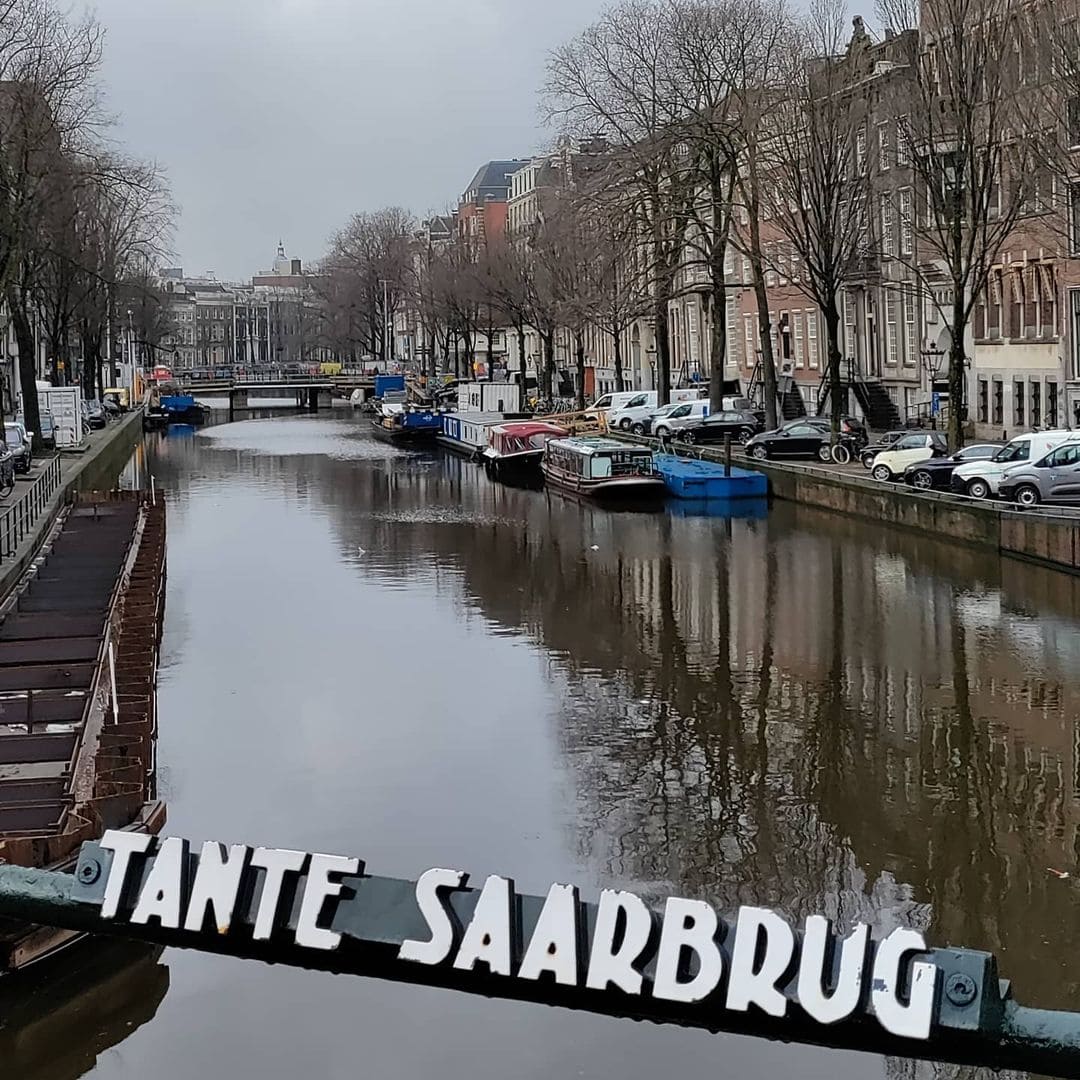
An 18th-Century Arch Bridge at the Most Photographed Canal Junction in Amsterdam
There is a spot in Amsterdam where, if you stand in the right place, you can count sixteen bridges in a single glance. The bridge you are standing on when you do so is Bridge 31, the Tante Saarbrug. It is not the most elaborately decorated bridge in this series, and it carries no sculptures by Hildo Krop or wrought iron balustrades by Piet Kramer. What it has instead is something rarer: genuine 18th-century fabric, a position at the most famous canal intersection in the city, and the name of a woman who sold flowers in rain and winter for sixty years, raised ten children in poverty, survived the Holocaust by the thinnest of margins, and became, in the words of a 1947 newspaper, not simply an aunt but a monument.
This bridge was named Aunt Saar after Sara Bachrach / Sara Bacharach / Sara Bacherach (1887-1982), who had a flower stall on Rembrandtplein for many years and a store on Thorbeckeplein. The bridge did not receive its name until 2016 when the municipality of Amsterdam called on the population to submit names for bridges without one. Aunt Saar Bridge, as it is commonly known, holds a significant place in the heart of Amsterdam. It serves as a symbol of the city’s history and the contributions made by its residents. Sara Bachrach, also known as Sara Bacharach or Sara Bacherach, was a remarkable woman whose entrepreneurial spirit and dedication to her community have left an indelible mark. For many years, Aunt Saar operated a charming flower stall on Rembrandtplein. Her passion for flowers brightened the lives of locals and tourists alike. The fragrant aromas and vibrant colours that emanated from her stall became a beloved part of Amsterdam’s landscape. As if that wasn’t enough, Aunt Saar also had a store on Thorbeckeplein, further cementing her presence in the city’s bustling streets. Her store was a gathering place for residents, a hub of activity, and a testament to her unwavering commitment to serving the community. It wasn’t until 2016 that the municipal authorities in Amsterdam recognised the importance of this bridge and called upon the population to suggest names for the nameless bridges scattered throughout the city. The voice of the people resounded, and Aunt Saar’s name emerged as the perfect homage to a woman who had touched the lives of so many. Today, Aunt Saar Bridge stands tall, a symbol of perseverance, community, and the power of recognizing those who have made a difference. It serves as a reminder of the cherished memories and significant contributions of Sara Bachrach, ensuring that her legacy will continue to thrive for generations to come.


1. Etymology and Naming: Tante Saar, Honorary Citizen, and Flower Queen of the Rembrandtplein
The bridge was named after Sara Bacharach, better known as Tante Saar, who sold flowers for more than sixty years on the nearby Rembrandtplein. She survived several concentration camps and stands as a symbol of someone from the Jewish proletariat who had to earn money for her ten children in bitter poverty. She lived near this bridge at Thorbeckeplein 28. She was appointed honorary citizen of Amsterdam.
The full biography behind that summary is one of the most extraordinary life stories commemorated by any bridge in this series. Sara Bacharach was born in London on 8 May 1887, the daughter of Rosette van Dam and Simon Bacharach, both from Arnhem. Her parents were very poor and had tried their luck in London, in the Spitalfields neighbourhood, which between 1880 and 1970 was the most Jewish district in London, with forty synagogues. Both parents died in London while the children were young. The children drifted and slept on a handcart before being taken back to Arnhem by a relative.
Sara arrived in Amsterdam on 26 October 1904. In 1912 she began selling flowers, at first not from a stall but from a large basket she carried on her arm. From this early phase she bought her flowers at the auction in Aalsmeer, travelling there and back by public transport with the merchandise. In 1929 she received her official permit to sell flowers on the Rembrandtplein, and in 1933 this permit was extended to allow her son Heini to replace her when she could not attend.
The scale of her wartime losses is almost beyond comprehension. When the war broke out, Sara’s two eldest children and her son were murdered, as was the entire family of her eldest daughter Annie, including Annie’s six children. Sara herself survived by the narrowest of margins. She had a British passport, the result of her birth in London, which gave her an exceptional status. Not until 20 May 1943 was she taken to Westerbork. She was transported from there to Bergen-Belsen on 11 January 1944, and on 17 November 1944 to Liebenau, a camp near Kassel. She was liberated by French troops on 29 April 1945.
On 13 July 1945 Sara was back in Amsterdam. She became a local celebrity. She had friends in the city’s cultural world, and when the names of the honorary committee for her jubilees are examined, the extraordinary affection this Amsterdam flower seller commanded becomes clear. At her 35th anniversary celebration in 1947, a newspaper wrote of her, as cited by joodsamsterdam.nl: “Tante Saar is not simply an aunt. Tante Saar has become a monument. The Rembrandtplein without Tante Saar is not the Rembrandtplein, and Tante Saar without her Rembrandtplein is not as it should be.”
Sara died in Amsterdam on 26 June 1982, aged 95, and was buried in Muiderberg.
The bridge was named in two stages. In December 2016 it was announced in Het Parool that Bridge 31 would be named the Tante Saarbrug. On 20 November 2019 the bridge was officially opened under that name by Sara’s granddaughter Simone Haller and others. The naming carries a precise topographical logic: from the bridge, Sara’s former house at Thorbeckeplein 28 is clearly visible. She crossed this bridge or its immediate vicinity throughout her working life, carrying flowers between the Rembrandtplein and her home.
2. Structural Evolution: Built in 1725, Reconstructed in 1784, Reinforced in 1958 and 1968
Bridge 31 is, alongside the Kerksluis (Bridge 74), one of only two genuinely 18th-century arch bridges remaining over the Reguliersgracht. Its structural history is the oldest of any bridge in this series.
The bridge at the Herengracht junction of the Reguliersgracht was built in 1725 and reconstructed in 1784, at the time of the renewal of the Herengracht and Reguliersgracht bridge complex. The 1784 reconstruction is directly linked to a significant event in the canal’s geography. In 1784, the section of the Reguliersgracht between the Herengracht and what is now the Thorbeckeplein was filled in, to save the cost of building a new bridge at that northern end. The square that resulted from this partial infilling, the current Thorbeckeplein, was paved and lined with posts and chains. Since that partial filling of 1784, the Reguliersgracht has connected the Herengracht with the Lijnbaansgracht. The filling in of the northern section of the canal is therefore the reason that Bridge 31 became the northernmost bridge in the famous seven-bridge alignment, rather than a middle bridge in a longer sequence.
The subsequent maintenance record is documented with precision. In 1958 the foundations of the bridge were reinforced, and ten years later, in 1968, the arch itself received renovation work. In 1981 the deck of both Bridge 74 and the bridge at the Herengracht junction was fully renewed and strengthened with reinforced concrete, while maintaining the masonry appearance.
A photograph of the bridge from 1902 by Jacob Olie is referenced in the bruggenvanamsterdam.nl record, showing the bridge in its late 19th-century form against the backdrop of the Herengracht. That image, held in the Stadsarchief Amsterdam, is one of the most direct historical records of the bridge’s appearance before the 20th-century reinforcement works.
3. Architectural Lineage: A Typical 18th-Century Arch Bridge of Brick and Natural Stone
Bridge 31 belongs to the generation of Amsterdam’s 18th-century bridge-building tradition, not to the Amsterdam School period of Kramer and Van der Mey. No individual architect’s name is confirmed for its design in any source consulted for this post.
Both 18th-century bridges over the Reguliersgracht, the one at the Herengracht junction and the Kerksluis, are typical 18th-century arch bridges. The brick abutments with arch and rounded cover stones of natural stone and the year stones are characteristic of that period. The bridges also have cast iron lamp posts on the abutments.
This description defines what Bridge 31 is and where it sits in Amsterdam’s bridge typology. The brick abutments, the natural stone voussoirs and cover stones, the rounded profile of the arch, and the cast iron lamp standards are the standard vocabulary of Amsterdam municipal bridge-building in the 18th century, and they have been preserved through every subsequent intervention. The bridge has been a municipal monument since 1995. That designation acknowledges what the physical evidence confirms: despite the 1784 reconstruction and the 1958, 1968, and 1981 interventions, the bridge retains the appearance and structural logic of its 18th-century form.
4. Urban and Social Context: The View of Sixteen Bridges, the Seven Bridges Phenomenon, and the Thorbeckeplein
Bridge 31 occupies what is, by any measure, the most photographed canal intersection in Amsterdam, and arguably one of the most photographed in the world. From this bridge, sixteen bridges are visible. That number requires some explanation.
The bridge is counted as one of the seven bridges of the Reguliersgracht, though the confusion about the exact number stems from the fact that bridges are considered to be part of the street in whose extension they lay. So while the first bridge crosses the Reguliersgracht, geographically speaking it is part of the Herengracht. Seven is the correct answer.
The seven-bridge view along the Reguliersgracht is one of Amsterdam’s most discussed urban phenomena, but it comes with an important technical caveat. In order to see the bridges of the Reguliersgracht lined up, you would have to be on stilts or in a boat. Notice the steady parade of tour boats sailing by; they all slow down at Bridge 31, because from their vantage point just above the water their passengers do see the seven bridges all lined up. The view from the bridge deck itself offers something different but equally compelling: standing on Bridge 31 and looking south along the Reguliersgracht, the successive arch bridges diminish into the distance, framing the canal in a perspective that becomes, in evening light with all the arches illuminated, one of the most memorable sights in the city.
The Reguliersgracht was dug out in 1658. It is named after an order of monks, whose monastery, the Reguliersklooster, was located at the nearby intersection of Utrechtsestraat and Keizersgracht. Although just 300 metres long, the canal is crossed by seven bridges.
The Thorbeckeplein, directly beside the bridge, is the square that came into existence in 1784 when the northern section of the Reguliersgracht was filled in. It is named after the liberal statesman Johan Rudolph Thorbecke. The Rembrandtplein, where Sara Bacharach sold her flowers for sixty years, is a two-minute walk away. The Museum Willet-Holthuysen, housed in a 17th-century canal mansion at Herengracht 605, is a few minutes’ walk along the Herengracht. The Gouden Bocht, the Golden Bend, begins just south of this crossing.
5. Technical Specifications
Based on confirmed sources, the following can be stated:
- Bridge type: Fixed arch bridge (vaste welfbrug), single arch
- Location: Western quay of the Herengracht, spanning the Reguliersgracht at its northern end, Amsterdam-Centrum
- Canal crossed: Reguliersgracht (dug 1658, named after the Reguliersklooster; approximately 300 metres long, connecting the Herengracht with the Lijnbaansgracht)
- Construction date: 1725; reconstructed 1784 at the time of the partial filling in of the Reguliersgracht’s northern section
- Materials: Brick abutments with natural stone arch voussoirs and cover stones; cast iron lamp posts on the abutments
- Maintenance history: Foundations reinforced 1958; arch renovated 1968; deck and foundations renewed and reinforced with concrete 1981
- Designer: Dienst der Publieke Werken (18th-century municipal tradition); no individual architect confirmed
- Amsterdam School attribution: None; the bridge predates the movement by nearly two centuries
- Monument status: Gemeentelijk monument (municipal monument) since 1995
- Name announced: December 2016, Het Parool
- Bridge officially named: 20 November 2019, opened by Sara Bacharach’s granddaughter Simone Haller
- Named after: Sara Bacharach (London, 8 May 1887 to Amsterdam, 26 June 1982), flower seller, Holocaust survivor, honorary citizen of Amsterdam
- Notable feature: From the bridge, sixteen other bridges are visible; the bridge forms the northern terminus of the famous seven-bridge Reguliersgracht alignment
- Wikidata: Q105735283
Sources Consulted
- Bruggenvanamsterdam.nl, bridge register entry for Brug 31: www.bruggenvanamsterdam.nl/herengracht_hoek_reguliersgracht.htm
- Joodsamsterdam.nl, “Sara Bacharach”: www.joodsamsterdam.nl/sara-bacharach/
- DutchAmsterdam.nl, “Fact Check: Can you really see 15 of Amsterdam’s bridges at this spot?”: www.dutchamsterdam.nl/67-bridges-of-amsterdam
- Bridges.cramberts.com, Bridge 73 (Reguliersgracht series): bridges.cramberts.com/2026/03/09/bridge-73-amsterdam/
- Bruggenstichting.nl, “Niet alles is wat het lijkt: Zeven welfbruggen over de Reguliersgracht,” dr. E. van Blankenstein: bruggenstichting.nl/106-bruggen/bruggen-2012/bruggen-september-2012/179-niet-alles-is-wat-het-lijkt-zeven-welfbruggen-over-de-reguliersgracht
- Bridgesofamsterdam.com, Bridge 73: bridgesofamsterdam.com/bridges/73/
- Lonely Planet, “Reguliersgracht”: lonelyplanet.com/the-netherlands/amsterdam/southern-canal-ring/attractions/reguliersgracht
- Wikipedia (en), “Reguliersgracht”: en.wikipedia.org/wiki/Reguliersgracht
- Amsterdam for Visitors, “Reguliersgracht: Seven Bridges Amsterdam”: amsterdamforvisitors.com/reguliersgracht/
- Wikipedia (nl), “Herengracht (Amsterdam)”: nl.wikipedia.org/wiki/Herengracht_(Amsterdam)
- Wikipedia (nl), “Bruggen van Amsterdam”: nl.wikipedia.org/wiki/Bruggen_van_Amsterdam
- Stadsarchief Amsterdam Beeldbank, photograph by Jacob Olie, 1902 (referenced in bruggenvanamsterdam.nl): archief.amsterdam
- Wikimedia Commons, Category: Brug 31, Tante Saarbrug: commons.wikimedia.org/wiki/Category:Brug_31,_Tante_Saarbrug
Public Domain Images

1. Photograph of the bridge by Jacob Olie, 1902, Stadsarchief Amsterdam Referenced in the bruggenvanamsterdam.nl bridge register as “hieronder staat een foto van deze brug uit 1902 van Jacob Olie,” this photograph shows Bridge 31 in its early 20th-century form, before the reinforcement works. Available via the Stadsarchief Amsterdam Beeldbank at archief.amsterdam. Jacob Olie (1834 to 1905) was one of Amsterdam’s most important early photographers. His work is in the public domain. URL: https://archief.amsterdam/beeldbank (search: “brug 31 Reguliersgracht Jacob Olie 1902”) Attribution: “Jacob Olie, 1902. Collectie Stadsarchief Amsterdam. Public domain.”

2. “Bloemenkoopvrouw tante Saar Bacharach, 40 jaar bloemenvrouw op het Rembrandtplein, Amsterdam, 17 juli 1952” Photograph by Ben van Meerendonk, held in the collection of the International Institute of Social History (IISG), Amsterdam. This photograph is cited in the joodsamsterdam.nl biography of Sara Bacharach as: “Foto Ben van Meerendonk / AHF, collectie IISG, Amsterdam.” The IISG collection makes many of its historical photographs available for research and editorial use. URL: https://www.joodsamsterdam.nl/sara-bacharach/ Attribution: “Ben van Meerendonk / AHF, collectie IISG, Amsterdam, 17 juli 1952.”
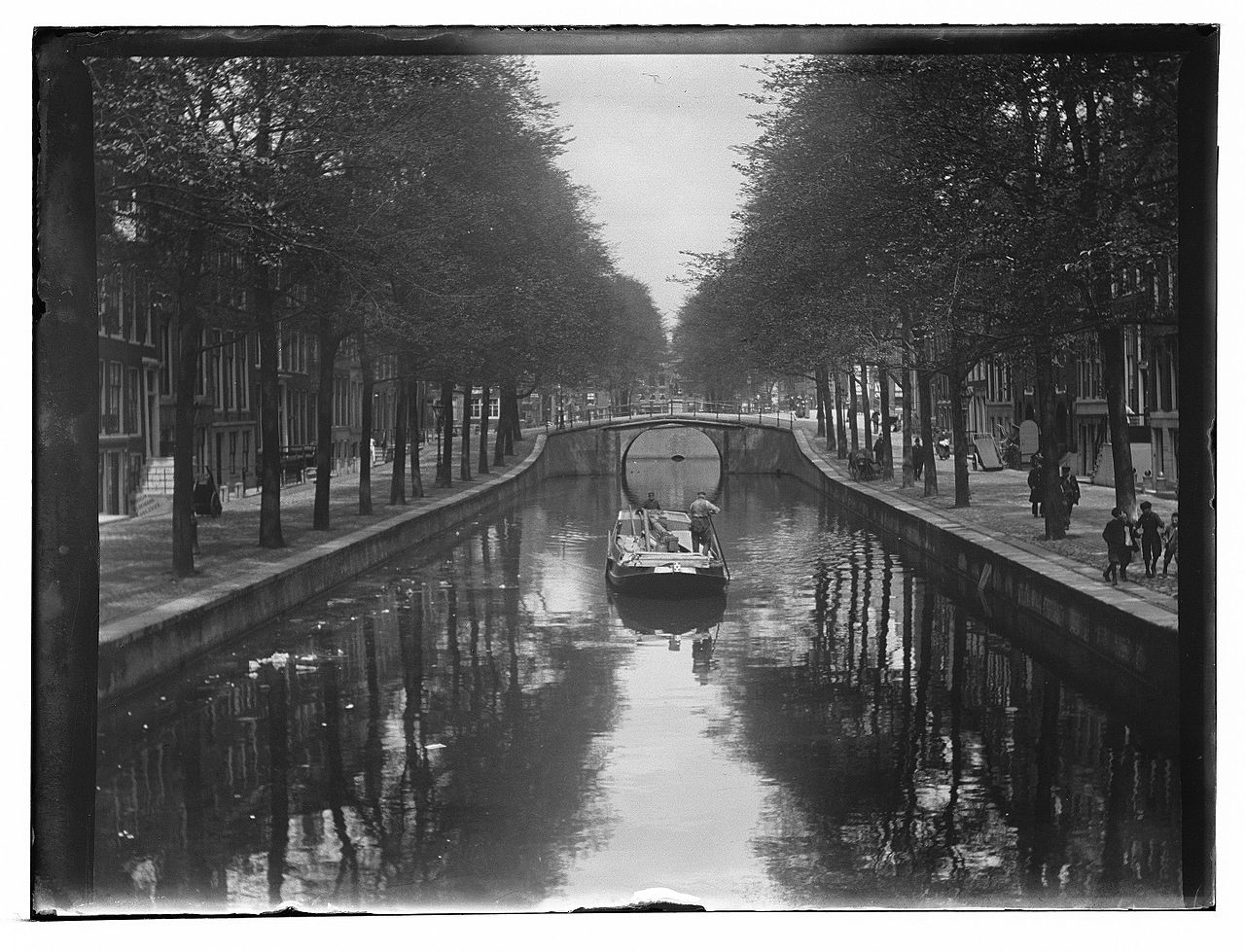
3. Wikimedia Commons photographs of the Tante Saarbrug and the Reguliersgracht seven-bridge view The Wikimedia Commons category for Bridge 31 holds several contemporary photographs of the bridge in its current form, including images of the arch seen from canal level showing its position at the head of the Reguliersgracht alignment. Available under free licences. URL: https://commons.wikimedia.org/wiki/Category:Brug_31,_Tante_Saarbrug Attribution: “Wikimedia Commons, Category: Brug 31, Tante Saarbrug. Available under the licence specified on each file’s description page.”
Location of bridge number 31 The Aunt Saar Bridge (De Tante Saarbrug)
This bridge is located in the Herengracht and spans the Reguliersgracht.
It is the first of the Reguliersgracht Seven Bridges of Amsterdam which many of the canal boat tours include on their itinerary.
For a traffic bridge accessible to all types of traffic it has a relatively high arch and can be a challenge on a bike. On the side of Herengracht to the left of the bridge a foundation stone has been placed in the quay wall with “Anno 1734” on it.
Picture
Detail map 1680 door Jacobus Bosch with bridge 31 at the bottom left

Detail map 1680 door Jacobus Bosch with bridge 31 at the bottom left


Bridge number 31 De Tante Saarbrug some History
This bridge was named Aunt Saar after Sara Bachrach a local florist.
In 1947, her thirty-five years of business was lavishly celebrated, although she spent much of her life in poverty. In addition, as a Jewish woman, she spent part of the Second World War in various concentration camps and lost a number of children and grandchildren there. She became an honorary citizen of Amsterdam and was buried in the Jewish cemetery in Muiderberg.
The nameplates were unveiled on November 20, 2019 in the presence of some of her family members.

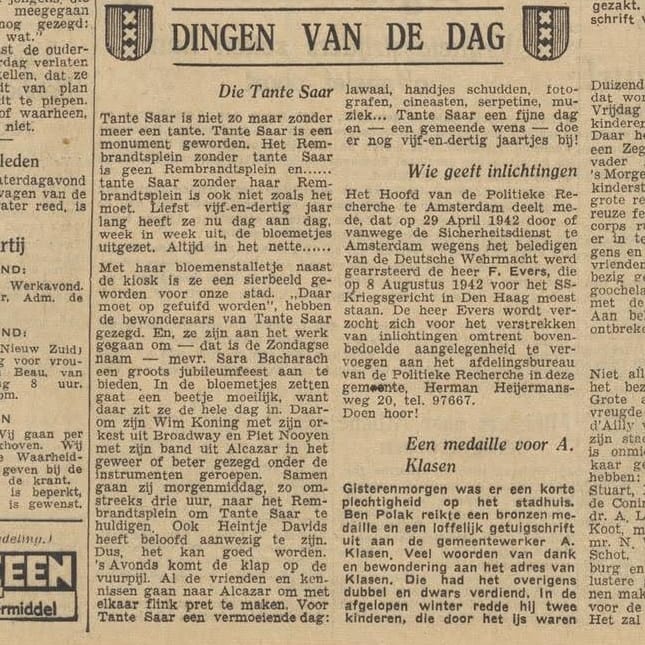
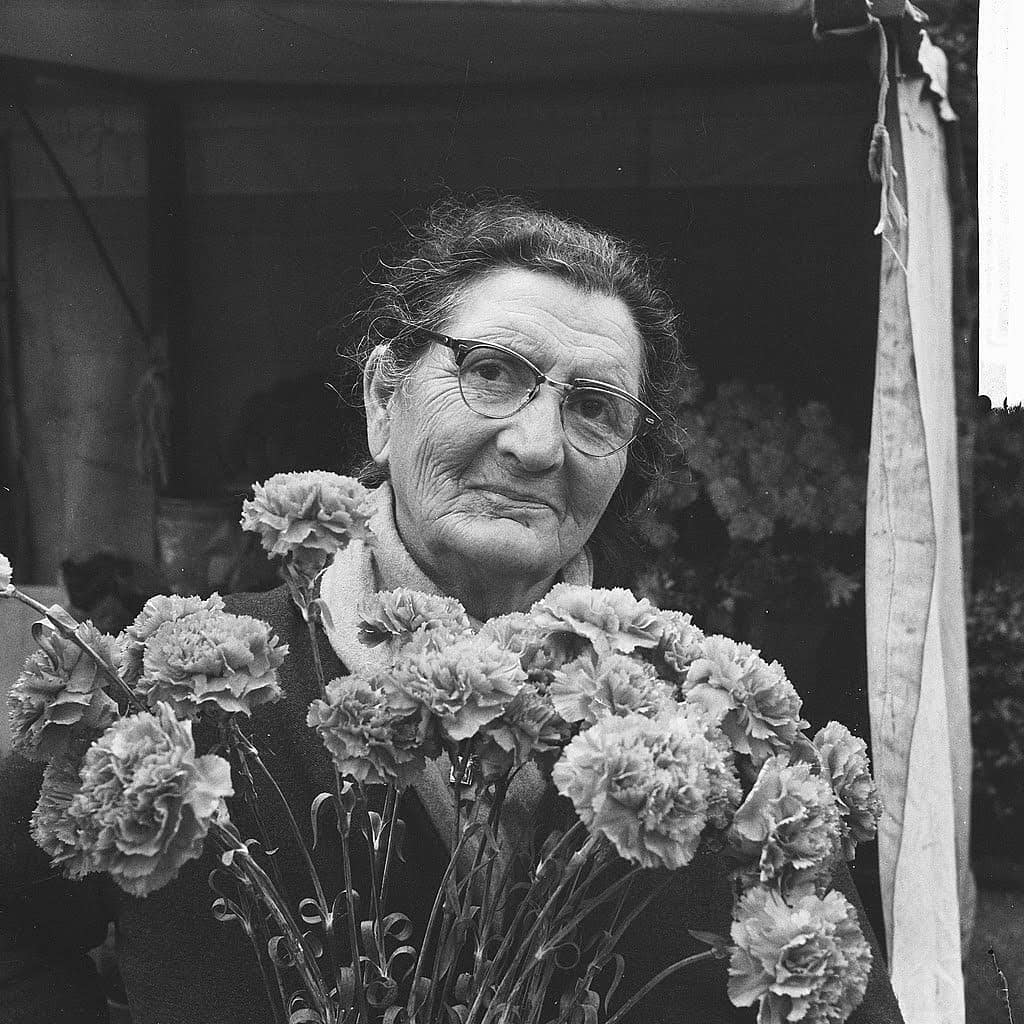
Picture 1 Tante Saar
Picture 2 De Waarheid 16 July, 1947
Picture 3 Obituary De Telegraaf June 28, 1982