Most Bridges Had Only a Number
Every bridge the city of Amsterdam manages has a number, starting with bridge 1, the Muntsluis. For most of the twentieth century, most of them had nothing else. In July 2016, when the city asked residents for help, it counted 1,680 bridges of which 346 had an official name. A council proposal that October gave about 1,700 bridges and 384 names. The numbering itself is explained in How Amsterdam numbers its bridges. This article is about the names: how the old ones came about, how the city now chooses new ones, and who the bridges remember.
The names that existed before 2016 came from several directions. Many simply grew up in use, like the Koekjesbrug, the Biscuit Bridge, on the Singelgracht. Others describe a place, like the Halvemaansbrug by the Halvemaansteeg. Some honour historical figures, like the Berlagebrug over the Amstel, named after the architect. The Saïdja en Adindabrug is named after two characters in a novel, and the Timo Smeehuijzenbrug remembers a Dutch soldier killed in Uruzgan in 2007.
Brug and Sluis
Almost every official bridge name ends in -brug, Dutch for bridge, joined directly to the rest of the name: Tante Saarbrug, Walter Süskindbrug, Ben Ali Libibrug. A person’s full name runs straight into the suffix, which is why the Dutch spellings look strange to English eyes, and initials are kept where the city chose them, as in the M. Justbrug. The rules of the city’s naming council express a general preference for such suffixes. Metro viaducts named in 2017 end in -metrobrug.
The older names include a second form: -sluis. A sluis is normally a lock, but in Amsterdam bridge names the word often means a stone bridge rather than any kind of water control. The Muntsluis is the standard example: it has no lock gates. The same use survives in the Torensluis, the Reesluis and the Leliesluis. Some structures called sluis really are locks as well.
Who Decides
Naming streets, squares, canals and bridges is the job of the municipal executive, the college of mayor and aldermen. Until 2021 it was advised by the Commissie Naamgeving Openbare Ruimte (CNOR), the committee for naming public space, set up by the college to guard the quality and consistency of names. As the council described the procedure in 2016, anyone, whether a resident, a business or an institution, could submit a request to the city’s Basisinformatie department. The department checked it against the criteria and the procedure and put it to the CNOR for advice, then wrote a proposal for the college, which decided.
The criteria were strict. A person proposed for a name had to have shown special merit for Amsterdam society or for society more broadly. Nobody could be commemorated until five years after their death, with an exception for members of the royal family. And because so few bridges in the centre were still unnamed, a request for one of them would be granted only in very exceptional cases.
The case of the Wim Sonneveldbrug shows the system at work. In November 2014 Daan Bartels, a specialist in Dutch song, asked the city to name bridge 40, where the Keizersgracht crosses the Reguliersgracht, after the singer Wim Sonneveld. Sonneveld had lived nearby and had been photographed on that bridge for a record cover. The CNOR turned the request down for lack of sufficient reason to choose that particular bridge, and suggested bridge 94 on the Leidsegracht instead, near the DeLaMar Theater that Sonneveld had directed from 1952. The name finally went to bridge 175, also on the Leidsegracht, and André van Duin was among those who unveiled the plate on 28 June 2017. A little further along the same canal, the Pieter Goemansbrug remembers the man who wrote the lyrics of that song.
The 2016 Clear-Out and the Call for Names
The big change came in 2016, and it was driven by an administrative need. The city records its public spaces in the Basisregistratie Adressen en Gebouwen (BAG), the national register of addresses and buildings, where a bridge has to have a name to be easy to find. A number is not enough.
In 2016 the city reviewed the informal names in circulation and dropped all of them. Wikipedia dates the decision to April 2016; Peter Korrel’s register of Amsterdam bridges gives 5 July 2016. The informal names went onto two lists: one of names that could simply be made official, and one of names to be decided after public consultation. Some failed: the Felix Meritisbrug on the Keizersgracht lost its name partly because of its commercial link with the cultural centre beside it, and the Meeuwenpleinbrug in Noord because the name had never been formally adopted. Bridge 306 in front of Centraal Station, known informally as the Stationsbrug, became the Sint Nicolaasbrug, after the city’s patron saint.
At the same time the city invited residents to propose names for anonymous bridges. On 5 October 2016 the council adopted an initiative proposal from the VVD councillor Marianne Ruigrok asking the college to put a short explanation in Dutch and English on every named bridge, to draw up a plan for involving Amsterdammers through a recurring naming contest, and to bring in schools and the Canon of Amsterdam. Proposals in 2016 and 2017 produced names including the Tante Saarbrug, the Ben Ali Libibrug, the Pa Sembrug and the bridges named after the Bording fishermen of Durgerdam.
In November 2017 the council named almost all the bridges and viaducts of the metro, usually after the street or water beneath, as in the Hemsterhuismetrobrug. The metro bridges that stand in Diemen were left out, and so was the viaduct at Van der Madeweg station in Ouder-Amstel, which Amsterdam only manages.
The Adviesraad and Its Rules
On 20 October 2020 the college adopted a new naming policy meant to increase public participation, make the process more transparent and widen the diversity of names. It needed a new advisory body, and from 12 May 2021 the Adviesraad naamgeving openbare ruimten, the advisory council for naming public spaces, replaced the CNOR.
Its founding decision sets out the principles it applies. Names are chosen within coherent categories, and the category comes first. A new name must not look or sound too much like an existing one, must be easy to pronounce and spell, and should avoid numerals. Living people are not commemorated, except members of the royal family, and nobody is named until five years after their death. The council is to be restrained about naming further resistance heroes of the Second World War, especially those with no clear link to Amsterdam. Existing names are changed as little as possible,. A person proposed must have shown special merit for Amsterdam or society more broadly, or have great symbolic value for many Amsterdammers or for particular groups. Among equally suitable candidates, women and other under-represented groups come first.
The new council has also moved names. In 2016 the name of Henriëtte Pimentel had been given to bridge 603 in Slotermeer. In December 2021 the Adviesraad transferred it to bridge 265 in Oost, the former Muiderpoortbrug, because that bridge is closer to the Hollandsche Schouwburg, where her work had taken place.
Bridges for People Persecuted Under the Occupation
A significant group of named bridges commemorates people persecuted or murdered under the German occupation, and people who rescued others from it. The background is the same for all of them. About 80,000 Jews lived in Amsterdam in 1941. Around 60,000 of them were murdered: the German occupier rounded them up, with substantial assistance from the Amsterdam municipal police, and deported them, first to the Hollandsche Schouwburg, the theatre used as an assembly point, then to the Westerbork transit camp, and from there to Auschwitz and Sobibor, where most were killed on arrival. It was the highest proportion of any country in Western Europe. The Joods Monument records each of them by name.
The Walter Süskindbrug, bridge 237, is a double drawbridge over the Nieuwe Herengracht where it meets the Amstel, and its name is older than most: the bridge was named in 1972, the year the present bridge opened. Walter Süskind, born in Lüdenscheid on 29 October 1906, was a German Jew who had moved to the Netherlands in 1938. As an employee of the Jewish Council he managed the Hollandsche Schouwburg, where Amsterdam’s Jews had to report before the occupier sent them on to Westerbork. With Felix Halverstad, the crèche director Henriëtte Pimentel and several resistance groups, he falsified records and smuggled at least 600 children out through the crèche across the road. The German authorities eventually deported Süskind, his wife and his daughter to Westerbork, then on 4 September 1944 to Theresienstadt, and in October to Auschwitz-Birkenau. The SS murdered his wife and daughter in the gas chambers on arrival. Süskind himself was kept in the camp system and died around 28 February 1945 at a place that has never been established, possibly on one of the death marches on which the SS drove camp prisoners west. A bronze plaque from 1972 on the bridge records that he withdrew many Jewish fellow citizens from deportation at great danger to his own life. His entry in the Joods Monument is here.

The men and women who worked with him have bridges nearby. The Halverstadbrug, bridge 260 in the Roetersstraat, is named after Raphaël (Felix) Halverstad, the economist who removed the children’s registrations from the files; the German occupier murdered his parents and his only sister in Auschwitz in 1943. Further along the same street are the Lau Mazirelbrug, named in 1982 after the lawyer and resistance member Lau Mazirel, and the Ben Polakbrug. The Piet Meerburgbrug, named on 12 September 2013, remembers Piet Meerburg, who took many Jewish children from the crèche to safety. Ed van Thijn, one of those children and later mayor, unveiled its name plate. Henriëtte Pimentel herself, born in Amsterdam in 1876, was deported to Westerbork on 23 July 1943 with 70 children and 36 nursery staff. On 14 September the occupier sent her on to Auschwitz, where she was murdered on arrival on 17 September 1943. The Henriëtte Pimentelbrug, bridge 265, has carried her name since 2021.
The Ben Ali Libibrug, bridge 838, is a timber footbridge in the Amstelpark, designed by Dirk Sterenberg for the Floriade of 1972. Ben Ali Libi was the stage name of Michel Velleman, a magician born in Groningen on 5 January 1895, who had performed for children in the afternoons and in cabaret in the evenings, and once for the former German emperor. In the round-up of 20 June 1943, one of the large raids in Amsterdam, the German occupier arrested him and his family at their home at Merwedeplein 59. The occupier deported him to Westerbork and on 29 June to Sobibor, where he was murdered on arrival on 2 July 1943. His son, who was warned not to come home, was the only member of the family to survive. The city approved the name, proposed by a member of the public, in March 2017. His entry in the Joods Monument is here.
The Truus Wijsmullerbrug, bridge 793 in De Aker in Nieuw-West, already carried its name by 2007. Truus Wijsmuller-Meijer (1896 to 1978) was not Jewish. Before the war she organised the Kindertransport trains from Vienna, Berlin, Prague and other cities to the Netherlands and Britain, and together with others in that work she saved the lives of more than 10,000 Jewish children. Yad Vashem recognised her as Righteous Among the Nations.
The Simon Wiesenthalbrug, bridge 790, crosses the Bonhoeffersingel in Nieuw-West. The city named it on 13 May 2020. Simon Wiesenthal (1908 to 2005) was imprisoned by the Nazi regime in the Janowska camp near Lwów and then in Mauthausen, and survived. The regime murdered 89 members of his and his wife’s families. After the war his documentation centre in Vienna traced around 1,100 war criminals for arrest and trial.
The M. Justbrug, bridge 803 on the Van Nijenrodeweg in Buitenveldert, was named on 7 April 2013 after Meir Just (1908 to 2010), chief rabbi of Amsterdam. Just survived the persecution of the Jews in Hungary because a non-Jew hid him and his wife. He came to Amsterdam in 1963 and often walked over this bridge between his home and the Jewish cultural centre on the Van der Boechorststraat.
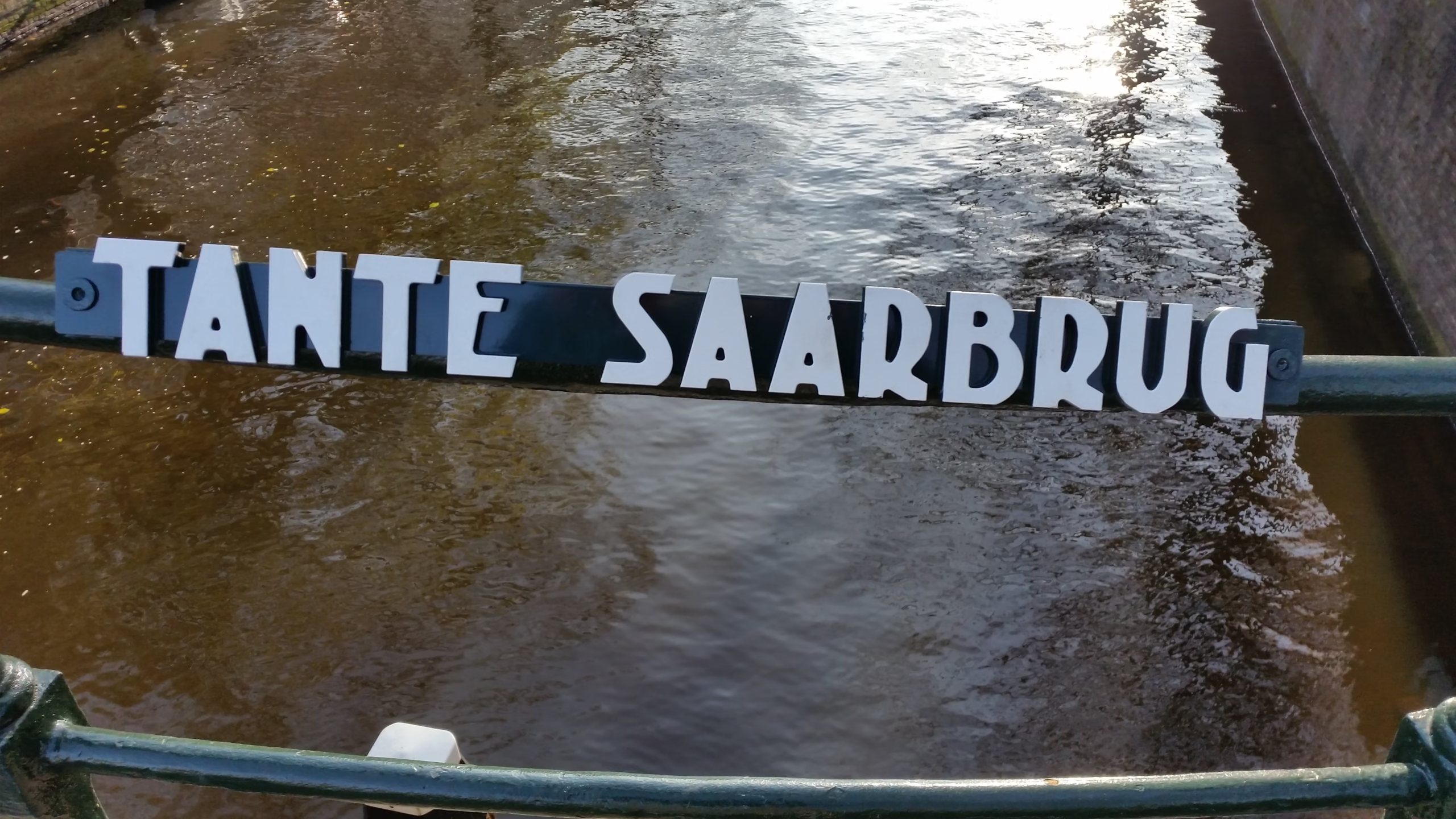
The resistance is remembered too. On 4 May 2016, Remembrance Day, the city unveiled the name of the Frieda Belinfantebrug, bridge 600 in Slotermeer, and that month six bridges in Nieuw-West were named after women of the resistance, among them the Hannie Schaftbrug, bridge 601. The Tante Saarbrug, bridge 31 on the Herengracht over the Reguliersgracht, belongs here as well as among the local figures. Tante Saar was Sara Bachrach (1887 to 1982), who ran a flower stall on the Rembrandtplein for decades and became an honorary citizen of the city. As a Jew she was held in several concentration camps during the war, and the German occupier murdered several of her children and grandchildren. Her bridge was named in 2016, and its name plates were unveiled on 20 November 2019 with members of her family present.
Writers, Artists, Politicians and Neighbours
Many of the other names honour people with a link to one particular spot. The Hans van Mierlobrug, bridge 18 on the Herengracht at the Blauwburgwal, was named in January 2021 after the founder of the D66 party, who lived nearby and crossed it on the way to his local café; in the official register it is the Van Mierlobrug. The Marten Toonderbrug, bridge 48 on the Keizersgracht, nameless since its informal name was dropped in 2016, was named after the writer and comic artist in 2022.
The Freddy Heinekenbrug, bridge 84 over the Singelgracht beside the old brewery, was locally known as the Weteringbrug until it was rebuilt. When Charlene de Carvalho-Heineken opened the new bridge on 16 December 2005, it took its official name from her father. The Joes Kloppenburgbrug, bridge 5 on the Singel, was named on 5 July 2016 after a young man killed on 17 August 1996 in the nearby Voetboogstraat in an act of random violence, and is meant as a symbol against such violence.
Some names come from further back. The Klaas Bordingbrug and Jacob Bordingbrug at Durgerdam, bridges 109 and 2461, remember three fishermen, a father and two sons, who drifted for two weeks on ice floes on the Zuiderzee in January 1849 before fishermen from Vollenhove rescued them. And the Pa Sembrug in Zuidoost, bridge 1145, was named on 4 October 2017, twenty-five years after the Bijlmer disaster, after Willem Symor (1936 to 2008), known as Pa Sem, who went back into the burning flats after the plane crash and carried out a boy, suffering serious injuries himself.
Other bridges on this site with names of people include the Johanna Borskibrug, the Kees Fensbrug, the Isa van Eeghenbrug and the Anton Jolingbrug, while four bridges remember the men who planned the canal ring.
Names and Numbers Together
A name never replaces a number. The Walter Süskindbrug is still bridge 237 in the city’s lists, and this site files every bridge by its number first. Names keep arriving: Peter Korrel counted 1,005 named bridges, viaducts and locks in 2026. Every bridge documented so far is listed in the bridge index, by number, by name and by canal.
Sources Consulted
- Gemeente Amsterdam, Initiatiefvoorstel Amsterdamse bruggen, Gemeenteblad 2016, 153214
- Gemeente Amsterdam, Instellingsbesluit Adviesraad naamgeving openbare ruimten (2021)
- DutchNews.nl, “Locals asked to name 1,334 of Amsterdam’s bridges”, July 2016
- Peter Korrel, Alle Amsterdamse bruggen (bruggenvanamsterdam.nl)
- Walter Süskindbrug and Walter Süskind, Nederlandstalige Wikipedia
- Ben Ali Libibrug and Michel Velleman, Nederlandstalige Wikipedia
- Truus Wijsmullerbrug and Truus Wijsmuller-Meijer, Nederlandstalige Wikipedia
- Simon Wiesenthalbrug and Simon Wiesenthal, Nederlandstalige Wikipedia
- M. Justbrug and Meir Just, Nederlandstalige Wikipedia
- Halverstadbrug, Raphaël Halverstad, Lau Mazirelbrug and Piet Meerburgbrug, Nederlandstalige Wikipedia
- Henriëtte Pimentel and Henriëtte Pimentelbrug (Amsterdam-Oost), Nederlandstalige Wikipedia
- Tante Saarbrug, Frieda Belinfantebrug and Hannie Schaftbrug, Nederlandstalige Wikipedia
- Van Mierlobrug, Marten Toonderbrug (Amsterdam), Freddy Heinekenbrug and Joes Kloppenburgbrug, Nederlandstalige Wikipedia
- Wim Sonneveldbrug, Pa Sembrug, Jacob Bordingbrug en Klaas Bordingbrug and Sint Nicolaasbrug, Nederlandstalige Wikipedia
- Brug 491, Hemsterhuismetrobrug and Muntsluis (Amsterdam), Nederlandstalige Wikipedia
- Joods Monument
- Martha Bakker (ed.), Stadsatlas Amsterdam: Stadskaarten en straatnamen verklaard (2006), Amsterdam Publishers
- Featured image: the name plate of the Tante Saarbrug, bridge 31, Ceescamel, 2019, CC BY-SA 4.0