A City That Started Dressing Up as Itself
Somewhere around 1970, Amsterdam changed its mind about what a new bridge should look like, and began building modern structures with historical faces. Concrete decks acquired nineteenth-century balustrades. A canal that had been filled in was dug back out. A neighbourhood flattened for a motorway was rebuilt on property lines that had stopped existing.
It is tempting to call all of this dishonest, and people did at the time. The more interesting question is what the city thought it was doing, because the answer is not nostalgia. It is a municipality that had spent forty years demolishing its own centre, lost the argument in the street, and had to work out what to build instead.
What Came Before: Four Decades of Flattening
To see why the 1970s look the way they do, you have to look at what the city had been doing since the 1920s.
Amsterdam’s canal bridges were built as arches, and an arch is a problem for wheeled traffic. It humps in the middle, which is hard work for a loaded cart and impossible for a tram, since trams cannot climb or descend sharply. So through the late nineteenth and twentieth centuries the city lowered and flattened bridge after bridge, buying an easier gradient on the road with lost headroom on the water.
The same logic operated at larger scale. Canals were filled to make wide streets, and the vacancies in the bridge register cluster around waterways that stopped existing: the Vijzelgracht went in 1933, taking Brug 83 and the original Brug 85 with it. The register is a record of what the city has built, not an inventory of what it still has.
Occasionally a bridge escaped. Brug 74 is on this site precisely because it refused to be flattened, and it is the exception that establishes the rule.
The Year the Argument Was Lost
The plan reached its limit in the Nieuwmarkt.
Building the Oostlijn metro required assembling the tunnel from concrete caissons cast above ground and sunk into place, which meant clearing everything above the line. Much of the Lastage, between the Geldersekade and the Oudeschans, came down. A four-lane motorway was to follow the metro through the district.
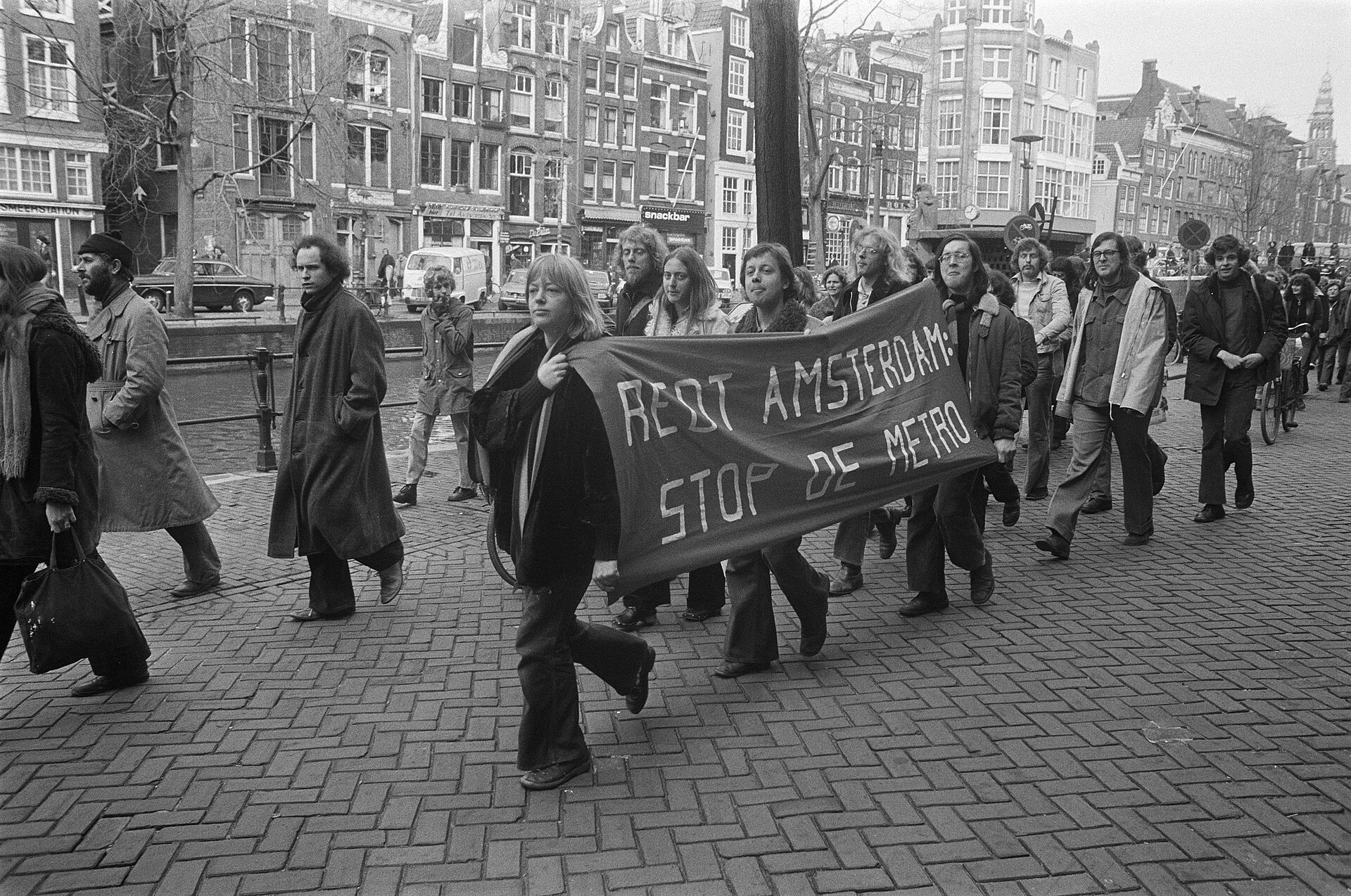
On 24 March and 8 April 1975 the evictions were fought in the street. The Nieuwmarktrellen were among the most serious civil disturbances in post-war Amsterdam.
The metro was finished. Almost nothing else was. The city withdrew the Metroplan, dropped the remaining lines, abandoned the motorway, and shifted to small-scale development and what it called building for the neighbourhood.
And it rebuilt the Nieuwmarkt on the old property boundaries, rather than on the plan that had justified the demolition.
That decision is the purest example of the phenomenon this article is about. New buildings, built in the 1970s and 1980s, following the footprints of buildings that had already been destroyed. Not a restoration, because nothing was left to restore. A reconstruction of a plan.
The Canal That Was Dug Back Out
The clearest single reversal is at the Steenvoetsluis, Brug 291, on the Houtkopersburgwal.
That waterway was filled in during the late 1960s, to provide construction ground for the Maupoleum, the vast brutalist block on the Jodenbreestraat designed by Piet Zanstra, Ab Gmelig Meyling and Peter de Clercq Zubli, opened in 1971.
In 1977 the city decided to excavate the waterway again, and Dirk Sterenberg built a new bridge over it in 1977 and 1978: concrete, with brick pylons and steel railings.
The Maupoleum itself was demolished in 1994, after twenty-three years. It had been widely loathed. Merchants blocked its windows, the university rooms it housed had no daylight, and students reportedly fell asleep in lectures.
So within a single decade Amsterdam filled a canal for a building, then reopened the canal, and within another two decades removed the building. The water is older than the argument about it.
Modern Structure, Historic Surface
The bridges of this period share a recognisable construction: the engineering is entirely of its time, and the parts you touch are not.
The Sint Anthoniesluis, Brug 287, was built in 1968 and 1969 by Dick Slebos with the tunnel division engineer J. Bardet. It is concrete, finished with balustrades in a nineteenth-century style. It also carries a deck nearly twice the width of the streets at either end, because it was built to feed a highway that was never constructed. A bridge in period costume, sized for a road that lost.
Brug 89 on the Weteringstraat, built in 1971 and 1972, is the same idea in miniature: concrete pillars and a modern composite beam deck, with traditional iron balusters on top. Modern below the handrail, nineteenth-century above it.
And Brug 81, rebuilt in 1976 at the end of the Reguliersgracht, was given an arch at a moment when flat decks were cheaper, stronger and standard. It sits at the end of the most photographed sightline in the city, where a flat deck would have broken the row of nested rings. The shape was specified by the view.
Is It a Lie?
The charge, then and now, is Disneyfication: a city performing its own past for visitors.
Two things complicate it.
The first is that almost every bridge in the canal ring is younger than it looks, and this did not start in 1970. Timber does not last in water, so the original crossings were replaced repeatedly, and the nineteenth century rebuilt the ring wholesale in iron and stone. What you walk across on a seventeenth-century canal is usually Victorian or later. The 1970s did not invent the gap between the age of a line and the age of a structure; it inherited it.
The second is that Amsterdam did not always take the disguise. When Brug 96 came up for renewal in 1952, the city could have replaced the beam bridge with a stone arch that would have looked convincingly older. It rebuilt the beam bridge instead, and a newspaper called the result a jewel for the city. When Brug 93 was renovated in 1987 and 1988, the same choice arose and the same answer was given: the nineteenth-century iron girder bridge was rebuilt in steel rather than replaced with masonry.
A city committed to fakery does not do that twice.
What the record actually shows is a municipality making the decision case by case, and giving different answers depending on whether the crossing was load-bearing to a view. Where the silhouette mattered, as at the Reguliersgracht, it kept the arch. Where it did not, it built what was needed and let it look like what it was.
The Ground Underneath
One further thing changed in this period, and it is invisible.
Amsterdam stands on peat and clay, neither of which will carry a building, so since the Middle Ages the city has driven timber piles down to the firm sand and built on top of them. Timber piles last indefinitely while submerged and rot when the groundwater drops and exposes their tops, a condition known as paalrot.
Bridges of this era were commonly underpinned in modern materials while keeping their visible fabric. It is the same principle as the balustrades, applied where nobody will ever see it, and it is the reason the phrase consolideren, to reinforce a historic structure without changing its appearance, appears so often in the Public Works vocabulary of the time.
A canal bridge is therefore a structure whose survival depends on the canal staying wet. The water it crosses is also the thing holding it up.
What to Look For
- Balustrades that do not match their bridge. Nineteenth-century ironwork on an obviously twentieth-century deck is the clearest tell.
- Decks wider than the streets they join. Usually a sign of a road scheme that was abandoned, as at the Sint Anthoniesluis.
- An arch where an arch is not needed. Where a 1970s bridge is humped, ask what view it is protecting.
- A flat bridge on an old canal. The opposite tell: a crossing that was lowered for trams and never given its profile back.
- Straight lines in masonry. Traditional brick arches do not produce perfectly regular joints.
Sources Consulted
- Featured image: Nieuwmarkt protests against demolition for the metro, 1975 by Hans Peters for Anefo, 1975, via Wikimedia Commons, CC0
- Nieuwmarktrellen, Nederlandstalige Wikipedia
- Maupoleum, Nederlandstalige Wikipedia
- Steenvoetsluis, Nederlandstalige Wikipedia
- Sint Anthoniesluis, Nederlandstalige Wikipedia
- Brug 81, Nederlandstalige Wikipedia
- Brug 89, Nederlandstalige Wikipedia
- Brug 96, Nederlandstalige Wikipedia
- Pieter Goemansbrug (Brug 93), Nederlandstalige Wikipedia
- Dirk Sterenberg, Nederlandstalige Wikipedia
- Paalrot, Nederlandstalige Wikipedia
- Stadsarchief Amsterdam, Beeldbank and Publieke Werken archives
- Bruggen van Amsterdam
- Frank V. Smit, Bruggen in Amsterdam (2008), Uitgeverij Matrijs