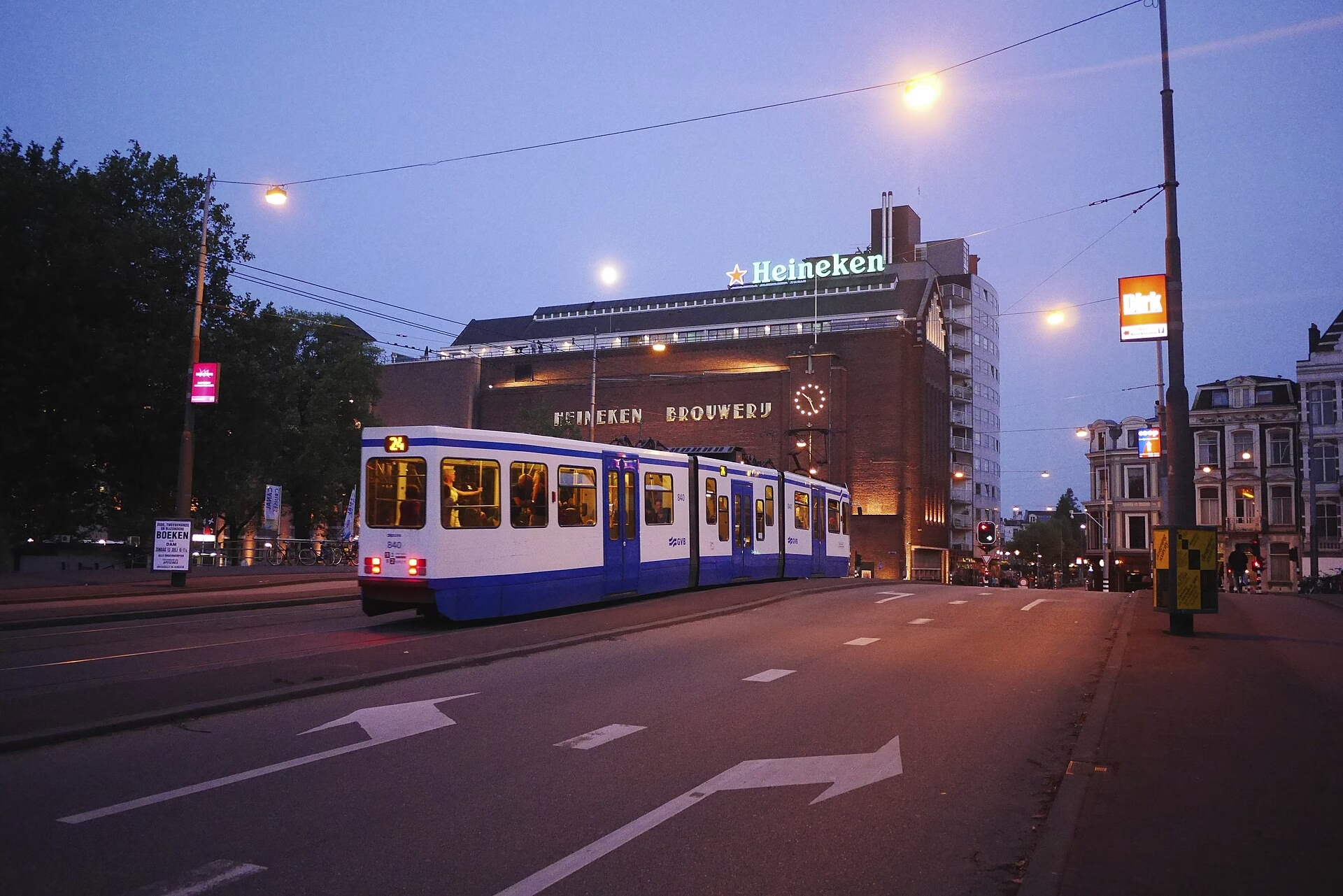
The Brewer’s Bridge: Brug 84 and a Name Bought With a Kidnapping Ransom’s Worth of Goodwill
Amsterdam names bridges after trades, buildings, architects and, occasionally, people who did something remarkable. Brug 84 is named after a brewer, and it is one of the very few bridges in the city named after a businessman.
The Freddy Heinekenbrug carries the Weteringlaan across the Singelgracht, linking the Weteringschans, the Nieuwe Vijzelstraat and the Weteringplantsoen on the north side to the Ferdinand Bolstraat and the Stadhouderskade on the south. Locally it is still called the Weteringbrug, which is what it was for 130 years and some people do not like change.
Structural Evolution: 1875, 1915, 2005
The first bridge here went in during 1875, part of the same wave of Singelgracht crossings that produced the Museumbrug two years later, when Amsterdam was finally building outward past its seventeenth-century boundary.
It was substantially widened in 1915, and the design of that rebuild is generally attributed to Jo van der Mey, the architect of the Scheepvaarthuis and one of the founding figures of the Amsterdam School. Further modifications followed in 1925 and 1949.
By the turn of the century the structure was finished. It was demolished and rebuilt in 2004 and 2005, to a design by Henk Meijer of Kerste-Meijer. What stands today is a fixed bridge with a modest 1.75 metre clearance, which tells you at once that nothing much is expected to pass beneath it.
Etymology: Naming a Bridge After a Brewer
The bridge was officially named on 16 December 2005, when the new structure was opened by Charlene de Carvalho-Heineken, Freddy Heineken’s daughter.
The location is not incidental. The Ferdinand Bolstraat runs south from this bridge into De Pijp, and the original Heineken brewery stood a short distance along it, on the Stadhouderskade, from 1867 until it closed in 1988. The building is now the Heineken Experience. Anyone crossing this bridge southward in the nineteenth or twentieth century was walking towards the brewery.
Alfred Henry Heineken, known as Freddy, ran the company from 1971 and turned a Dutch brewery into a global brand. He is also, unavoidably, remembered for his kidnapping in 1983, an event that has generated more books and films than his commercial career. Amsterdam named the bridge after the businessman.
Urban Context: The Weteringcircuit
This is one of the busiest and least loved junctions in central Amsterdam. The bridge lands on the Weteringcircuit, a roundabout on the ring of roads that replaced the old city defences, and the traffic here is heavy in every mode at once.
Two war memorials stand within a few metres. The Van Randwijkmonument commemorates the resistance writer H.M. van Randwijk, and De Gevallen Hoornblazer, the fallen horn blower, marks the spot where resistance fighters were executed in the closing months of the occupation.
It is a characteristic Amsterdam arrangement. A traffic roundabout, a brewery’s name on a bridge, and two memorials to people shot by the occupier, all inside fifty metres.
The Brewery at the End of the Street
Gerard Adriaan Heineken bought the De Hooiberg brewery in 1864 and built a new one on the Stadhouderskade, a few hundred metres from this bridge, which began brewing in 1867. It ran for 121 years and closed in 1988, when production moved to Zoeterwoude and Den Bosch. The buildings survive as the Heineken Experience.
For most of that period this bridge was the brewery’s northern approach. Barley and hops came in, beer went out, and the traffic crossed here. Naming the crossing after the family in 2005 formalised a connection the street had had for over a century.
Jo van der Mey and the 1915 Widening
The attribution of the 1915 rebuild to Jo van der Mey is worth pausing on, because of what he was doing in the same years. Van der Mey was the architect of the Scheepvaarthuis, begun in 1912, the building generally taken as the first work of the Amsterdam School, and he worked on it with Michel de Klerk and Piet Kramer.
Kramer went on to design well over two hundred Amsterdam bridges, and his hand appears twice in this batch alone, on Brug 86 and Brug 87. The generation that gave the city its most expressive brickwork also, quietly, rebuilt a great deal of its ordinary infrastructure, and a widened traffic bridge on the Singelgracht is exactly the sort of job that does not appear in the monographs.
Technical Specifications
- Bridge number: 84
- Name: Freddy Heinekenbrug, locally the Weteringbrug
- Type: Vaste brug (fixed bridge)
- Carries: Weteringlaan, linking Weteringschans and Nieuwe Vijzelstraat to Ferdinand Bolstraat and Stadhouderskade
- Spans: Singelgracht
- District: Boundary of Amsterdam-Centrum and De Pijp, Amsterdam Oud-Zuid
- Coordinates: 52.3584 N, 4.8909 E
- Clearance height: 1.75 m
- First bridge: 1875
- Widened: 1915, attributed to Jo van der Mey
- Modified: 1925 and 1949
- Current structure: 2004 to 2005, Henk Meijer of Kerste-Meijer
- Named: 16 December 2005
Sources Consulted
- Featured image: Freddy Heinekenbrug, Bridge 84, Amsterdam by Franklin Heijnen, 2014, via Wikimedia Commons, CC BY-SA 2.0
- Freddy Heinekenbrug, Nederlandstalige Wikipedia
- Alfred (Freddy) Heineken, Nederlandstalige Wikipedia
- Jo van der Mey, Nederlandstalige Wikipedia
- Weteringcircuit, Nederlandstalige Wikipedia
- Bruggen van Amsterdam
- Stadsarchief Amsterdam, Beeldbank
- Frank V. Smit, Bruggen in Amsterdam (2008), Uitgeverij Matrijs