
Where it actually was
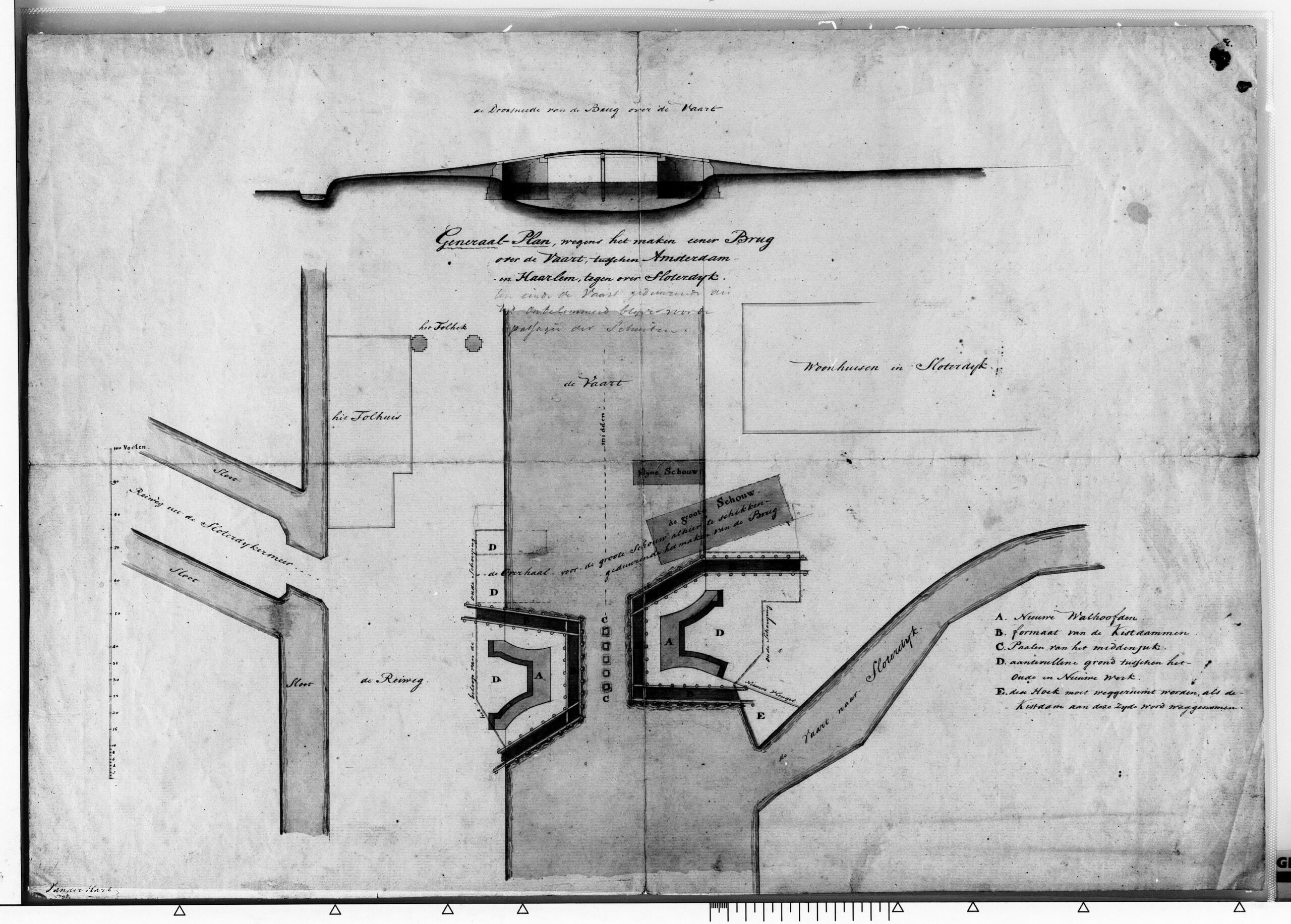
Bridge 33 was not a canal ring bridge. It stood in Amsterdam-West, carrying the former Sloterdijkermeerweg and the Notweg over the Haarlemmervaart to the village street of Sloterdijk, renamed the Velserweg in 1938. A crossing had been there for centuries. A construction drawing of 1792 by the city architect Abraham van der Hart covers its renewal, with the stipulation that traffic across it should not be interrupted while the work went on, and Gerrit Lamberts recorded that 1792 bridge in a drawing.
Kramer’s wooden bridge of 1921
By 1921 the drawbridge of 1893 that had replaced the older fixed bridge was itself worn out. The city wanted another drawbridge, but the price came back at 150,000 guilders. A fixed bridge would cost around 25,000. Money was not the only argument: traffic was shifting from boats to motor vehicles, and a fixed bridge stood up better to lorries that were getting heavier every year.
The replacement was designed by the Dienst der Publieke Werken, where Piet Kramer was responsible for the aesthetic design of bridges, and it came out in full Amsterdam School dress with wooden lanterns on the corners. It was one of the first wooden bridges Kramer built, and it matters more than its obscurity suggests: the heavy timber balustrades and railings he worked out here came back later across a whole family of his bridges in the Amsterdamse Bos. A temporary bridge had to be thrown alongside during construction so that Sloterdijk was not cut off. The bridge was widened in 1936 and strengthened in 1939.
How it disappeared, and what is still there
The Zoutmanbrug was delivered in 1956, carrying the new junction of Molenwerf and Admiraal de Ruijterweg that the building of Station Sloterdijk required, and the deck of bridge 33 was lifted out under the supervision of the same Public Works department. The northern abutment was left standing. Old photographs of the bridge usually have the Coca-Cola factory on the Molenwerf and Velserweg somewhere in the frame; that went too, cleared for the Coentunnelweg.
From 1959, when the Haarlemmerweg and the Coentunnelweg met here as two national roads, the area passed to Rijkswaterstaat, partly because the Haarlemmerweg runs on a dyke body. The Haarlemmerweg was widened again and again, and one of those widenings took the southern abutment. Photographs from 1972 show that a new span had been laid in the meantime, this time in concrete.
So the number did not vanish into an archive. Because Rijkswaterstaat had taken over the management, the new span was given a different number: 172P, where the P marks a structure maintained by a third party. It is more culvert than bridge. It was still there in April 2021, in a deplorable state, fenced off at both ends, and serving no purpose that anyone has been able to name.
Bridge 34 exists, and has its own entry in this series. The gap in the sequence is not in the numbering. It is only in the city.
Featured Image credit