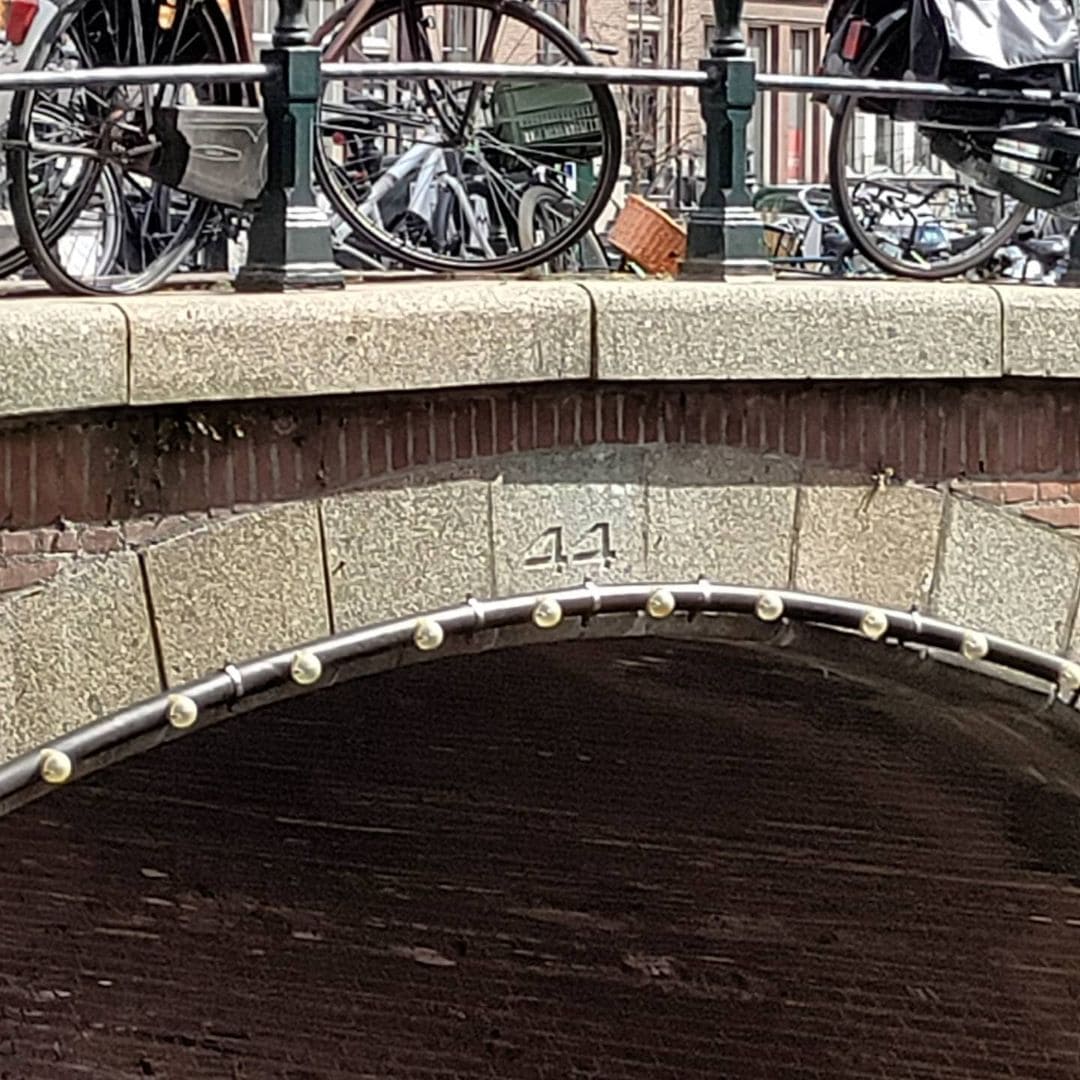
An Arch Bridge on the Southwestern Quay of the Keizersgracht, Spanning the Leidsegracht, with Two Terrace Moorings and a History Written in Bronze
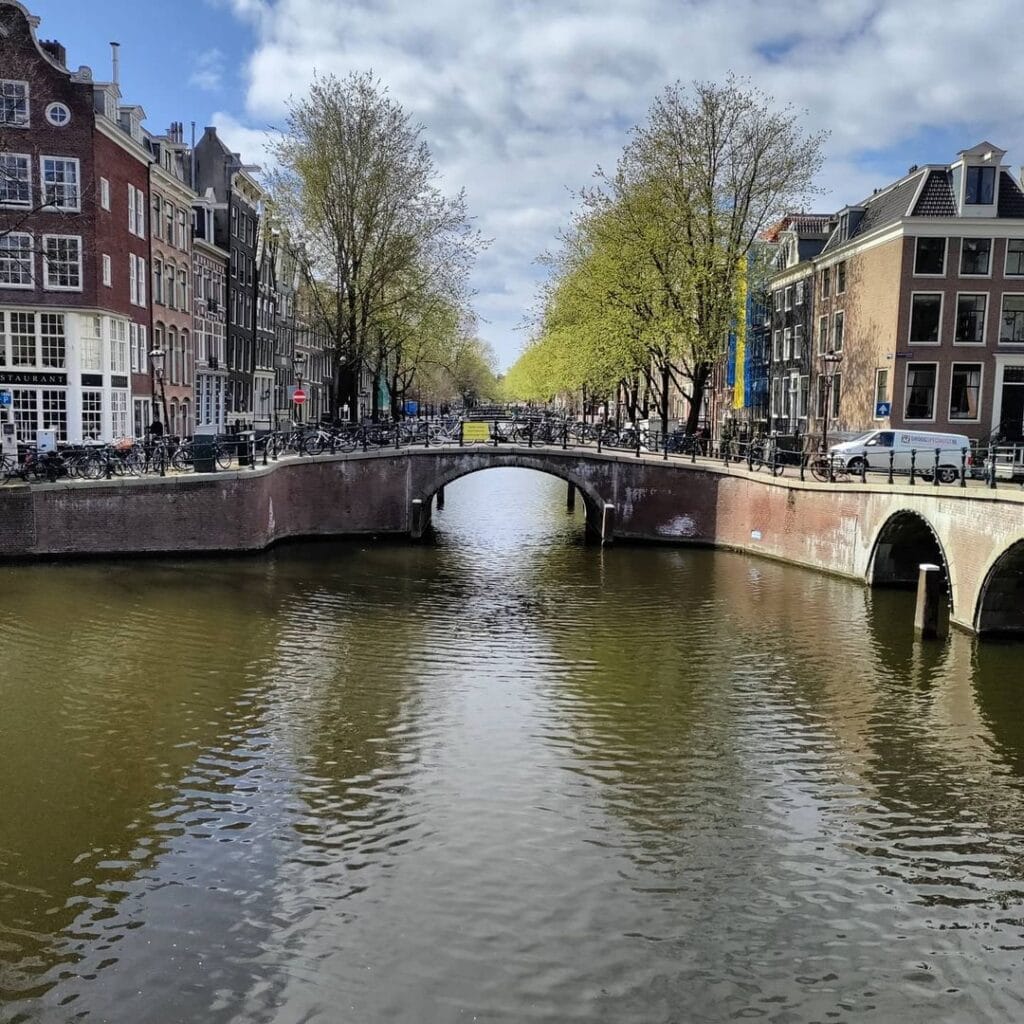
Bridge 44 occupies a precise and beautiful position in the Keizersgracht’s southward run. The bridge is a fixed bridge in Amsterdam-Centrum. The arch bridge is situated in the southwestern quay of the Keizersgracht and spans the Leidsegracht. It arrives at the point where the Keizersgracht crosses the Leidsegracht, the canal that was, until 1658, the southern boundary of the city. Unlike the busy plate bridges of the Vijzelstraat and Leidsestraat sequences, Bridge 44 is a quiet arch crossing, flanked on its western side by two mooring quays that double as canal-side terraces in summer. It carries no official name and, since July 2016, no informal one either. But the name it once carried tells one of the most sonorous stories in this entire series: the name of two brothers from Lorraine who changed the sound of Amsterdam, and of all the cities whose towers ring with carillons tuned by their hands.
Bridge 44 Unnamed. Brug vierenveertig.
This arch bridge is located in the southwest bank of the Keizersgracht. The bridge spans the Leidsegracht. Like many of our previous bridges #brug44 had an unofficial name until the review in 2016. The unofficial name for this bridge was Hemony Bridge after brothers Pieter and François Hemony who in the 17th century had their workshop on the corner of Keizersgracht and Molenpad just around the corner from the bridge. It didn’t make the cut for a name though and remains unnamed.


1. Etymology and Naming: The Hemonybrug, a Name Abolished, and the Brothers Who Cast the Bells of the Westertoren
The bridge had the unofficial designation Hemonybrug, named after the brothers Pieter and François Hemony, who had their workshop on the corner of the Keizersgracht and the Molenpad in the 17th century, just around the corner from the bridge.
The distance between “just around the corner” and a name on a bridge is a question of civic memory, and it is one that Amsterdam’s 2016 naming policy resolved against the Hemonybrug. The bridge does not lie near the Hemonystraat and Hemonylaan, which are situated in Amsterdam-Zuid, in De Pijp, and only received their names at the end of the 19th century. This discrepancy in location from the street and avenue was one of the reasons that the Hemonybrug was raised in 2016 at the college of mayor and aldermen of Amsterdam. During a check on bridge names, it emerged that the name did not meet the guidelines required for inclusion in the Basic Registration of Addresses and Buildings. The bridge appeared on list 2 of two lists of informal bridge names requiring adjustment.
The reason the name fails the registry test is therefore geographical: there is already a Hemonystraat and Hemonylaan in De Pijp, and they refer to the same men. Having a bridge also called Hemonybrug in a different part of the city, at the location where the brothers actually worked, would create navigational confusion in the address database. The municipal logic is defensible. The cultural loss is real.
The Hemony brothers’ story deserves the full telling it has rarely received in the context of Amsterdam’s bridges. François (c. 1609 to 1667) and Pieter Hemony (1619 to 1680) were the greatest carillon bell founders in the history of the Low Countries. They developed the carillon, in collaboration with Jacob van Eyck, into a full-fledged musical instrument by casting the first tuned carillon in 1644. The brothers’ skill was unequalled in their time; after their death, their guarded trade secrets were lost, and not until the 19th century were bells of comparable tuning quality cast.
In 1657, the brothers parted ways. François moved to Amsterdam, at the invitation of the city government, to establish a foundry. He cast twenty carillons as well as statues for various sculptors, such as Artus I Quellinus. Pieter in 1664 rejoined his brother in Amsterdam where, together, they cast some of their finest carillons, including that of the Dom Tower of Utrecht and the Town Hall, now the Royal Palace on Dam Square.
The location of their Amsterdam foundry is confirmed by the Peabody Essex Museum’s documentation of the Westerkerk carillon: the casting company of Hemony was situated within the city borders, at the Molenpad (Mills path, between Prinsengracht and Leidsegracht). From here Hemony cast twenty sets of bells, including several for foreign cities such as Antwerp, Ghent, Mainz, Hamburg, and Stockholm. The Molenpad, where the foundry stood, runs between the Prinsengracht and the Leidsegracht, directly around the corner from Bridge 44 on the Keizersgracht. The carillons of the Westertoren, the Zuiderkerk, the Oude Kerk, and the Town Hall on Dam Square were all cast within earshot of the bridge that once carried the founders’ name.
When you cross Bridge 44 today and hear, as you inevitably will in Amsterdam’s inner city, the sound of a carillon carried across the canal water, you are hearing the tradition that the Hemony brothers perfected from this very neighbourhood.
2. Structural Evolution: Stalpaert’s Plan of 1662, a Collapsed Neighbouring Arch That Changed Everything, and an Arch Restored in the 1970s
There has been a bridge at this location for centuries. City architect Daniël Stalpaert drew the bridge already on his map of 1662, but the surroundings are still indicated as undeveloped. Frederik de Wit’s map of 1688 shows the bridge.
The modern structural history of Bridge 44 is shaped by a single catastrophic event on a neighbouring crossing that had nothing to do with Bridge 44 itself. At the end of the 19th century a simple plate bridge appeared here. This came about because an adjacent arch bridge over the Keizersgracht had collapsed. This fed the fear that other arch bridges would also collapse. Moreover, at that time there was less appreciation for the aesthetic value of the bridge.
This is a remarkable piece of structural contagion history. The collapse of a different bridge, on the same canal, caused a precautionary replacement of a perfectly sound arch bridge at Bridge 44 with a flat plate bridge, purely out of anxiety about what the collapse implied for all similar structures nearby. The fear was that arch bridges as a type were vulnerable, not that Bridge 44 specifically had failed. This kind of reasoning, essentially a precautionary mass replacement programme triggered by a single failure, shaped dozens of canal belt crossings in this period.
The reversal came in the following century. When the bridge became due for major maintenance in the 1970s, the situation had been reversed. An arch bridge was built that is aesthetically better in keeping with its surroundings, and which fits in harmoniously with the existing bridges on the Leidsegracht.
This is the key structural fact about Bridge 44: the arch bridge visible today is not an 18th-century original, nor even a 19th-century survival. It is a 1970s reconstruction, built specifically to restore the aesthetic quality that the late 19th-century plate bridge had removed. The decision to build an arch was a conscious heritage choice, made at a moment when Amsterdam’s attitudes toward its canal belt infrastructure had shifted from a modernising pragmatism toward a preservation consciousness. The bridge itself is not a monument, as it is too young for that, but it is surrounded by rijksmonumenten.
3. Architectural Lineage: A 1970s Arch Built to Match the Leidsegracht, Surrounded by Protected Buildings
No individual architect is confirmed for the current Bridge 44 in any source consulted for this post. It is attributed to the Dienst der Publieke Werken (or its successor body at the time of the 1970s reconstruction) without further specification.
The bridge’s alignment with the existing arch bridges on the Leidsegracht is the defining architectural intention behind its current form. The Leidsegracht, which Bridge 44 spans, is one of Amsterdam’s most harmoniously preserved canals, its entire length lined with protected 17th and 18th-century canal houses and crossed by arch bridges that have survived the 19th-century flattening drive. Building a plate bridge at Bridge 44, where a plate bridge sat from the 1880s to the 1970s, would have created a visual interruption in that sequence. The 1970s decision to build an arch restored the visual continuity that the precautionary late 19th-century replacement had broken.
To the west of the bridge lie two mooring quays and/or terraces. These two small terraces, at the western end of the bridge where the canal opens onto the Leidsegracht, are among the most pleasantly positioned waterside sitting areas in this part of the canal belt. They are used by canal-side cafés and restaurants, and in summer they represent a particularly agreeable version of the Amsterdam canal terrace: close to the water, sheltered by the bridge, and with views in two directions across the Leidsegracht and the Keizersgracht.
4. Urban and Social Context: The Leidsegracht’s Border History, the Van Loon Museum, and a Canal That Survived the Planners
Bridge 44 sits at the intersection of two historically significant waterways. The Keizersgracht, as established throughout this series, is the widest canal in Amsterdam’s inner city, dug from 1615. The Leidsegracht has an older and more politically charged identity.
The Leidsegracht was part of the Expansion of Amsterdam and marked the border between the first and the second phase of the construction of the Grachtengordel. Between 1615 and 1658, the Leidsegracht was the southern boundary of the city. When Bridge 44 was first placed here in the 17th century, it therefore crossed the line between the established city and the territory that was only just being opened up for construction. The Keizersgracht south of this point was still, in the 1660s, freshly dug through recently reclaimed land.
The Leidsegracht at this point is also crossed, a few hundred metres to the south, by the Vier Heemskinderenbrug (Bridge 28), discussed earlier in this series. The two bridges bracket a short stretch of the Leidsegracht that was once the fortified southern edge of the city, with timber stakes and earthen ramparts where canal houses and terraces now stand.
The Museum Van Loon at Keizersgracht 672 is visible from Bridge 44 looking north. Museum Van Loon is a seventeenth-century canal house that has been kept in its original condition and is open to visitors. It is located between Bridges 37 and 39 on the Keizersgracht. The Foam Photography Museum at Keizersgracht 609 is within easy walking distance to the north. The Spiegelkwartier and Bridge 42 (Nieuwe Spiegelstraat crossing) are a short walk south.
5. Technical Specifications
Based on confirmed sources, the following can be stated:
- Bridge type: Fixed arch bridge (vaste welfbrug), 1970s construction in arch form chosen to harmonise with the existing Leidsegracht bridge sequence
- Location: Southwestern quay of the Keizersgracht, spanning the Leidsegracht, Amsterdam-Centrum
- Canals: Keizersgracht (dug from 1615, widest canal in Amsterdam’s inner city at 28.31 metres, UNESCO World Heritage); Leidsegracht (constructed from 1615, southern boundary of Amsterdam until 1658, named after the city of Leiden)
- Cartographic record: Daniël Stalpaert’s city plan, 1662 (planned, surroundings undeveloped); Frederik de Wit’s map, 1688 (completed bridge in developed neighbourhood)
- Late 19th century: Arch bridge replaced with a simple plate bridge following the collapse of a neighbouring arch bridge on the Keizersgracht; precautionary decision based on fear of arch bridge failure generally rather than any specific defect at Bridge 44
- 1970s: Major maintenance; plate bridge replaced with a new arch bridge built to harmonise aesthetically with the Leidsegracht bridge sequence; this is the current structure
- Two mooring quays/terraces: Located west of the bridge on the Leidsegracht, used as canal-side terrace space
- Designer: Dienst der Publieke Werken (or successor body, 1970s reconstruction); no individual architect confirmed
- Amsterdam School attribution: None; the bridge is a 1970s construction
- Monument status: Not a monument (geen monument), the bridge being too recent for listing; surrounded by rijksmonumenten
- Former informal name: Hemonybrug (after François and Pieter Hemony, bell founders, whose foundry at the Molenpad was around the corner from the bridge); abolished July 2016 after the name was found not to meet the guidelines for the Basic Registration of Addresses and Buildings; there is already a Hemonystraat and Hemonylaan in De Pijp, Amsterdam-Zuid
- Current official name: None; designated in the municipal register as Brug 44
Sources Consulted
- Wikipedia (nl), “Brug 44”: nl.wikipedia.org/wiki/Brug_44
- Wikipedia (en), “Pieter and François Hemony”: en.wikipedia.org/wiki/Pieter_and_François_Hemony
- Peabody Essex Museum, “Westerkerk Carillon Sample Library,” James Forrest, 2011 (Hemony foundry location at Molenpad, between Prinsengracht and Leidsegracht): archive.org/details/PeabodyEssexMuseum-WesterkerkCarillonSampleLibrary
- Wikipedia (en), “Leidsegracht”: en.wikipedia.org/wiki/Leidsegracht
- Wikipedia (en), “Keizersgracht”: en.wikipedia.org/wiki/Keizersgracht
- Towerbells.org, “Index: Hemony bell foundry”: www.towerbells.org/data/IXfoundryHemony.html
- Historical marker, “François and Pierre Hemony, Hemonystraat/Hemonylaan, De Pijp,” Geef Straten Een Gezicht: www.hmdb.org/m.asp?m=227335
- Britannica, “François Hémony”: www.britannica.com/biography/Francois-Hemony
- Essential Vermeer, “The Carillon”: www.essentialvermeer.com/music/carillon/carillon_a.html
- Wikipedia (nl), “Keizersgracht (Amsterdam)”: nl.wikipedia.org/wiki/Keizersgracht_(Amsterdam) (noting that the Hemony foundry was at the Molenpad)
- Wikimedia Commons, Category: Brug 44 (Amsterdam): commons.wikimedia.org/wiki/Category:Brug_44_(Amsterdam)
- Frank V. Smit, “Bruggen in Amsterdam,” Matrijs 2008 (cited in Wikipedia nl, “Brug 44”)
Public Domain Images

1. Wikimedia Commons: Category Brug 44 (Amsterdam) contemporary photographs The Wikimedia Commons category for Bridge 44 holds contemporary photographs of the bridge in its current 1970s arch form, showing its position at the junction of the Keizersgracht and Leidsegracht, and the two terrace mooring quays to the west. Available under free licences. URL: https://commons.wikimedia.org/wiki/Category:Brug_44_(Amsterdam) Attribution: “Wikimedia Commons, Category: Brug 44 (Amsterdam). Available under the licences specified on individual file description pages.”

2. Stadsarchief Amsterdam Beeldbank: historical photographs of the Keizersgracht at the Leidsegracht The Stadsarchief Amsterdam Beeldbank holds historical photographs of the Keizersgracht at the Leidsegracht crossing from the late 19th and early 20th centuries, showing the plate bridge that replaced the original arch after the neighbouring collapse, and the pre-1970s state of the crossing. Searchable at archief.amsterdam under “Keizersgracht Leidsegracht brug 44.” URL: https://archief.amsterdam/beeldbank Attribution: “Collectie Stadsarchief Amsterdam. Available for non-commercial use with attribution.”

3. Portrait of François and Pieter Hemony, 19th-century historical illustration, c. 1880, Wikimedia Commons A historical picture from around 1880 showing the brothers François and Pieter Hemony experimenting with bell tuning together with Jacob van Eyck is reproduced in W. Hofdijk, “Lauwerbladen uit Neerlands Gloriekrans I,” The Hague, and is cited in the Essential Vermeer discussion of the carillon. As a 19th-century engraving it is fully in the public domain. Available via Wikimedia Commons under the Pieter and François Hemony article. URL: https://commons.wikimedia.org/wiki/File:Hemonys_en_Van_Eyck.jpg Attribution: “Historical illustration, c. 1880, in W. Hofdijk, Lauwerbladen uit Neerlands Gloriekrans I. Public domain.”

Brug 44 map and location
Bridge 44 is located on the southwest bank of the Keizersgracht. The bridge spans the Leidsegracht and to the west of the bridge along the Leidsegracht are two mooring quays or terraces which are lovely spots for a coffee.
Both #brug45 and #brug46 are also located at this ‘junction’.


Bridge 44 history and information
Again like many of our previous bridges, there has been a bridge here for centuries and it appears on many of the old maps. Many older arched bridges had collapsed in the centre of Amsterdam and so a simple slab bridge was built here at the end of the 19th century. Before the canal ring in Amsterdam became a world heritage site people had less concern for the aesthetic value of the older arched bridges. However, in recent times the municipality has determined that bridges should fit the street scene and so when the bridge was rebuilt in 1978 the arch came back here. At the time it was described as an “architectural lie”, a bridge in the style of the 17th century but with a concrete span and foundation.
Also like many of the bridges in Amsterdam, it had an unofficial name until the review in 2016. This one (Hemonybrug) was named after the Hemony brothers, Pieter and François, who had their workshop on the corner of Keizersgracht and Molenpad which was near the bridge in the 17th century. Confusingly therefore the bridge is not located near either the Hemonystraat (Amsterdam-Zuid) or Hemonylaan (De Pijp). Whilst this isn’t unusual (and we’ve seen this with #lijnbaansbrug #bridge10 and #warmoesbrug #bridge22) this deviating location from street and avenue is one of the reasons that the Hemony Bridge was discussed in 2016 at the Municipal Executive of Amsterdam. During a check of the bridge names, the name did not meet the guidelines that apply to be included in the Key Register of Addresses-Buildings. So officially now unnamed #brug44


Photos from Amsterdam Archive
1,2 & 3 Brug 44
Near bridge 44-45-46 Collection Archives of the Department of Spatial Planning December 1980
4 Keizersgracht 464-472 and the corner of Leidsegracht 29 the rebuilt state in 1936. In the foreground a part of Bridge 45 and behind it Bridge 44. Anonymous Collection Archives of the Bureau Monumentenzorg 1936
5 Keizersgracht 452-462 In the foreground a part of Bridge 44. Anonymous Collection Archives of the Bureau Monumentenzorg 1940 ca.