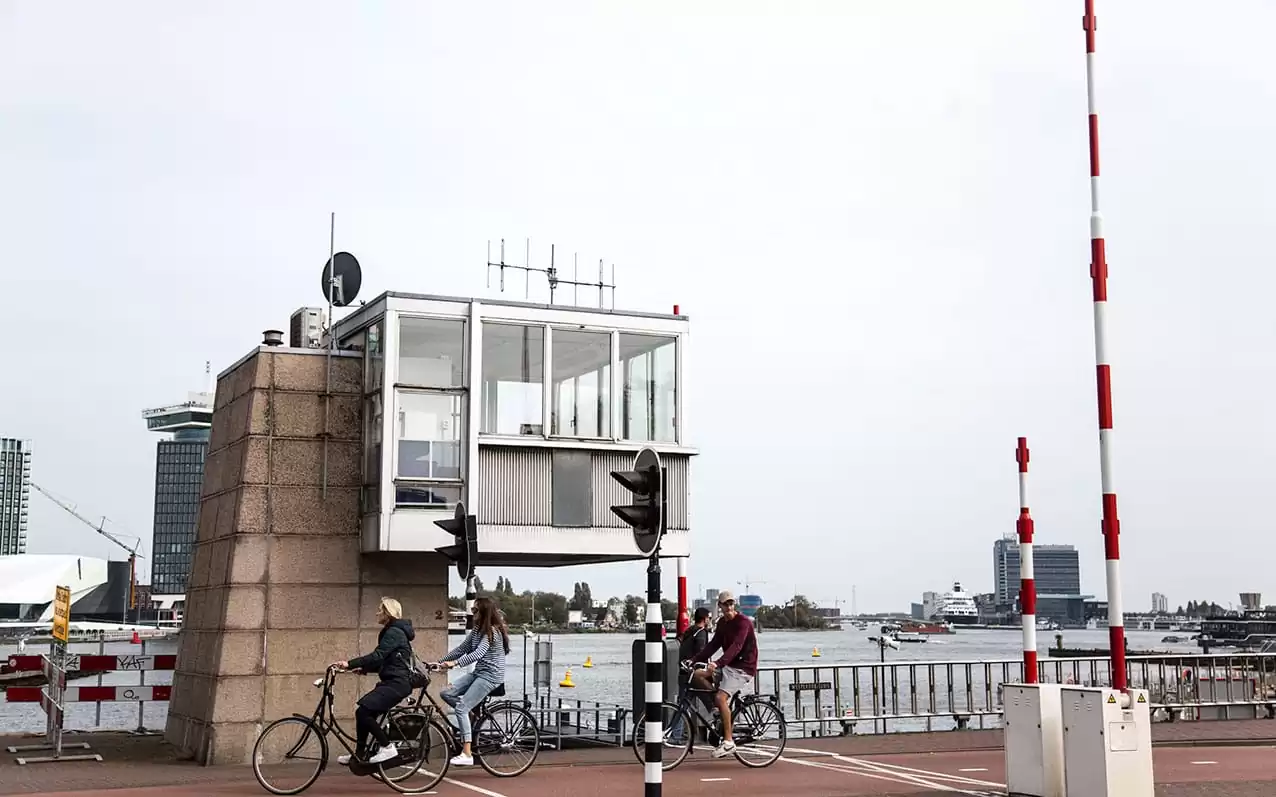
For centuries, the rhythm of Amsterdam was set by the “Brugwachter” (bridge watcher). As boats approached, these guardians of the waterway would spring into action, collecting tolls in a wooden clog dangled from a fishing pole and manually hoisting the massive drawbridges. To shelter these workers, the city commissioned hundreds of tiny, specialized buildings: the Brugwachtershuisjes.
These structures are more than just functional sheds; they are miniature masterpieces that reflect the architectural trends of their time. From the neoclassicism of the 19th century to the whimsical, brick-heavy designs of the Amsterdam School in the early 1900s, these houses were designed to be both visible landmarks and efficient control centers.
A Master’s Touch: Piet Kramer and the Amsterdam School
If you have explored the bridges of the Amsterdam South (Zuid) or West districts, you have likely seen the work of Piet Kramer. Between 1917 and 1952, Kramer designed hundreds of bridges and their accompanying houses. His style, all decorative masonry, wrought iron detail and integrated sculpture, turned simple infrastructure into public art. These houses weren’t just for show; they provided a 360-degree view of the water, allowing the keeper to monitor approaching barges and modernizing traffic.
The Digital Shift and the Birth of “Sweets”
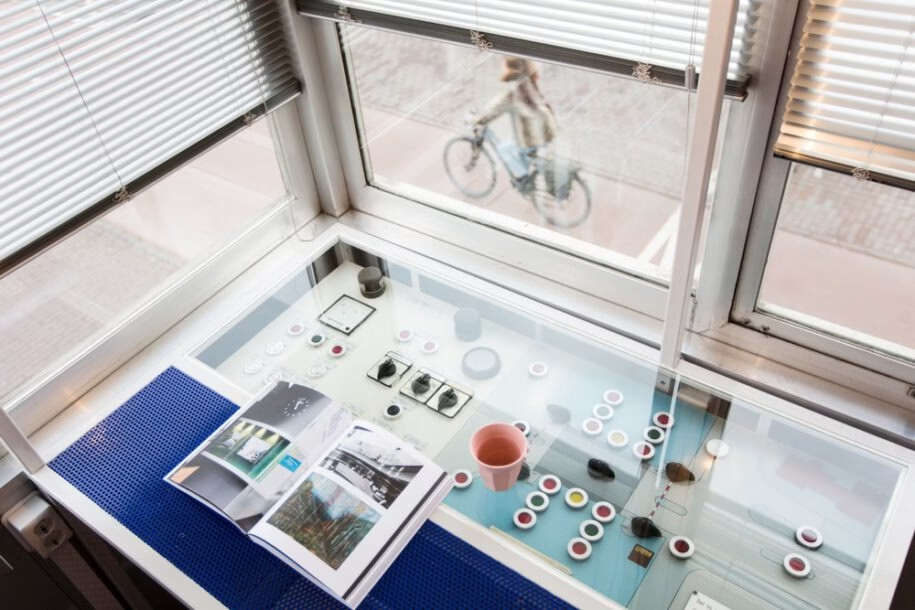
The 21st century brought a silent revolution to Amsterdam’s canals. Today, most of the city’s bridges are operated remotely from a central control room. This technological shift left hundreds of bridge houses empty. Rather than tearing them down, the city embarked on a creative “adaptive reuse” project. Many of these tiny icons have been transformed into Sweets Hotel rooms, allowing travellers to stay in a private, one-room hotel perched directly over the water.
SWEETS hotel now operates in 28 different bridge houses along the canals of Amsterdam.
Although some only have an area of around 10m² and are not designed for people to live in, all the bridge houses function well as hotel suites for 2 people. Due to their former function and location, all 28 bridge houses have amazing panoramic and unique views along the Amsterdam canals.
While the bridge houses were being repurposed, the original identity of the buildings preserved as much as possible. For example, some historical remains came to light during the renovation at the Amstelschutsluis, where the lock itself goes back to 1673 although the little house standing on it today is a twentieth-century replacement. In addition to the preserved ruins, the design team of SWEETS hotel, Space & Matter (De Ceuvel and Schoonschip), balanced 17th century Dutch traditions with contemporary elements and used materials and colours in keeping with the history.
Mapping the History of the Bridge House
While the iconic brick houses we see today are mostly from the 20th century, the concept of a “bridge guard” is ancient. They show on maps between 1673-2009, each designed in the architectural style of its time.
- On the 1599 Pieter Bast map, you can spot small structures near the city gates that served as both toll booths and guard shacks.
- By the 1737 Gerrit de Broen era, these had become more permanent stone fixtures, often located at the entrance to the newly built canal sectors.
These houses, built for bridge keepers or lock keepers, ceased to function in 2012 due to the centralisation of bridge control. The SWEETS hotel concept reinvigorates industrial heritage by transforming 28 bridge houses into standalone hotel suites with unique interiors with an eye on each buildings’ architectural history.

Why They Matter Today
The bridge houses of Amsterdam are a reminder of a time when the city’s movement was a manual, human-scale operation. They represent the transition from a fortified medieval port to a modern, interconnected metropolis. Next time you cross a bridge, look for the tiny building standing guard at the corner; it is a small piece of a much larger story.
A Gallery of Amsterdam’s Most Iconic Bridge Houses
While every bridge has a story, these four examples showcase the evolution of the Brugwachtershuisje from a simple shelter to an architectural landmark.
1. The Sculptural Brickwork: Brug 74 (Piet Kramer)
This house is a definitive example of the Amsterdam School style. Designed by Piet Kramer, the house is integrated into the bridge’s stone abutments. Notice the expressive masonry and the way the windows are angled to give the bridge-watcher a clear view of both the canal and the road traffic.
- See the Full Post: Exploring the Art of Brug 74
2. The Classic “Toll House” Style: The Amstel Lock Houses
Located near the Amstel River, these older, more traditional stone houses represent the 18th and 19th-century approach. They were built for permanence and often housed the families of the lock-keepers. On the 1737 Gerrit de Broen map, you can see the strategic importance of these waterway “checkpoints.”
- Historical Connection: View the 1737 Gerrit de Broen Map

3. The Modernist “Sweets” Transformation: The Amstelschutsluis
Perched in the middle of the Amstel River, this tiny independent house has been famously converted into a luxury one-room hotel. It represents the “adaptive reuse” movement in Amsterdam, where historical infrastructure is preserved by giving it a new, modern purpose.
- Architecture Style: Functionalist, mid-twentieth century, standing on a lock first built in 1673.

4. The “Old Bridge” Lookout: The Sint Antoniesluis House
This house sits at a vital junction between the old city and the 17th-century expansions. It has a rugged, industrial feel compared to the decorative Kramer houses. It is a perfect spot to observe how the city’s water management system evolved from the medieval era shown in the 1544 Cornelis Anthonisz. map.
- Historical Connection: Compare this location to the 1544 Cornelis Anthonisz. Woodcut
Further Reading
As seen in our 1737 Gerrit de Broen map, these guard houses were strategically placed at the city’s toll points.
For more on the architect behind these designs, see our deep dive into Piet Kramer’s Bridges.
This style is perfectly exemplified in Brug 74, where the house and bridge form a single artistic unit.
If you want to stay in one of the Bridge houses then check out sweets hotels.