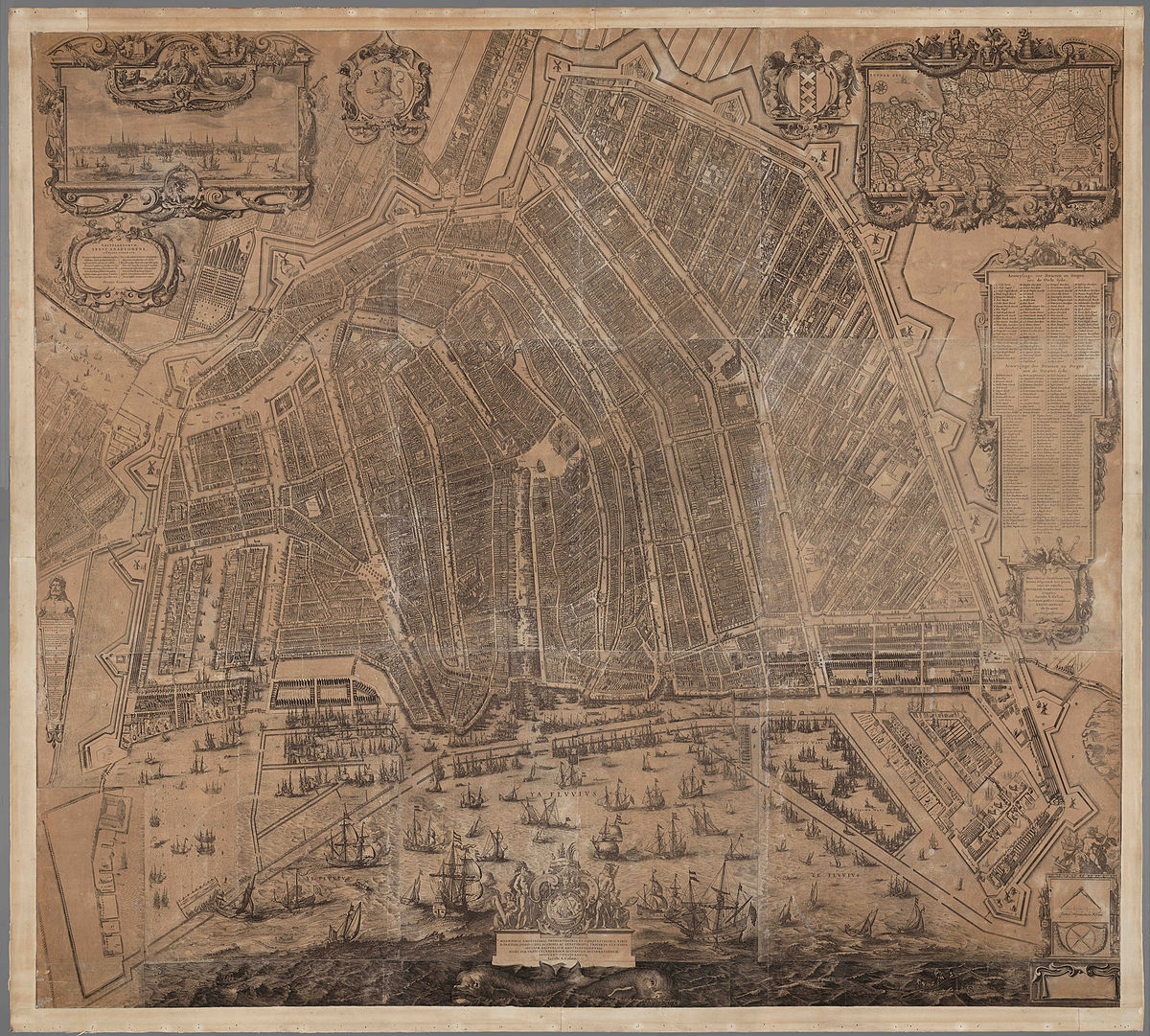
The 1657 map by Balthasar Florisz. van Berckenrode stands as a monumental achievement in 17th-century cartography, representing the most detailed and visually rich “portrait” of Amsterdam ever produced during its Golden Age. While many maps of this era were functional tools for navigation or administrative planning, Van Berckenrode’s work was a high-status art object. Printed from nine separate copperplates, the combined sheets create a massive wall map that allows viewers to zoom in on individual houses, backyard gardens, and the intricate rigging of ships in the IJ harbor.
To truly appreciate the 1657 edition, one must look back at Van Berckenrode’s previous 1625 version. That earlier map was a “work in progress,” capturing the city just as the first phase of the great triple-canal expansion was beginning. In 1625, much of the western canal belt was still a construction site, with the Herengracht, Keizersgracht, and Prinsengracht stopping abruptly at the Leidsegracht. By 1657, however, Van Berckenrode was able to document a city that had successfully integrated these grand waterways into its social and economic fabric. The 1657 map shows a more mature, densely packed metropolis, where the prestigious merchant houses now fully lined the primary canals, reflecting the immense wealth flowing into the city from global trade.
Technically, the 1657 map retains the famous “isometric” or parallel perspective that made the 1625 version so revolutionary. Every building is drawn with three-dimensional depth, but the 1657 edition offers even greater precision in its rendering of the city’s infrastructure. It meticulously depicts the twenty-six defensive bastions, each topped with a windmill, which formed the city’s outer crust. It also captures the Jordaan district in its mid-century state, showing the fascinating contrast between the organic, diagonal street patterns of the working-class quarters and the stately, mathematical curves of the elite canal belt.
Beyond its geographical accuracy, the 1657 map is a masterpiece of engraving. The borders are often adorned with the city’s coat of arms and elaborate cartouches, while the water of the IJ is filled with a “forest of masts,” representing the naval might of the Dutch East India Company (VOC). This map was the ultimate status symbol for an Amsterdam regent or merchant, serving as a proud declaration that their city was not only the most prosperous in the world but also the most beautifully planned. It remains the primary visual source for anyone seeking to understand the architectural grandeur of Amsterdam at its mid-century peak.

Explore the Evolution of Amsterdam
The 17th-century cartography of the Dutch Republic is a testament to the city’s rapid global expansion. This post is part of our comprehensive chronological archive.
- ← Previous Map: 1652 Jan Micker
- Main Collection: Maps of Amsterdam: A Chronological Guide
- Next Map: → 1662 Daniel Stalpaert
This 1657 map by Balthasar Florisz. van Berckenrode of Amsterdam is a key part of our Chronological Guide to the Maps of Amsterdam, which documents the city’s growth from a medieval port to a global capital.
Disclaimer: These works are in the public domain in their country of origin and other countries and areas where the copyright term is the author’s life plus 100 years or fewer.