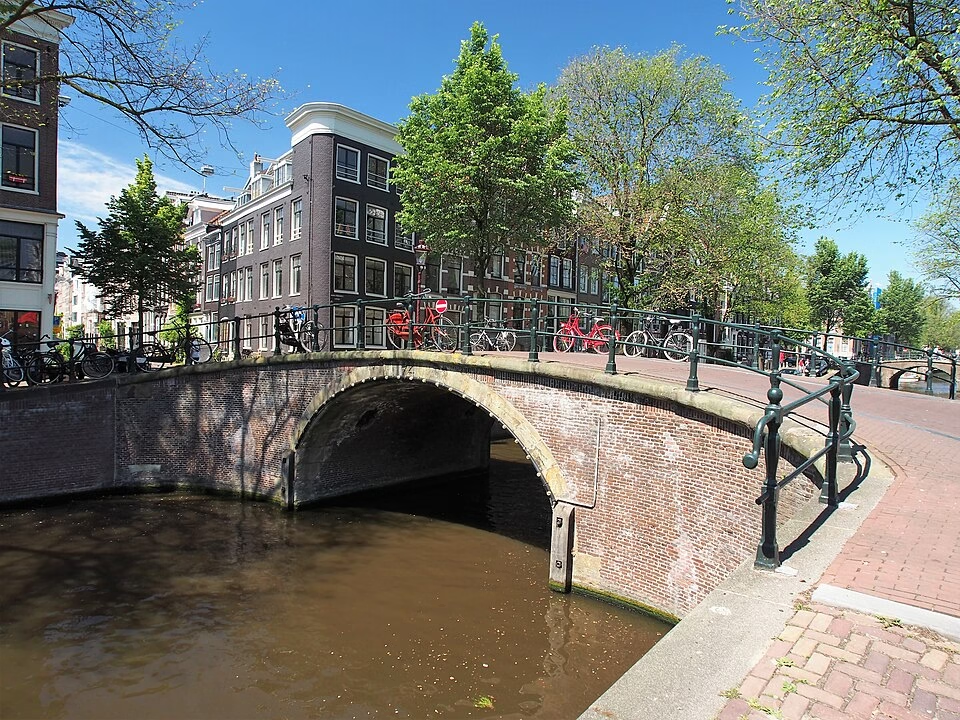
The View Everyone Photographs and Almost Nobody Can Name
Stand on the Herengracht at the corner of the Reguliersgracht, on the odd-numbered side, and look south. Seven stone arches line up one behind the other, each one framing the next, until the last is a small bright ring of light a few hundred metres away.
It is the most photographed sightline in Amsterdam. It appears on postcards, in tour-boat brochures and in roughly half the photographs ever taken of the city at night. Almost nobody who takes it knows that the seven arches have numbers, or that this site has written about six of them individually.
This is the guide to what you are actually looking at.
The Seven Bridges, in Order
Seven bridges cross the Reguliersgracht. Running from north to south, away from you as you look down the canal, they are numbered 31, 39, 40, 74, 73, 72 and 81. The numbering is not sequential along the canal because Amsterdam numbers its bridges by the order they entered the municipal register, not by geography.
- Bridge 31, De Tante Saarbrug carries the Herengracht. Named for a flower seller.
- Bridge 39 carries the Keizersgracht, the northern face of the junction.
- Bridge 40 carries the Keizersgracht on the southern side.
- Bridge 74 carries the Prinsengracht. The bridge that kept its arch when the trams flattened its neighbours.
- Bridge 73 carries the Kerkstraat.
- Bridge 72 carries the Keizersgracht at the southern end.
- Bridge 81 is the seventh and the last in the row. It is the one crossing on this list that this site has not yet covered.
That last line is worth dwelling on. The famous view is made of seven bridges, and the seventh is the first bridge in the numbering block that comes next in this series. It will get its own entry.
Why the Arches Line Up
The effect is not an accident of perspective, and it is not a designed viewpoint either. It is a by-product of how the canal ring was built.
The Reguliersgracht was dug as part of the seventeenth-century canal ring expansion, cutting south across the three main canals rather than running parallel to them. Because the Herengracht, Keizersgracht and Prinsengracht are laid out as concentric arcs at regular intervals, and because the cross-streets between them are also regularly spaced, every crossing over the Reguliersgracht sits at a roughly even distance from the last.
Add to that a municipal habit of building the crossings to a common pattern, brick arches of similar span and similar height, and the result is seven near-identical openings spaced at near-identical intervals. Line your eye up with the canal and they nest inside one another.
It is the same regularity that makes the canal ring legible from the air, seen at eye level and by accident.
The Fifteen Bridges Claim
A second claim attaches itself to the same corner: that from this one spot you can see fifteen bridges, not seven.
The count works like this. Seven arches down the Reguliersgracht, plus the bridges visible left and right along the Herengracht, plus those over the Reguliersgracht behind you to the north. Get the angle exactly right and the arithmetic can be made to reach fifteen.
Whether you can genuinely see all fifteen at once is disputed, and it depends heavily on what counts as seeing a bridge. A sliver of a distant parapet at an oblique angle is not the same as the clean nested arches of the southward view. Our position is that seven is the view worth crossing the city for, and fifteen is a number that circulates because it sounds better.
If you want to test it, go at dusk in winter when the bridge lights are on and the trees are bare. Foliage is what defeats most attempts.
How to See It Properly
- Where: the Herengracht at the Reguliersgracht, on the odd-numbered side of the canal.
- Looking: south, down the Reguliersgracht.
- Best time: after dark, when the arches are lit from beneath and each ring is picked out against the next.
- Best season: late autumn to early spring. Summer leaf cover blocks the further arches.
- From the water: a tour boat entering the Reguliersgracht from the Herengracht passes under all seven in sequence.
The Bridges Around the Junction
One point of confusion is worth clearing up, because it catches people comparing photographs. Bridge 38 sits at the same junction but is not one of the seven. It carries the Herengracht across the Amstelstraat side, and it is the bridge many photographs are actually taken from rather than of.
If you are working through this stretch of the canal ring, the neighbouring entries on Bridge 39 and Bridge 40 cover the two faces of the junction in detail.
Sources Consulted
- Reguliersgracht, Nederlandstalige Wikipedia
- DutchAmsterdam.nl, fact check on the fifteen bridges claim
- UNESCO World Heritage Centre, Seventeenth-Century Canal Ring Area of Amsterdam, reference 1349
- Bruggen van Amsterdam
- Stadsarchief Amsterdam, Beeldbank
- Frank V. Smit, Bruggen in Amsterdam (2008), Uitgeverij Matrijs