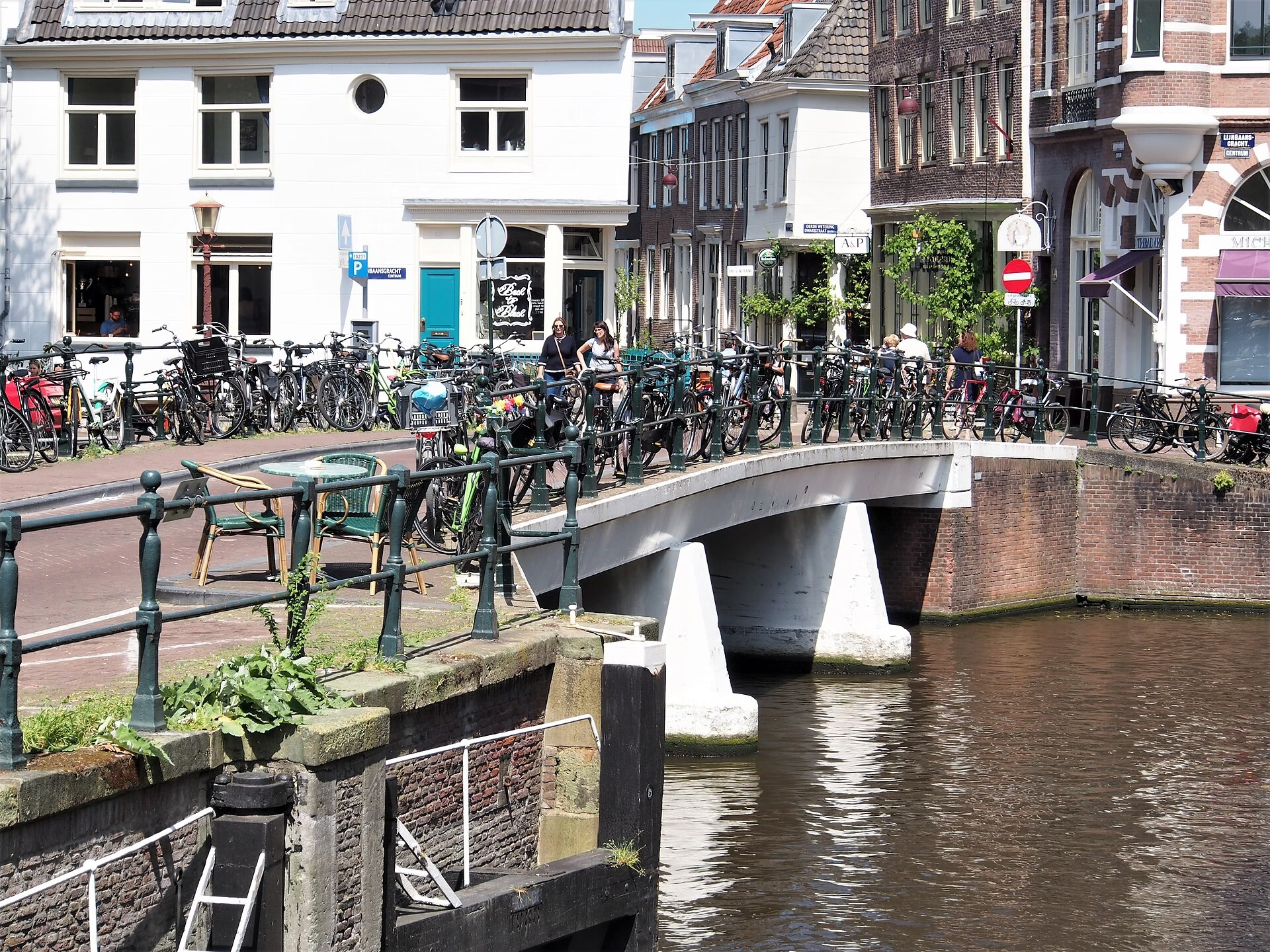
The White Bridge: Brug 89 and the One That Broke the Colour Rule
Amsterdam paints its bridges green. Brug 89 is white, and it is the only thing most people would notice about it.
It carries the Weteringstraat over the Lijnbaansgracht, and the structure standing today went in during 1971 and 1972.
The Colour, and Why It Is Odd
Amsterdam’s bridge ironwork is traditionally a dark green, close to the colour of many of the city’s bollards (amsterdammertje) and railings, and it is applied with enough consistency that it reads as municipal livery rather than decoration. Walk the canal ring and the parapets are green almost without exception.
Brug 89 is painted white, which makes it look less like a canal bridge and more like the bridges of Slotermeer and the other post-war garden suburbs west of the city, where a lighter modern palette was used deliberately to distinguish the new districts from the old.
A white bridge in the seventeenth-century centre is therefore a small piece of 1970s design thinking that escaped its intended neighbourhood. Whether it was a decision or an oversight is not recorded.
Structural Evolution
A bridge has stood here for centuries, appearing on Daniel Stalpaert’s map of 1662 and again on Frederik de Wit’s of 1688.
An 1887 renovation produced an iron beam bridge on wooden supports, the standard Amsterdam solution of the period and the standard Amsterdam weakness: the ironwork lasts, the timber underneath does not.
By the early 1970s it had deteriorated enough to require replacement, and the current bridge was built in 1971 and 1972: concrete pillars, a modern composite beam deck, and traditional iron balusters reused or reproduced on top.
That last detail is the compromise Amsterdam kept reaching in these decades. Modern engineering below the handrail, nineteenth-century vocabulary above it, so that the bridge reads as old from the pavement and performs as new underneath.
Attribution
The bridge was built by the Dienst der Publieke Werken, and the designer is not recorded. Dick Slebos was the department’s bridge architect at the time, which makes him the likeliest candidate but not a documented one.
Slebos designed the Sint Anthoniesluis, Brug 287, in 1968 and 1969, and the same uncertainty attaches to a good deal of Public Works output from this period. The department credited itself rather than its architects, and the individual names have had to be reconstructed afterwards.
Urban Context: The Weteringbuurt
The Weteringstraat is a short street in the Weteringbuurt, the quiet pocket of the canal ring between the Prinsengracht and the Singelgracht that most visitors walk past on the way to the Rijksmuseum.
The bridge’s immediate neighbour is Brug 90, the Weteringpoort, which carries the far busier Weteringschans a short distance away. The two make a useful contrast: one a 6-metre-wide local crossing in a side street, the other a 23-metre traffic bridge on the ring road, built thirteen years apart.
The Attribution Problem in Post-War Public Works
Brug 89 is one of a great many Amsterdam bridges whose designer is genuinely unknown, and the reason is institutional rather than accidental.
The Dienst der Publieke Werken credited itself. Drawings went out under the department’s name, not the architect’s, and for most of the twentieth century that was considered the correct way to do it: infrastructure was municipal work, not authored work. The names that are known, Piet Kramer, Dirk Sterenberg, Dick Slebos, Wichert Arend de Graaf, are known largely because researchers went back through the archives afterwards and matched hands to files.
So a bridge like this one gets a probable attribution rather than a certain one. Slebos was the department’s bridge architect in 1971, the bridge was built by the department in 1971, and that is as far as the evidence goes. It is worth being honest about the gap rather than filling it.
Technical Specifications
- Bridge number: 89
- Name: None, unnamed
- Type: Fixed beam bridge (liggerbrug)
- Carries: Weteringstraat
- Spans: Lijnbaansgracht
- District: Amsterdam-Centrum
- Coordinates: 52.3608 N, 4.8884 E
- Total length: 18.7 m
- Width: 6 m
- Materials: Concrete pillars, composite beam deck, iron balusters
- Colour: White, unusually for an Amsterdam bridge
- Earliest records: Stalpaert 1662, de Wit 1688
- Iron beam bridge: 1887
- Current structure: 1971 to 1972
- Designer: Dienst der Publieke Werken, possibly Dick Slebos
Sources Consulted
- Featured image: Brug 89, Bridge 89, Amsterdam by Alf van Beem, 2017, via Wikimedia Commons, Public domain
- Brug 89, Nederlandstalige Wikipedia
- Lijnbaansgracht, Nederlandstalige Wikipedia
- Slotermeer, Nederlandstalige Wikipedia
- Bruggen van Amsterdam
- Stadsarchief Amsterdam, Beeldbank and Publieke Werken archives
- Frank V. Smit, Bruggen in Amsterdam (2008), Uitgeverij Matrijs