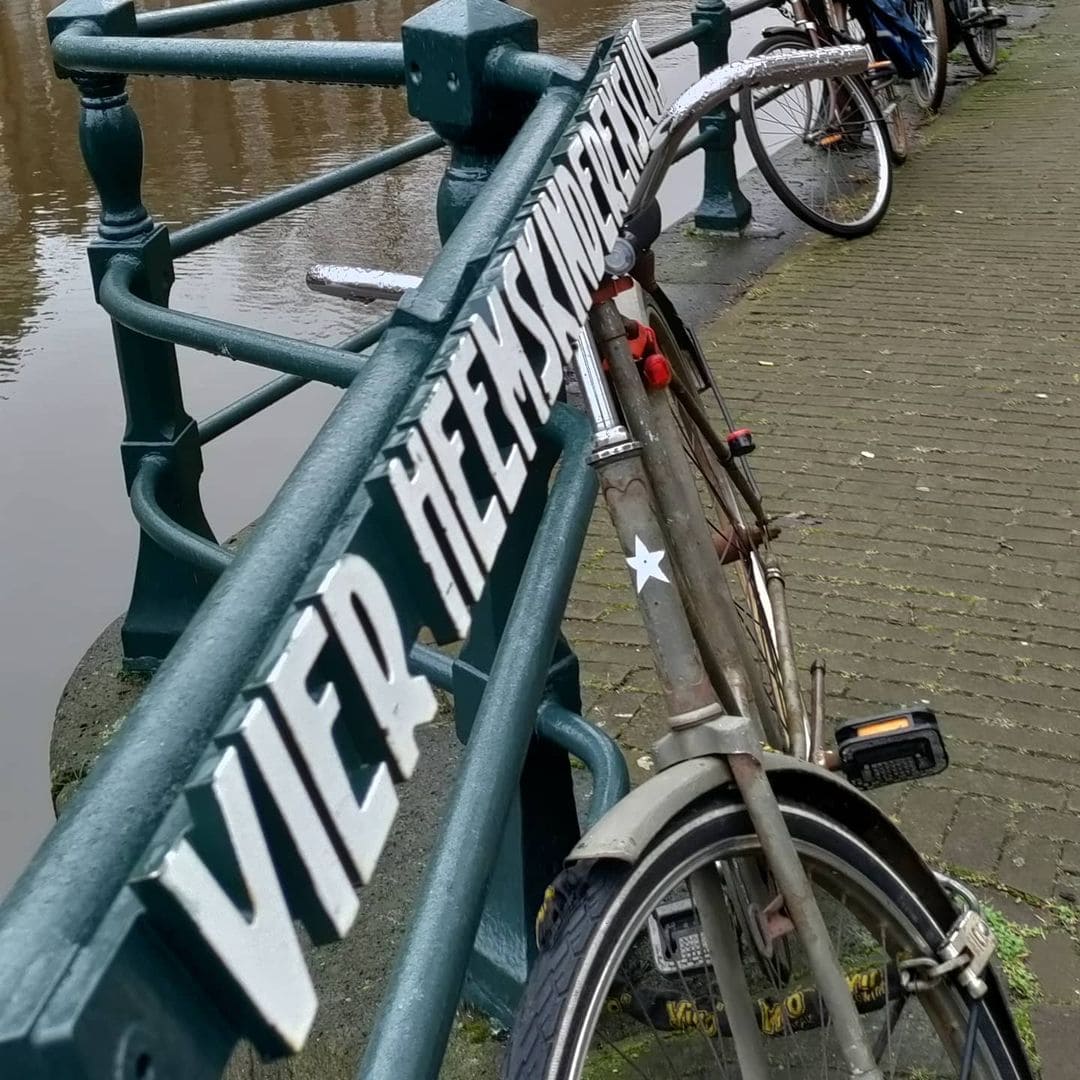
The Four Sons of Aymon Bridge
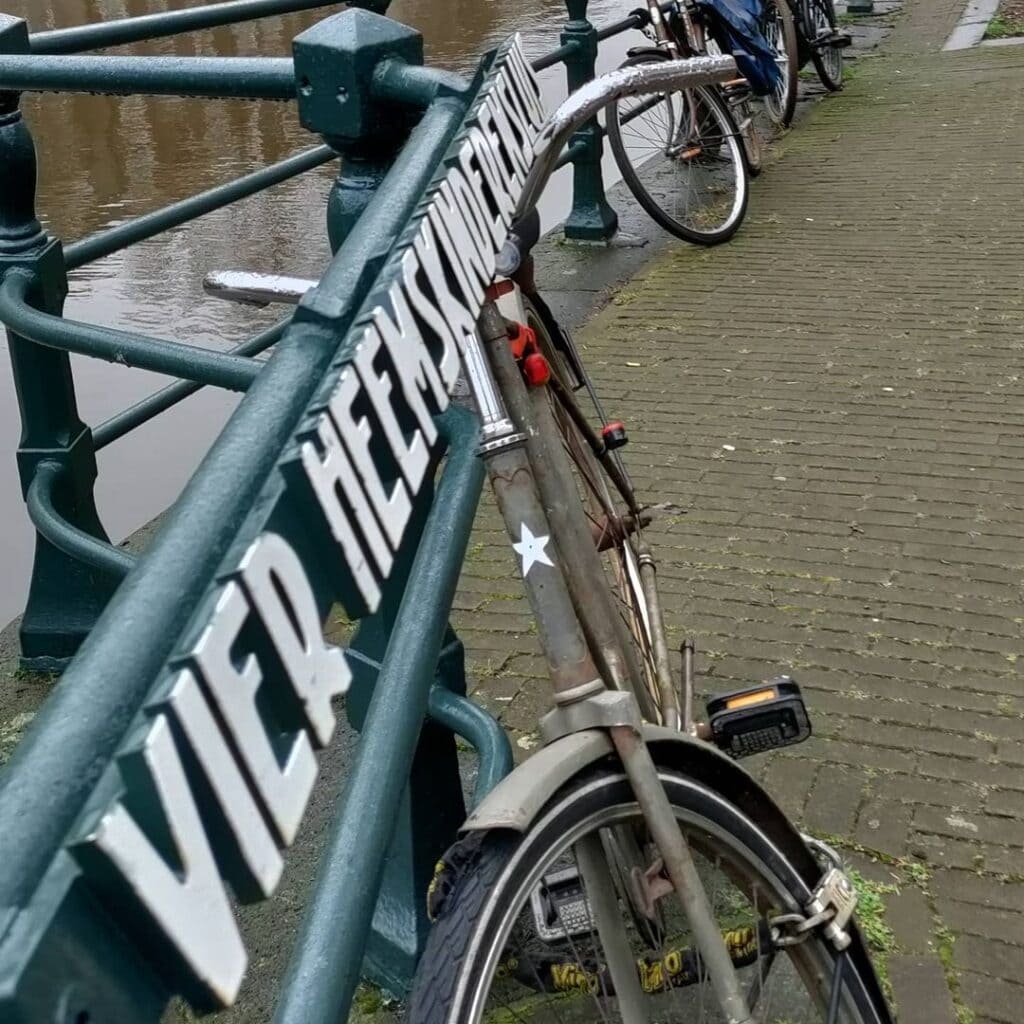
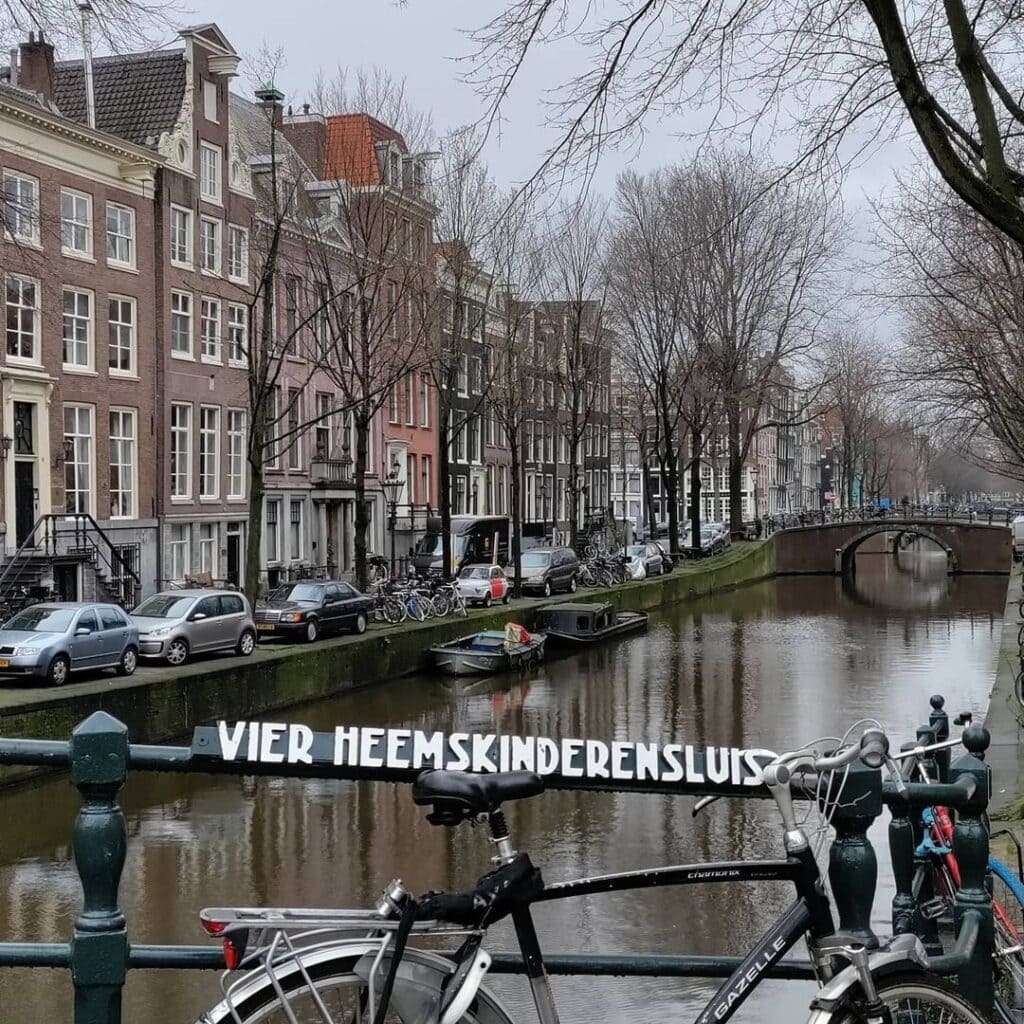
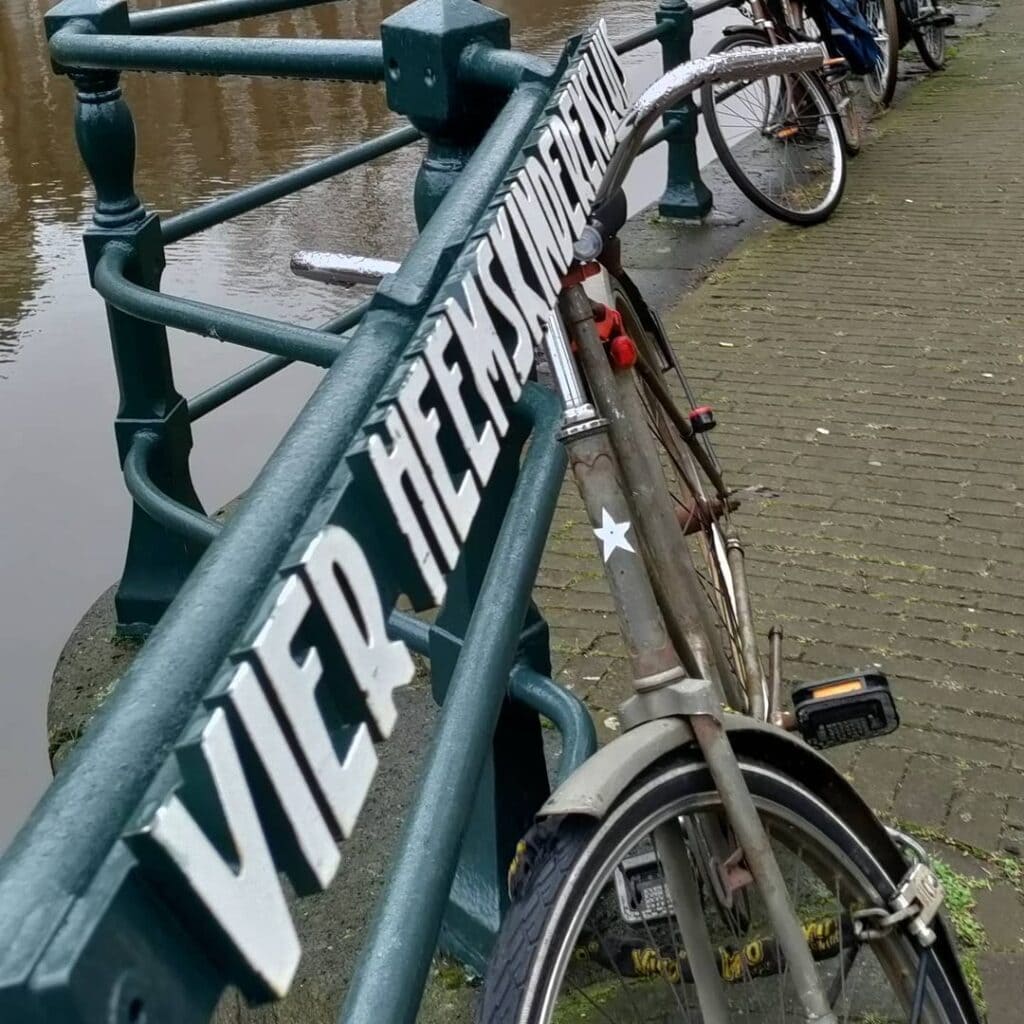
Bridge number 28 (Vier Heemskinderenbrug, also known as the Vier Heemskinderensluis) brug nummer achtentwintig. The Four Sons of Aymon Bridge.
This bridge is named after the gable stone with the Vier Heemskinderen on the corner of the Herengracht and the Leidsegracht.
The Four Sons of Aymon (De Vier Heemskinderen), sometimes also referred to as Renaud de Montauban (Reinout van Montalbaen), after its main character, is a medieval tale spun around the four sons of the Duke Aymon: the knight Renaud de Montauban, his brothers Guichard, Allard and Richardet, their magical horse Bayard, their adventures and revolt against the emperor Charlemagne.
The bridge likely dates from 1722 although was on earlier maps and has been a municipal monument since 1995.
The Vier Heemskinderenbrug, also known as the Vier Heemskinderensluis, is the official name of this architectural wonder. It is the twenty-eighth bridge on the list of the renowned Amsterdam bridges. This bridge is famous in the city for its connection to the legend of the Four Sons of Aymon. The legendary gable stone depicting the Vier Heemskinderen stands tall on the corner of the Herengracht and the Leidsegracht, giving the bridge its name. The Four Sons of Aymon, also known as Renaud de Montauban or Reinout van Montalbaen, is a captivating medieval tale that revolves around the four sons of the Duke Aymon: Renaud de Montauban, Guichard, Allard, and Richardet. These valiant knights, along with their magical horse Bayard, embark on thrilling adventures and stage a revolt against the emperor Charlemagne. The bridge, believed to have been constructed in 1722, is a true testament to the rich history of Amsterdam. It has been marked as a municipal monument since 1995, serving as a reminder of the city’s glorious past.
A Three-Arched Stone Bridge at the Boundary of Amsterdam’s First and Second Expansions
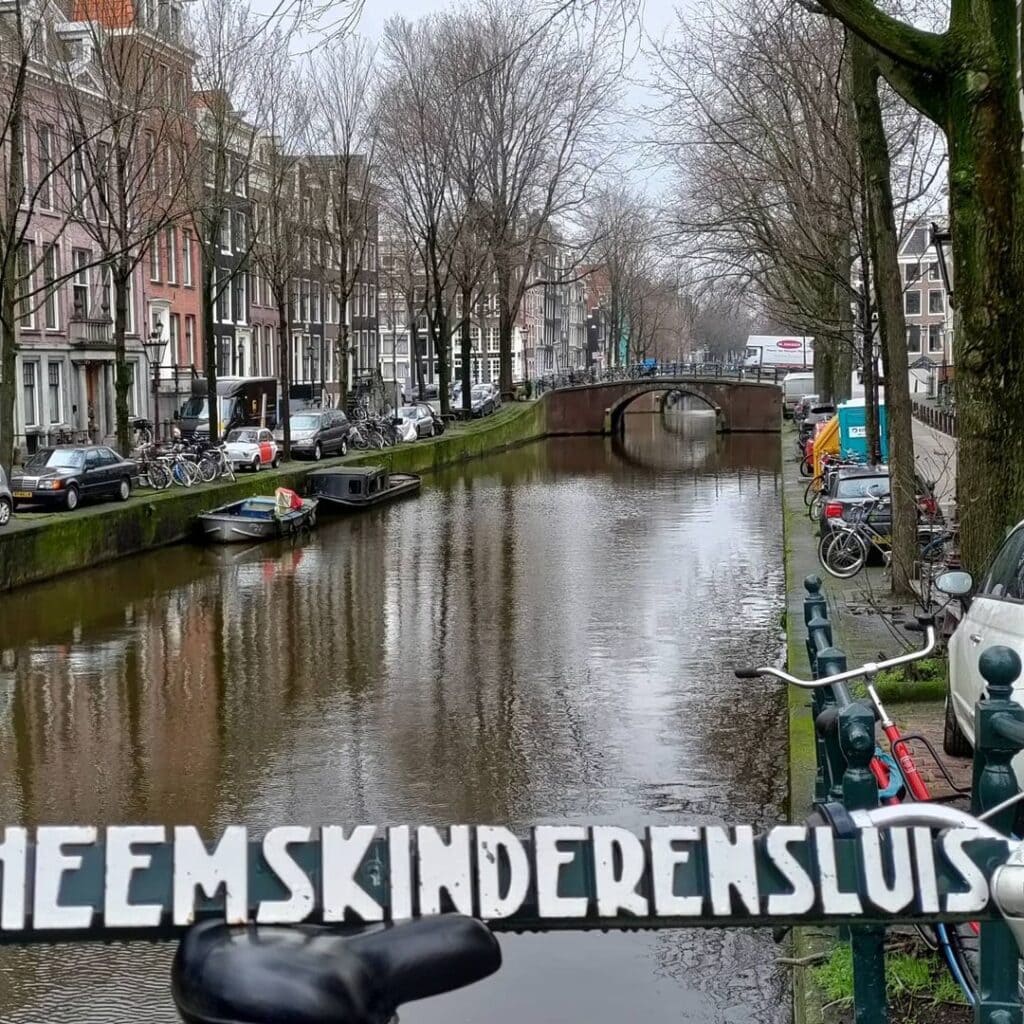
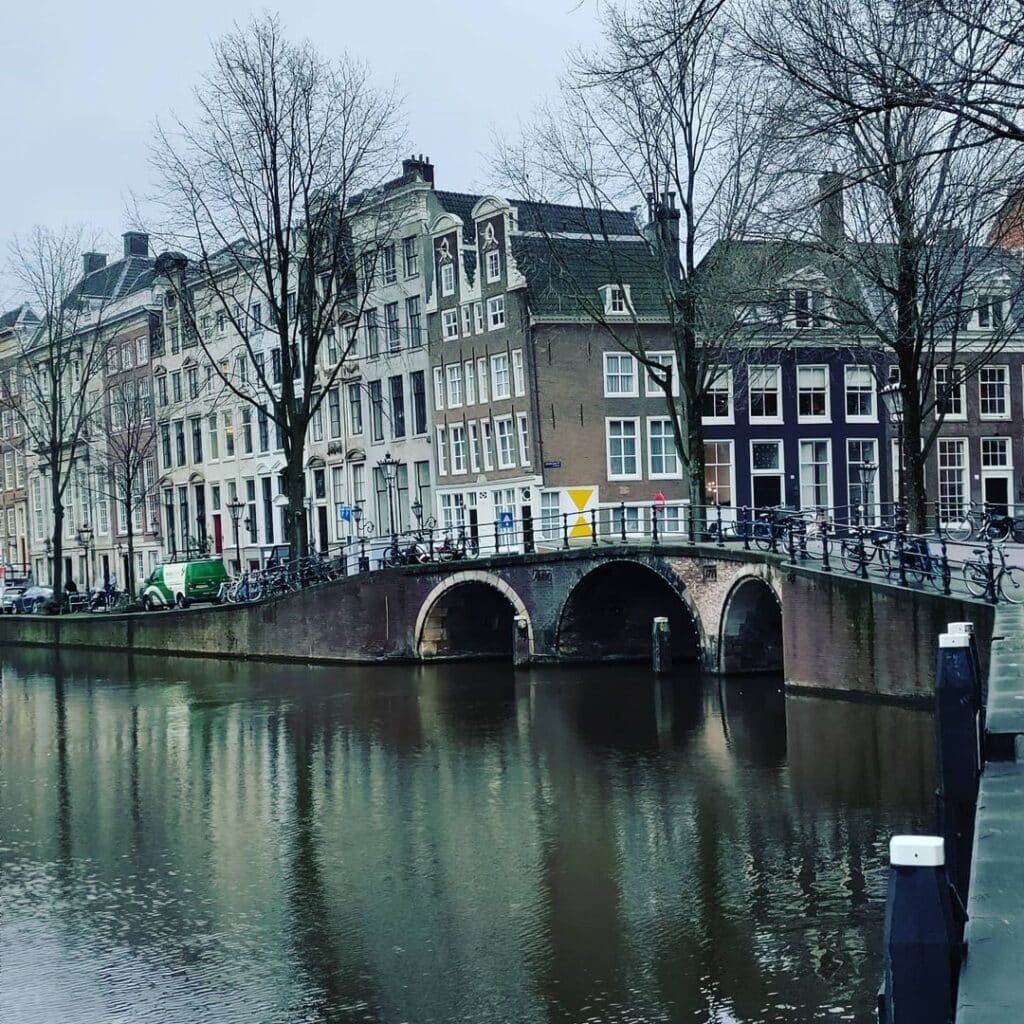
Some bridges span a canal. Bridge 28 spans two eras. The Vier Heemskinderenbrug is a fixed bridge in Amsterdam-Centrum, located on the western quay of the Herengracht, carrying the crossing over the Leidsegracht. It sits precisely at the boundary between the first and second phases of Amsterdam’s great 17th-century expansion: on one side, a city that had been built and inhabited for decades; on the other, land that had only just been reclaimed and laid out when the first bridge was placed here. That boundary has not moved. The bridge has simply sat above it, through three and a half centuries of city life, until it became, somewhat unexpectedly, a filming location for a 21st-century young adult film about love and grief.
1. Etymology and Naming: Knights, a Magic Horse, and a Gable Stone That Names a Bridge
The bridge takes its name from the gable stone with the Vier Heemskinderen on the corner building of the Herengracht and the Leidsegracht. That single gable stone, 45 by 60 centimetres of carved sandstone set into a canal house facade, is the origin of everything: the bridge’s official name, its alter ego as the “Vier Heemskinderensluis,” and its connection to one of the oldest and most widely circulated tales in the Dutch literary tradition.
The building in question is Herengracht 394. The corner plot was purchased by the baker Jan Specht, who commissioned the house to be built “where the Vier Heemskinderen stand in the facade.” The house has almost continuously housed a bakery from its construction until around 1900. The property was built on a triangular footprint, a consequence of it occupying the precise corner where the Herengracht and the Leidsegracht meet at a slight angle, and its tall neck gable of 1671 with sculpted flank pieces and a curved pediment is a fine example of Dutch Classicism at its most assured. The gable stone showing the Vier Heemskinderen, Adelaart, Ritsaart, Writsaart and Reinout, on their magical horse Beyaert, was reproduced as a Dutch postage stamp in 1975. The property has been owned by the Vereniging Hendrick de Keyser since 1918 and was restored in 1920 and again in 1970.
The story that the gable stone illustrates is one of the longest-lived in European popular culture. The Four Sons of Aymon, sometimes referred to as Renaud de Montauban after its main character, is a medieval tale built around the four sons of the Duke Aymon: the knight Renaud de Montauban, his brothers Guichard, Allard and Richardet, their magical horse Bayard, their adventures and their revolt against the emperor Charlemagne. The story was set down in writing in poem form in the 13th century. It survived because it was reprinted around 1490 as a prose novel that remained popular for centuries. The oldest fully preserved Dutch version, “De historie vandē vier Heemskinderē,” was printed in Leiden in 1508. The tale had circulated for three centuries before Jan Specht placed it in stone on the corner of his new canal house, and it has circulated for three and a half centuries more since.
The word “sluis” in the bridge’s alternative name, Vier Heemskinderensluis, carries the same meaning as in the case of Bridge 27: sluis here means stenen brug, a stone bridge, rather than a hydraulic lock.
2. Structural Evolution: From Stalpaert’s Map to an 1870 Photograph, with Repairs in 1910 and 1968
The documentary record for Bridge 28 is unusually rich and extends from the earliest years of the canal ring to the present.
Daniël Stalpaert drew a bridge over the Leydesche graft in the quay of the Heere graft on his map of 1662. Whether the bridge was already physically in place at that time is uncertain, as the area south of the Leidsegracht was then still undeveloped and appears on the map more as a planned idea than a completed reality. When Frederik de Wit produced his map around 1688, the new expansion had been built out and the bridge is clearly shown.
The bridge likely dates from 1722, though it appears on earlier maps. This date most probably refers to a substantial reconstruction or rebuilding of the original structure into the form that has largely persisted since.
The current bridge is a triple-arched structure, and it is already visible in a photograph by Andries Jager taken around 1870. It consists of brickwork, natural stone for the arch and deck elements, and reinforced concrete, with wrought iron balustrades. The three-arched profile is one of the bridge’s most distinctive features, setting it apart from the flatter plate bridges that replaced many Herengracht crossings during the late 19th and early 20th century modernisation drive.
The maintenance record is well documented: in 1910 the bridge was out of service for a time due to repair work, and in the following year traffic here was also disrupted due to further works. In 1968 the bridge was substantially worked on and needed to be reinforced. From 19 February 1968 it was open only to pedestrians and cyclists for three months. Throughout all of this, the bridge retained the same appearance. This is a remarkable point of continuity. The bridge visible today is recognisably the same structure shown in Andries Jager’s 1870 photograph.
A notable feature of the bridge is the transition, or rather the absence of any smooth transition, between the quayside on both banks and the bridge surface itself. The slight step or abrupt join at each abutment is a characteristic that distinguishes this bridge from many of its neighbours and gives it an almost archaic quality, as if the crossing was set into the canal belt rather than built as part of it.
3. Architectural Lineage: A Pre-Amsterdam School Structure in Natural Stone and Wrought Iron
The Vier Heemskinderenbrug is a triple-arched bridge in brickwork and natural stone, with wrought iron balustrades. No individual architect is named in connection with its current form in any source consulted for this post, and the bridge is attributed to the Dienst der Publieke Werken in the municipal records.
The bridge predates the Amsterdam School movement entirely. It was already in its current tripled-arch form by 1870, and both Piet Kramer’s 1917 appointment and Johan van der Mey’s 1911 appointment as aesthetic advisers at Publieke Werken came long after the bridge’s structural identity had been established. There are no Hildo Krop sculptures at the abutments, no custom wrought iron railings of the type Kramer introduced, and no integrated granite nose stones of the Amsterdam School vocabulary. What there is instead is something arguably more interesting: a three-arched stone bridge from the era before those conventions existed, which has persisted unchanged through a century and a half of Amsterdam’s bridge-building history precisely because it was sturdy enough and significant enough never to require replacement.
4. Urban and Social Context: A Boundary Bridge, a Film Bench, and the Leidsegracht’s Historic Role
Bridge 28 occupies a structurally significant position in Amsterdam’s urban geography. The Leidsegracht was part of the Expansion of Amsterdam and marked the border between the first and the second phase of the construction of the Grachtengordel. Between 1615 and 1658, the Leidsegracht was the southern boundary of the city. Leidsegracht was the main route for barges travelling between Amsterdam and Leiden, the city from which the canal takes its name. Bridge 28 therefore crosses not just a canal but a historical boundary, the line between the Amsterdam of the Golden Age’s first generation and the expanded city built on its south side from the 1660s onward.
When the Leidsegracht was constructed in 1615, it formed the southern border of Amsterdam, and on this spot a heavily fortified rampart was built to keep out potential attackers, with a row of high timber stakes ensuring that enemies were kept at bay. The bridge now standing where that fortified boundary once ran gives some sense of how comprehensively Amsterdam’s defensive perimeter was absorbed into the city fabric within a few generations.
The Gouden Bocht, the Golden Bend of the Herengracht, begins just south of Bridge 28. The part between the Leidsegracht and the Binnen Amstel is part of the expansion after 1658 and contains the Gouden Bocht, the most prestigious part of the Herengracht, where many buildings were inhabited by regents, mayors and traders who earned their fortunes in trade with South America or the Dutch East Indies. Crossing Bridge 28 southward is therefore to cross from the first Golden Age into the second, more opulent one.
The bridge has also acquired an entirely unexpected modern dimension. Near this bridge is the bench that featured in the 2014 film “The Fault in Our Stars,” and which has since become a tourist attraction. Located near the intersection of the Herengracht and Leidsegracht, the bench is where Augustus shares his news with Hazel and the couple have an iconic embrace. The exact location of the bench is in front of the addresses Leidsegracht 2 and 4, at the corner where the Herengracht and Leidsegracht meet. The original bench was stolen in 2014, and the municipality of Amsterdam replaced it with a dedicated bench before the film’s Dutch release on 10 July 2014. The replacement bench, now covered in declarations of affection and carved initials, draws visitors from around the world who may never have heard of the Vier Heemskinderen but who make their way to this canal junction regardless.
5. Technical Specifications
Based on confirmed sources, the following can be stated:
- Bridge type: Fixed triple-arched bridge (drievoudige boogbrug)
- Location: Western quay of the Herengracht, spanning the Leidsegracht, Amsterdam-Centrum
- Canal crossed: Leidsegracht (constructed from 1615, southern boundary of Amsterdam until 1658, named after the city of Leiden)
- Materials: Brickwork, natural stone (arches and deck), reinforced concrete, wrought iron balustrades
- First cartographic appearance: Daniël Stalpaert’s city map of 1662 (as a planned or newly built structure); Frederik de Wit’s map of around 1688 (as a completed crossing in an inhabited neighbourhood)
- Probable construction date of current form: 1722, though the structure is already identifiable in a photograph by Andries Jager taken around 1870
- Repair history: Out of service for works in 1910 and 1911; major structural reinforcement in 1968 (pedestrians and cyclists only for three months from 19 February); appearance unchanged throughout
- Designer: Dienst der Publieke Werken; no individual architect confirmed
- Amsterdam School attribution: None; predates both Kramer’s 1917 appointment and van der Mey’s 1911 appointment
- Monument status: Gemeentelijk monument (municipal monument) since 1995
- Coordinates: 52°22’3.02″N, 4°53’11.61″E (Wikidata Q35200839)
- Notable feature: The adjacent canal bench from the 2014 film “The Fault in Our Stars,” installed permanently by the municipality of Amsterdam at Leidsegracht 2 to 4
Sources Consulted
- Bruggenvanamsterdam.nl, bridge register entry for Brug 28: www.bruggenvanamsterdam.nl/herengracht_hoek_leidsegracht.htm
- Bridges.cramberts.com, “Vier Heemskinderenbrug, Bridge 28, Amsterdam”: bridges.cramberts.com/2022/04/03/vier-heemskinderenbrug-bridge-28-amsterdam/
- Bridges.cramberts.com, “Vier Heemskinderenbrug, Bridge 28, Map and location”: bridges.cramberts.com/2022/04/03/vier-heemskinderenbrug-bridge-28-map-and-location/
- Wikipedia (nl), “Vier Heemskinderenbrug” (via Wikiwand): wikiwand.com/nl/Vier_Heemskinderenbrug
- Wikipedia (nl), “Vier Heemskinderen”: nl.wikipedia.org/wiki/Vier_Heemskinderen
- Wikipedia (en), “Leidsegracht”: en.wikipedia.org/wiki/Leidsegracht
- Wikipedia (en), “Herengracht”: en.wikipedia.org/wiki/Herengracht
- Wikidata, “Vier Heemskinderenbrug” (Q35200839): wikidata.org/wiki/Q35200839
- Gevelstenenvanamsterdam.nl, “Herengracht 394, De Vier Heemskinderen”: gevelstenenvanamsterdam.nl/herengracht-394-amsterdam-heemskinderen/
- Hendrickdekeyser.nl, “Herengracht 394”: hendrickdekeyser.nl/de-huizen/herengracht-394
- Amsterdam-monumentenstad.nl, “Herengracht 394” (Rijksmonument nr. 1832): amsterdam-monumentenstad.nl/database/grachtenboek_objecten.php?id=1710
- Amsterdamsegrachtenhuizen.info, “Herengracht 394 Vier Heemskinderen”: amsterdamsegrachtenhuizen.info
- NL Times, “Amsterdam okays ‘Fault in Our Stars’ bench,” July 2014: nltimes.nl/2014/07/01/adam-oks-fault-stars-bench
- Travelersmagazine.nl, “Exact location of bench in Amsterdam ‘The Fault in Our Stars’”: travelersmagazine.nl/exact-location-bench-amsterdam-fault-stars/
- Sceen-it.com, “The Fault in Our Stars, Leidsegracht 4 bench”: sceen-it.com/sceen/1070/The-Fault-in-Our-Stars/Leidsegracht-4-bench
- Wikimedia Commons, Category: Brug 28, Vier Heemskinderenbrug: commons.wikimedia.org/wiki/Category:Brug_28,_Vier_Heemskinderenbrug
- Stadsarchief Amsterdam Beeldbank, Afb 010018000229 and Afb 012000006522: archief.amsterdam
Public Domain Images

1. “Overzicht bij uitmonding van de Leidsegracht (nr.) Amsterdam,” Rijksdienst voor het Cultureel Erfgoed (RCE) This photograph shows the Vier Heemskinderenbrug in its full setting at the junction of the Herengracht and Leidsegracht. It is held in the Wikimedia Commons category for the bridge and is freely available for use under a public domain or open licence through the RCE. URL: https://commons.wikimedia.org/wiki/Category:Brug_28,_Vier_Heemskinderenbrug Attribution: “Rijksdienst voor het Cultureel Erfgoed (RCE), Amsterdam. Public domain.”

2. “Stadsarchief Amsterdam, Afb 010018000229,” showing the Vier Heemskinderenbrug from the Herengracht A historical photograph from the Stadsarchief Amsterdam, held in the Wikimedia Commons category for the bridge as “Stadsarchief Amsterdam, Afb 010018000229.jpg.” Available for non-commercial use with attribution. URL: https://commons.wikimedia.org/wiki/File:Stadsarchief_Amsterdam,_Afb_010018000229.jpg Attribution: “Collectie Stadsarchief Amsterdam, Afb 010018000229.”

3. Gevelsteen “De Vier Heemskinderen,” Herengracht 394, drawing from Caspar Philips Jacobszoon, “Grachtenboek,” 1768 The Grachtenboek drawings by Caspar Philips Jacobszoon, produced in 1768, show the facades of Herengracht canal houses including Herengracht 394 with the Vier Heemskinderen gable stone clearly visible. These drawings are held in the Stadsarchief Amsterdam and are fully in the public domain as 18th-century works. The relevant drawing is referenced in the Amsterdam Monumentenstad database entry for the property. URL: https://archief.amsterdam/beeldbank/detail/98d3093c-daa6-6585-dd76-20032afeca41 Attribution: “Caspar Philips Jacobszoon, Grachtenboek, 1768. Collectie Stadsarchief Amsterdam. Public domain.”
Vier Heemskinderenbrug Location
It is located on the western quay of the Herengracht and leads over the Leidsegracht. One of the nearby monuments Herengracht 394 has a gable stone under the middle window on the first floor with the Vier Heemskinderen on horseback, the namesake of this bridge. There has been a bridge here for centuries. Daniël Stalpaert drew a bridge over the Leydesche graft in the quay of the Heere graft on his map of 1662. The question is whether the bridge was already there at that time as the area south of the Leidsegracht was still then undeveloped. The bridge on the western quay of the Herengracht, leading over the Leidsegracht, is an impressive structure. It is a historic landmark that has stood the test of time. One cannot help but admire the gable stone under the middle window on the first floor of Herengracht 394. This piece of art depicts the Vier Heemskinderen on horseback, and it is this depiction that gives the bridge its name. For as long as anyone can remember, there has always been a bridge in this spot. In fact, even in the 17th century, the renowned cartographer Daniël Stalpaert included a bridge over the Leydesche graft in his map of 1662. However, there is some speculation as to whether the bridge existed prior to that time, considering the undeveloped nature of the area south of the Leidsegracht. Regardless, the bridge remains a symbol of the rich history and architectural beauty of this neighborhood.


Vier Heemskinderenbrug some history
There has been a bridge here for centuries. Daniël Stalpaert drew on his map of 1662 a bridge over the Leydesche graft in the quay of the Heere graft. The question is whether the bridge was already there at that time, the area south of the Leidsegracht was still undeveloped at the time and is more on the map as an idea than actually filled in. See Image 1. The bridge itself though has two cornerstones with “Anno” and “1722” on them which suggests the current bridge actually dates from 1722 and not 1662.
One of those monuments closeby Herengracht 394 has a gable stone under the middle window on the first floor with the Vier Heemskinderen on horseback, the namesake of this bridge. See Image 2.
One thing worth mentioning is that the historical presence of this bridge, as depicted on Daniël Stalpaert’s 1662 map, reveals the significance of this architectural landmark. During that period, the development of the Leidsegracht area was still in progress, and the presence of the bridge on the map reflected more of an anticipated concept rather than an actual structure. However, it is noteworthy that the current bridge, with its distinctive cornerstones marked “Anno” and “1722,” suggests that the bridge was constructed in 1722 rather than in 1662. It is fascinating to observe how this bridge’s historical context intertwines with the neighboring monument, located at Herengracht 394, which features a gable stone portraying the equestrian figures of the Vier Heemskinderen, after whom the bridge is named. These remarkable historical elements contribute to the rich heritage of this prominent location.


Image 1 The bridge on the map of Stalpaert from 1662 on the border between red and white
Image 2 Vier Heemskinderen on horseback at herengracht 394
