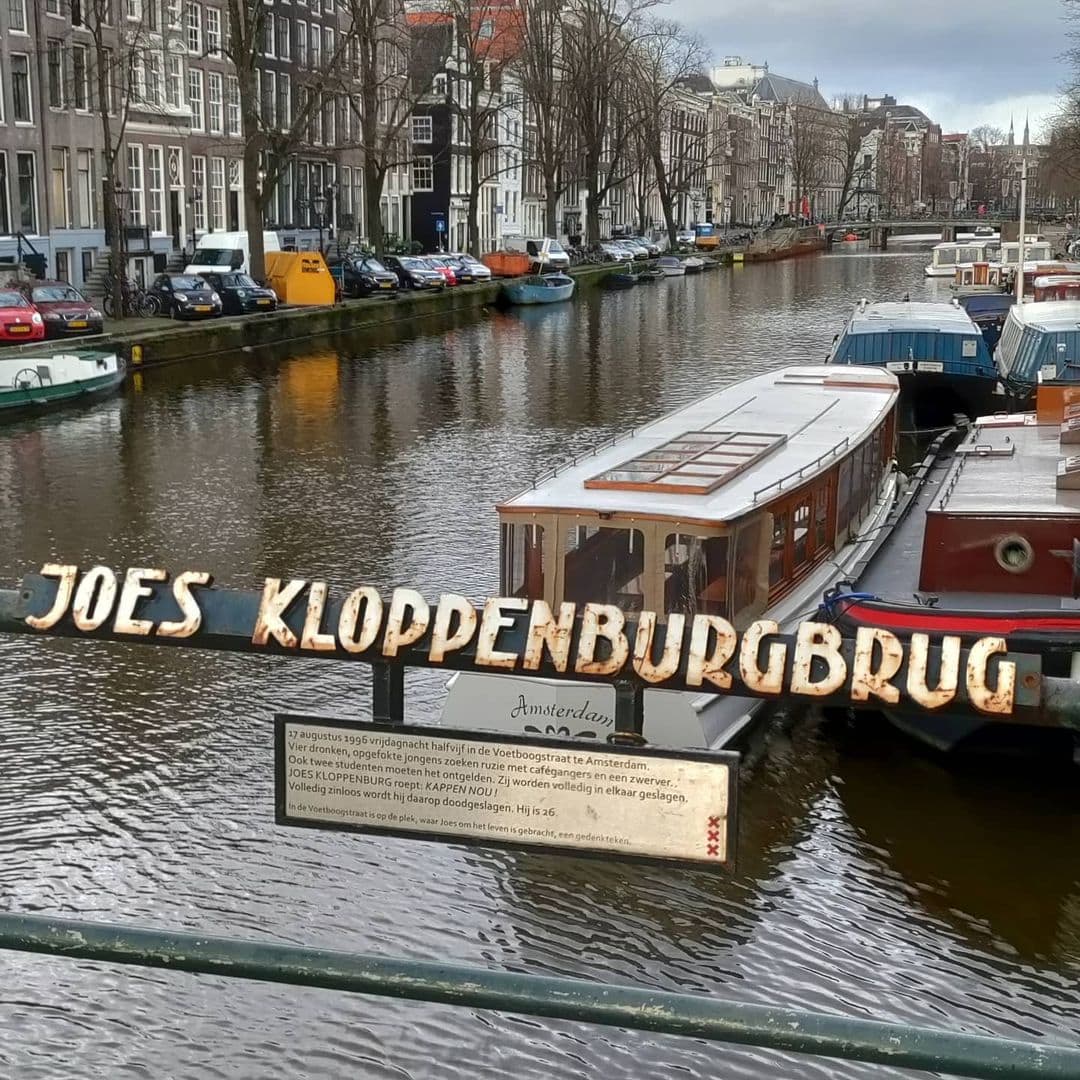
Bridge Number 5, also known as Joes Kloppenburgbrug, is a notable plate bridge located in Amsterdam Center, Netherlands. It serves as a vital connection between Raamsteeg and Oude Spiegelstraat, spanning over the iconic Singel canal. The bridge’s historical and cultural significance has been officially recognized, as it was designated a municipal monument on October 10, 1995.
Originally, the bridge was nameless, but informally referred to as the “Raambrug” due to its proximity to Raamsteeg. Additionally, it was also known as the “Appelmarktbrug” or “Appelmarktsluis,” inspired by the nearby apple market that was once held in the vicinity.
However, on July 5, 2016, the bridge was officially named after Joes Kloppenburg, a young man whose life was tragically cut short on August 17, 1996, as a victim of senseless violence in Voetboogstraat, which is not far from the bridge’s location. The decision to name the bridge after Joes Kloppenburg was made as a poignant symbol against senseless violence, aiming to raise awareness and promote a safer and more compassionate community.
After the official naming, the nameplate commemorating Joes Kloppenburg was affixed to the bridge on September 26, 2017. This act further solidified the bridge’s significance as a reminder of the importance of addressing and preventing senseless violence in society.
Joes Kloppenburgbrug now stands not only as a practical infrastructure element connecting two streets over the Singel canal but also as a symbolic tribute to a life lost too soon. It serves as a poignant reminder to visitors and locals alike of the impact that senseless violence can have on individuals and communities. The bridge’s story is one that encourages empathy, compassion, and the continuous pursuit of creating a safer and more harmonious environment for everyone.
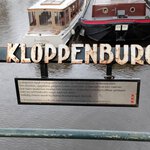
A Bridge With a Name That Means Something
Most of Amsterdam’s 1,200 or so bridges carry names that point backward in time: to a trade, a gate, a building long demolished, a corner house whose occupant no one remembers. A few carry the names of architects or engineers. Bridge Number 5, the Joes Kloppenburgbrug, is different. Its name points to a specific moment on a specific night, to a person who chose to act when others might not have, and to the cost of that choice. It is, in this sense, one of the most purposeful bridge names in the city.
To stand on this modest fixed crossing over the Singel, with the spire of De Krijtberg visible to the south and the entrance to the Gasthuismolensteeg just steps away to the west, is to stand at the edge of one of Amsterdam’s most-visited and most-photographed districts. The bridge connects the northern tip of the Negen Straatjes (Nine Streets) to the Singel’s eastern bank, and on any given afternoon it carries a steady stream of cyclists, tourists, shoppers, and students. It does not announce its significance. The plaque on its parapet does that for it.
A Friday Night in the Voetboogstraat: 17 August 1996
What happened in the Voetboogstraat on 17 August 1996 entered Dutch public memory not simply as a crime, but as a kind of parable about public space and civic courage. The street is short and unremarkable: it runs between the Spui and the Nes, a few minutes’ walk from the Singel and the bridge that would, two decades later, bear the name of a man who died there.
That Friday night, four drunk and agitated young men came looking for trouble. They moved through the street attacking people more or less at random: café-goers eating chips outside, a homeless person, anyone who happened to be in their way. The violence was arbitrary, impulsive, and severe. Among those they assaulted was a student, a young father named Yiannis Zafiris.
Joes Kloppenburg was 26 years old and had just come out of the café De Schutter when he saw what was happening further down the alley. He did not look away. He shouted “Kappen nou!” (“Stop it now!”) at the group of men. It was a direct, unambiguous intervention, of the kind that takes a moment of courage most bystanders in such situations do not find. The men turned on him. Joes was beaten severely. He was taken to an Amsterdam hospital, where he died a few hours later.
Yiannis Zafiris survived the night. He survived, according to those who knew what had happened, because Joes Kloppenburg had intervened.
The perpetrator, a combat sports athlete named Joelan Ritchard L., was sentenced to eight years in prison. His brother, who had also fought, was convicted alongside him. The case drew national attention in a way that few individual crimes of the period had managed. It became one of the first cases to be widely discussed under the term zinloos geweld, meaning “senseless violence”: a phrase that, in the Netherlands of the mid-1990s, was beginning to acquire the weight of a social movement and a political challenge.
The Movement That Followed: “Kappen Nou!” and “HELP”
The death of Joes Kloppenburg did not remain a private grief. In the year following his death, a memorial monument was unveiled in the Voetboogstraat at the location where the attack had taken place. The word “HELP” appeared above it in large, illuminated letters: the final cry attributed to Joes in his last moments, transformed into a permanent civic statement.
That word, “HELP,” carries more than one meaning in this context. It is a witness statement and a memorial. It is also, in the tradition of Dutch directness, a piece of social instruction: if you see someone in need, help them. If you see violence happening, call for help. The illuminated letters asked passers-by a question that most cities prefer not to ask aloud.
Joes’s father, who became one of the most persistent voices in the Dutch public conversation about street violence, founded the “Kappen Nou!” foundation (“Stop It Now!”). The foundation took the phrase his son had shouted in the Voetboogstraat and made it the name of an ongoing campaign. In 2009, the foundation produced the film En jij…? (“And you…?”), a documentary account of Joes’s death and its aftermath, shown in schools across the Netherlands. That same evening, Joes’s father was appointed a Knight in the Order of Orange-Nassau, a royal distinction for his two decades of public work on the issue of senseless violence.
In 2021, on the twenty-fifth anniversary of Joes’s death, his father was still speaking publicly about the case, telling interviewers that it was “sad that senseless violence still exists” and that the work of the foundation remained as necessary as it had ever been. It is a quiet kind of endurance: the commitment to keep saying, year after year, “Kappen nou.”
The Naming of the Bridge: 26 September 2017
The decision to name Bridge 5 after Joes Kloppenburg was taken by the Amsterdam city council on 5 July 2016. The timing mattered: 2016 marked twenty years since his death, and the council’s decision was an explicit act of civic memory, placing his name permanently in the public landscape of the city where he had died.
The official naming ceremony took place on 26 September 2017. The plaque bearing Joes Kloppenburg’s name was unveiled in a short ceremony beside the bridge. The bridge is close to the Voetboogstraat where the attack occurred, and the decision to use a crossing on the Singel, at the entrance to the Negen Straatjes, placed the memorial in one of the most animated and visited parts of the city centre: a deliberate choice, ensuring that the name would be read not just by those seeking it out, but by the thousands of people who cross this bridge in the ordinary course of a day in Amsterdam.
The ceremony was performed, or attended, by Mayor Eberhard van der Laan. It was, though no one at the time may fully have known it, one of the last major public events of Van der Laan’s mayoralty. He had announced his lung cancer diagnosis earlier that year, and in September 2017 he formally resigned his post in an emotional letter to Amsterdam residents, ending with the words: “Take care of our city and of each other.” He died on 5 October 2017, nine days after the bridge naming ceremony.
The connection is not incidental. The naming of a bridge after someone who died because he chose to look out for a stranger, presided over by a mayor whose final public message was an instruction to look out for one another, in a city Van der Laan had described as a place that should remain een lieve stad (a kind city): these things form a coherent civic statement, even if none of it was planned as such.
In Amsterdam’s Zomergasten interview that summer, Van der Laan’s interviewer, Janine Abbring, had told him: “You made it kinder.” The bridge that bears Joes Kloppenburg’s name carries something of the same idea. Almost a million people watched that television broadcast. The bridge carries a daily fraction of that number, but it carries it permanently, and in stone.
Bridge 5 Before the Name: A Singel Crossing With a Long Past
Before it was named after Joes Kloppenburg, Bridge 5 was simply that: Bridge 5. Its history as a crossing at this location on the Singel goes back considerably further than its recent naming, and follows the standard pattern of Amsterdam’s inner-city bridges: a wooden crossing eventually replaced in stone, then in iron, then restructured to meet the demands of a growing city.
The bridge at this location connects the Raamsteeg on the Singel’s eastern bank with the Oude Spiegelstraat, or, depending on the period and the map consulted, with the Gasthuismolensteeg, the alley that forms the northernmost of the three cross streets in the Negen Straatjes grid. The Gasthuismolensteeg, whose name translates as “Inn Mill Alley,” runs between the Singel and the Herengracht and is documented in this area from the seventeenth century, when the canal belt was first laid out. For residents and locals who knew the area before the 2017 renaming, this connection to the Gasthuismolensteeg and the Negen Straatjes was the bridge’s primary identity.
The structure appears on Amsterdam’s historical maps dating to the late sixteenth and early seventeenth centuries. A stone arch bridge was constructed here in 1753, replacing an earlier wooden crossing. Steel girders were installed in 1910, in line with the broader programme of early twentieth-century modernisation that updated many of the Singel’s bridges to accommodate trams, heavier commercial vehicles, and the general increase in urban traffic that followed Amsterdam’s late nineteenth-century expansion. This flattening of once-arched bridge profiles was a characteristic feature of the period, driven by the practical demands of tram tracks and heavy-axle loads, which the curved surfaces of older stone or iron arch bridges were not well suited to handle. The result, at Bridge 5 as at many of its neighbours, was a lower, flatter, more functionally versatile crossing.
The bridge is recorded as having been rebuilt in the first decade of the twentieth century, giving it the fixed girder form it retains today. It is a modest structure, well proportioned, and, until 2017, functionally anonymous.
The Negen Straatjes at the Bridge’s Doorstep
The bridge’s location at the southern entrance to the Negen Straatjes is, in one sense, a piece of historical serendipity. The Nine Streets area takes its modern identity from the 1990s, when local shopkeepers gave this cluster of canal-crossing lanes a promotional name and a shared identity. But the streets themselves are considerably older: laid out during Amsterdam’s third great city expansion, around 1612, they were from the beginning characterised by trade and craft. The street names in the district still encode that original character: the Wolvenstraat (Wolf Street), Huidenstraat (Leather Street), and Reestraat (Deer Street) all point to the skin-processing trades that once dominated the area.
Today the Negen Straatjes is among the most-photographed shopping destinations in the world, and its narrow lanes lined with independent boutiques, galleries, and coffee bars attract visitors from well beyond the Netherlands. More than 140 national and municipal monuments are located within its boundaries. The construction in this area dates to the first half of the seventeenth century, and the majority of surviving buildings are from the eighteenth century, though the urban framework is a century older.
The Joes Kloppenburgbrug stands at the point where the Singel, the outermost canal in the grachtengordel sequence, meets the beginning of this district. It is the bridge that people cross when they arrive at the Nine Streets from the Singel side, heading toward the Gasthuismolensteeg or turning south toward the Koningsplein and the flower market. This is a bridge in active, continuous daily use: not a landmark destination in itself, but an inescapable part of the routes through this part of the city.
The contrast between the bridge’s biography and its present-day setting is, depending on how you read it, either jarring or appropriate. A bridge named for an act of solidarity in the face of street violence, located at the entrance to a district whose daily character is as benign and commercially cheerful as anywhere in Europe: there is something in this adjacency that speaks to what memorial naming can do in a city. It does not change the surroundings. It places a story inside them, for anyone who reads the plaque.
The Maagdenhuis and the Presence of the University
A short walk east from the Joes Kloppenburgbrug, across the Singel and toward the Spui, stands the Maagdenhuis. It is one of Amsterdam’s most historically dense addresses: a building constructed between 1783 and 1787 by city architect Abraham van der Hart, originally as a Catholic orphanage for girls (the name derives from maagden, maidens or girls), and later converted into the administrative headquarters of the University of Amsterdam (UvA).
The Maagdenhuis at Spui 21 is designated a Rijksmonument. Its history as a building is, like so much of Amsterdam’s urban fabric, a layered accumulation: charity institution, bank premises, university administration, and, on at least twelve occasions, a site of student occupation. The two most famous of these were in May 1969, when hundreds of students occupied the building demanding democratic representation in university governance, and in February-April 2015, when a group calling themselves “The New University” occupied both the Maagdenhuis and the nearby Bungehuis building in protest against planned cuts to the humanities faculty. The 2015 occupation ended with police evacuation, eleven arrests, and the resignation of UvA board chair Louise Gunning.
The proximity of the Maagdenhuis to the Joes Kloppenburgbrug means that Bridge 5 sits at the intersection of two distinct currents of Amsterdam’s civic life: the commercial and tourist energy of the Negen Straatjes on one side, and the tradition of student engagement and public protest that has characterised this part of the canal belt since at least the 1960s. The bridge does not mediate between these two worlds. It simply connects them, as bridges do.
What the Bridge Asks
There is a plaque on the Joes Kloppenburgbrug. It tells a story: of a Friday night in August, of four men looking for trouble, of a young man who shouted “Kappen nou!” and paid for it with his life, of another man, Yiannis Zafiris, who survived because someone had intervened. The plaque was unveiled by Eberhard van der Laan in the last weeks of his mayoralty, by a man who had spent seven years trying to keep Amsterdam the kind of city where people look after each other.
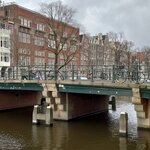
The bridge itself is not remarkable as a piece of engineering. It is a fixed girder crossing on the Singel, steel-girded in 1910, rebuilt in the early twentieth century, reprofiled and maintained through the decades since. It is 5 metres wide and spans a canal that is, at this point, perhaps 20 metres across. You would cross it and forget it, if not for the plaque.
But there is the plaque. And there is the word “HELP,” which still appears at the Voetboogstraat memorial, two streets away, as it has since the year after Joes died. And there is the name above the parapet, in the ordinary typeface of an Amsterdam bridge sign, asking anyone who reads it to remember that on a night in August 1996, a man decided not to walk past, and that this cost him his life, and that the city has chosen to remember him for it.
That is, finally, what a city does with its bridges: it names them, and in naming them, it chooses what to say about itself.
Research compiled February 2026. Principal sources consulted include the Wikipedia article on the Doodslag op Joes Kloppenburg (nl.wikipedia.org), reports in Het Parool and NOS on the twenty-fifth anniversary of the case (2021), DutchNews.nl coverage of Mayor Eberhard van der Laan’s final months and death (October 2017), the Negen Straatjes district website (de9straatjes.nl), the University of Amsterdam’s account of the Maagdenhuis history (uva.nl), and the Bridges of Amsterdam reference archive (bridgesofamsterdam.com). For primary archive material on the bridge’s construction history and the 2016 council decision on naming, the Stadsarchief Amsterdam (stadsarchief.amsterdam.nl) holds the relevant municipal records.
Key Facts at a Glance
Official name: Joes Kloppenburgbrug Bridge number: 5 (Brug 5) Location: Singel, connecting Raamsteeg / Oude Spiegelstraat (east bank) to Gasthuismolensteeg / Negen Straatjes (west bank) Type: Fixed girder bridge Earlier references: Known locally by its proximity to the Gasthuismolensteeg; no distinct historic name prior to 2017 Stone arch bridge: 1753 (replaced earlier wooden crossing) Steel girder installation: 1910 (modernisation to accommodate increased traffic and tram lines) Council decision to rename: 5 July 2016 Official naming ceremony: 26 September 2017 Named by: Mayor Eberhard van der Laan (his last major public engagement before his death on 5 October 2017) Named for: Joes Kloppenburg (1970-1996), who died after intervening to stop street violence in the Voetboogstraat on 17 August 1996 The assailant’s sentence: 8 years in prison Memorial at Voetboogstraat: Monument unveiled one year after the death; “HELP” in illuminated letters above the memorial Associated foundation: “Kappen Nou!” foundation, established by Joes’s father; produced the school documentary En jij…? (2009) Joes’s father: Appointed Knight in the Order of Orange-Nassau in 2009 for his work on senseless violence awareness Nearby landmarks: De Krijtberg church (Singel 446, Alfred Tepe, 1883); Maagdenhuis / UvA (Spui 21, Abraham van der Hart, 1783-1787); Negen Straatjes shopping district View along Singel: Bridge 4 (Heibrug) to the south; Bridge 6 to the north Naming significance: Explicitly chosen as a symbol against zinloos geweld (senseless violence)
https://nl.wikipedia.org/wiki/Joes_Kloppenburgbrug
https://www.bruggenvanamsterdam.nl/singel_hoek_oude_spiegelstraat.htm
Bridge number 5 (Brug Vijf) Joes Kloppenburgbrug connects the Raamsteeg with the Oude Spiegelstraat and leads over the Singel in central Amsterdam.

https://w3w.co/ponies.deprive.spending
https://w3w.co/kandidaat.rijmend.getij
///ponies.deprive.spending
///kandidaat.rijmend.getij
52.370216, 4.887999
This what3words address refers to a 3 metre square location. Tap the link or enter the 3 words into the free what3words app to find it.
Raamsteeg: Raamsteeg is a charming and narrow street located near the Singel canal in Amsterdam. It is a relatively quiet and picturesque area, often lined with traditional Dutch canal houses that date back several centuries. The street is known for its quaint atmosphere and is often a hidden gem amidst the more bustling parts of the city. While not a major thoroughfare, it offers a delightful walking route for those exploring the surrounding neighborhoods.
Oude Spiegelstraat: Oude Spiegelstraat is a renowned street in Amsterdam, located close to the Singel canal. It is well-known for its collection of antique shops, art galleries, and specialty boutiques. Visitors and locals alike frequent this street to discover unique and valuable antiques, art pieces, vintage items, and decorative objects. Strolling along Oude Spiegelstraat can be a delightful experience for art enthusiasts and collectors.
Singel: The Singel is one of the most famous canals in Amsterdam and forms part of the historic Canal Ring, which is a UNESCO World Heritage site. It encircles the old city center, and the area along the canal is characterized by picturesque views and beautiful canal houses. In the past, the Singel served as the outer moat of the city’s defenses, but now it is a scenic waterway, often dotted with houseboats and boat tours. The canal is bordered by lively streets with a mix of shops, cafes, and restaurants, making it a popular destination for both locals and tourists.
Together, the area encompassing Raamsteeg, Oude Spiegelstraat, and Singel offers a unique blend of history, art, and scenic beauty. It’s a place where visitors can immerse themselves in Amsterdam’s rich cultural heritage, explore artistic treasures, and enjoy the charming ambiance of its historic canal belt. As with any area in a popular city, it’s best to be mindful of your belongings and surroundings while exploring and appreciating the attractions in the vicinity.
For centuries, a bridge has stood at the location now known as Joes Kloppenburgbrug. Around 1599, Pieter Bast designed a drawbridge here, and on Gerrit de Broen’s map from approximately 1737, a permanent bridge was depicted. Fascinating historical maps, including these, can be explored at the Scheepvaartmuseum.
In 1910/1911, the bridge underwent renovation, coinciding with the renovation of bridge 25. The design was carried out by the Public Works Department, just before the era of Jo van der Mey, and it was initially without an official name.
During its earlier days, the bridge remained unnamed, but informally, it became known as the “Raambrug” in reference to the nearby Raamsteeg. It was also referred to as the “Appelmarktbrug” or “Appelmarktsluis” due to the apple market that used to take place in the vicinity. However, on July 5, 2016, a significant decision was made to officially name the bridge after Joes Kloppenburg, who tragically lost his life to senseless violence on August 17, 1996, near the Voetboogstraat, close to the bridge. This naming served as a powerful symbol against senseless violence, advocating for a safer and more compassionate society. The official nameplate bearing Joes Kloppenburg’s name was installed on September 26, 2017, solidifying the bridge’s new identity.
On October 10, 1995, the bridge was honoured with the status of a municipal monument, recognising its historical and cultural importance. Through the passage of time, Joes Kloppenburgbrug has witnessed centuries of history and transformations, now standing not only as a practical crossing over the water but also as a poignant reminder of the impact of senseless violence and a beacon of hope for a more peaceful future.
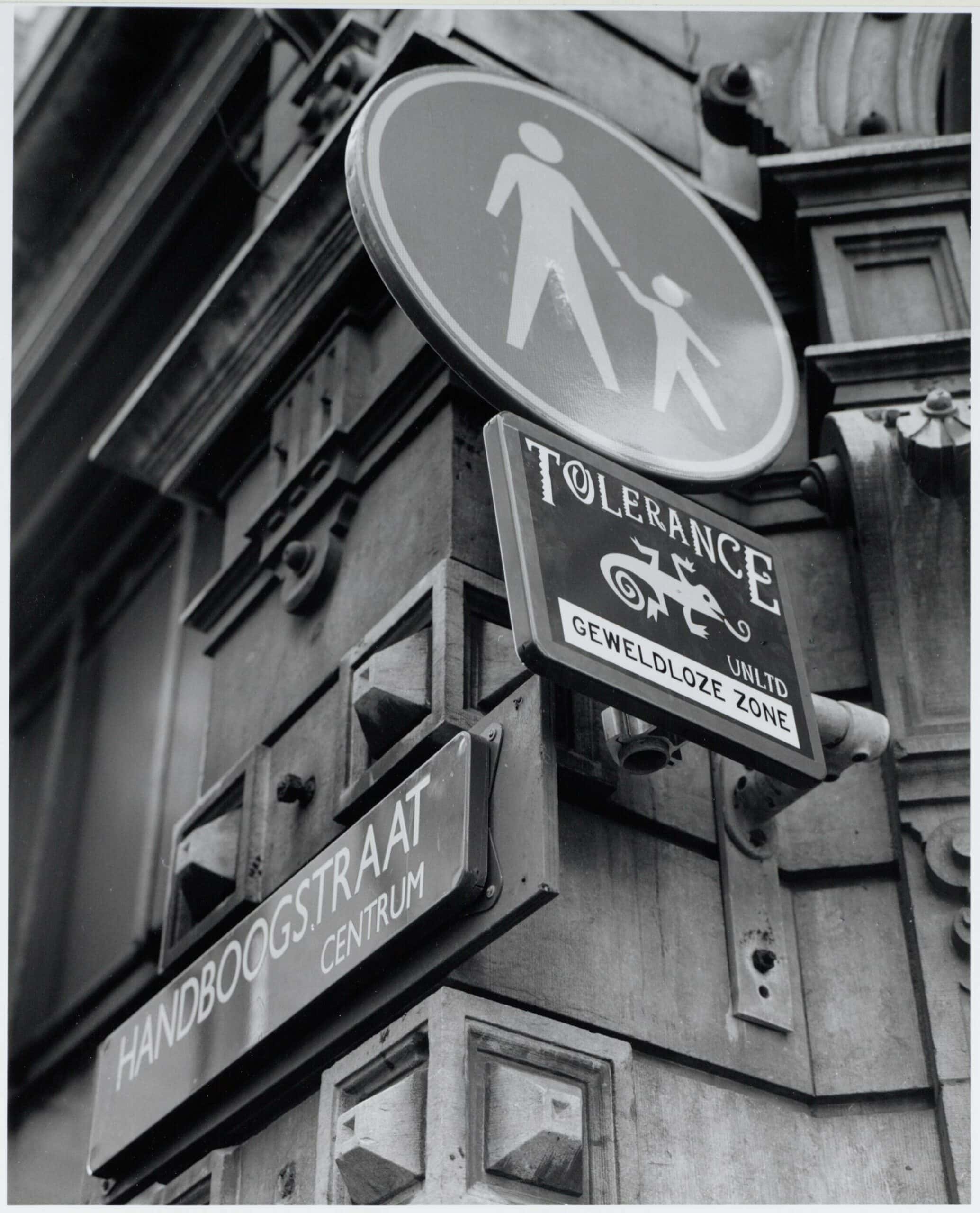
- Corner Spui. Sign “Tolerance” nav. the kicking of Joes Kloppenburg to death by four drunk boys on the night of August 17, 1996

De doodslag op Joes Kloppenburg op 17 augustus 1996 in Amsterdam was een geruchtmakend geweldsmisdrijf, waarbij een 26-jarige man door uitgaansgeweld om het leven…
Architect: Unknown