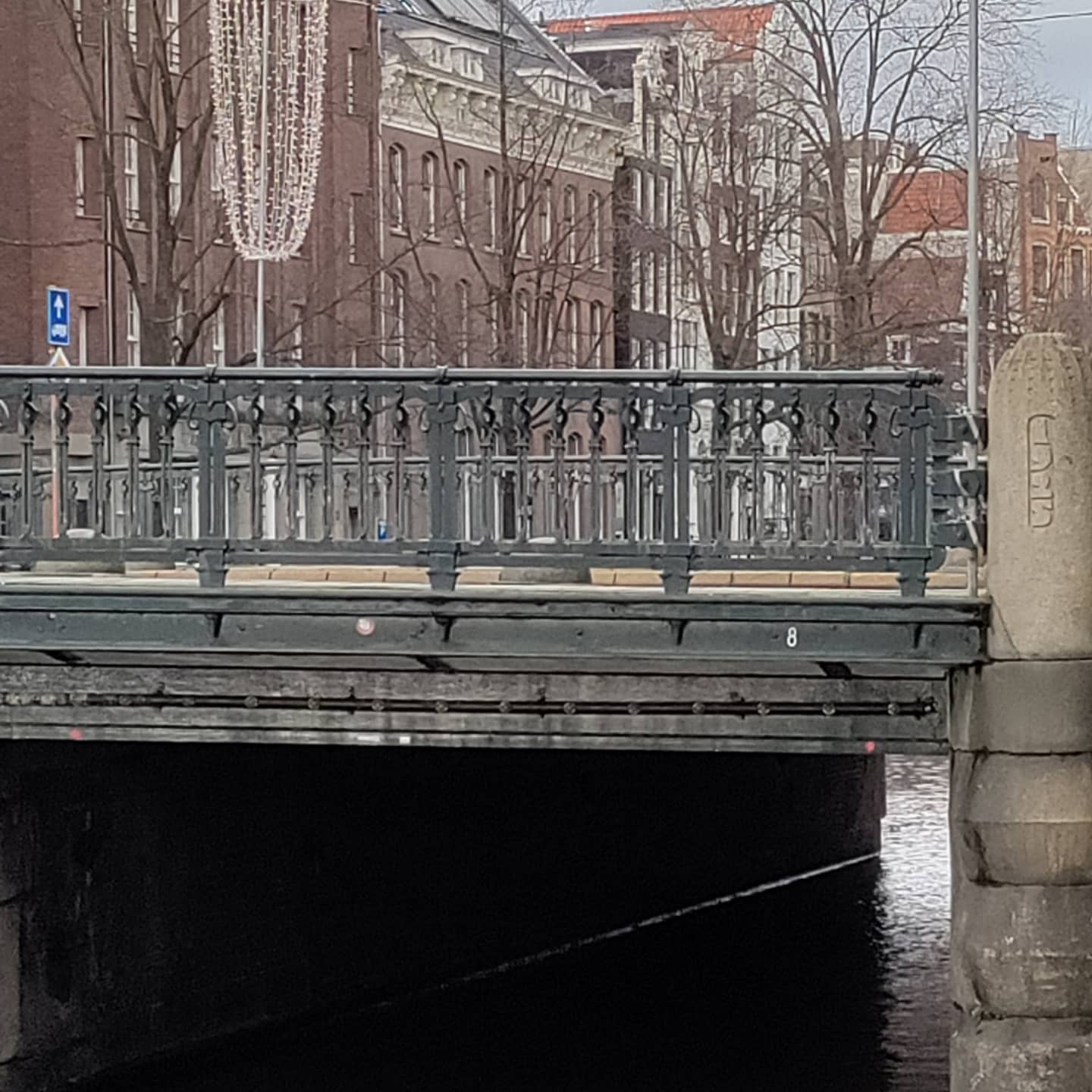


Bridge 8: Where Charity and Flour Met the Singel
Stand on Bridge 8 and you are standing at a confluence of old Amsterdam’s welfare systems. The street running away to the west is Gasthuismolensteeg, named for a medieval hospital and its grain-grinding windmill. The great arterial road sweeping in from the east is Raadhuisstraat, which follows the ghost of a lane once lined with the storehouses of the city’s outdoor poor relief. Two distinct charitable histories, planted on opposite banks, meet at this point on the Singel, and a fixed steel and concrete span, rebuilt to Piet Kramer’s designs in 1925, carries the modern city across the water between them. Bridge 8 is officially unnamed today. For most of its modern life it was known informally as the Huiszittenbrug, a name formally retired on 5 July 2016 when the city adopted a policy of assigning all surviving informal bridge names to the municipal register. It carries no replacement name. Its story is carried instead by the streets at its feet.A Hospital and Its Mill: The Naming of Gasthuismolensteeg
The Gasthuismolensteeg, which meets the Singel at the bridge’s west end, distils several centuries of Amsterdam history into a single compound noun. Gasthuis is the old Dutch word for a hospital or hospice; molen is a mill; steeg is an alley. Together they record two institutions that once stood near this spot. The hospital is the Sint-Elizabethsgasthuis, Amsterdam’s earliest documented hospital and one of the oldest welfare institutions in the city. It is recorded from 1361, when the city was still a modest trading settlement, and it occupied a site behind the old town hall, in what is roughly the Paleisstraat area today. The hospital sheltered the sick poor, and to feed them it maintained a windmill. That windmill stood at the corner of the Singel and the alley that would take its name, at some point during the fifteenth or sixteenth centuries. The mill ground flour for the hospital’s bread supply. When the institution moved or changed form, the mill eventually disappeared too, but the alley remembered it. Gasthuismolensteeg: the mill alley of the hospital. The connection between the gasthuis and this part of the Singel also touches Paleisstraat, one bridge to the south at Bridge 6. Paleisstraat was itself earlier known as Gasthuissteeg, a different alley serving the same complex of hospital property. What this means is that the Sint-Elizabethsgasthuis was not a single building but an institutional presence spread across several alleys and plots along the Singel’s medieval edge. Gasthuismolensteeg and the old Gasthuissteeg are two surviving traces of that now-vanished complex.The Huiszittende Armen and the Bridge’s Former Name
The east bank of Bridge 8 tells a different charitable story. When Raadhuisstraat was carved through the city in the years around 1895 to 1900, it replaced and absorbed a much older lane called the Korte Huiszittensteeg. The name referred to the huiszittende armen: literally the “homebound poor,” people too sick, elderly, or infirm to leave their homes and collect relief in person. The city maintained a separate system of outdoor poor relief for them, administered from a network of Huiszittenhuizen (houses of the homebound poor) and their associated Huiszittenpakhuizen, warehouses where food, peat, and cloth were stored for distribution. One of these warehouses, the Huiszittenpakhuis, stood on the corner of Spuistraat until its demolition in the later nineteenth century. It gave the bridge at the head of the lane its informal name: the Huiszittenbrug, or the Huiszittensluis when its original form included a sluice gate. The warehouse and the lane it served were swept away by the Raadhuisstraat project, but the bridge name persisted in common use until the 2016 register revision. The two names (Gasthuismolensteeg and Huiszittenbrug) are independent histories. They do not describe the same institution or the same moment. What they share is a preoccupation with relief and provisioning: bread from the hospital mill on the west; grain and peat from the relief warehouse on the east. For several centuries this bridge existed at the juncture of two of Amsterdam’s principal systems for caring for its most vulnerable residents.From Sluice to Steel: The Structural History
A bridge had stood at this spot for at least two centuries by the time the modern city got to it. Like most early Singel crossings it would have been a wooden drawbridge, allowing sailing vessels through to the inner harbour. It was brought up to the requirements of the day in 1894, when the Raadhuisstraat had only just been laid out, which transformed this previously modest crossing into a major urban intersection. The widening of the road demanded a corresponding widening and strengthening of the bridge. The decisive renovation came in 1925, when the bridge was redesigned and rebuilt under the direction of Piet Kramer, working within the Dienst der Publieke Werken (the municipal Public Works Department). Construction ran from February to December of that year. The result was the fixed plate bridge (vaste plaatbrug) that stands today: a span of steel and reinforced concrete forming three navigation passages across the Singel. The profile is flat, deliberately so. Trams and heavy motor traffic required a surface without the camber of an older arch bridge, and the 1920s city-wide bridge-building programme led by the Publieke Werken systematically replaced the high-arched welfbruggen with low, functional decks. Bridge 8’s current silhouette is a direct product of that policy.Piet Kramer’s Hand on the Stonework and the Railings
Piet Kramer (1881-1961) is the dominant figure in the appearance of the Singel bridges as they exist today. Working from within the Publieke Werken, he produced more than 220 built bridges across Amsterdam, developing a recognisable design vocabulary across the decades of his work: warm-toned brick abutments laid with care for texture and colour, granite “nose” stones at the corners of each abutment (those rounded projections that break the water’s surface and deflect the hull of a passing barge), and ornamental wrought iron railings whose geometric patterns vary subtly from bridge to bridge. Bridge 8 carries all of these elements. The abutments show the brick expressionism associated with the Amsterdam School movement of the 1910s and 1920s, to which Kramer belonged alongside Michel de Klerk and Johan van der Mey. The granite nose stones at the Singel’s edge have absorbed more than a century of canal traffic and still carry their original weight. The railings are the work of H.J. Winkelman, whose firm Ateliers voor Kunstnijverheid H.J. Winkelman was a principal collaborator with Kramer throughout the 1920s bridge programme. Hendrik Jan Winkelman (1872-1947) founded the atelier in 1910, and his firm developed a close working relationship with Kramer’s design office, translating Kramer’s drawings into fabricated wrought iron. For the Raadhuisstraat bridge group (of which Bridge 8 was part), Winkelman won the 1925 municipal tender for ornamental wrought iron railings. The contract covered 43,750 kilograms of ironwork at a price of fl. 28,715. The geometric patterns in the railings at Bridge 8 reflect this collaboration: precise, angular, and consistent with the broader Amsterdam School interest in surface pattern as architectural ornament. All of Kramer’s drawings for his bridges were destroyed after his death in 1961. What survives is the built work itself: the brickwork, the stone, the iron, and the concrete beneath your feet.The Northernmost Crossing of the Nine Streets
Bridge 8 marks the point where the Negen Straatjes (the Nine Streets) reach the Singel for the last time. The nine cross streets that give the district its name run between the Singel and the Prinsengracht, threading through the Herengracht and Keizersgracht along the way. Moving northward from the Leidsegracht, they form a sequence of crossings on each canal, and the sequence ends at the Singel. Bridge 8 is the last Singel crossing to fall within the Nine Streets zone before the canal bends toward the Torensluis and the Brouwersgracht. The Nine Streets as a branded district were formally constituted on 12 November 1996, when the Vereniging de 9 Straatjes was established. The area encompasses more than 250 specialty shops and over 140 protected monuments. Standing on Bridge 8, a visitor oriented toward the west looks directly into Gasthuismolensteeg and beyond it toward the Herengracht crossing, which is part of the network of alleys and short streets that define the district’s character. The crossing also functions as the gateway from the Raadhuisstraat axis to the quieter commercial and residential streets of the Nine Streets. Raadhuisstraat, which terminates its westward run at the Westerkerk, feeds foot and cycle traffic onto the bridge at its eastern end and disperses it into the canal belt’s finer grain on the western side. Bridge 8 is, in that sense, both a major arterial junction and the beginning of something smaller and older.Looking North: The Multatuli Museum and the Torensluis
The view from Bridge 8 looking north along the Singel leads almost immediately to the Torensluis, Bridge 9, the oldest bridge in the old centre to survive in its original state and, at forty-two metres, one of the widest. It is an arch bridge of 1648, its width derived from the fact that it was originally built over and around the foundations of a medieval city gate tower. The sluice chamber beneath it was later used as a prison. On the Torensluis stands a bronze statue of Multatuli (Eduard Douwes Dekker, 1820-1887), the writer whose novel Max Havelaar (1860) attacked Dutch colonial exploitation in Java and changed the course of Dutch literature. The statue was made by Hans Bayens and placed in 1987. Multatuli was born at Korsjespoortsteeg 20, a short distance from the Singel, and the house is now the Multatuli Museum, established in 1957 as the first house museum in the Netherlands dedicated to a writer. The museum documents his life and the reception of his work, and it sits within easy walking distance of Bridge 8. Also at the Torensluis site: the ghost of the Jan Roodenpoortstoren, a medieval defensive tower that was embellished in 1616, probably to a design by Hendrick de Keyser, which took it to nearly fifty-five metres and gave the city a public bell tower that doubled as a prison, before it was demolished in 1829. Since 2003, the tower’s footprint has been marked in the pavement in cobblestones, so that what was once a physical presence above the water survives as a ground-level inscription. From Bridge 8, looking north toward the Torensluis, you are looking toward three layers of memory simultaneously: a bridge that is the city’s oldest, a statue commemorating its most provocative nineteenth-century writer, and a cobblestone outline of a tower that stood for centuries before the modern city removed it.National Monument and Heritage Status
Bridge 8 holds the status of Rijksmonument (national protected monument) under number 518387. This is the higher of the two heritage designations available in the Netherlands: a Rijksmonument is protected by national legislation, where a gemeentelijk monument is protected only by municipal ordinance. Several of the neighbouring Singel crossings carry the lesser municipal designation, most of them awarded in October 1995. Bridge 8 is protected at the national level. It is also not alone. Bridge 8 is one of a set of three built to the same appearance, with bridge 22, the Warmoesbrug, and bridge 106, the Niek Engelschmanbrug; the ornamental ironwork of the balustrades is the easiest place to see the family likeness. Bridge 63, the Nieuwe-Wercksbrug, was taken into the same tender as part of the traffic route out to Amsterdam-West by way of the Rozengracht. The bridge carried an unofficial name for years, the Huiszittenbrug or Huiszittensluis, after the Huiszittenpakhuis that dispensed poor relief and stood until the end of the nineteenth century where the main post office, now Magna Plaza, was then built; the Huiszittensteeg ran between it and the Singel. In July 2016 the council decided, after consultation, that the unofficial name could no longer be used in official documents. The link to the past behind it had simply been forgotten. The bridge is a fixed plate bridge (vaste plaatbrug) of steel and reinforced concrete, carried on three navigation passages. No major structural intervention beyond routine maintenance has been publicly documented since the 1925 reconstruction, though periodic inspection and repair are standard for the city’s bridge stock of this age and type.Two Charities, One Bridge
Bridge 8 sits at an unusual intersection of historical narratives. Most bridges carry a single name, drawn from a single street or a single institution. This one carried two quite different charitable associations simultaneously: the windmill of the Sint-Elizabethsgasthuis on the west, and the warehouse of the huiszittende armen on the east. Neither institution exists anymore in any form. The hospital moved and eventually dissolved into the city’s later medical infrastructure; the system of outdoor poor relief was gradually absorbed into municipal welfare administration. But the bridge remains, its 1925 fabric still intact, still connecting Raadhuisstraat to Gasthuismolensteeg, still framing the view northward to the Torensluis and the memory of the Jan Roodenpoortstoren. When you cross Bridge 8, you cross between the remnant name of a hospital mill and the remnant name of a relief warehouse. The bridge itself has no name to offer in return: only the ironwork, the granite, the brick, and the flat steel span that Piet Kramer designed in the winter of 1924 and built in the ten months between February and December 1925.Sources: Municipality of Amsterdam bridge register and Rijksmonument listing no. 518387 (Rijksdienst voor het Cultureel Erfgoed); J. Baggeler and R. van Schaik, Piet Kramer. Bruggenbouwer van de Amsterdamse School (Amsterdam, 2016); Amsterdam municipal tender records for ornamental wrought iron railings, Raadhuisstraat bridges, 1925 (H.J. Winkelman, Ateliers voor Kunstnijverheid, 43,750 kg, fl. 28,715); Stadsherstel Amsterdam property records, Sint-Elizabethsgasthuis documentation; Vereniging de 9 Straatjes founding records (12 November 1996); Multatuli Museum, Korsjespoortsteeg 20, Amsterdam (established 1957); Amsterdam municipality heritage register, Gemeentelijk monument bulk designation 10 October 1995 (72 Singel bridges); informal name retirement records, Municipality of Amsterdam, 5 July 2016.
Key Facts at a Glance
| Official name | None (unnamed) |
| Former informal name | Huiszittenbrug (also Huiszittensluis); name retired 5 July 2016 |
| Bridge number | 8 |
| Location | Singel, at Raadhuisstraat (east bank) and Gasthuismolensteeg (west bank) |
| Heritage status | Rijksmonument no. 518387 (national protected monument) |
| Type | Fixed plate bridge (vaste plaatbrug), steel and reinforced concrete |
| Navigation passages | 3 |
| First crossing | ca. 1650 |
| First permanent element | 1773 |
| Modernised | 1894-1900 (concurrent with Raadhuisstraat construction) |
| Current form | Rebuilt February-December 1925 to Piet Kramer design |
| Ironwork | H.J. Winkelman / Ateliers voor Kunstnijverheid H.J. Winkelman (1925 municipal tender; 43,750 kg; fl. 28,715) |
| Gasthuismolensteeg etymology | Sint-Elizabethsgasthuis (doc. 1361) + its grain-grinding windmill at the Singel corner (15th-16th c.) |
| Huiszittenbrug etymology | Huiszittende armen (homebound poor) + Huiszittenpakhuis (relief warehouse, demolished late 19th c.) |
| Nine Streets | Northernmost Singel crossing within the Negen Straatjes zone |
| Bridge to the north | Bridge 9 (Torensluis): Amsterdam’s oldest and widest preserved bridge, 42 m, arch bridge 1648/1649 |
| Nearby | Multatuli Museum (Korsjespoortsteeg 20); Jan Roodenpoortstoren cobblestone outline (Torensluis site, marked 2003) |
| Architect | Piet Kramer (1881-1961), Dienst der Publieke Werken |
.jpg/1200px-Amsterdam_(2406979317).jpg)
Brug 8 – Wikipedia
Brug 8 is de officiële aanduiding van een brug in Amsterdam-Centrum. De brug had tot 5 juli 2016 de onofficiële naam Huiszittenbrug, waarmee het verwees naar het Huiszittenpakhuis. Deze naam is echter komen te vervallen.
nl.wikipedia.org
 https://w3w.co/enacts.restored.sides
https://w3w.co/omgezet.zenders.afkomen
///enacts.restored.sides
///omgezet.zenders.afkomen
52.373208, 4.888882
This what3words address refers to a 3 metre square location. Tap the link or enter the 3 words into the free what3words app to find it.
Dit what3words-adres verwijst naar een locatie in een vierkant van 3 meter. Tik op de link of voer de 3 woorden in de gratis what3words app in om het te vinden.
For many years bridge 8 was known as Huiszitsluis or Huiszitbrug. This name related to the Huiszitpakhuis (warehouse), which was located here until the end of the 19th century. The Huiszitsteeg ran between the Singel and the Huiszitspakhuis. So the building, nearby road and bridge all had similar naming. This location is where the Amsterdam Main Post Office was built more recently. So since this building no longer existed knowledge about the name of the bridge and its connection with the past had been lost so in July 2016, after a consultation round, the city council decided that this unofficial name could no longer be used in official documents. This is one of many bridges that suddenly became “unnamed” at this time.
Bridge 8 was designed by Piet Kramer and built from February to December of 1925 and is part of a set of three bridges designed at the same time which include bridge 22 and bridge 106. All three have some characteristics belonging to the Amsterdam School which Kramer championed including decorative ironwork for the balustrades the brick bridgeheads and natural stone columns.
Architect
1925: Piet Kramer
https://w3w.co/enacts.restored.sides
https://w3w.co/omgezet.zenders.afkomen
///enacts.restored.sides
///omgezet.zenders.afkomen
52.373208, 4.888882
This what3words address refers to a 3 metre square location. Tap the link or enter the 3 words into the free what3words app to find it.
Dit what3words-adres verwijst naar een locatie in een vierkant van 3 meter. Tik op de link of voer de 3 woorden in de gratis what3words app in om het te vinden.
For many years bridge 8 was known as Huiszitsluis or Huiszitbrug. This name related to the Huiszitpakhuis (warehouse), which was located here until the end of the 19th century. The Huiszitsteeg ran between the Singel and the Huiszitspakhuis. So the building, nearby road and bridge all had similar naming. This location is where the Amsterdam Main Post Office was built more recently. So since this building no longer existed knowledge about the name of the bridge and its connection with the past had been lost so in July 2016, after a consultation round, the city council decided that this unofficial name could no longer be used in official documents. This is one of many bridges that suddenly became “unnamed” at this time.
Bridge 8 was designed by Piet Kramer and built from February to December of 1925 and is part of a set of three bridges designed at the same time which include bridge 22 and bridge 106. All three have some characteristics belonging to the Amsterdam School which Kramer championed including decorative ironwork for the balustrades the brick bridgeheads and natural stone columns.
Architect
1925: Piet Kramer

Raadhuisstraat 2-6 v.r.n.l., aan het Singel de achtergevel van Spuistraat 134 en rechts Spuistraat 168
Daartussen het Hoofdpostkantoor, het Koninklijk Paleis en brug 8 over het Singel
archief.amsterdam

Singel 183
Gezicht op de achterzijde van het gebouwencomplex van de UvA afd. Letteren, waarvan de hoofdingang en postadres aan de Spuistraat 210 is gelegen, gezien van Torensluis met op de achtergrond Brug 8 voor de Raadhuisstraat.
archief.amsterdam

Singel hoek Raadhuisstraat
Tot 5 juli 2016 stond deze brug onofficieel bekend als Huiszittenbrug, genoemd naar
het voormalige Huiszittenpakhuis op de hoek van de huidige Spuistraat.
het voormalige Huiszittenpakhuis op de hoek van de huidige Spuistraat.
www.bruggenvanamsterdam.nl
Sources and Further Reading
- Wikimedia Commons, Category: Brug 8 (in Amsterdam)
- Bruggen van Amsterdam
- Stadsarchief Amsterdam, Beeldbank and Publieke Werken archives
- Frank V. Smit, Bruggen in Amsterdam (2008), Uitgeverij Matrijs