The Blauwbrug: Bridge 236, and the Paris Bridge That Came Afterwards
Almost every account of the Blauwbrug will tell you it was modelled on the Pont Alexandre III in Paris. It is repeated in guidebooks, on plaques and in both the Dutch and English encyclopaedia entries, and it cannot be true.
The Blauwbrug was built in 1883. The Pont Alexandre III was built between 1896 and 1900, for the Exposition Universelle. Amsterdam’s bridge is thirteen years older than the bridge it is supposed to have copied.
That is not a small correction, because once you take the Pont Alexandre III out of the story a better one appears.
What the Designers Were Actually Looking At
The architects were Bastiaan de Greef and Willem Springer, with the decorative scheme by Springer’s son Jan Springer. What they were working from was the Paris of the Second Empire: Haussmann’s rebuilt city, and specifically the monumental stone bridges over the Seine that preceded the Pont Alexandre III by decades.
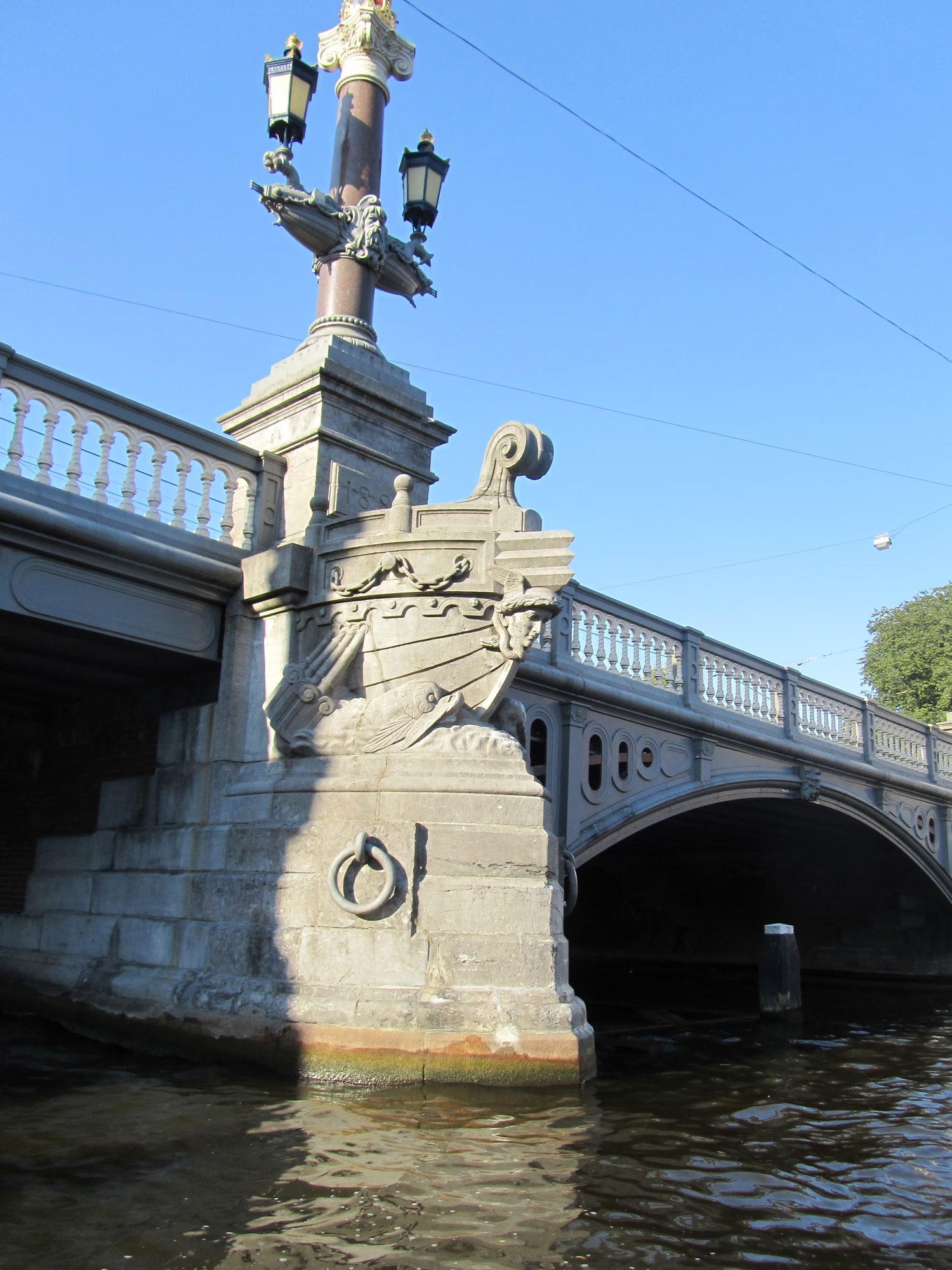
The single most direct quotation is not from a bridge at all. The lampposts take their form from those of the Place de la Concorde, installed in the 1830s and by the 1880s among the most imitated pieces of street furniture in Europe.
So the resemblance people notice between the Blauwbrug and the Pont Alexandre III is real, and the explanation runs the other way round. Both bridges draw on the same French monumental vocabulary of the mid-nineteenth century. Amsterdam simply got there first.
The chronology also disposes of a related claim, that the bridge was a Dutch answer to a French masterpiece. It was not answering anything. It was Amsterdam spending money on itself in a year when it particularly wanted to be looked at.
More of my photographs of the Blauwbrug are in this album.
1883: A Bridge Built for an Exhibition
The Blauwbrug went up for two reasons at once, one practical and one theatrical.
The practical reason was the tram. The wooden drawbridge that stood here, a structure much like the Magere Brug further up the Amstel, could not carry a tramway across the river, and the network was expanding.
The theatrical reason was the International Colonial and Export Exhibition of 1883, held in Amsterdam and drawing something over a million visitors. A city hosting a world exhibition wants a set piece, and the crossing of the Amstel between the Amstelstraat and the Waterlooplein was the obvious place to put one.
The result is the most self-consciously grand bridge in the city, and it is worth being blunt about the money behind it. The exhibition that prompted it was a colonial exhibition, staging the Dutch East Indies for a European audience, and the wealth on display in the granite and the gilding came from the same source.
Design: Crowns, Ships and Shortened Arches
The bridge stands on eight granite pylons topped with limestone balustrades, and the pylons are finished with imperial crowns.
The crown is the Imperial Crown of Austria, granted to Amsterdam by Maximilian I in 1489 and carried on the city arms ever since. It reappears in the lanterns themselves, which are crown-shaped, while the lantern poles carry shipping decorations. Crowns for the city, ships for the trade: the iconography is not subtle and was not meant to be.
One design decision is specifically Amsterdam. The arches were shortened relative to their French models, because a long, shallow, heavily loaded arch would have settled into the city’s soft peat and clay. The bridge looks Parisian and is engineered for a swamp.

The Name: Blue Railings, a Rejected Queen, and Some Lions
The name predates the bridge. Earlier wooden drawbridges on this crossing had blue railings, and the city called the crossing the blue bridge long before it was granite.
It very nearly became something else. In 1839 King Willem III proposed naming it the Sophiabrug, after his wife Sophie of Wurttemberg. Amsterdam did not take the suggestion. Another current name was the Leeuwenbrug, the lion bridge, after decorative lion heads on the old wooden railings.
Blue won, and it won for the least official reason available: it is what people already said.
Kramer, Concrete and the 1999 Reversal
In 1938 and 1939 the bridge was rebuilt internally. Motor traffic had grown heavier than an 1883 structure was designed for, and the iron beams were replaced with concrete ones on the original foundations. The work was directed by Piet Kramer, the Amsterdam School architect responsible for hundreds of the city’s bridges and the subject of our piece on Kramer, Hildo Krop and the sculpted bridge.
It is a good example of how bridge conservation actually works in Amsterdam. Kramer had a strong architectural identity of his own and did not impose it. The visible bridge stayed as de Greef and Springer left it, and the structure inside it was replaced.
A further restoration in 1999 undid a century of accumulated modification and returned the bridge to its original character, blue included.
Trams and Riots
Tram line 9 crossed the Blauwbrug from 1903 until 2018, one hundred and fifteen years, and line 14 was added in 1982. The bridge was built for a tramway and carried one for most of its life.
Its other public role is less decorous. On 30 April 1980, the day Beatrix was crowned, the Blauwbrug became the front line between squatters and riot police in the worst civil disorder Amsterdam had seen since the Nieuwmarkt clearances five years earlier. The confrontation gave A.F.Th. van der Heijden the title of his novel De slag om de Blauwbrug, the battle for the Blauwbrug.
The bridge is a rijksmonument, registered as number 518352.
Technical Specifications
- Bridge number: 236
- Name: Blauwbrug
- Former and proposed names: Sophiabrug (proposed 1839), Leeuwenbrug
- Type: Fixed traffic bridge
- Carries: Amstelstraat to Waterlooplein
- Spans: The Amstel
- District: Amsterdam-Centrum
- Coordinates: 52.3663 N, 4.9009 E
- Current structure: 1883
- Architects: Bastiaan de Greef and Willem Springer; decoration by Jan Springer
- Materials: Eight granite pylons, limestone balustrades, concrete beams from 1938 to 1939
- Ornament: Imperial crowns, crown-shaped lanterns, shipping motifs on the lamp poles
- Lamppost model: Place de la Concorde, Paris
- Structural rebuild: 1938 to 1939, directed by Piet Kramer
- Restoration: 1999, returning the bridge to its original appearance
- Trams: Line 9 from 1903 to 2018; line 14 from 1982
- Status: Rijksmonument, number 518352
Sources Consulted
- Featured image: Blauwbrug amsterdam by Jvhertum, via Wikimedia Commons, CC BY-SA 3.0
- In-text image: Photograph by Iain Croll, 2022
- Blauwbrug, Nederlandstalige Wikipedia
- Blauwbrug, English Wikipedia
- Rijksmonumentenregister, monument 518352
- Pont Alexandre III, English Wikipedia, for the 1896 to 1900 construction dates
- Internationale Koloniale en Uitvoerhandel Tentoonstelling 1883, Nederlandstalige Wikipedia
- Piet Kramer, Nederlandstalige Wikipedia
- Kroningsoproer 1980, Nederlandstalige Wikipedia
- Wikimedia Commons, Category: Blauwbrug
- Stadsarchief Amsterdam, Beeldbank and Publieke Werken archives
- Bruggen van Amsterdam
- Frank V. Smit, Bruggen in Amsterdam (2008), Uitgeverij Matrijs