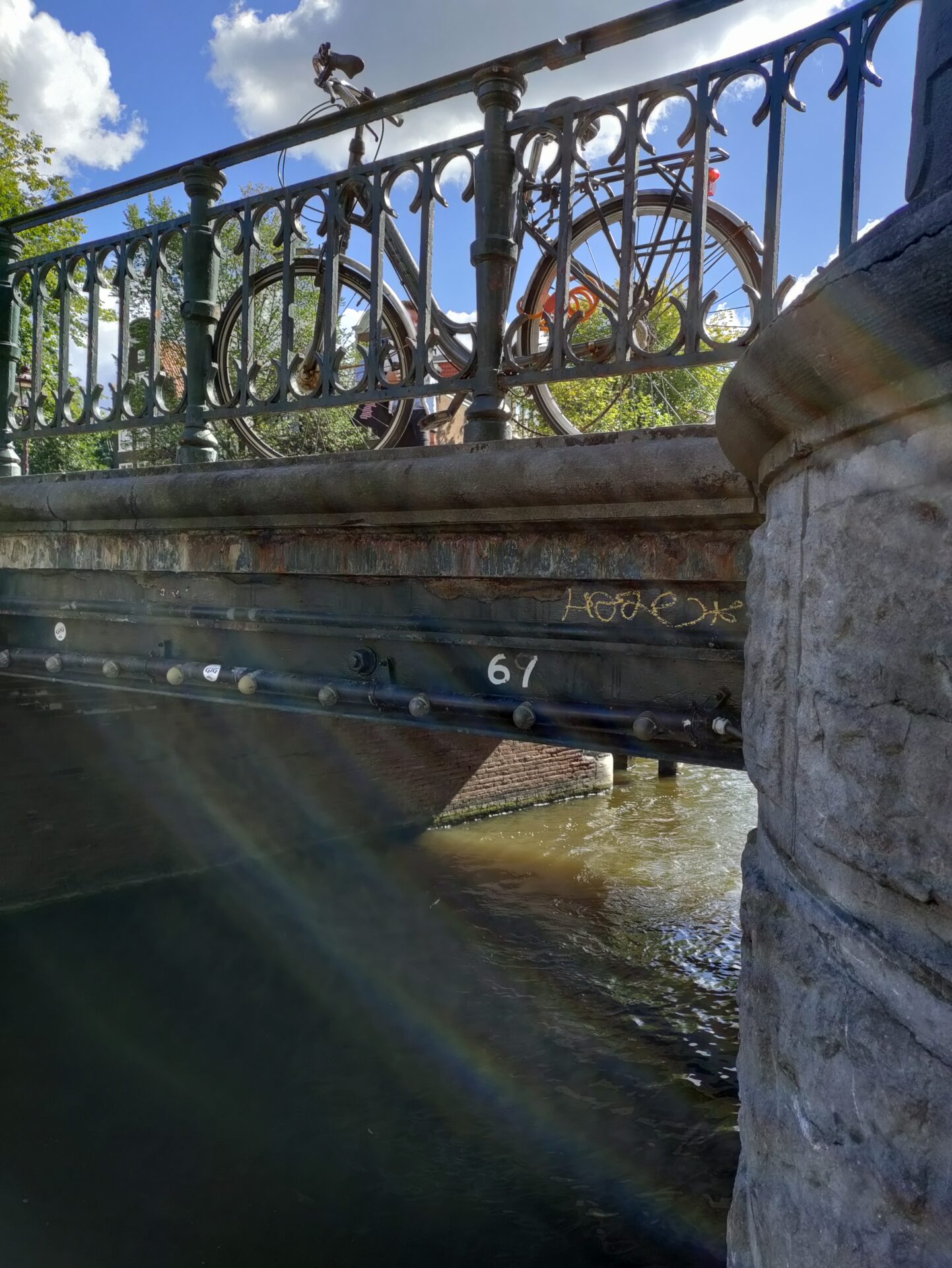
The Bridge Named After a Woman Who Took In Foundlings, Two Centuries After She Did It
The Angenietje Swarthofbrug carries the northern quay of the Leidsegracht across the Prinsengracht. Structurally it is one of a set: it forms a single composition with Bridge 122 and Bridge 93, the three of them handling the junction where the Leidsegracht meets the Prinsengracht from different quays.
What makes this crossing worth stopping at is not its engineering but its name, which it acquired only in December 2021 — and which it received after first having a different name taken away.
Etymology and Naming: Losing the Kleine Brouwerssluis, Gaining Angenietje Swarthof
Until April 2016 this bridge was known as the Kleine Brouwerssluis. The name was unofficial and its historical basis was untraceable, and it carried an additional practical problem: Amsterdam already has a Brouwersgracht and a Brouwerssluis roughly a kilometre to the north, and a second “Brouwers” crossing invited confusion.
In 2016 the municipality resolved to strip names from bridges where the name lacked historic significance or risked being confused with another place. Eighty-eight unofficial names were removed by council decision in July of that year. The Kleine Brouwerssluis was among the casualties, and the crossing reverted to being simply Brug 67.
The second act came in December 2021, when the bridge was named the Angenietje Swarthofbrug. Angenietje Swarthof was one of Amsterdam’s minnemoeders — women who took in foundlings, receiving abandoned infants through the city almoner. The relevance to this particular bridge is geographic: the almoner’s institution stood close by, at Prinsengracht 436.
The choice is a pointed one. Amsterdam’s older bridge names commemorate trades, buildings, canals and occasionally wealthy men. Naming a bridge for a woman who nursed other people’s abandoned children is a deliberate correction to that record — part of a broader municipal effort, running since the mid-2010s, to give the city’s unnamed bridges names that reflect a wider range of lives than the merchant class.
Structural Evolution: De Greef and Springer, 1889–1890
In 1889 the municipality contracted the renovation of the bridge over the Prinsengracht near the Leidschegracht. By February 1890 the new bridge was ready.
The design came from Publieke Werken — Amsterdam’s Public Works department — where Bastiaan de Greef and Willem Springer were then working. The pairing matters. De Greef was city architect and Springer his long-serving collaborator, and between them they were responsible for an enormous quantity of Amsterdam’s nineteenth-century public infrastructure. Their bridges belong to the great replacement wave of that century, when the arched masonry crossings of the Golden Age were systematically swapped for flat iron decks that carts and, later, motor traffic could cross without climbing.
The same names recur along this stretch of the Prinsengracht: De Greef designed a bridge at the Aalmoezeniersbrug site around 1860. A single municipal office, over a few decades, reshaped the profile of the entire canal ring.
Urban and Social Context: The Leidsegracht Junction
The Leidsegracht is a significant radial canal and its junction with the Prinsengracht is correspondingly complex, which is why three bridges rather than one are needed to resolve it. Bridge 93, on the opposite quay, was itself renamed — it carried the unofficial name Bestedelingenbrug, after the nearby Bestedelingenhuis, before becoming the Pieter Goemansbrug, for the lyricist who wrote Aan de Amsterdamse grachten.
Within a hundred metres, then, the naming history runs: a poorhouse, a songwriter, a brewer’s name that turned out to be unfounded, and a woman who took in foundlings. Few junctions in the city compress quite so much of Amsterdam’s argument with its own past into so small a space.
Technical Specifications
- Bridge number: 67
- Name: Angenietje Swarthofbrug (since December 2021)
- Former name: Kleine Brouwerssluis (unofficial, until April 2016)
- Type: Road bridge, fixed
- Spans: Prinsengracht
- Carries: Northern quay of the Leidsegracht
- Forms a group with: Bridge 122 and Bridge 93 (Pieter Goemansbrug)
- Renovation contracted: 1889; completed February 1890
- Designed by: Publieke Werken Amsterdam — Bastiaan de Greef and Willem Springer
Sources Consulted
- Bruggen van Amsterdam — Angenietje Swarthofbrug
- Gemeente Amsterdam, bridge naming decisions of July 2016
- Gemeente Amsterdam, naming decision of December 2021
- Pieter Goemansbrug, Nederlandstalige Wikipedia
- Municipal contract records for the Prinsengracht bridge at the Leidschegracht, 1889–1890
 The bridge had an untraceable none historic name and until April 2016 it was known as the Kleine Brouwerssluis. Then in 2016 the municipality of Amsterdam decided that some names were to be removed from bridges without historic significance or if the name could be confused with another bridge or location (Amsterdam already has a Brouwersgracht and a Brouwerssluis about a kilometre north) so like many of the previous Brug 66 this bridge became unnamed and was known simply as Brug 67. Then in December 2021 the bridge was given a new name: Angenietje Swartbrug. Angenietje was one of the ‘minnows’ in Amsterdam, women who received foundlings through the City chaplain in Amsterdam, which was located closeby at Prinsengracht 436. Angenietje Swart is believed to have cared for 126 foundlings.


History and information
Modern history of bridge 67 in Amsterdam’s historic canal ring begins around 1879, when they wanted to lower the bridge height, but the municipality did not have enough money to do so. Back then, there was still talk of an arched bridge; in 1887, a petroleum company still got permission to store 6,000 litres under two arches. This could continue until 1889, when the municipality contracted “The renovation of the bridge over the Prinsengracht near the Leidschegracht with, among other things, the supply of 18 tonnes of beam iron.” On 6 May, the bridge closed indefinitely to all traffic, including shipping, only pedestrians could use an auxiliary bridge. In February 1890, it could be reported that the new bridge was ready. The design came from Public Works Amsterdam, where Bastiaan de Greef and Willem Springer were working at the time. The “egghead-like” finish of the piers is said to be by Springer. However, it is not clear whether they were also responsible for the design or just looking over the shoulders of employees. In 1913, the bridge faced another hazard. The municipality got the idea of draining the Leidsegracht and, by that measure, being able to build a new “highway” to the west; plans remained. The current bridge dates from 1988, when the municipality (still) chose to restore the iron plate/beam bridge instead of replacing it with an old-style vault bridge.

Map and location
The Angenietje Swarthofbrug is located in the northern quay of the Leidsegracht and spans the Prinsengracht. The bridge forms a whole with bridge 122 and bridge 93 both of which are in the quays of Prinsengracht over Leidsegracht.
As with most of the central canal belt bridges there has been a bridge at this location for centuries. Daniel Stalpaert drew a bridge here on his map from around 1662. He lived and worked for some time at Leidsegracht 108, the city masonry garden nearby so knew the bridge well. The Leidsegracht at that time formed the boundary between already built and yet to be built, but planned, Amsterdam. South of Leidsegracht, apart from a single building, there is nothing marked on the map. What is clearly visible on that map are the compacted walkways on the north side of the bridge, possibly moorings. Jan de Beijer painted the bridge around 1755 in which those walkways are visible, as well as a bridge with a large arch and two small arches. Then again in 1824, the bridge is painted but shown to be different by Johannes Jelgerhuis.

